
 Support us

Never again to murdered lesbians: Emotion at the verdict and a debt owed to Sofía
Barrientos's conviction marked the first time the courts had considered the victims' sexual orientation. The sentence was emotional, a turning point for the rights of lesbian women, but it also leaves unfinished business. There is still much to be done.
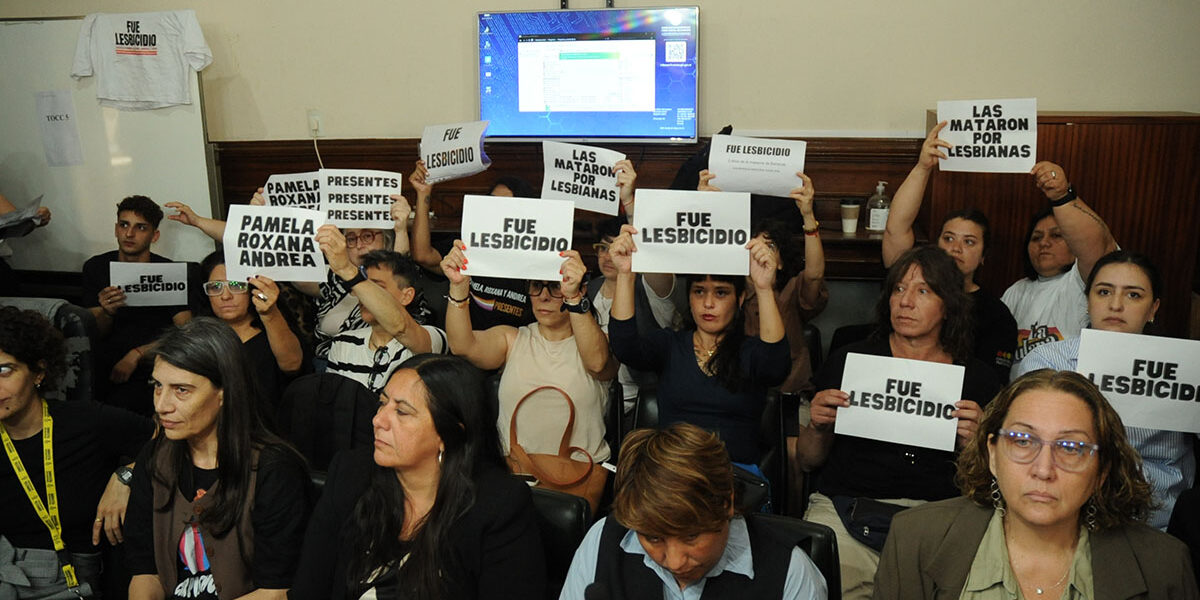


BUENOS AIRES, Argentina. It was a hate crime. The courts confirmed this on Wednesday, November 18, when they sentenced Justo Fernando Barrientos for “aggravated homicide with cruelty and premeditation motivated by hatred of the victims’ sexual orientation.” Barrientos killed them for being lesbians, and the amount of evidence (far less than what was considered) proved this during the six-month trial.
The news, delivered outside the courthouse, was received under a torrential downpour that began almost at the same time the sentence was announced. Tears, shouts, smiles, hugs, and chants erupted among the activists who had been waiting since early morning for the courthouse entrance at 1300 Tucumán Street.
“What they did to them, they did to all of us.”
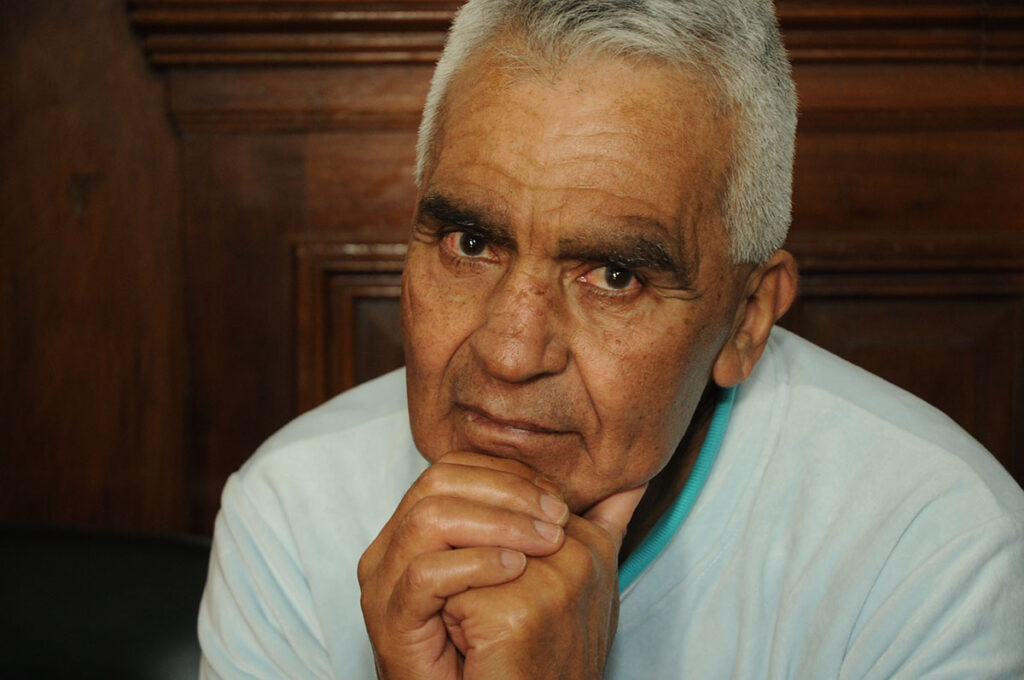
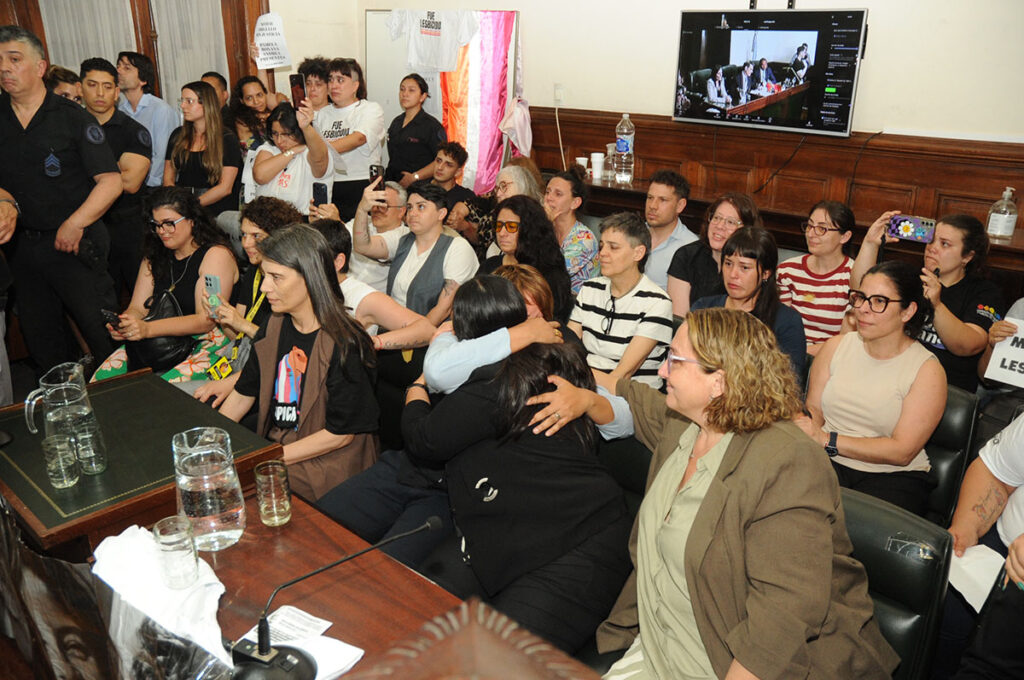
The final day of the trial began with the closing statements of the man accused of murdering the three women. In the small courtroom where the oral arguments took place, the defense team, comprised of Ricardo Richiello and Florencia Díaz Cantón—who days earlier had requested the acquittal of Justo Fernando Barrientos due to lack of evidence—approached him with the microphone. The accused spoke: “I feel innocent.” His words were nothing more than confirmation of the existence of a climate of hatred toward sexual minorities. According to recent reports, attacks against LGBTQ+ people have increased since Javier Milei took office. The attack at the Barracas hotel in May 2024 occurred ten days after Nicolás Márquez, the current president's “biographer,” disseminated a blatant message of hate in an interview with Ernesto Tenembaum on Radio con Vos.
Yesterday at midday, after the section between Talcahuano and Uruguay streets was closed, the various planned activities took place as people awaited the verdict from the court composed of judges Adrián Pérez Lance, Juan Manuel Grangeat, and Cinthia Oberlander. The nervousness preceding the reading of the sentence turned into a cathartic celebration when the verdict of the Oral Criminal Correctional Court No. 5 was read , convicting Barrientos as the perpetrator of the lesbian murders of Pamela Cobbas, Roxana Figueroa, and Andrea Amarante, and of attempted murder in relation to the attack on Sofía Castro Riglos.
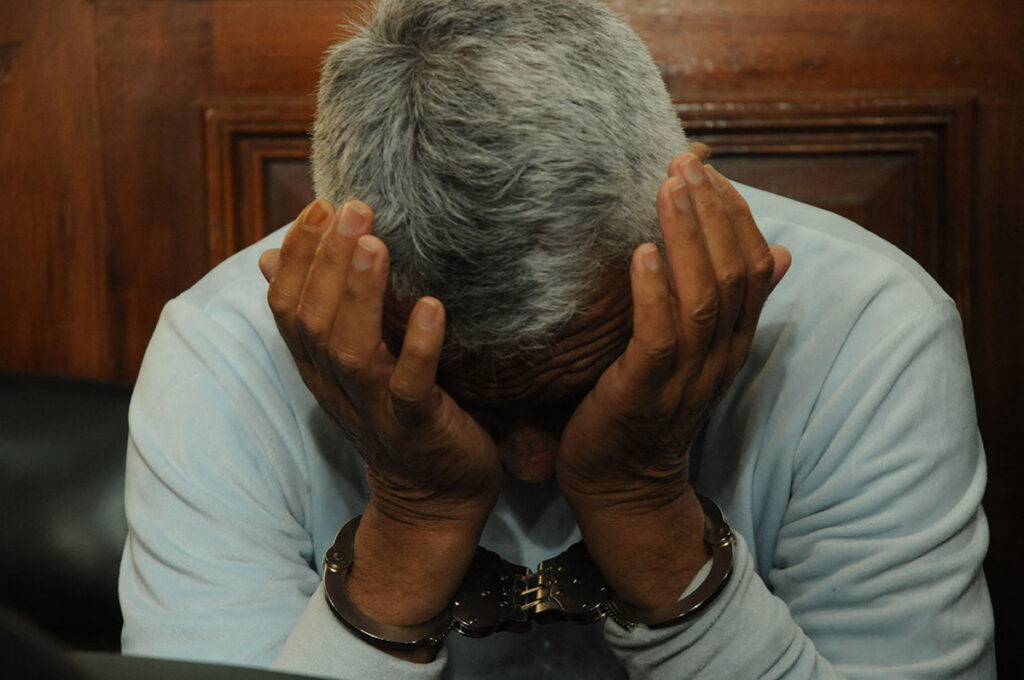
However, the bitter taste of the rejection of the reparations measures for Sofía Riglos Castro, the only survivor of the attack, which the lawsuit led by Luciana Sánchez had requested, remained.
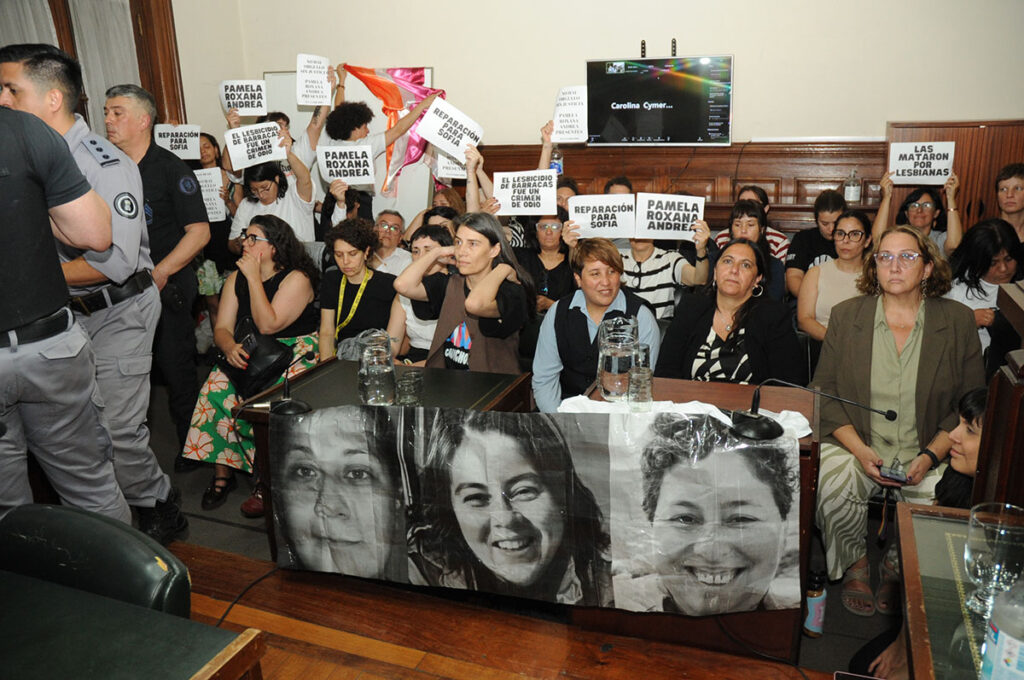
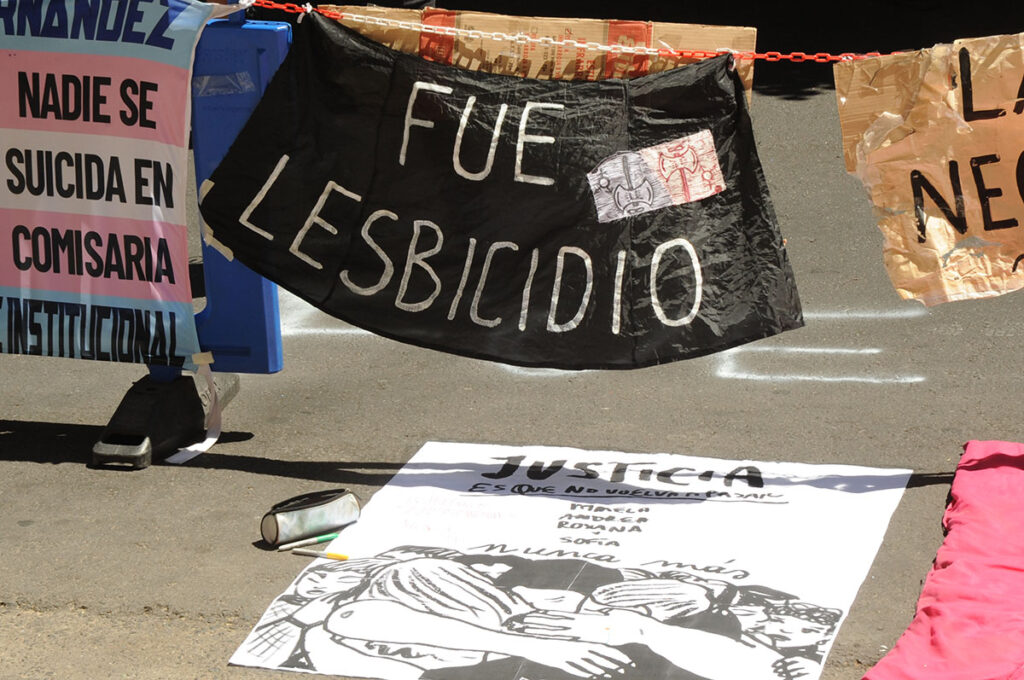
Under a relentless downpour, Samanta Pedrozo, who spearheaded the collective lawsuit on behalf of the Argentine Federation of Lesbians, Gays, Bisexuals, and Trans (FALGBT), emerged from the courthouse amidst applause and tears. In front of the tent of the Lesbicides Never Again Coordinator, where a glossy sign read “Pamela, Roxana, Andrea, present!” the lawyer held a brief press conference.
“It was a very difficult and complex process; we’ve been following this case for two years,” said Pedrozo. Yesterday, she recalled learning about the case from a friend who wrote to her, worried. “They killed three lesbians and are throwing all their belongings out into the street. What can we do?” she remembers her friend asking. From then on, she became involved in the assemblies that were being held at the time to demand justice. Some time later, the FALGBT (Argentine Federation of Lesbians, Gays, Bisexuals, and Transgender People) contacted her to take on the legal action.
“It took months of listening to testimonies, of uncovering that element that was so difficult to prove: hatred. We dug deep, we interrogated, and we were able to demonstrate that the deaths of these girls were not isolated incidents; they occurred within a context of hatred and discrimination,” the plaintiff's lawyer emphasized. “Unfortunately, this is happening, it continues to happen, and it will continue to happen because we have a government that discriminates against us. And when hate speech comes from the top, it is very difficult for LGBTQ+ people, for women, and also for children to survive this wave of hatred.”
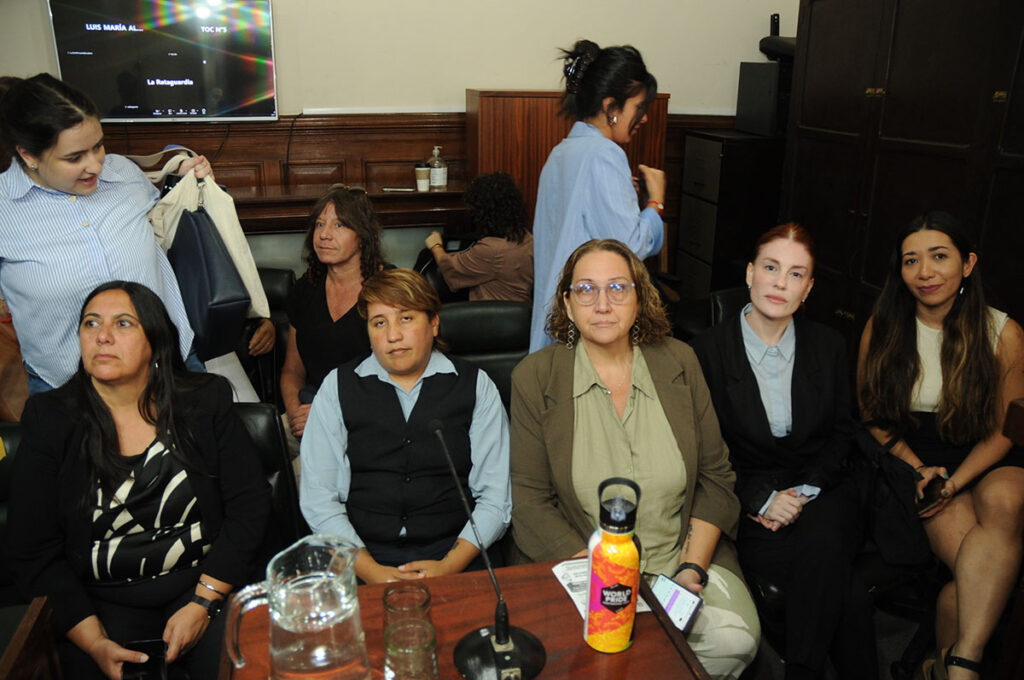
She also emphasized the importance of the conviction by Criminal Court No. 5. “Today we fought against hate and were able to secure a life sentence for Justo Fernando Barrientos for the murder of lesbians,” she said. She added, “The spirit of this lawsuit was to represent collective interests; it wasn't just these four women, but what they represented. As I said in my closing argument, what they did to them, they did to all of us. It's a warning. That's why we responded with justice, and we tell them that we will always be here, that if they touch one of us, they touch us all.”
Everyone's request and what's missing: for Sofia, repairs
From the outset of the case, Sofía Riglos Castro, the sole survivor of the brutal attack, had to fight to be included in the call for justice. The investigating judge, Edmundo Rabbione, initially denied her request to be a plaintiff as Andrea Amarante's partner. This decision was overturned by the Court of Cassation.
During the trial, Luciana Sánchez, the lawyer representing her, requested in her closing arguments : access to a widow's pension due to her relationship with Andrea, exemption from payments for her partner's grave, and the creation of a specialized prosecutor's office focused on the rights of LGBTQ+ individuals. She also requested that the Buenos Aires City Legislature expropriate the hotel where the crime was committed to create a memorial space. None of these measures were considered by the court.
Shortly before the sentencing, Laura, a member of the Femicides Never Again Coordinating Committee, told Presentes ya Tiempo about her expectations for these measures to be recognized. “We expect reparations for her and also for our community. Material and symbolic reparations because we don't want this to happen again, because we need a future. For that, in addition to needing the term 'lesbicide' to be officially recognized, we need reparations and for the State to take responsibility for this crime.”
Lawyer Luciana Sánchez announced that after reviewing the legal arguments, they will appeal to the Court of Cassation in February 2027 to try to overturn the decision. She also emphasized that the aggravating circumstance of femicide was not considered.
Amnesty International also spoke out on the matter, stating that “the State must guarantee effective policies to prevent violence against lesbians and other LGBTI+ people. No one should be afraid to freely live their identity and relationships.”
Lesbicides never again
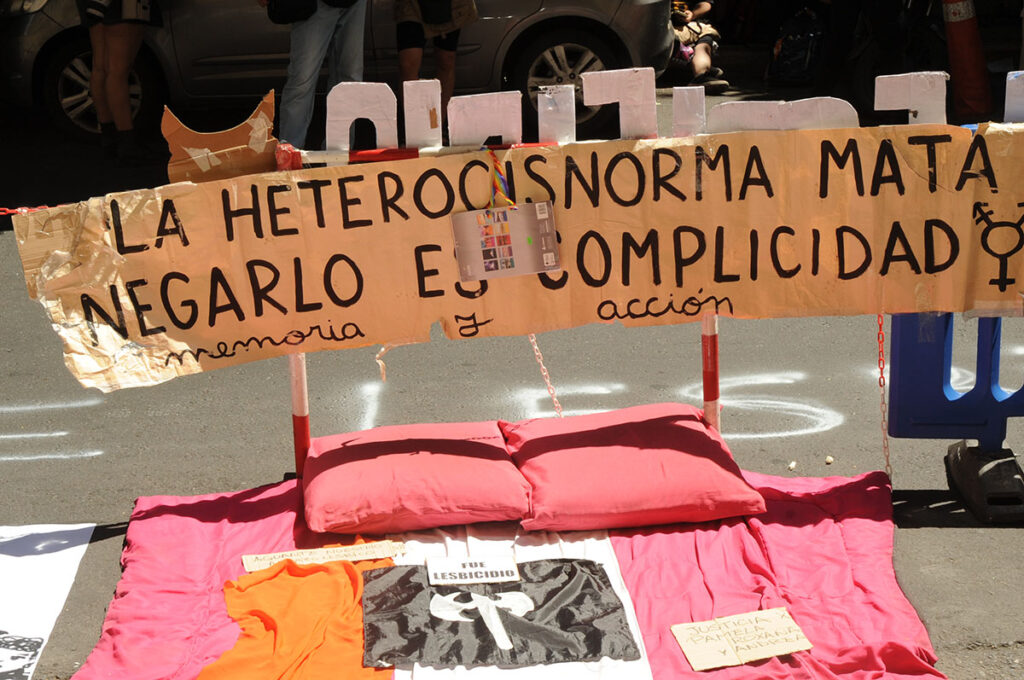
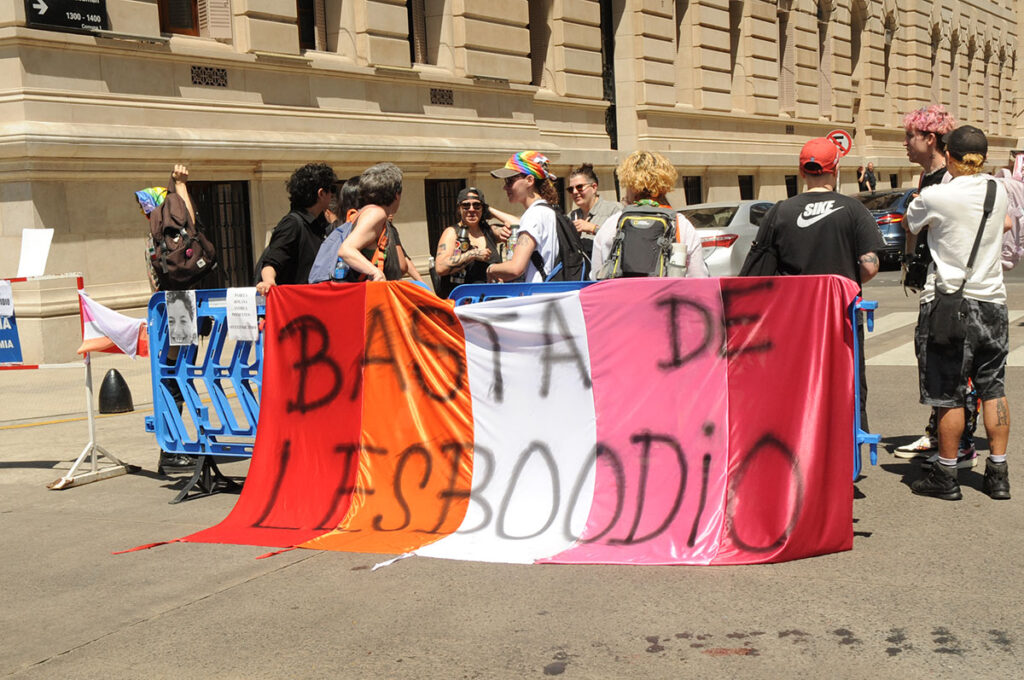
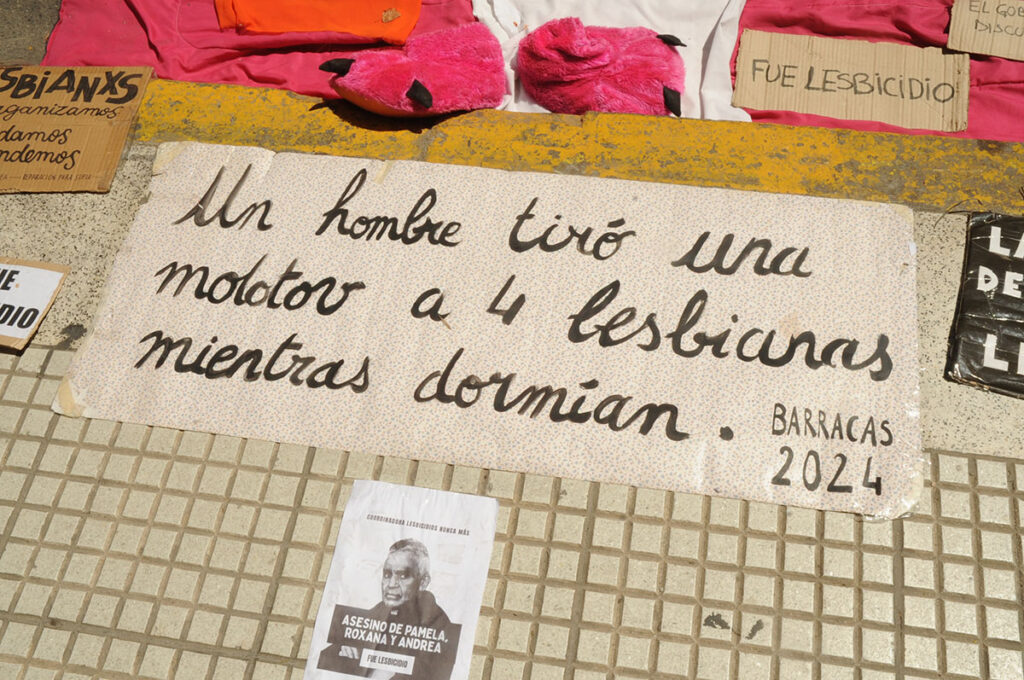
At the entrance to the courthouse, the Femicide Never Again Coordinator had set up an artivist installation, recreating a bedroom. “Heteronormativity kills, denying it is complicity,” read a sign just above the pillows. The intervention thus recounted the cruelty of one of the most horrific attacks suffered by the lesbian community in Argentina. Barrientos set fire to the four women as they slept, closed the door, and pushed them into the flames so they couldn't escape.
Following the sentencing, and after lawyer Pedrozo spoke, Pia Lacelli, a member of the coordinating committee, read a statement about the ruling. “This verdict represents much more than an individual conviction. It is the recognition that the attack was not an isolated incident nor an expression of violence unrelated to hatred toward lesbian identities. Naming the act as lesbicide in a court ruling is also to acknowledge a historical and structural violence, and to move forward in building tools to prevent, investigate, and punish it,” the statement reads.
Justice, memory and collective construction
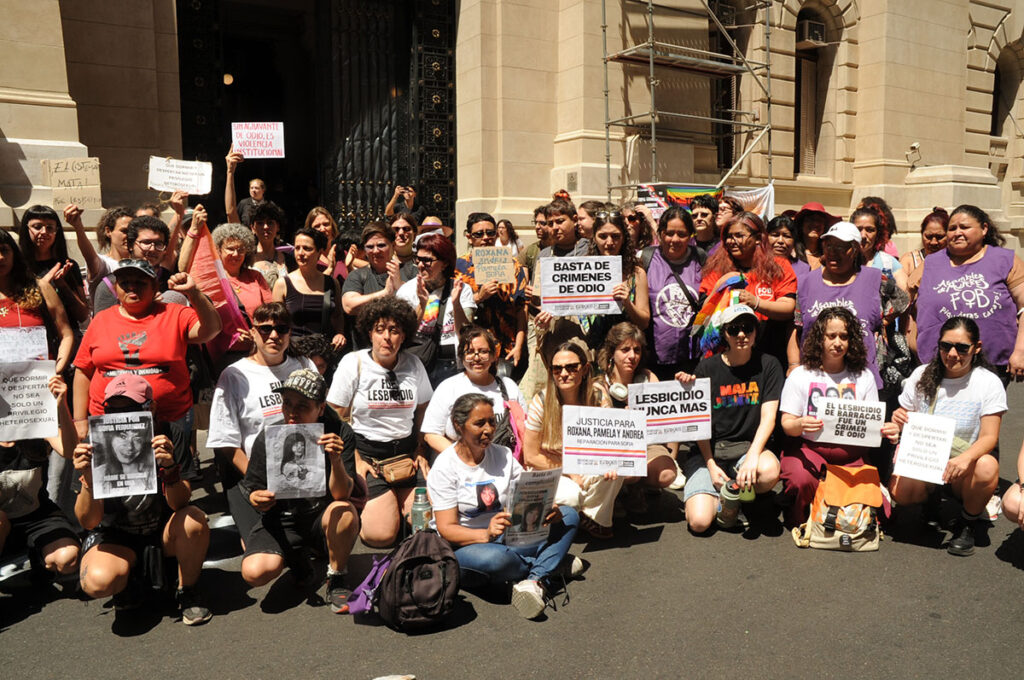
They also highlighted something crucial: the trial was made possible by collective struggle, and after the crime, a space for "encounter, containment, and resistance" could be built.
“At every hearing we were there to uphold the memory of Andrea, Pamela, and Roxana, to support Sofía, and to make it clear that behind this trial was an entire community demanding justice. Faced with hatred, we responded with organization, love, and collective strength. Faced with attempts to erase us, we came together, embraced each other, and continued fighting.”.
In another statement, they expressed that the ruling “sets a fundamental precedent, but also reminds us that justice cannot end with a single judgment. We will continue to demand public policies for prevention, redress, and protection against violence based on sexual orientation and gender identity. Because the memory of Andrea, Pamela, and Roxana, and the reparations for Sofía, need to translate into concrete guarantees for all lesbian identities.”
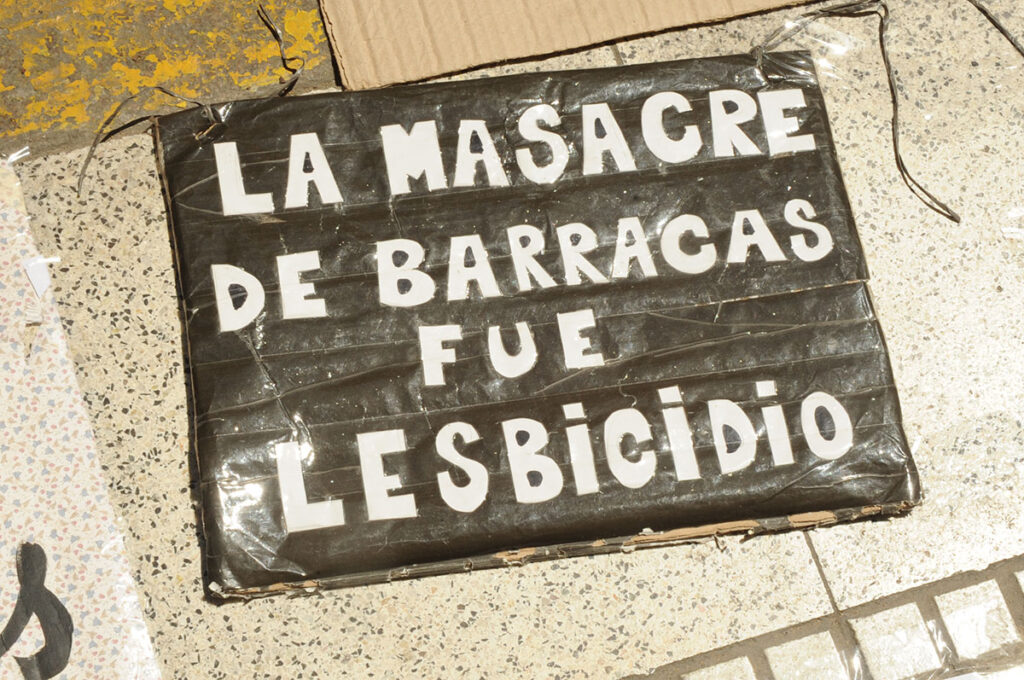
Around 4 p.m., the activists lifted the street blockade but continued celebrating the importance of the ruling on the sidewalk. By then, the sun had begun to rise. On the asphalt, in white letters, shone a phrase that would remain etched in memory for some time: “It was lesbicide!”.
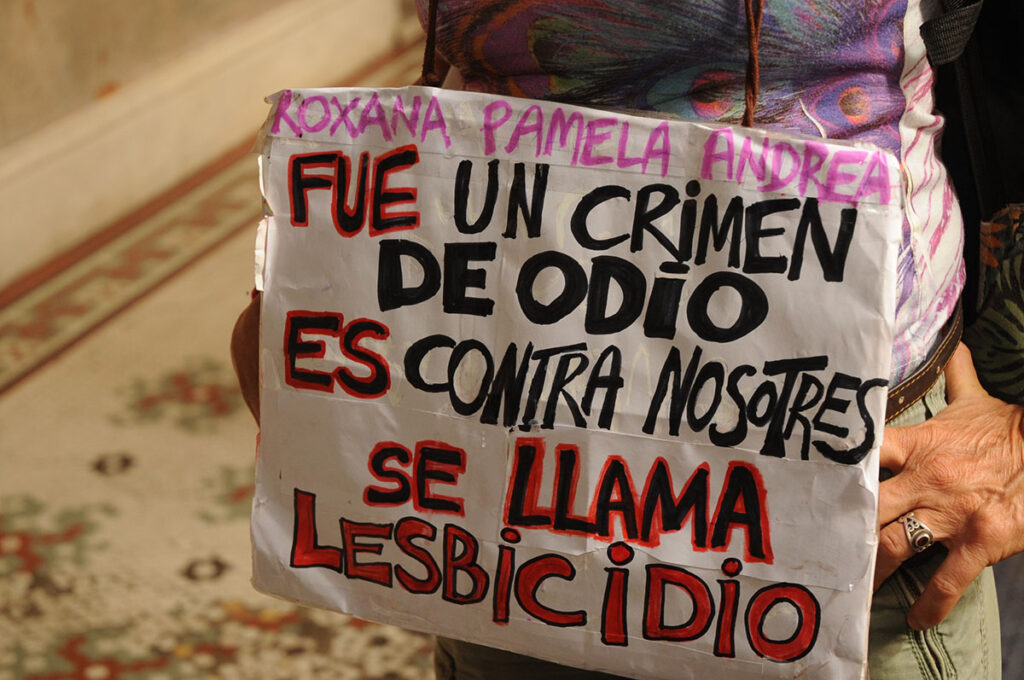
We are present
We are committed to journalism that delves into the territories and conducts thorough investigations, combined with new technologies and narrative formats. We want the protagonists, their stories, and their struggles to be present.
SUPPORT US

FOLLOW US
Related notes
We are present
This and other stories are not usually on the media agenda. Together we can bring them to light.