
 Support us

The court convicted Barrientos of triple lesbicide and said it was a hate crime
BUENOS AIRES, Argentina. The Oral Criminal Court No. 5 today sentenced Justo Fernando Barrientos for the murders of Pamela Cobbas, Roxana Figueroa, and Andrea Amarante, and for the attempted murder of Sofía Castro Riglos, the only survivor. He was sentenced to…
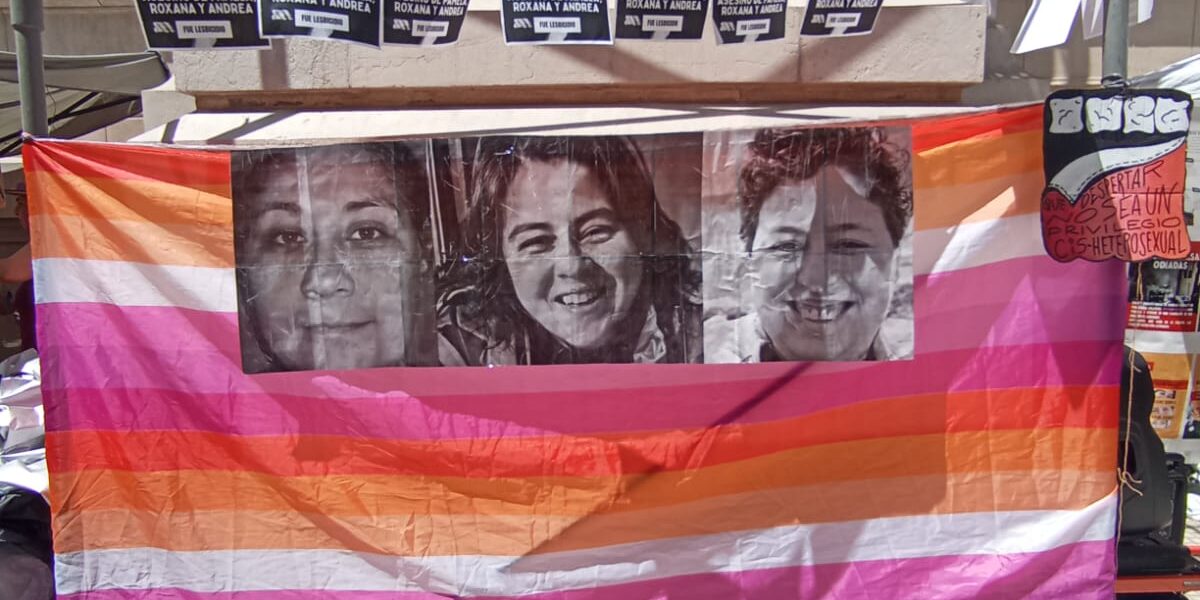

CITY OF BUENOS AIRES, Argentina.
The Oral Criminal and Correctional Court No. 5 today sentenced Justo Fernando Barrientos for the murders of Pamela Cobbas, Roxana Figueroa, and Andrea Amarante, and for the attempted murder of Sofía Castro Riglos, the only survivor. He was sentenced to life imprisonment. The grounds for the sentence will be read on February 19, 2027, at 2:00 p.m.
Judges Adrián Pérez Lance, Juan Manuel Grangeat and Cinthia Oberlander held that Barrientos is the perpetrator of “aggravated homicide with cruelty and treachery due to hatred of the sexual orientation of the victims and for the use of a suitable means to create a common danger to the detriment of Pamela Fabiana Cobas, Mercedes Roxana Figueroa and Andrea Amarante, and of aggravated homicide due to the same circumstances but in the degree of attempt with respect to Sofía Castro Riglos.”
The judges decided not to grant the reparations requested by Sofia's lawyer, for reasons that they said would be explained in the grounds for the ruling.
The verdict ordered the obtaining of the defendant's genetic profile for inclusion in the National Genetic Data Registry
Furthermore, the court declared Article 14 of the Penal Code and Article 56 bis of Law 24660 unconstitutional and “inapplicable to the life sentence imposed on Justo Fernando Barrientos.” Paragraph 1 of Article 14 of the Penal Code establishes that parole cannot be granted to individuals sentenced to life imprisonment for aggravated homicide.
Organized activism and activism in the streets
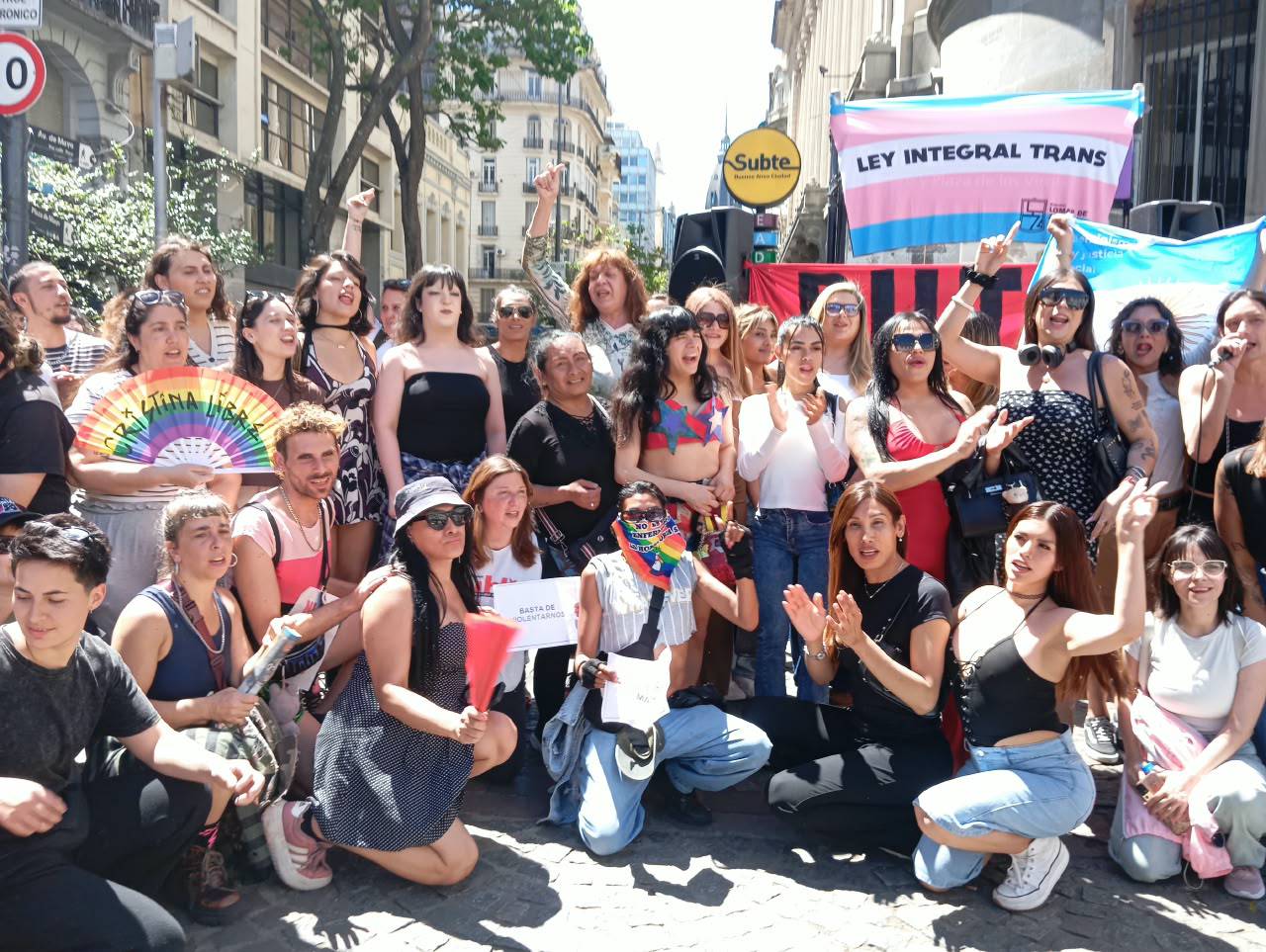
From 8 a.m., activists gathered in the vicinity of the courthouse. At the entrance to Talcahuano 550, in the heart of downtown Buenos Aires, dozens of activists and ordinary people spontaneously convened to demand justice for the multiple murders of lesbians, amidst LGBT+ and lesbian flags (with orange, pink, and white stripes).
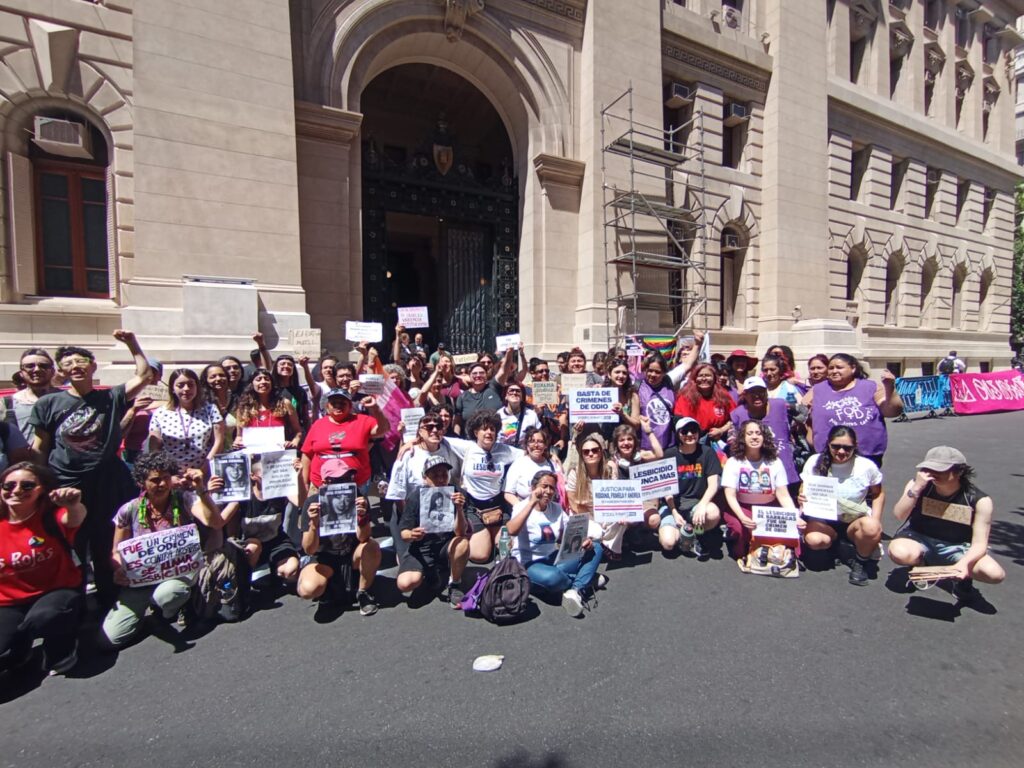
“Stop hate crimes,” “Lesbicides never again,” “Justice means it never happens again” read some of the many signs. And on the asphalt of the street, white spray paint proclaimed, “It was lesbicide.” This reflected one of the crucial elements of what had been demanded of the Justice system since the investigation began: that it be explicitly stated that the victims were attacked and killed for being lesbians, and that the hate crime be named with the precise terms.
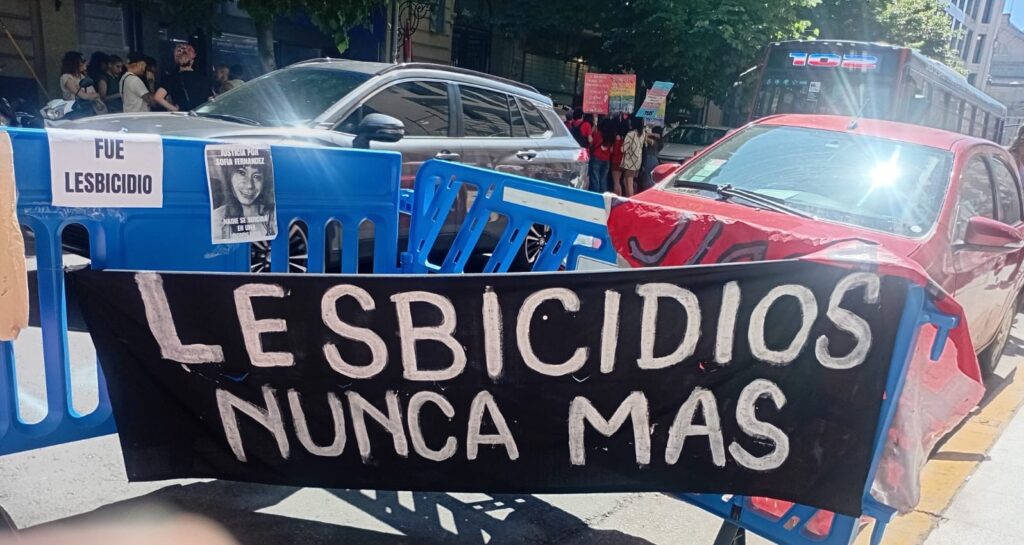
The role of lesbian feminist and diversity organizations was crucial in ensuring that the trial considered this aggravating factor of hate crime, which was initially resisted by the investigating court.
One of the first reports on the case, from Agencia Presentes, provided testimonies stating that the victims suffered harassment because of their sexual orientation.
How was the trial?
"They were killed for being lesbians": Before the verdict (at 2 PM), activists, who have supported the cause from the beginning and demand recognition of the hate crime component, raised their signs: Justice for Pamela, Roxana, and Andrea. #ItWasLesbicide Coverage with @tiempoarg https://t.co/hxTyHA4Egt
— Presents (@PresentesLatam) November 18, 2026
The trial began in May of this year, two years after the attack that killed three lesbian women and left Sofía seriously injured. Between the night of May 5 and the early morning of May 6, 2024, Barrientos intentionally set fire to the room where the four women, two couples who formed a family, lived together in the hotel located at 1621 Olavarría Street, in the Barracas neighborhood of Buenos Aires. When they tried to escape, the man attacked one of them, beat her, and threw her back into the flames.
As a result of the attack, Pamella died a few hours later on May 6. Roxana died two days later. Both had burns (first-degree and intermediate-degree) over 90% of their bodies. Andrea died on May 12, with burns over 75% of her body. Sofía was the only survivor. She suffered burns over 1.3% of her body, primarily affecting her hands and face. She continues to suffer serious mental health consequences.
Throughout the 19 hearings, statements were heard from hotel neighbors, police officers, firefighters, experts, survivor Sofía Castro Riglos, and relatives of the victims.
The trial involved three lawsuits:
-A collective led by the Argentine LGBT Federation, whose legal team was made up of Samanta Pedrozo, Flavia Massenzio and the legal assistant Sofía Saavedra Chávez.
-The case of Pamela Cobas and Roxana Figueroa is in the hands of the Public Defender's Office for Victims.
-That of Sofía Castro Riglos, by Luciana Sánchez.
The accused
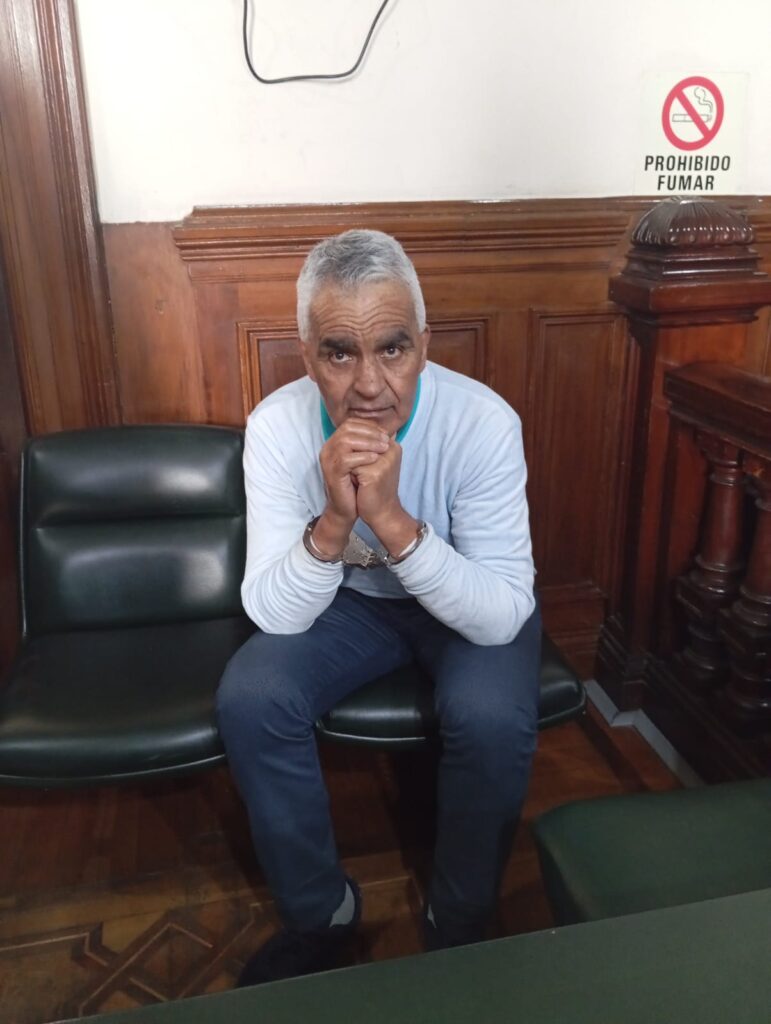
Barrientos has been held in pretrial detention at the Ezeiza prison for the past two years. He is 70 years old, originally from San Miguel de Tucumán, and moved to Buenos Aires at the age of 26. He was the third of seven siblings, with whom he has had no contact since the crime. He also has no relationship with his two children.
At the time of his arrest, he earned a living selling candied nuts and drinks at soccer fields.
This morning, at the last hearing, when asked by the judge, he shared with those present: "I feel innocent, that's all I can say.".
What did the arguments request?
In his closing argument on October 28, Attorney General Juan Manuel Fernández Buzzi asserted that there is evidence to suggest that “the crime was motivated by a very deep and visceral feeling: the hatred he felt toward the victims. He not only burned them alive but did so at night, inside his bedroom, where they lived together.” He emphasized that Barrientos felt “contempt and aversion” toward them for being lesbians. The victims “lived harassed and discriminated against by Barrientos for being lesbians and for being women,” he stressed.
The prosecution had requested that the sentence take into account that it was a case of aggravated homicide due to cruelty, gender-based violence, and hatred based on sexual orientation in the cases of Pamela, Roxana, and Andrea, and attempted homicide in the case of Sofía. Thus, it addressed the crimes as femicides and lesbicides.
The plaintiffs had also requested the maximum sentence for Barrientos for the triple murder and the attempted murder of Sofía. In particular, they highlighted the aggravating circumstances of the crimes having been committed in a context of gender-based violence and hatred or prejudice and discrimination related to the victims being perceived as women and lesbians.
“What happened to Andrea, Pamela, Roxana, and Sofía didn't just happen to them; it happened to all of us who, from birth, have to learn to live with hatred and discrimination,” Dr. Pedrozo shared in her statement. She insisted, “We need to ask the State to protect our identities. We cannot live in fear that someone like Barrientos will decide to set us on fire for being who we are and how we live.”.
In her closing argument, Sánchez emphasized the historical necessity for the sentence to explicitly address the aggravating circumstance of hate based on sexual orientation and to name the crime as lesbicide. Since the reform of the Penal Code, no sentence has been handed down that specifically addresses this violence against lesbians. Furthermore, among the reparations requested for Sofía, she asked for comprehensive free care, financial compensation, and a widow's pension. She also requested that the court order measures such as the national government's public recognition of the crime as lesbicide, the expropriation of the Barracas hotel to transform it into a memorial space named after the victims, and the creation of housing solutions for LGBTQ+ people by the City of Buenos Aires.
Barrientos' defense attorney, Ricardo Antonio Richiello, requested his client's acquittal based on reasonable doubt. He argued that the defendant's role "was not proven with certainty." He also requested a conviction for simple homicide, dismissing the aggravating circumstances.
The case that marked a milestone
The case marked a turning point for LGBTQ+ activism in Argentina and shocked the entire country. It exposed the precariousness and violence faced by LGBTQ+ people.
The testimonies throughout the trial revealed the context of discrimination in which the crime and attack took place. Neighbors of the women called them “tomboys,” “dykes,” “weirdos,” “coarse,” and “sluts.” “The pervasive prejudice clearly conveys the message that the lives of these four lesbian women are worth less than their own,” stated public defender Carolina Cymerman.
But the case also highlighted the vulnerability of many people within the community. The four women lived together in a room in a run-down hotel, where street vendors, self-employed workers, waste pickers, retirees, evicted people, and those experiencing homelessness resided. They shared the bathroom, the kitchen, and the limited common space with everyone else, including their attacker.
For the past two years, the demand for justice for Pamela, Roxana, Andrea, and Sofía has been included in every Pride March, every Plurinational Meeting of Women and Diversities, and every other opportunity. During this time, there have been several demonstrations outside the Barracas hotel, and the wake for the three women drew activists and ordinary citizens alike. Their memory lives on today and marks a precedent: it was a lesbicide.
We are present
We are committed to journalism that delves into the territories and conducts thorough investigations, combined with new technologies and narrative formats. We want the protagonists, their stories, and their struggles to be present.
SUPPORT US

FOLLOW US
Related notes
We are present
This and other stories are not usually on the media agenda. Together we can bring them to light.