

Advancement of LGBTI political leadership in Latin America and the Caribbean
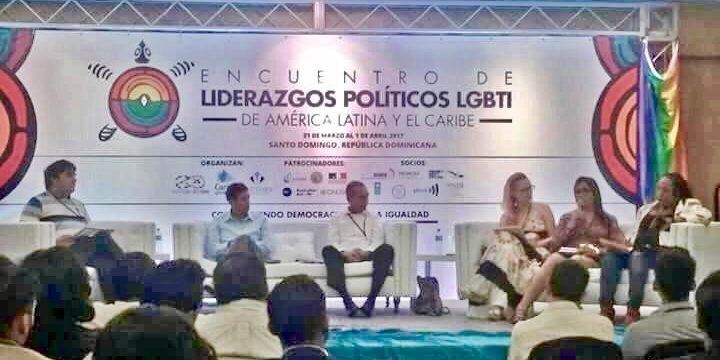
The Third Meeting of LGBTI Political Leaders for Latin America and the Caribbean brought together more than 320 leaders from 35 countries in the Dominican Republic. "Today, the number of openly lesbian, gay, bisexual, transgender, and intersex people is growing rapidly. These leaders are on the front lines in the fight for equality."

Share

The Third Meeting of LGBTI Political Leaders for Latin America and the Caribbean brought together more than 320 leaders from 35 countries in the Dominican Republic. “Today, the number of openly lesbian, gay, bisexual, transgender, and intersex people in elected and government positions is growing rapidly. These leaders are on the front lines in the fight for equality.” More than 320 LGBTI leaders, government officials, activists, and legislators from across the political spectrum in 35 Latin American and Caribbean countries met from March 31 to April 1 in Santo Domingo, Dominican Republic, for the Third Meeting of LGBTI Political Leaders for Latin America and the Caribbean. The objective was to analyze the progress, shortcomings, and challenges within political parties, legislatures, and government agencies in the fight for equality.
Leadership for equality
It is estimated that more than 70 LGBTI people currently hold elected and government positions in the region. "Just five years ago, the number of openly LGBTI people in elected and government positions in the region could be counted on one hand. Today, the number is growing rapidly. These leaders are on the front lines in the fight for equality," the statement read. Representing Argentina as panelists and moderators were Marcela Romero, from the Association of Transvestites, Transsexuals, and Transgender People of Argentina (ATTTA); Darío Arias (Conurbanos por la Diversidad and Frente para la Victoria, Justicialist Party); Esteban Paulón (Undersecretary of Sexual Diversity Policies of Santa Fe and Vice President of the Argentine Federation of Lesbians, Gays, Bisexuals, and Trans People (FALGBT)); and Claudia Vasquez Haro (Otrans Argentina). Participants included Congressman Alberto de Belaunde from Peru; Bolivian Congressman Manuel Canelas; Uruguayan Congressman Martín Couto; Venezuelan Congresswoman Tamara Adrián; Ecuadorian Assemblywoman Diane Rodríguez; and Costa Rican Vice Minister of the Interior Carmen Muñoz.
"To assess what is happening in Latin America with religious fundamentalisms"
“In my speech, I shared our concern about what is happening in the region due to conservative restoration projects regarding LGBTI rights and neoliberal economic and social policies. Together with other comrades from across Latin America, we are carrying the voice of popular political movements committed to the emancipation of our continent,” Arias told Presentes from the Dominican Republic. She highlighted the launch of the LGBTI Politicians Network: “It will be a permanent space for exchange to strengthen our work in the region.” Deivis Ventura, an LGBTI politician from the Dominican Republic and candidate for Congress in the 2016 elections for the Modern Revolutionary Party (PRM) and the Citizen Movement RD, proposed the creation of the Network. Ventura—who in 2016 was chosen by Foreign Policy magazine (USA) as one of the world's 100 most influential global thinkers—explained the Network's objective to Presentes. “To allow the exchange of information about what is happening in different countries in the political sphere; to exchange best practices and strategies; and to be able to collectively assess what is happening in Latin America, especially regarding religious fundamentalism and the interference of these groups in politics.” He added that the Network also seeks to link initiatives to establish mechanisms for addressing different situations, in order to strengthen the specific struggles of our movements across the continent. The event was organized by Diversidad Dominicana (Dominican Republic), Corporación Caribe Afirmativo (Colombia), and the Gay and Lesbian Victory Institute (United States). It was the third gathering of LGBTI political leaders. The first took place in Lima, Peru, in 2014, with over 100 attendees from 17 countries. The second was held in Tegucigalpa, Honduras, in 2015.
"The political participation of LGBTI people, a tool towards equality"
“LGBTI people continue to face exclusion and violence in the region. Their participation in democratic processes has been very limited and has lacked a planned strategy. Our organizations believe that the presence of openly LGBTI people in state institutions changes the perspective of their fellow legislators, educates the public, and enables the passage of measures to achieve equality. Political participation, combined with other forms of advocacy from civil society, is a very powerful tool for advancing equality,” the organizers stated in their call to action.[READ MORE: LGBTI Rights in Latin America: What's New]
Democracy and LGBTI leadership in the context of the Americas; trans leadership, lessons learned from the political participation of indigenous LGBTI leaders; building alliances with media in adverse contexts; migration, human mobility and LGBTI brain drain; corruption; documentation of hate crimes, financing of electoral campaigns and real impact on the advance towards equality, were some of the themes addressed in the workshops, debate panels and plenary sessions that took place at the Barceló hotel, the venue of the meeting.New space for trans organizations
Within this framework, on the second day of the meeting, the Latin American and Caribbean Trans Confederation (COTRANSLAC) was presented. It is led by Claudia Vázquez Haro, president of the organization OTRANS Argentina. Its members include Amaranta Gómez (Mexico), Diane Rodríguez (Ecuador), Tania Duarte (Colombia), Rihanna Ferrera (Honduras), Gaby Castillo (Guatemala), and Collette Spinetti (Uruguay). “We are a pluralistic, horizontal, and diverse space with leaders who have a strong presence and extensive work in the field, recognized by our peers. We want to transform the reality of trans people in Latin America and the Caribbean, a reality that is violated daily by a capitalist and patriarchal system that excludes us from the political arena,” stated Vázquez Haro, president of OTRANS Argentina. In a publicly released document, they emphasized self-determination as a core value and expressed that their efforts should contribute to a broader response for the protection of human rights and social justice. “It is time for LGBTQ+ movements to raise their banners and defend their rights against those who prefer to negotiate, surrender, and silence them for money or capital… we invite you to celebrate life and be part of this ship of dreams, desires, and the will to fight for Human Rights and Social Justice.”
Photos from the Meeting: Courtesy of Caribe Afirmativo.
In a publicly released document, they emphasized self-determination as a core value and expressed that their efforts should contribute to a broader response for the protection of human rights and social justice. “It is time for LGBTQ+ movements to raise their banners and defend their rights against those who prefer to negotiate, surrender, and silence them for money or capital… we invite you to celebrate life and be part of this ship of dreams, desires, and the will to fight for Human Rights and Social Justice.”
Photos from the Meeting: Courtesy of Caribe Afirmativo.
Follow Presentes:
Twitter @PresentesTLGBI
Instagram: PresentesLTGBI
Facebook: https://www.facebook.com/presentesLGBTI/
]]>
We are present
We are committed to journalism that delves into the territories and conducts thorough investigations, combined with new technologies and narrative formats. We want the protagonists, their stories, and their struggles to be present.
SUPPORT US

FOLLOW US
Related notes
We are present
This and other stories are not usually on the media agenda. Together we can bring them to light.
Greetings from Nicaragua! This is Yadira Gomes, General Secretary of the only union of trans women domestic workers and other trades in Nicaragua. We are a union that defends the human and labor rights of the trans population of Nicaragua. Congratulations on your success! It's great that trans women from Nicaragua participated in this leadership meeting. I'm leaving my number and email because I want to be part of you. Number: +505 8792 4936 Email: sitradotrans29@gmail.com Greetings from us, the trans women of Nicaragua, and from me. Our motto is: "Employed, yes, but with dignity."
Greetings from Nicaragua! I'm Jeysi Cayasso, coordinator of AMTC, a group of trans and cultural women. Congratulations on all the work you've been doing…
Greetings from Nicaragua! I'm Jeysi Cayasso, coordinator of AMTC, a group of trans and cultural women. Congratulations on all the work you've been doing…