Twitter @PresentesTLGBI
Instagram: PresentesTLGBI
Facebook: https://web.facebook.com/presentesTLGBI/
 Support us
Between melodrama and pop, Daniel Tolentino created a fashion collection as a way to exorcise his experience and show that there are many ways to cope with the virus. “Me Muero” (I'm Dying), presented in seven episodes, is inspired by beautiful and unstable divas, like life itself. Journalist Esteban Marchand went to find out what was behind this talented and troubled millennial and wrote this profile.
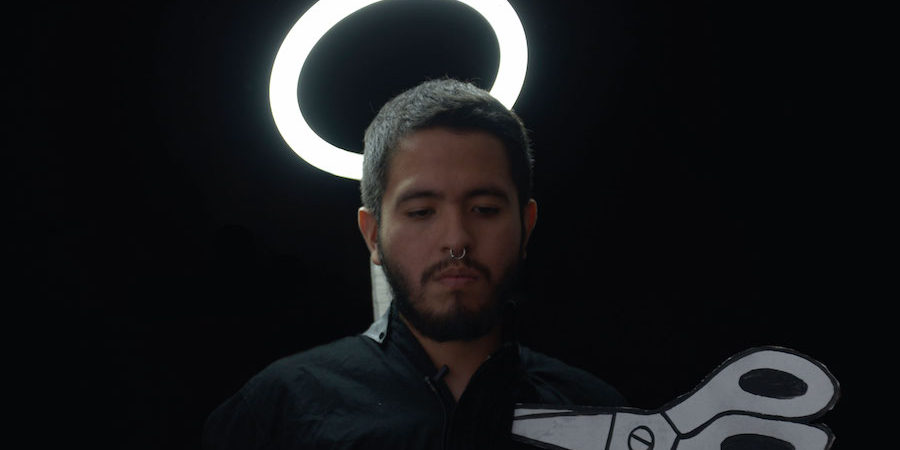
A melancholic and intense artist. A romanticism obsessed with mental health and related issues . But from a generation with irony, one that idolizes pop culture icons and whose natural habitat is the internet. Daniel Tolentino “Da Morgue” has just turned 27: a pivotal age.
His black beard contrasts sharply with the clothes he designs, and it hides a shy face ready to reveal a troubling reality: young people aren't using protection during sex, and the number of HIV-positive youth is on the rise. To raise awareness, break down prejudices, and share his own experience, he created "I'm Dying," a seven-episode melodrama that showcases his fashion collection. These micro-stories, published on his social media, recreate snippets of life from a young gay man confronting his own mortality.
 Credit: Vicente Mosto
"One of my friends had unprotected sex and told me that he felt his lymph nodes were swollen and that this could be a symptom of having HIV," he begins to tell Presentes .
It was three in the morning on a Friday in June 2015, and Daniel was drawing. Inspiration at that hour and waking up with a pencil in his hand were common. He touched his lymph nodes and felt them swollen. “Oh shit,” he said aloud, even though he was alone.
That same day, he went to the Peruvian Institute of Responsible Parenthood (Inppares) for a blood test. The device used for the rapid test malfunctioned, causing his blood to clot. He returned on Saturday for the same test. He was scheduled to pick up his results on Monday, but the center's system was down, and they couldn't assist him.
-It was as if the world was telling me: this is going to happen, get ready.
 Credit: Esteban Marchand
On Tuesday, they told her what she feared most at that moment: Daniel had HIV. He was a person living with the human immunodeficiency virus.
-At that moment I asked the young lady: How much do you think they will charge me to get to the Interbank tower?
That iconic building had always seemed to him an ode to instability. From a distance, it looked as if it were about to collapse onto the Paseo de la República expressway.
Daniel thought he wasn't going to survive. He was depressed and had occasional panic attacks. How was he going to be able to live with all that, plus a virus that until then he associated with death?
"I had no information. I didn't know anyone living with HIV, and I didn't know if I was going to be okay. But that day I made the decision to be okay. I told myself: either you kill yourself today, or you decide to stay and have the best life you can get, and I chose the latter."
His closest friends dropped everything they were doing at that moment to accompany him and be with him during one of the most difficult episodes of his life.
 Credit: Esteban Marchand
On June 17, he went to a clinic for a blood test to confirm his diagnosis. The next day, he was referred to the state hospital affiliated with that clinic. A somber atmosphere greeted him. He was made to wait alongside people who were dying of AIDS. He was asked a series of unexpected questions: Do you prostitute yourself? Do you inject drugs? Do you use drugs? Do you participate in orgies?
Daniel felt like he'd gone back to the nineties. The nurse told him he'd probably contracted the virus because he hadn't lived with his parents. She also told him that if he wanted children, he should find a female partner, not a male one.
-At that moment I was just thinking: surely Alanis Morissette is going to come out playing a song any minute now.
For weeks she woke up with a voice in her head saying: reactive, reactive. She felt like she had a dark cloud hanging over her. Misinformation at the hospital was rampant. They told her she couldn't share toothpaste with her family, that she had to keep all her personal belongings locked away.
Even the doctors at the state hospital told me I couldn't even perform anal sex, and that's what really depressed me. That place became hell; it was like a loop . I told myself I couldn't stay in such a toxic environment because my emotional health was also affecting my physical health.
 Credit: Vicente Mosto
Daniel left the hospital and went to the Impacta Health and Education Civil Association. There he learned about undetectability: when the viral load is so low that there are no measurable levels of HIV in pre-seminal fluid. He knew that boosting his immune system was his job and nobody else's.
Daniel compares the virus to a disassembled machine gun. The treatment he's receiving helps keep this gun from being cocked. He also knows that if he stops the treatment, this machine gun will begin to cock itself and fire from within. He learned that he could have children if he wanted to in the future. He learned that there is post-exposure prophylaxis (PEP) for those who are HIV-negative. He also learned about serodiscordant couples: those formed by people living with HIV and people living without HIV.
-That's when I started to say: okay, this isn't so bad. Little by little, the dark cloud shrank. It was just a matter of time.
At some point, he stopped shaving for fear of cutting himself. The stigma was a constant companion. If he bled for any reason, he would frantically disinfect everything. Today, if he meets someone, he isn't afraid to tell them he's living with HIV. Not doing so would only fuel the existing prejudices.
-I use my empathy to survive. I decide who to tell and who not to.
He once told a boy he wanted to share intimate moments with, beyond sex. A boy he liked. But that person distanced themselves. Daniel wasn't saddened; it wasn't up to him. The other person wasn't ready yet. There was no drama. No one cried.
A year and a half after the diagnosis, he told his whole family over breakfast after Christmas Eve. There were tears, yes. But there was also relief: Daniel was doing well and living a completely normal life.
-The virus changed me in a good way. That day I realized that I wanted to live, that I wasn't destined to be that gloomy being, I was destined to be more than that.
 Credit: Vicente Mosto
To keep living, Daniel had to set goals for himself. What did he want to do? Why did he want to stay in this world? His answers were stronger than his desire to self-destruct. That was the seed of his collection "I'm Dying," where he narrates how someone takes refuge in gay icons to cope with what is happening.
Dorothy Gale, Marilyn Monroe, Audrey Hepburn, Bette Davis, Winona Ryder, Liza Minnelli and Natalie Portman are the unstable women who accompany Daniel on this journey.
-That's the concept of the exhibition, to transform something that seems horrible into something beautiful, something that people want to see and want to wear.
For Daniel, clothing is like armor; it provides protection. Everyone decides what they wear. He wanted people who identified with his story to be able to dress up and gain visibility through fashion. The crucified liver represents the double burden his organ currently faces: he must take medication for depression and continue his antiretroviral therapy.
 Credit: Vicente Mosto
Daniel realized throughout this trip that gay people learn a lot from pop culture and pornography. There is no sex education in schools that is geared toward LGBTQ+ people.
Many gay men believe that everything is like porn, and there can't be a bigger lie. Young people who don't know that porn actors undergo pre-exposure prophylaxis (PrEP) to prevent infections.
He also makes it public that he is living with HIV because when his friends found out they were HIV-positive, they didn't go through such a traumatic experience. They didn't feel as devastated or scared as he did. They knew there was someone out there who had shown them that everything was going to be alright.
We've encountered pain, heartbreak, because that's what the journey entails. These things happen, and now there's nothing you can do about it. But you can try to find a positive side, however ironic that may seem.
All that discomfort and fear – and other demons – he was able to transform into drawings, into stories, into clothes.
– I hope that some boy or girl who has just discovered they are living with HIV knows that they can have a happy ending. That they don't stay crying alone in their room listening to a Shakira song. And if they do, let it be for a while. And with the Shakira of the nineties.
Twitter @PresentesTLGBI
Instagram: PresentesTLGBI
Facebook: https://web.facebook.com/presentesTLGBI/

We are committed to journalism that delves into the territories and conducts thorough investigations, combined with new technologies and narrative formats. We want the protagonists, their stories, and their struggles to be present.

This and other stories are not usually on the media agenda. Together we can bring them to light.