

Lulén and Max: the story that the Justice system of Córdoba refused to hear
Lulén Watts and Max Caviglione, two trans men, were sentenced by the Córdoba courts to 12 years and six months in prison for attempted murder. The story behind the sentence that the justice system refused to hear.


Share

Photo: Eze Luque/La Tinta
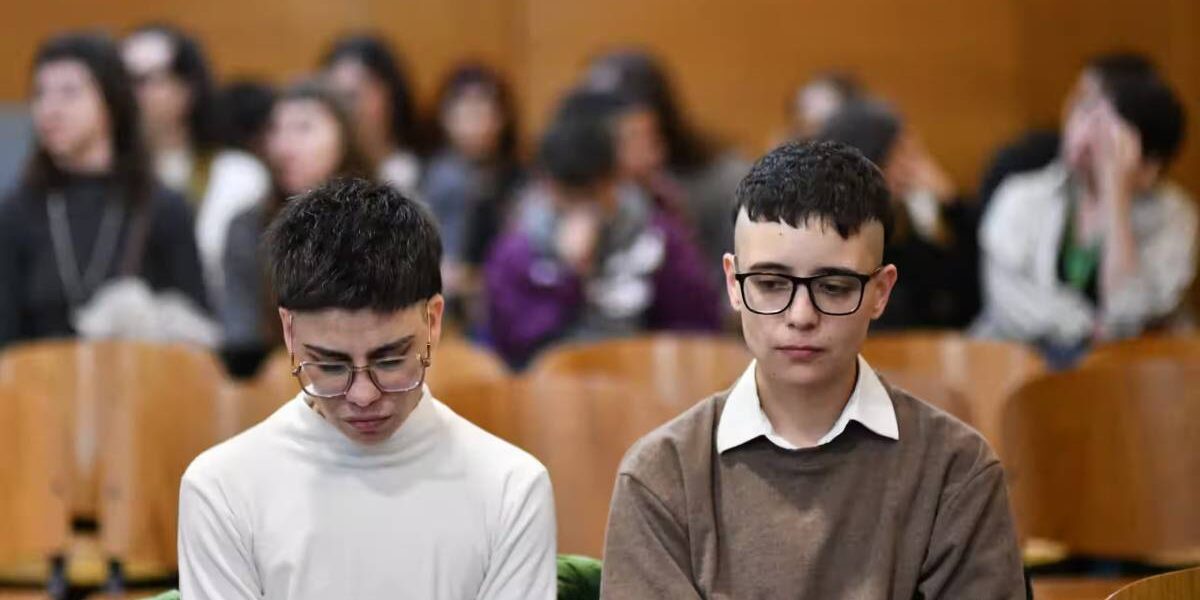
BUENOS AIRES, Argentina. Lulén Watts and Max Caviglione are two trans men who were sentenced in August by a Córdoba court to 12 years and six months in prison for attempted murder. The crime occurred in February 2025, and the sentence was reached after a judicial process that, according to them, lacked a gender perspective. According to Lulén's closing statements, the trial was "torturous." Both the defense attorneys and the young men's friends and colleagues say that at times their gender identity was even denied.
“I am sorry. I take responsibility for the mistake we made,” Lulén said at the end of the trial. There, he and Max admitted to assaulting William Watts, the man who raised him but who also abused him from the age of 10.
The Fifth Criminal and Correctional Court of Córdoba, composed of judges Cristian Griffi, Alfredo Villegas, and María Susana Blanc Gerzicich, found Lulén and Max guilty as co-perpetrators of attempted homicide, aggravated by their familial relationship and committed to conceal another crime. The aggravating circumstance of being committed to conceal another crime stems from the court's finding that the attempted homicide was motivated by robbery. The prosecutor in the case was Marcelo Fenoll, and the trial was conducted by a jury.
The story of Lulén
Lulen was born in Misiones and was adopted by William Watts and his partner when she was three days old. She found out about her biological family when she was nine, but it wasn't until she turned 18 that she was able to access information about them and finally meet them. Unlike her adoptive father, they respected Lulen's identity, even though she had been suffering Watts' hostility for years.
The young girl was 12 years old when she told her family she was a lesbian. Watts was initially angry, but then thought the best solution was to send Lulén to psychological therapy to "cure" her. When she didn't see any results, she ended the therapy. On the contrary, the psychologist, according to Lulén, recommended that her parents give her freedom; she was discovering her identity. Far from listening to her, Lulén's adoptive father began a campaign of harassment that never ended.
Even during the trial, according to lawyers Rocío García Garro and Dania Villanueva, who spoke to Agencia Presentes , William Watts did not hide his abuse of Lulén. In addition to requesting a longer sentence for his son, he repeatedly referred to the young man as "filthy" and "lazy" in his testimony. He added that he would never amount to anything because "he wasn't smart enough." The court completely ignored this when handing down the sentence.
In permanent violence
“You lesbian whore,” Watts yelled at Lulén when she was 13. He was upset because a school friend, who was also a lesbian, was always with her. Watts began to control the young boy's social life. He went to the school and demanded that they “forbid” his son from associating with that girl. From then on, he drove her to and from school to prevent her from interacting with other women. This didn't happen with her male classmates.
When the invitations for quinceañera parties began, other problems arose. By then, Lulén was entering another phase, related to her gender expression. She dressed in a more masculine style, something that particularly bothered Watts. The arguments escalated every time Lulén went out or came home. Some of her classmates witnessed these events and testified at the trial. They recounted how the young man's adoptive father mistreated, humiliated, and belittled him. They also testified, especially the women, that Watts constantly made unpleasant or inappropriate comments to them when they were teenagers.
“This undermined her self-esteem. That's when Lulén began to self-harm. A forensic doctor determined that these cuts began during Lulén's adolescence. This means she has depressive traits due to the psychological and social violence she suffered,” said lawyer Dania Villanueva.
Around that same time, an incident occurred that deeply affected the family. Lulén's adoptive mother had to leave her home after an act of domestic violence, during which the young man was also assaulted. The police had to intervene, and both women's injuries were documented. Both Lulén and her mother left their home that day, and aside from clothing and a few other belongings, they were never able to recover their possessions.
What happened in February 2025
The house in the Cofico neighborhoodof Córdoba, where Lulén and his parents lived, is on the same property as his paternal grandmother's house. It was she who raised Lulén, and with whom he had a special relationship. After leaving home, he would return to the house to be near his grandmother. He even cared for her after surgery. Even so, during his visits, he continued to endure Watts' insults, who never stopped harassing him.
In the summer of 2025, her mother learned of her grandmother's death through a Facebook message. Watts never told her. "He asked me not to tell you if she died," she said maliciously days later, when Lulén went to the house to confirm the news and retrieve some photos of him with her grandmother.
During that encounter, according to the young people's testimony at the trial, many things happened. For example, Watts approached Max Caviglione, Lulén's partner of some time, and confronted him about why he was taking hormones. He told him that "with that woman's face," he still had time to pass himself off as a woman "so things wouldn't go so badly for him." And he told Lulén that her grandmother had died of sadness because of her: "because of the way you are.".
“They assumed there was an attempted murder. What we argued was that there were extraordinary mitigating circumstances. The motive for that attempted murder was related to the violence he had experienced throughout his life. There was no other. They tried to add greed to the equation, claiming they wanted to rob, but we're talking about extremely frugal people. They apologized, they took responsibility, but without a doubt, all the violence Lulén suffered was part of what led him to try to do that,” says García Garro, one of the young men's defense attorneys.
“The incident occurred within the context of this harassment. There was a physical altercation in which the victim, Watts, required 15 days of recovery. In Lulén's case, due to the blows she suffered at that moment, she required 20 days of recovery and ended up more badly beaten than her father, with marks on her arms and neck. Even so, they never denied committing this act,” says the other lawyer, Dania Villanueva.
The network of friends
Victoria Dasein is a friend of Max's. She met him shortly after arriving in Córdoba from Santa Fe, where he was born and where his entire family lives, and they became friends. They work together as administrative staff at CONICET offices. On February 6, 2025, they were arranging a trip to the river, but Max stopped responding to her. Days passed, and Victoria went to the young man's house to see what was wrong. There, she found a police detail and quickly learned what had happened.
Lulén knew him through Max and was aware of the violence he had suffered at the hands of his family. Max also doesn't have much of a relationship with his family, whom he only contacts occasionally by phone. Their support network consists of friends.
“Lulén’s story is one that repeats itself. Everyone who has ever come out of the closet has had to face that situation within their immediate or extended family. We all know a William, to a greater or lesser degree. He’s the kind of guy who can’t accept who you are or what you do and lets you know it in every way possible,” Victoria tells Presentes. “It’s the feeling that the monster is in your house. Constantly, everything you do, say, or even express is going to be used against you.”
In Lulén, this violence had a huge impact, Victoria explains. “During the trial, it was established that she has injuries all over her body. It's a common behavior for almost anyone in the community. When people can't express their anguish or whatever, self-harm is a coping mechanism that almost everyone knows. It's a way of releasing some of what's happening, the hatred towards others and towards oneself. It's an awful situation. For the prosecutor to repeatedly say, 'Well, it's self-harm, not a suicide attempt,' that in itself is violent.”
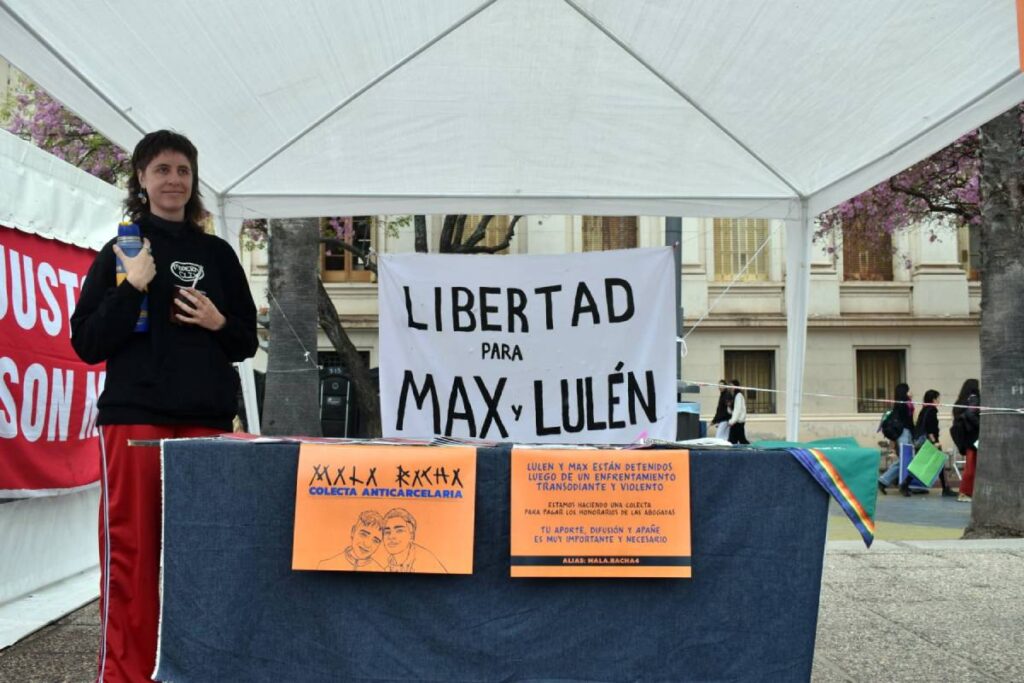
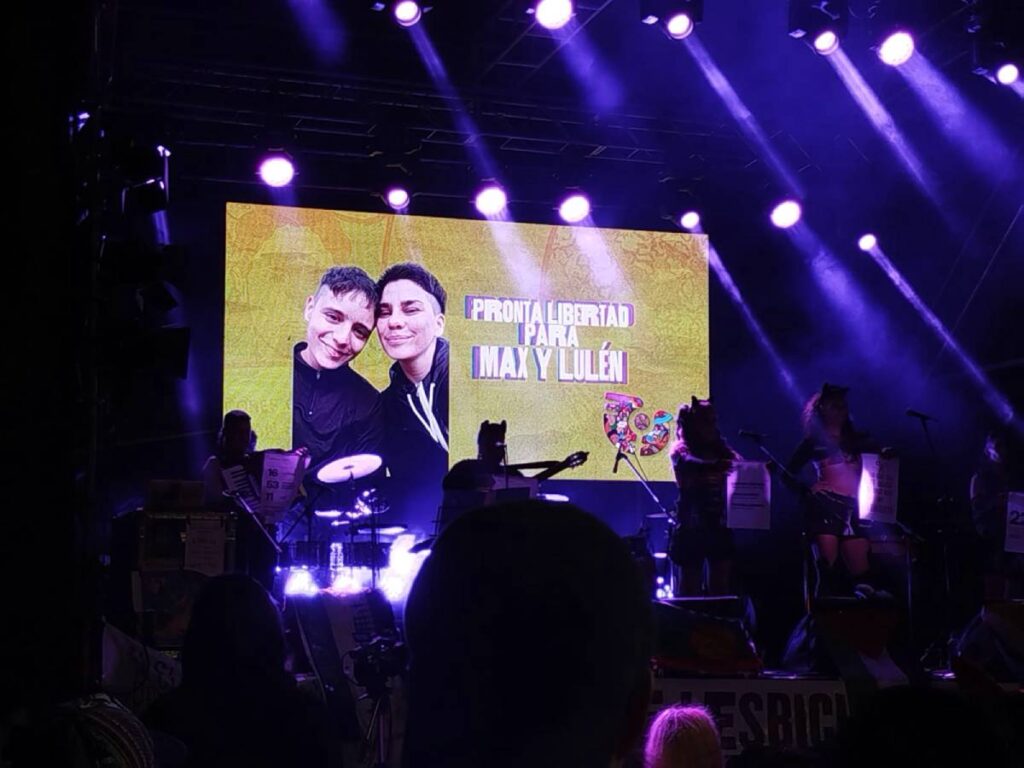
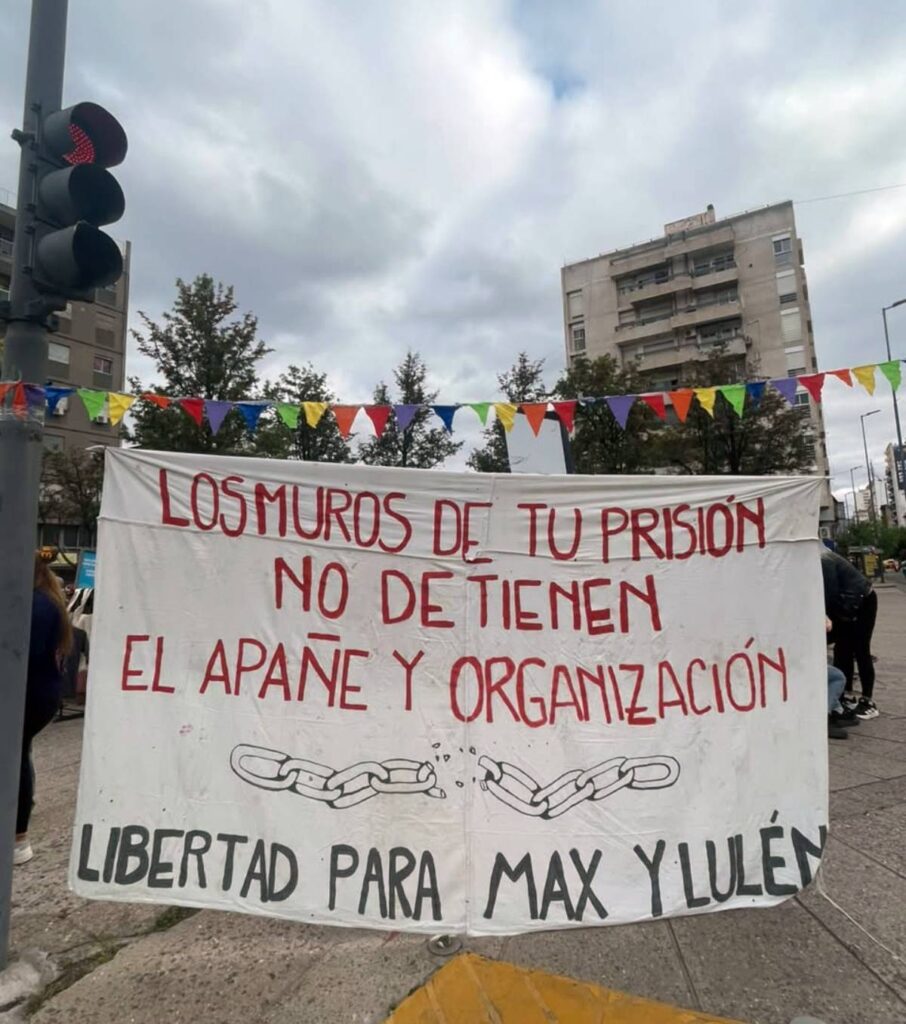
Victoria visits the boys every week at the Bower prison. As soon as she learned of the incident in February of last year, she alerted the rest of their friends. After a first defense attorney who offered little help with the case, they found Rocío and Dania, Lulén and Max's lawyers. “We knew they litigated well and with a gender perspective. They accepted the case even though we didn't have any money at the time,” she recalls. The boys' friends and classmates formed the organization Mala Racha (Bad Luck) to carry out actions demanding justice and to organize fundraising that allows them to pay the lawyers and cover the costs of each court appearance.
Justice without perspective
Both the lawyers and Victoria, who attended all the hearings, agree that the trial lacked a gender perspective. Furthermore, the Governing Council of the Faculty of Philosophy and Humanities at the National University of Córdoba issued a statement on October 13th, questioning the lack of a gender perspective in the judicial handling of the case. It warned that “the judicial decision exposes a structural problem within the Argentine system, linked to the perpetuation of stereotypes and the failure to recognize different forms of violence and discrimination.”
“It was a trial riddled with stereotypes from both the court and the prosecution,” says Rocío García Garro. “The Córdoba judiciary is the one in the country that struggles the most to adopt a gender perspective,” she added.
For her part, Dania Villanueva stated that “during the trial, the prosecution's objectivity was completely lost. They accused the boys of five aggravating circumstances: the familial relationship, intent to conceal another crime, treachery, greed, drug use, and many other things that didn't align with the evidence. The sentence is clearly arbitrary. A 10- to 15-year sentence for trans people with this kind of life history. That kind of sentence isn't given to a male rapist or murderer. This doesn't happen to them. There is clearly discrimination.”
An insult to the LGBT community
With Mala Racha, the group they formed to accompany them, they attended several hearings. Since they were public, they invited anyone who wanted to attend. Victoria went to all of them and was very uncomfortable with what she saw there.
“I’m upset by the ruling and the fact that Lulén’s whole situation wasn’t taken into account. I feel it’s somewhat insulting to the rest of us who have ever been through that. As if a lack of acceptance doesn’t have real effects on your life—being rejected by your family or your community, or not being able to find a job, not being able to rent. All of these things came up in the trial and were downplayed. For example, the economic crisis affects all sectors, but you can’t ignore the fact that, particularly as a trans person, you face difficulties accessing employment, housing, and healthcare. It shows a great lack of understanding or ignorance.”
And she adds, “I don’t know if it’s fear, hatred, ignorance, or a mixture of all three that makes them need to suppress these forms of expression. In other words, to invalidate any life path that didn’t conform to their standards of what is right. They weren’t questioning the kids just about that particular incident; they were questioning all the decisions they made: Why didn’t they have other jobs? Why didn’t they have a better house? Why were they suffering violence?”
Permanent discrimination
Victoria was particularly struck during the trial by the mistreatment of LGBTQ+ people by prosecutor Marcelo Fenoll . She was also concerned that the fact that Lulén had to return home at 18 was not taken into account, as her father had kicked her out because she was with her girlfriend at the time. Lulén testified at the trial, detailing how Watts chased them out of the house, yelling, throwing things, and banging on the walls.
“It can’t be that the eyes of justice are like this,” says Victoria. “These situations keep happening. Boys and girls are still being kicked out of their homes when they are gay or lesbian. The difficulties in finding work still exist, as do the difficulties in accessing healthcare, hormone therapy, anything.”.
“A gender perspective must be considered not only when you are a victim, but also when you are in the dock. Because ultimately, while the boys may not be victims of the act they are accused of, they were victims for many years.”
The most powerful moment for Victoria during those hearings was Lulén's testimony. “That's when you realize that what motivated him to do this was pain, not the desire to steal a television. That's why the sentence was such a blow. We were left thinking about everything that happened during the trial, where the boys' pronouns weren't respected, the lawyers were mistreated, witnesses from the LGBT community were belittled, and in the end, the sentence included strange aggravating circumstances like 'criminis causa' (meaning the crime was committed to conceal another crime). If the justice system didn't take into account all the violence that was proven during the trial, then you can't say there was justice.”
The paths that remain
Lawyers Villanueva and García Garro filed an appeal of the conviction and a request for a review of the trial with the Court of Cassation. “In Córdoba, something happens: for a woman or a gender non-conforming person, the deprivation of liberty is determined at the time of the act, and from then on, pretrial detention is automatically ordered. We see this all the time. At the same time, we have cases like that of Barrelier (Agostina Vega's murderer) where it takes a very long time to order pretrial detention,” says García Garro.
“The prosecution even told us that we were making a mockery of the rights of the LGBT community. That there are trans women who are killed. As if the only valid violence was if they killed, forgetting how violence begins, the iceberg of violence described even in the National Violence Act that applies to the LGBT community.”.
The 39th Plurinational Meeting of Women and Diversities was marked by the demand for justice for Lulén and Max. This demand was even reflected in the opening and closing documents of the Meeting, which took place days before the appeal was filed with the Court of Cassation.
We are present
We are committed to journalism that delves into the territories and conducts thorough investigations, combined with new technologies and narrative formats. We want the protagonists, their stories, and their struggles to be present.
SUPPORT US

FOLLOW US
Related notes
Cannon fodder: the book that recovers silenced stories of transvestites and trans people during the civic-military dictatorship
Lechedevirgen: “Undoing art means restoring its ritual and collective dimension”
Why the trial for the murder of Eldin and Milton could be historic for Guatemala's LGBT community
We are present
This and other stories are not usually on the media agenda. Together we can bring them to light.