

Cannon fodder recovers the silenced stories of transvestites and trans people during the civic-military dictatorship
The book, published by the Trans Memory Archive, compiles the testimonies of victims of state terrorism. Fifty years after the civic-military coup, it is a fundamental record.


Share

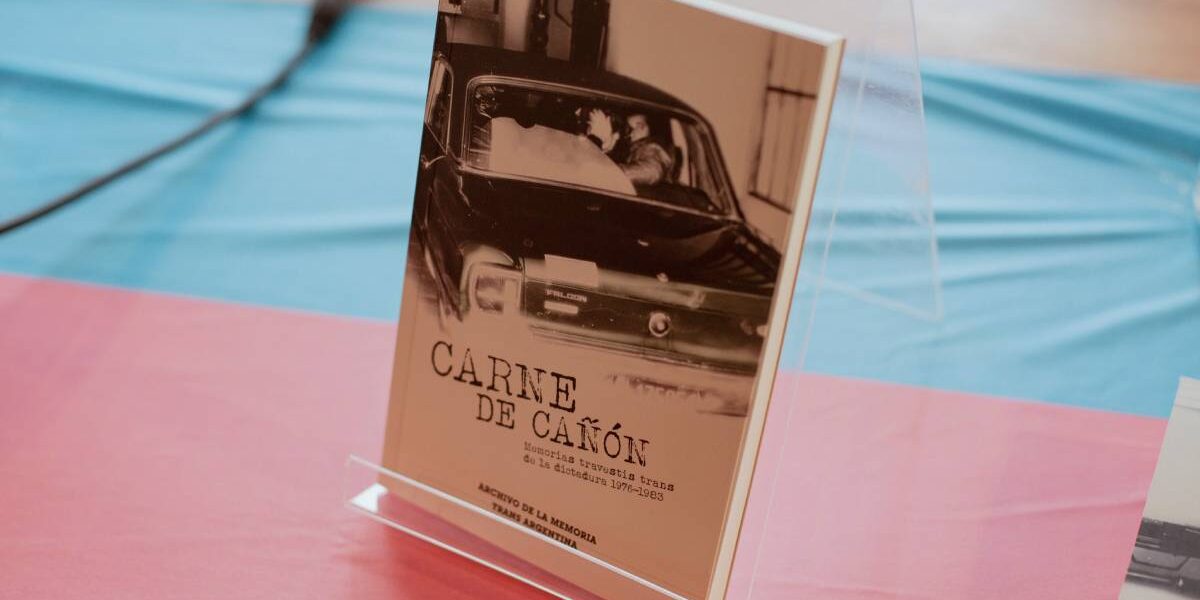
BUENOS AIRES, Argentina. The experiences of twelve transvestites and trans women during Argentina's last military dictatorship are now immortalized in a new book from the Trans Memory Archive (AMT). "Cannon Fodder" details the diverse life trajectories marked by military and police persecution, crimes, exile, and strategies for survival during a state terrorism that also targeted these identities. The book, published 50 years after the coup, seeks to fill a significant gap in literature and the social imaginary regarding the 1970s in Argentina.
In 2023, five trans women and transvestites who survived the dictatorship testified in a trial for crimes against humanity. All of them had been detained in the Pozo de Banfield, one of the 230 clandestine detention centers that operated in the province of Buenos Aires. A year later, for the first time in history, a court verdict legally recognized eight trans women and transvestites as victims of state terrorism. The crimes committed against this group included aggravated illegal deprivation of liberty, aggravated torture, aggravated sexual abuse, and enslavement.
These voices are now captured in the book. Furthermore, the Archive sought out testimonies that could not be included in the Brigadas trial. The result was a 175-page book with first-person accounts that reveal the diversity of experiences under the dictatorship. “Each individual story is filled with other voices: those of those who were there, those who are no longer with us, and those we continue to search for,” explains the epilogue written by the AMT.
A long period of persecution
Under the same umbrella of persecution, violence, and abuse, transvestite and trans women experienced different facets of the atrocities perpetrated by the civic-military dictatorship. Some had to hide in their homes; many lost friends. Others could not escape mandatory military service or detention in clandestine centers. In these places, they were forced to do hard labor, to eat scraps—only when possible—to clean up the blood of others, to listen to screams. And they experienced torture firsthand: from electric shocks and beatings to repeated rapes. An entire state and military apparatus was placed at the disposal of eliminating any life and idea that did not fit within the neoliberal, Western, Christian, binary, and misogynistic political project that the de facto government sought to perpetuate between 1976 and 1983.
Police persecution of the trans community continued after the dictatorship. In fact, most consider that democracy arrived with the Gender Identity Law in 2012.However, it is still vital to acknowledge the specific forms of violence committed against them during the State Terrorism. In the epilogue written by the AMT, they insist: “Remembering is a political act. Reconstructing, a form of justice. Naming is restoring existence.”
At this point, the book seeks to begin to repay that debt. For many years, the situation of transvestite and trans people during the dictatorship was rendered invisible. In the judicial sphere, there were 40 years of silence on the subject. Something similar occurred with regard to literature focused on the 1970s in Argentina. Decades passed before human rights movements and journalism embraced the memory of sexual diversity, and in particular that of transvestites and trans people.
This is a process that is increasingly strengthened today. The Archive considers this book to be heir to a genealogy of struggle driven by the Mothers and Grandmothers of Plaza de Mayo . In fact, *Carne de cañón* (Cannon Fodder) makes references to and acknowledges * Nunca más* (Never Again ) as its main antecedent and inspiration . “The first thing I noticed is that there is no information about this community in that book, and that is the first point of contention I find, the first clash between the two. But at the same time, from an editorial perspective, * Nunca más* was the book that guided me,” acknowledges editor Sofía Naara.
A fundamental book
In July 2024, the Federal Oral Court No. 1 of La Plata released the grounds for its landmark ruling recognizing trans and travesti survivors as victims of crimes against humanity. These grounds largely echoed the arguments presented in the prosecution's closing statement, led by Ana “Pipi” Oberlin. Thus, for the judges, the gender identity of these victims was included “within the binary framework that eliminated anything presented as dissenting to the oppressor's worldview.” In this regard, Oberlin argued that trans women were among those considered enemies by the State Terrorism regime because they did not conform to the “Western and Christian” gender-sex model that the dictatorship sought to enforce. Therefore, they were considered subversive because of their gender identity and were targeted for extermination.
Oberlin wrote the prologue and back cover text for *Carne de cañón* (Cannon Fodder). In it, he argues that reading the book is essential because it “fundamentally exposes the brutality of state and non-state violent practices against trans and travesti people.” But also because it “reveals numerous and creative networks of resistance: the complicity, the laughter, the joint strategies, the supportive community, and, above all, the joy in the face of horror.”
After what they endured during those years, many refused to speak about what had happened. They didn't want to reopen such a deep wound; they longed to forget. Some managed to leave the country. Others chose to adopt a masculine appearance to avoid being noticed. But with time, those experiences resurfaced. Through activism and conversations with other trans and travesti women, many began to understand what had happened to them. They realized that they, too, had been held in clandestine detention centers and had suffered the abuses of the dictatorial regime. And in that process, they recognized the importance of speaking out.
“They gave us back our voice”
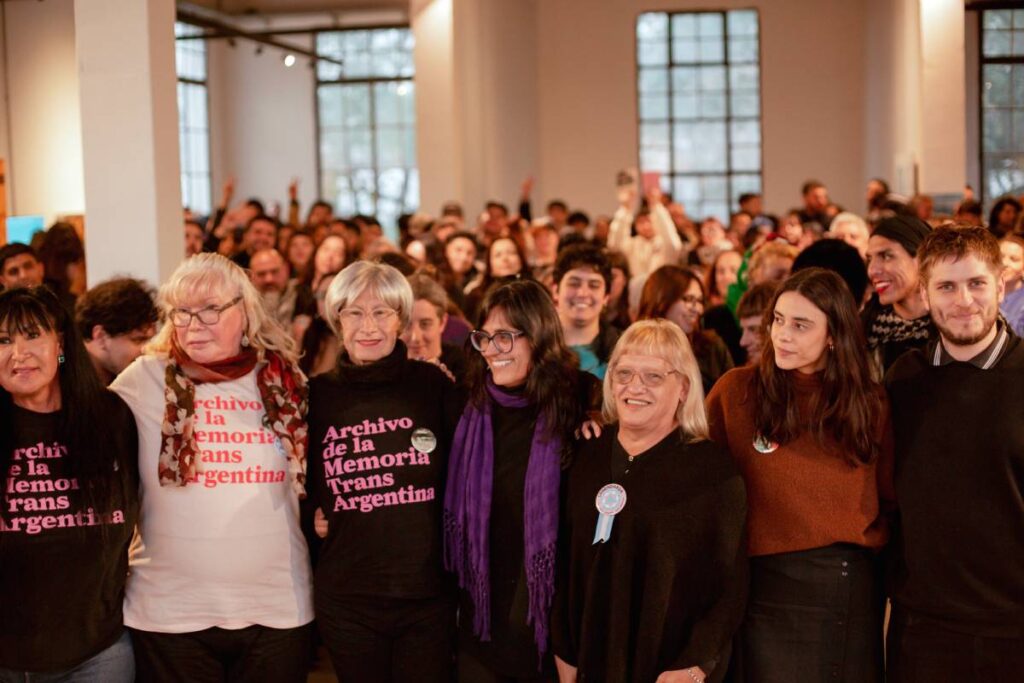
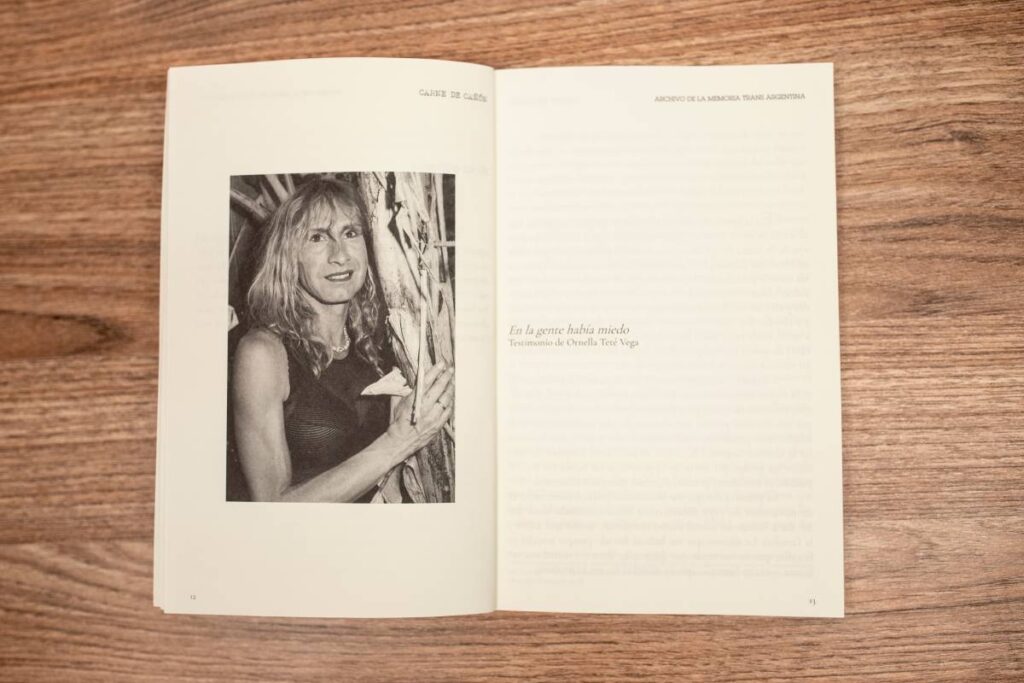
Between 2019 and 2026, “when it became possible to name what had been kept silent for decades, shrouded in fear and shame,” the interviews that led to this book took place. “What’s special about it is that we can tell our own stories about how we lived under the dictatorship. Society never really knew, and still doesn’t know, how a trans person lives. Society always sees trans people as divine, splendid, but that’s not the case. We suffered a lot of persecution, a lot of hatred. And that’s because now we can talk about it, and because the archives have given us the opportunity to all share our experiences,” shared Ornella Teté Vega during the book’s presentation at the ESMA Memory and Human Rights Space.
Carolina Figueredo, also a member of AMT, spoke in the same vein: “They gave us back our voice. Because they always kept us silent. This was the opportunity for us to speak about something that oppressed us for so many years. They kept us blind to that mistreatment.”.
Everything presented in the book speaks to a need: to acknowledge the violence and crimes committed against the trans community during the dictatorship. This situation continued for them well into the democratic era. “Many have already passed away. Many have been forgotten, many disappeared, many are dead, friends of mine who are no longer with us. We demand recognition of the abandonment and mistreatment we suffered. We were always used and robbed: of our lives, our dignity, so much more,” says Carolina. This recognition must be accompanied by necessary reparations for our sisters. And also by a plea they extend to the readers: “Don’t forget us. Memory, truth, and justice for us.”.
The book can be purchased on the Trans Memory Archive's website: archivotrans.mitiendanube.com
We are present
We are committed to journalism that delves into the territories and conducts thorough investigations, combined with new technologies and narrative formats. We want the protagonists, their stories, and their struggles to be present.
SUPPORT US

FOLLOW US
Related notes
We are present
This and other stories are not usually on the media agenda. Together we can bring them to light.