

39th Plurinational Meeting: Transfeminism charts the horizon of a new country
Thousands of women and gender-diverse people gathered in Córdoba to discuss the economic crisis, national sovereignty, gender-based violence, and patriarchal justice. This inclusive, nationwide gathering called for building a trans-feminist democracy based on equality and social justice.


Share

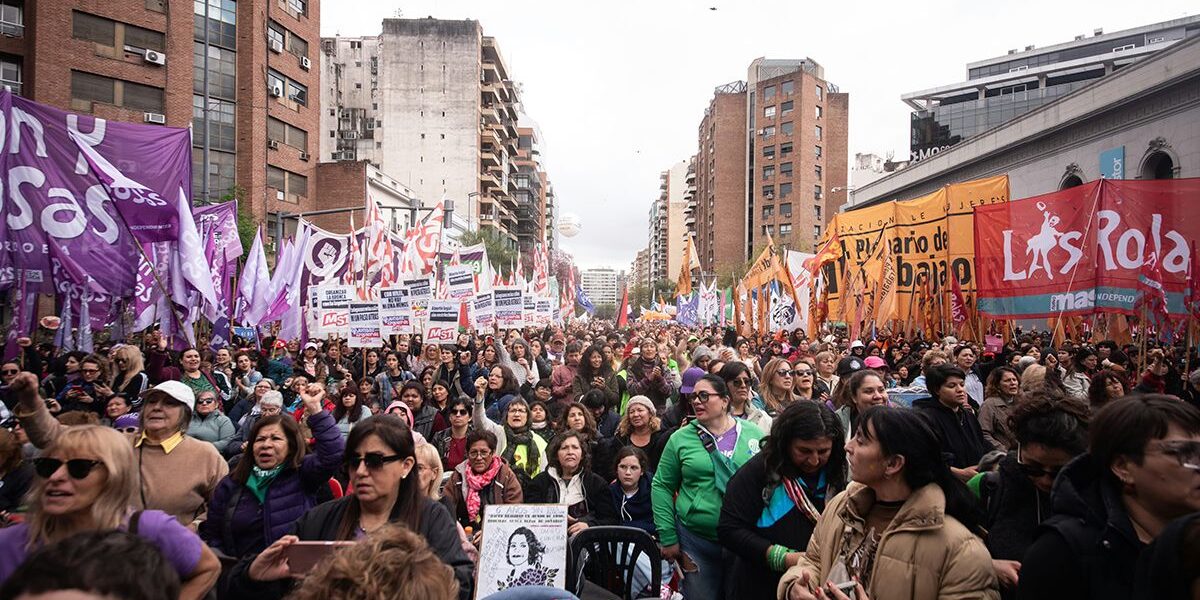
CITY OF CORDOBA. “Out with Milei!” was the cry that resonated most throughout Saturday morning in the streets of Cordoba, where, in a further display of cross-party unity and political power, the 39th Plurinational Meeting of Women, Lesbians, Transvestites, Transgender, Bisexual, Intersex, and Non-Binary People. The opening document, following the inaugural spiritual ceremony, presented a list of social and political demands directed at the national and local governments and the judiciary. It demonstrated that both the document and the organization of the meeting were the result of intense debate.
“We arrive at this 39th Plurinational Gathering with the pride of having built, despite our differences, an organizing committee to welcome this wave. Because we believe in organization, in the defiance of our scarves, in the history of our victories,” the opening speech states. “This organizing committee leaves a legacy for those to come: that of an organization that overcame its individual differences in pursuit of a great collective gathering.”
“We are the ones who organize to support the struggles of teachers, retirees, workers, people with disabilities, and in the face of every injustice. We are the ones who keep the pot boiling. We are the ones who are not willing to back down. To Milei and his chainsaw, we say that we are here, more organized than ever. We are the great wave that defends joy and rebellion as a political stance, because our rights are won and defended in the streets,” they declared at the welcome.

Photo: Alejandra Morasano
It was Córdoba
When Córdoba was chosen as the host city last year in a hard-fought election against Buenos Aires, the Córdoba police had not yet murdered Samuel Tobares, a young LGBT man, who was tortured to death. Nor had the young migrant Delicia Mamaní disappeared; Lulén and Max had not yet endured a trial lacking a gender perspective, for which they are now serving excessive sentences; and Agostina Vega, a 14-year-old girl whose femicide exposed the poor performance of the Córdoba state and the patriarchal bias of the justice system when the prosecutor in charge of the investigation insistently refused to call it femicide, had not yet been murdered.
And it is also in Córdoba where Paola Ortiz spent 12 years in prison for an obstetric emergency and was released (without being acquitted) less than a month ago. The activists say that without the framework of the Encuentro (Meeting), it would not have been possible for the justice system to hear them.
Much of what happened in Córdoba during this tumultuous year of 2026 is a reflection of what is happening to women and diverse groups throughout the country. For this reason, this Gathering carries a profound political and emotional weight, which translates into organization and a vision for the future. The transfeminist movement is once again prepared to put its body on the line and fight for an equal country with social justice.

Photo: Alejandra Morasano
A group of women hold a banner made of embroidered fabric scraps. This is the action they carried out at the Nelly Ruiz de Llorens Popular Library. “This is a project we've been doing with the women of the neighborhood for several years through Juntas y Diversas (Together and Diverse). We embroider the stories of victims of femicide and transphobic murder as a way to break with the idea that they are just another statistic. We try to make visible the stories behind those lives; we are interested in seeing who they are.”
They even put together a display of 100 handkerchiefs that they hung up like "rags in the sun," as they put it, to talk about sexist violence.
The story that builds the future
Two older women walk together, smiling and chatting. One of them is Graciela Lorenz, who has come to participate in the Encuentro, as she has done since 1992. That year, and again in 2019 when it was held in her city, La Plata, she was part of the organizing committee. She says that the Encuentro is “the most amazing event that happens all year in the country. Coming together in a completely horizontal space, where we are all equal, where we listen to each other and where we can identify with each other's pain, is extraordinary for women. I invite all of you who are listening or reading this to participate sometime, and you'll see that you won't want to stop coming.”
Beside her, Cristina Ventura recalls that she has participated since the first meeting and attended 30. She couldn't attend the remaining nine for various reasons, including financial ones. She agrees with her friend that these meetings must be defended and strengthened because they are "an uncomfortable event for many people.".
“To me, this gathering seems unique, a persistent revolution. Thirty-nine years of coming together, growing. We've achieved so much. Thirty-nine years in which we dreamed of abortion being legal and free, and we never thought we'd get this far, but we did, with this idea of being horizontal. It wasn't horizontal when it started, now it's truly horizontal, truly for everyone,” says Cristina. She adds that at 83, she's moved to see so many young women. “It's the greatest joy, because you don't see this everywhere, nor do you see it with men. But with the women… It moves me to know that I have someone to pass on this banner I've carried for 39 years.”
Beside the stage, Adriana Spila, a member of the committee for the first meeting held in the 1980s, says she is moved to see new colleagues and sectors joining. “It was always a political event, but it gained much more strength with the legislation and the progress that was achieved. Everything that has been achieved since the return of democracy, we women achieved little by little in these spaces. And now we have reached this stage where,unfortunately, all the rights we have won over the past 40 years have been curtailed by this last government. Not only for women and gender minorities, but for workers in general,” she tells Tiempo.

Photo: Alejandra Morasano
Sovereignty as the central axis
Seven workshops formed part of the thematic focus on sovereignty. The protest against the Law on Foreign Land Ownership and the demand for the repeal of Decree 70 were among the most prominent demands heard throughout the event.
“This is a unique gathering in the world. In the Sovereignty workshops, we've heard the experiences of women and diverse groups from different parts of the country; it's very moving,” said one of the participants in the Sovereignty of Territories and Land workshop. “We want Milei to leave, and we want to build a national project that is for what we, we, need, independently, with political sovereignty, with economic independence, and from there, strive to ensure that we all have a roof over our heads, a job to live on, land to cultivate, access to healthcare, and free education. We want to have recreation and culture that meet our needs,” she added.

Photo: Alejandra Morasano
Lichita present
The International Campaign in Solidarity with the Villalba Family was also present at the opening of the Meeting. “We are denouncing the imprisonment of our comrades Carmen Villalba, Francisca Antino, and Laura Villalba, two of whom have been detained for 20 years. Lichita disappeared in an operation by the Joint Task Force (FTC) of the Paraguayan government, and it has already been determined that two of the girls were murdered by that force. This is the injustice that has been lived in Paraguay for many years; the peasant movement is persecuted by the Paraguayan oligarchy,” said Miriam Paz, a member of the campaign. “This is the situation of a family that is completely cornered by that State, and part of the Villalba family is in exile in another country because their lives are at risk. Because they killed Ernestito, Carmen Villalba's eldest son, they also killed her nieces, and they disappeared her daughter.”
For her part, lawyer Blanca Barreiro, from the Lawyers' Guild, stated that there are no new legal developments beyond the presentation made to the UN, requesting that the Council on the Rights of the Child hold the Paraguayan State responsible for the murder of the two girls and the disappearance of Lichita. "The Paraguayan State is not responding to any of this and is holding Carmen Villalba in detention under extreme conditions. They don't always show solidarity with these women because they question their methods of struggle, while the Paraguayan State imprisons and kills them," said Barreiro, who is also a member of the Las Dianas collective.
I do believe you
Outside the Balseiro School, the workshop " Protective Mothers, Sexual Abuse of Children and Adolescents, Survivors". There, the organization Aquelarre Feminismo Popular (Popular Feminism Coven) created an installation with direct quotes from the Córdoba judicial system, illustrating how the system handles these cases: without a child-centered perspective or a gender perspective. They also created a Mother Justice figure on an altar to encourage intention. "It was extremely important for us that this gathering is taking place here. We congratulate the organization that achieved all of this in our province, which is extremely conservative and where the current government continues its rampant mistreatment. It is essential to reclaim the feminist movement and declare that today, while there is a regression, we are here asserting our rights, our demands, and our claims.
Organized workers
The role of women organized in unions and labor federations has become increasingly important in recent gatherings. The economic crisis, the crisis in care work, and the rise in violence affect all sectors, which are also suffering from debt and unemployment. Some of these issues were addressed during the workshop " Combating (Human) Capital," led by the Argentine Federation of Press Workers at the Cispren headquarters. In the afternoon, the CGT (General Confederation of Labor) distributed leaflets, and the activities leading up to the large closing march of the Encuentro (Meeting) will conclude with the "Out with Milei" action.
One hundred and forty women from the CCC arrived from Misiones. Emi is a community worker and came to join the protests against the government's austerity measures: “This government is taking away all our rights. As someone in charge of soup kitchens, I'm feeling it a lot in the social sphere.”.
Under transfeminist construction
Saturday concluded with the March Against Trans Murders, the largest march seen at any of the Encuentros. Prior to the march, the book Cannon Fodder, edited and published by the Trans Memory Archive, was presented. In the same plaza where the march began, a press conference was held to denounce cases of police violence against LGBT people.
Three years have passed with attacks from this government against a transfeminist movement that has always responded with greater organization. This powerful gathering is reflected in the desire to debate, to take action, and to once again be the ones putting their bodies on the line to build the country we want.

Photo: Alejandra Morasano
SIPREBA at the Plurinational Meeting of Women and Diversities
The women journalists organized under SipreBA arrived at the Cispren headquarters to participate in the various activities taking place at the 39th Plurinational Meeting. One of these activities was a training workshop given by Fatpren at the Cispren headquarters.

Photo: Courtesy of Natalia Bernades, La Retaguardia

Photo: Alejandra Morasano
This article was published today in the newspaper Tiempo Argentino and is reproduced as part of our agreement as media partners.
We are present
We are committed to journalism that delves into the territories and conducts thorough investigations, combined with new technologies and narrative formats. We want the protagonists, their stories, and their struggles to be present.
SUPPORT US

FOLLOW US
Related notes
We are present
This and other stories are not usually on the media agenda. Together we can bring them to light.