

LGBT hate crimes: when it's the police who kill
At the 39th Plurinational Meeting, four paradigmatic cases of police and prison service violence against LGBT people were presented.


Share

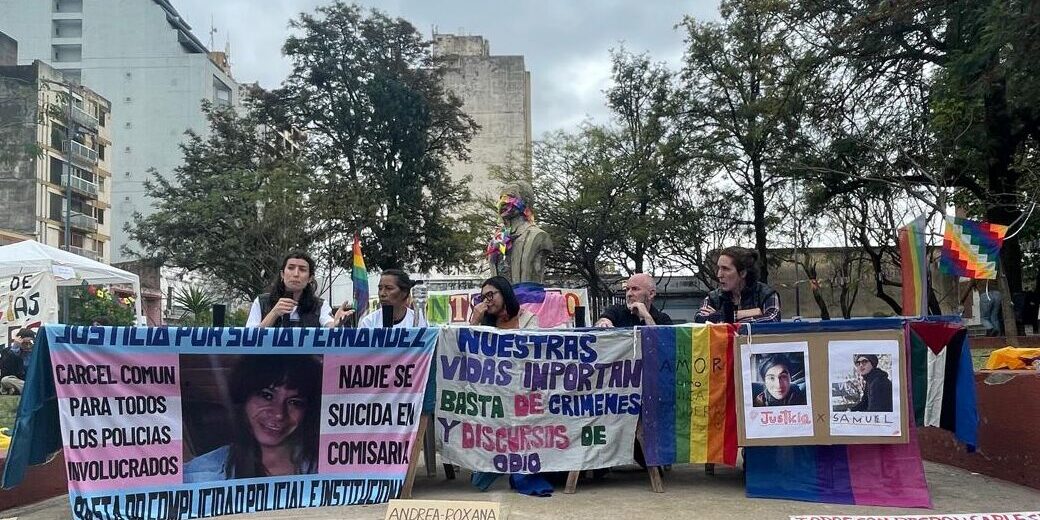
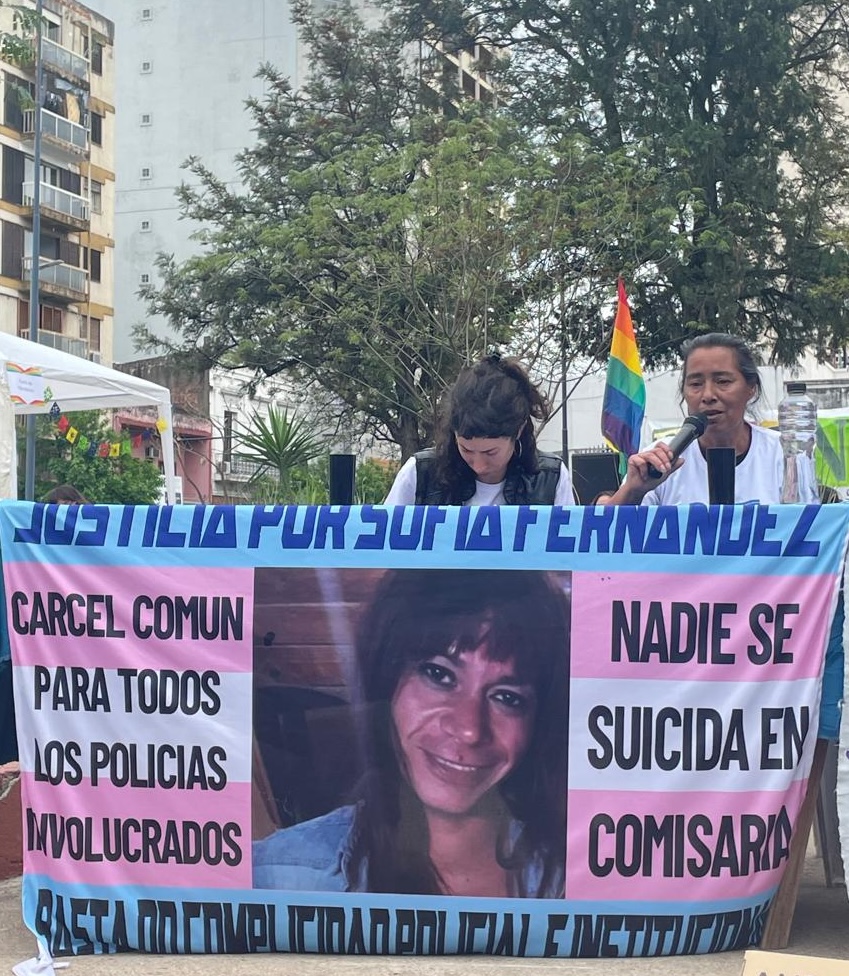
“Justice for Sofía Fernández: it was a transvesticide, common jail for the 10 police officers.” The huge sign is on the corner of General Paz and Tablada, in a small square in Córdoba where, on the afternoon of the first day of the Encuentro, intense colors shine: the rainbow flag, the trans flag, the wiphala of the Andean peoples.
Mabel, Sofía's sister, carries the demand for justice on her t-shirt and in her words: “I'm seeking to have the ten police officers returned to prison, without privileges. There are many similar cases.” She traveled to the Encuentro to participate in the Encotrolazo: an activity organized by the Assembly of Sexual Dissidents of Córdoba, a space for diversity within the framework of the Plurinational Encuentro.
The square from where the march against transvesticide later departed was the epicenter for disseminating and demanding justice for four cases that speak for others: the violent deaths of LGBT people at the hands of police forces and the prison service.
These are Sofía Fernández (39), a trans woman and nursing student murdered at police station No. 5 in Pilar in April 2023; Fernanda Arias (34), “found dead” while detained at police station No. 2 in Rosario de Lerma, Salta, on November 26, 2025; Samuel Tobares (34), murdered by two Córdoba police officers in December 2025 during an operation on Route 38 in the town of Villa Parque Síquiman; and Mónica Mego (36), a trans migrant woman who entered a prison in the province of Buenos Aires without a conviction, suffered torture, and died in March 2022 due to lack of proper medical care at Unit 32 in Florencio Varela.
Lives that matter
“Hate crimes of this nature are the most blatant expression of the State’s desire to determine which lives are worth living and how, and which are superfluous,” said Quimey Ramos, a member of the Justice for Sofía Fernández Commission. “We are not willing to accept that our lives don’t matter.”.
Also participating were Pía Ceballos, a transvestite activist who traveled from Salta where she participates in the Justice for Fernanda Arias Commission; Maxi García from the Assembly of Sexual Dissidences of Córdoba, and Sofía Ballesteros from the Provincial Commission of Memory of Buenos Aires.
Among the commonalities, Ramos highlighted the classist justice system and the inequality that exists when facing legal proceedings between victims and perpetrators when the latter are part of the state forces. “The Buenos Aires Province Ministry of Security is providing lawyers to ten police officers accused of murdering and covering up Sofía's crime. And there is a team of expert witnesses, active-duty police officers, working to prove that Sofía committed suicide,” he explained.
The memory of Fernanda
Pía Ceballos recalled Fernanda Arias's joy and mischievousness, her precarious work in the tobacco harvests, and the affection with which her neighbors remembered her. “Our lives don't begin with a police report. We need to recover the memory of our lives, not just our deaths,” she said. But above all, she asked: what did the State do to protect Fernanda's life and the lives of those in its custody?
Hours later, a large column departed from that same square in the March against Transvesticide and Transfemicide.
We are present
We are committed to journalism that delves into the territories and conducts thorough investigations, combined with new technologies and narrative formats. We want the protagonists, their stories, and their struggles to be present.
SUPPORT US

FOLLOW US
Related notes
We are present
This and other stories are not usually on the media agenda. Together we can bring them to light.