

The diverse Brazil that Erika Hilton, trans congresswoman, wants to build
The October elections in Brazil also renew Congress in a country where the leadership of black, trans and feminist people like Erika Hilton continues to make room in the face of an organized parliamentary right.


Share

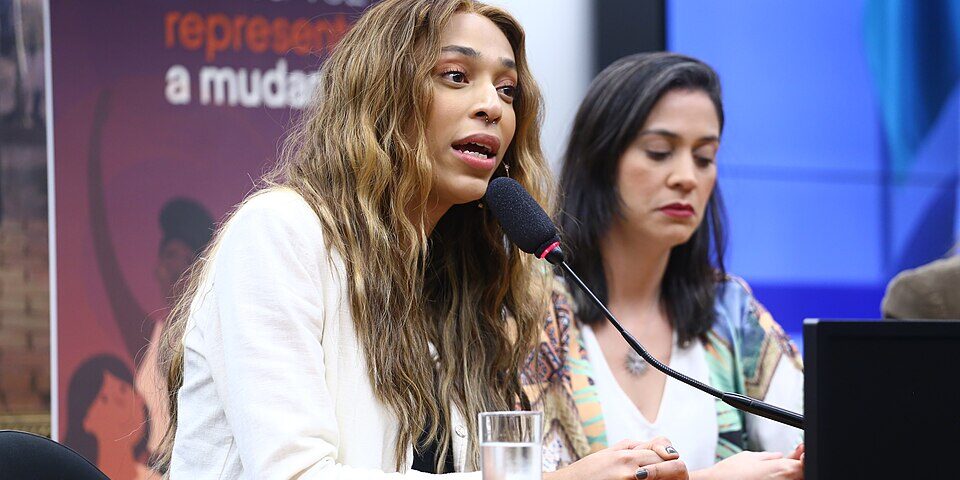
Erika Hilton wears a white garment, her hair loose in caramel and honey tones, and her gaze commands attention. She speaks before a special committeeof the Brazilian Congress created to debate the end of the 6x1 work schedule. In that session, she defends the proposed law to end this widespread routine among workers in sectors such as retail, supermarkets, shopping malls, restaurants, bars, cleaning, and transportation: six days of work followed by one day of rest. She raises her voice and draws the attention of the room: “People cannot live to work; they need to work to live.” The bill has been approved by the Chamber of Deputies and awaits its final decision in the Senate.
Hilton's speech was one of the most committed in her career as a federal deputy, marked by activism for human rights and the LGBTQ+ community. A Black, trans woman, she has been a legislator for the Socialism and Liberty Party (PSOL) since 2023 and is seeking reelection in the upcoming elections on October 4. If no presidential candidate obtains an absolute majority—more than half of the valid votes—a runoff election will be held on October 25.
In the aforementioned parliamentary committee, Hilton exposes more than just a dispute over labor rights: he reveals the current tense climate of a Brazil heading towards elections, with Lula seeking reelection and a right wing rallying behind Flávio Bolsonaro of the Liberal Party (PL), son of former president Jair Bolsonaro, convicted and under house arrest for an attempted coup in January 2023. Polls, for now, favor Lula, leader of the Workers' Party (PT), albeit by a narrow margin that casts a shadow over him.
Hilton is pushing an intersectional agenda that crosses gender, race, class, work, and identity
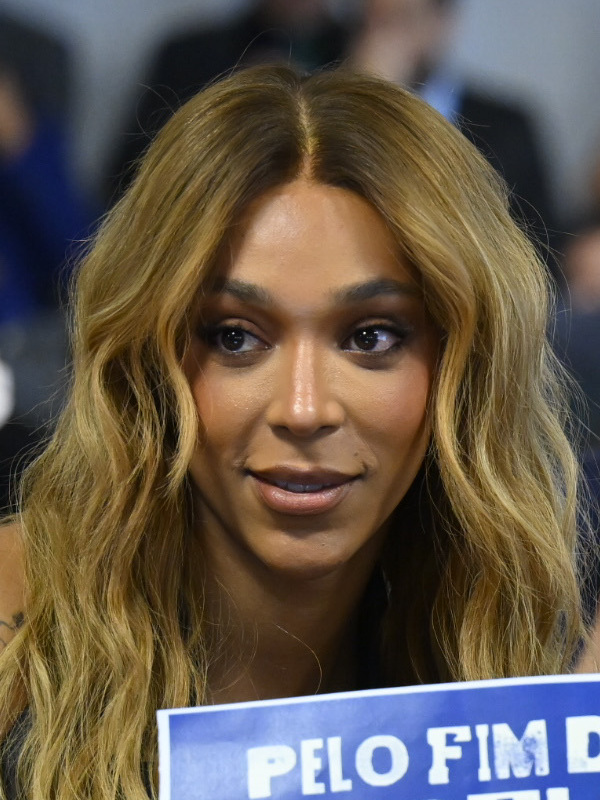
Beneath the modernist domes of the National Congress in the heart of Brasília, in Brazil's Midwest region, Hilton is pushing an intersectional agenda that crosses gender, race, class, work, and identity, and she is doing so in a Parliament where the ultraconservative right maintains a strong presence. Currently, out of a total of 513 seats in the Chamber of Deputies and 81 in the Senate, there are two trans women, Erika Hilton and Duda Salabert, a total of nine Black women in the Chamber of Deputies, and a single Black woman in the Senate—in Brazil, the category of Black population includes those who self-identify as pretas or pardas. Their presence is a way of challenging the hierarchies upon which much of Brazilian politics and society is organized.
A Parliament that doesn't resemble the country
Lula's return to the Planalto Palace, the Brazilian presidential residence, in early 2023 reopened a federal agenda of policies for women and post-Bolsonaro democratic reconstruction, but this momentum is not automatically reflected in Congress. The reality is that parliamentary representation is organized among fragmented parties, alliances, territories, campaign finance, and social forces that do not always move in the same direction as the proposals of the executive branch. And in this sense, the legislative class in Congress remains distant from a country where women make up 51.5 percent of the total population and people who self-identify as Black represent 55.5 percent.
Women's representation in Brazil, as in much of the region, has progressed more slowly than the electoral rules designed to promote it. Since 2018, parties have been required to allocate at least 30 percent of their campaign resources and free airtime to female candidates, but effective access to power remains limited. Until the 2022 elections, women held less than 20 percent of the seats in the Chamber of Deputies, and among the main parties, the proportion of elected women was relatively similar between the left and right. As Débora Thomé, a PhD in Political Science, explained to Pikara Magazine , this pattern changed in 2022: "The PT has a proportionally higher proportion of elected women than the PL."
However, this difference does not alter the overall composition of Congress. The right wing has more representatives in absolute terms, and this majority is also reflected among female members of parliament. “When we look at Congress as a whole, there are more right-wing women,” Thomé points out. In the Chamber of Deputies, the PT currently holds 64 seats; the federation made up of the PT, the Communist Party of Brazil, and the Green Party has 81, compared to the PL's 98 seats. Meanwhile, the large parliamentary bloc that brings together center and center-right parties holds 273 of the 513 seats.
"Brazilian women are worried about how to defend their bodies (...) how to put food on the table, how to report aggressors without them coming back."
But the struggle isn't measured solely by how many women reach seats in the Brazilian Parliament, but rather by who manages to cross that threshold and who remains excluded from the spaces where power is decided. Therefore, the presence of a legislator like Erika Hilton resonates with a recent history still lacking in terms of representation and intersectionality. In 1986, Benedita da Silva, of the Workers' Party (PT) from Rio de Janeiro, was elected as Brazil's first Black woman federal deputy and participated in the 1987-1988 National Constituent Assembly. Her trajectory opened a rift in a Congress that took decades to incorporate Black women into national representation. Years later, as rapporteur in the Chamber for the so-called "Domestic Workers' Proposal" (PEC das Domésticas), Benedita da Silva once again highlighted a historic struggle: the equalization of labor rights for domestic workers in a country where this work remains marked by the legacy of slavery. Today, at 84, she is a candidate for the Senate representing the state of Rio de Janeiro.
In March 2026, Erika Hilton assumed the presidency of the Women's Commission of the Chamber of Deputies with a speech highlighting the importance of having overcome the barriers of hatred and discrimination to reach that position: “We are committed to Brazilian women. To confront patriarchal and misogynistic violence, because Brazilian women are concerned about how to defend their bodies (…) how to put food on their tables, how to report aggressors without them returning.” The appointment placed her at the head of a key space for designing equality policies, after much internal resistance from conservative sectors that staged racism and transphobia.
Since her election in 2023, Hilton has authored over a hundred legislative proposals. This number reflects the breadth of her agenda, which ranges from decent work to LGBTQIA+ rights, and from political violence to homelessness. Among these initiatives, at least 21 are bills and 26 are related to women's rights.
In 2018, while campaigning for the Activist Caucus, she received death threats. El País Brasil reconstructed the graffiti on a wall that read “Transvestite elected dead,” and she was also threatened with violent emails. In this context, her leadership shifts the gender debate toward a dimension of respect for democracy and against hate speech. “Women are always limited, whether by the party itself, by a lack of funding, by the issues they address, or by the positions they hold,” Thomé concludes.
The violence surrounding representation
The backlash against Erika Hilton didn't happen in a vacuum. Brazil remains the country with the highest number of murders of transgender people in the world: according to the ANTRA Dossier, 80 transgender people were murdered in the country in 2025, the majority of them transvestites and women. This context helps explain Hilton's perspective when she denounces that Brazil still fuels hatred toward transgender people.
"The National Congress still cannot tolerate the arrival of those who were always outside and who are now entering through the main door."
Her presence at the head of a parliamentary commission dedicated to women's rights not only challenges a historically male and conservative political landscape, but also confronts a violence that attempts to restrict who can hold office, represent, and make decisions in the name of Brazilian democracy.
That dispute became clear when Hilton was chosen as the best female member of Congress by public vote at the Prêmio Congresso em Foco in August 2026. In her acceptance speech, she said that this recognition fueled the “tough and lonely battles” she faces in Congress. “The National Congress still cannot tolerate diversity, the arrival of those who were always excluded and who are now entering through the front door—us: Black women, LGBT people; we, transvestites and transsexuals, have a project for this country,” she stated in September 2024.
The question is why all that political experience encounters so many barriers to becoming institutional representation. For Carolina Althierof the Update Institute, Black women leaders already exist and have a track record and experience in different areas of management, many of them coming from organized civil society and social and anti-racist movements. “Expanding the presence of Black women means recognizing that there is an enormous accumulation of political knowledge produced in local communities and social movements that is underrepresented in democratic institutions,” she states.
With the October 4th elections approaching, the political continuity of figures like Hilton is at the heart of the democratic dispute
During the years of the Bolsonaro right's advance, anti-gender, racist, and transphobic forces grew and continue to operate both inside and outside Congress. For Hilton, acting politically in that environment demands a daily form of resistance, which she expresses constantly: "Sometimes we have to ignore it and keep a cool head," she recently said at a public hearing.
With the October 4, 2026 elections approaching, the political continuity of figures like Hilton is at the heart of the democratic debate. The entire Chamber of Deputies and two-thirds of the Senate will be up for election, in addition to the presidential race. Therefore, the legislative contest will be as decisive as the presidential one. The organization Mulheres Negras Decidem (Black Women Decide) warns that the renewal of two-thirds of the Senate seats opens a historic opportunity to increase the presence of Black women in a key center of power. But it also points to a risk: the advance of conservative sectors seeking to block these agendas.
The memory of Marielle Franco
Defending projects for the working majority with a gender and intersectional perspective also means invoking a memory that remains present: Marielle Franco, the Black, lesbian, and feminist city councilwoman murdered in Rio de Janeiro in 2018. She had, before many others, named this violent struggle to access and remain in decision-making spaces. “They’re going to have to put up with Black, trans, and lesbian women occupying the diversity of spaces,” she had firmly declared in the Rio de Janeiro City Council on March 8, 2018, in the context of International Women’s Day, just six days before her assassination.
Her memory resurfaces in every Brazilian election that insists on contesting historically denied positions and in every Black woman who wins a seat. In a Congress where figures like Erika Hilton still cause discomfort, this violence is not just a thing of the past: in August, while campaigning for reelection, the São Paulo Electoral Court ordered the removal of a video by Bolsonaro-backed candidate Lucas Pavanato that attacked her for her gender identity. Hilton's figure thus stands as a voice that takes to the podium to defend fundamental rights and reminds us that Brazilian democracy is also measured by those who manage to speak out, legislate, and survive the attempt.
Hilton projects this agenda amidst a highly polarized political landscape. This phenomenon, far from being an isolated event, consolidates a historical process of collective resistance and challenge. As the report 'Elected', the arrival of these new representatives to institutional power is a direct continuation of Marielle Franco's legacy: “It is undeniable that this explosion of Black women occupying positions of power, starting in 2018, is also a response to those who tried to silence Black women, to restrict them.”
Last month, when launching her reelection campaign, Hilton advocated for a “refounding” of the country that extends beyond Parliament, building on the streets and online. She said that young people, marginalized populations, excluded groups, political minorities, and social majorities “are waiting for their turn.” In her view, reelection is not merely about continuing a term, but about a broader struggle against the far right and about opening up space for those historically excluded from power. “That’s the country I want to build. Not just in Parliament, but in the streets, online, and by building something much bigger than me and us.”.

This article was originally published in Pikara Magazine. To learn more about our partnership, click here.
Opening photo: Erika Hilton at the 2023 'Elas Querem Igualdade' seminar. / Photo: Vinicius Loures/Câmara dos Deputados (Wikimedia Commons)
We are present
We are committed to journalism that delves into the territories and conducts thorough investigations, combined with new technologies and narrative formats. We want the protagonists, their stories, and their struggles to be present.
SUPPORT US

FOLLOW US
Related notes


We are present
This and other stories are not usually on the media agenda. Together we can bring them to light.