

Romina Villafañe: Being a teacher, Mapuche, and a woman between the classrooms of Patagonia and the United Nations
The history teacher participated in the UN scholarship program for representatives of Indigenous peoples. The exchange with other cultures and cultural diversity in the world. "We need to think about what kind of education we want.".


Share

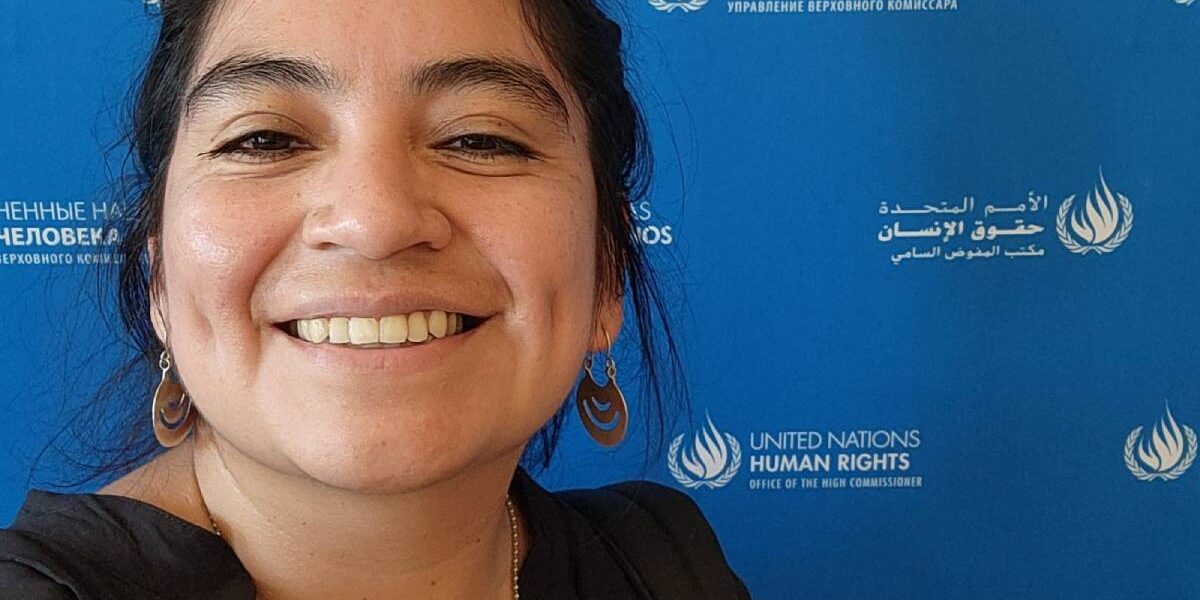
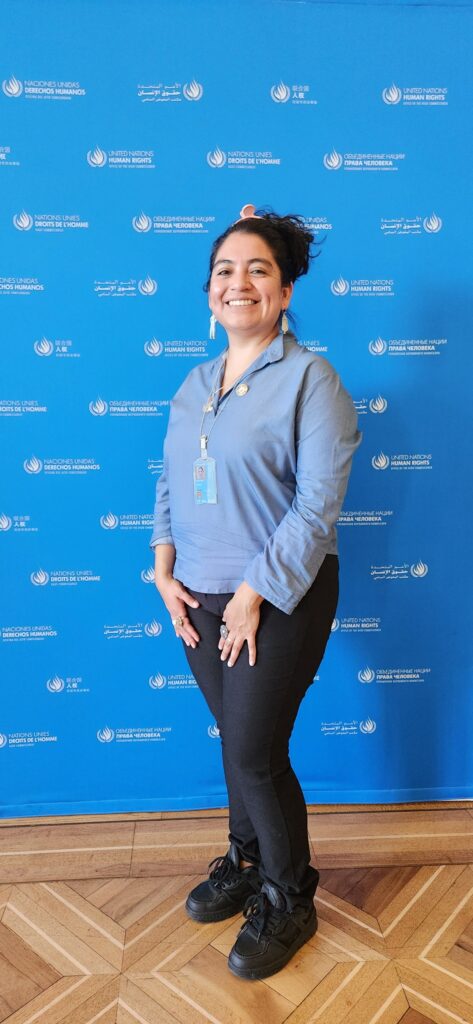
A few weeks ago, Romina Villafañe had a QR code on a card that opened the doors to the offices of the United Nations High Commissioner for Human Rights in Geneva. There, she shared classrooms as a fellow of the program for representatives of Indigenous peoples, alongside people from 36 Indigenous nations around the world. After a month, she returned to Esquel, Chubut, where she lives, and is still processing the intensity of her experience and connecting it to her work as a teacher. In her backpack, she carries those experiences and lessons learned, along with a nougat bar or a chocolate bar that will eventually go to one of her students. She teaches Social Studies and History at a public school, and each week she teaches about 200 teenagers.
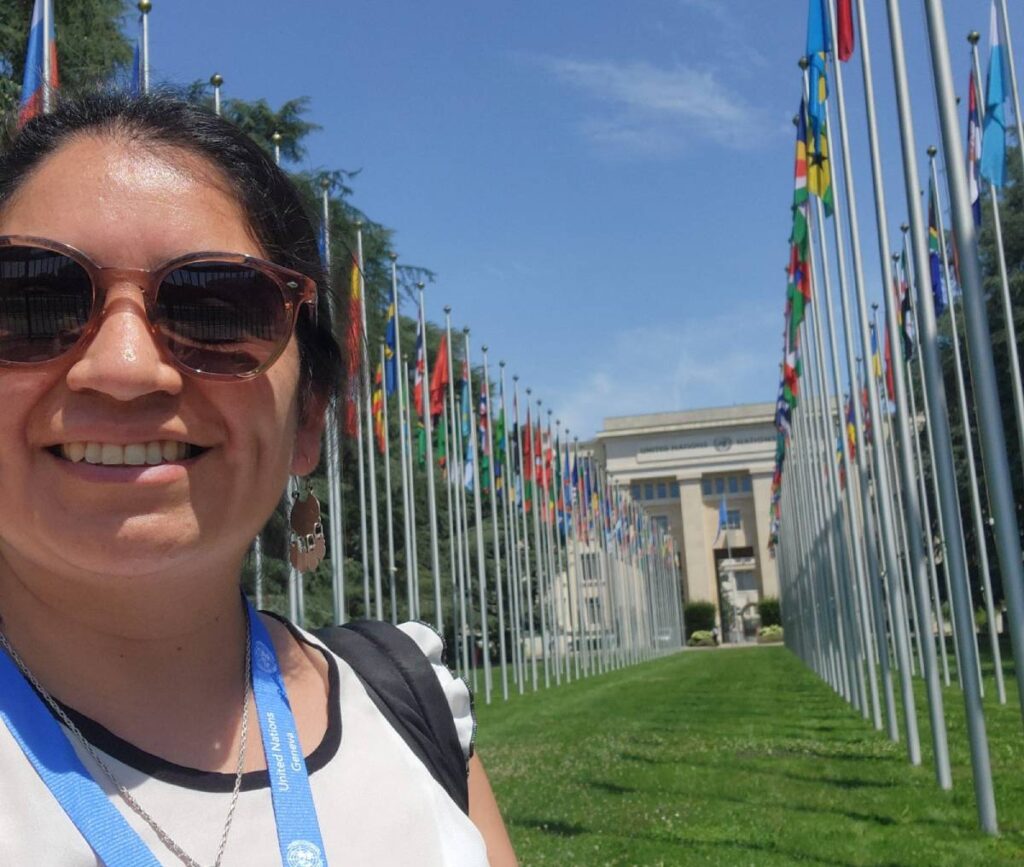
“Arriving at the United Nations as an Indigenous, Mapuche, woman, and teacher was wonderful,” says Romina, 39, a history graduate and teacher specializing in genocide studies with years of study at national universities, having also completed training in Spain in 2021. She often shares her knowledge in women's circles. “It's different being a woman, being Indigenous, and being poor or working-class. Community work and the bonds you establish are different. This is part of some of the discussions we've had with feminism. That's why the Meeting of Community, Peasant, and Popular Feminisms in Tilcara addresses other discussions,” she says, paraphrasing a note from Orbita Stream, a streaming program from Esquel, where she was interviewed days before leaving for Switzerland.
The Meeting has also been part of their agenda for several years, as were and are the No to the Mine marches in Esquel, a city of 50,000 inhabitants.
When Romina studied History in Comodoro Rivadavia, she was convinced that History, as a professor from Chubut, Roberto Vago, used to say, was going to change the world. “I was able to graduate thanks to the support of my parents and various national scholarships: for housing, for photocopies, for financing higher education. Otherwise, I wouldn't have been able to travel to study. At that time, there was investment in educational access for the working class. Thanks to that, I began my academic career,” she says.
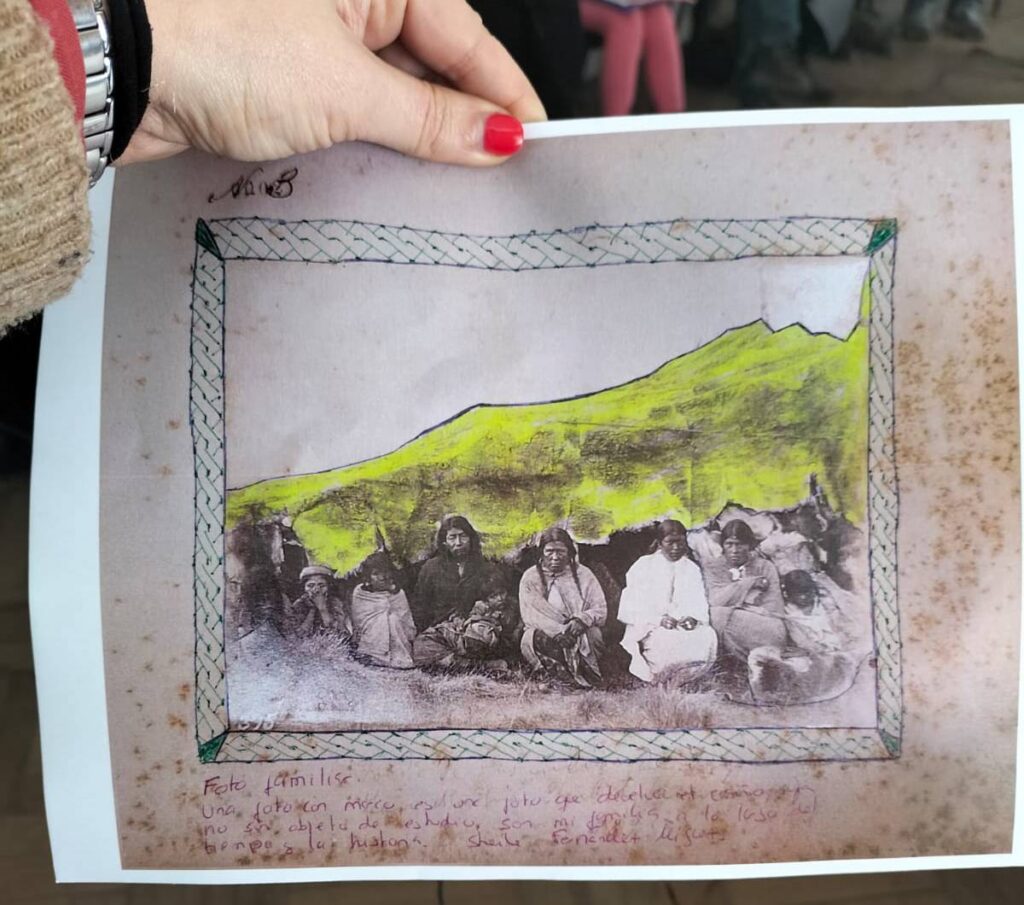
From a young age, she knew she was Mapuche, through her mother, Irma. Her father, Segundo, came from a different lineage. At university, her roots became politicized. There, she began studying genocide. First, she studied the Armenian Genocide, considered the first major genocide of the 20th century, in which 1.5 million Armenians died. At the Chair of Indigenous Peoples, she learned that they had gone through a similar process in Patagonia, including a phase of denial, such as the idea that the "Conquest of the Desert" was "necessary.".
From Esquel to the UN
– What was the process like and what motivated you to join the UN?
I had missed half my school hours and was in a job transition when I received an email in May of this year inviting me to apply. It was a complex process; I had to pass ten modules on diverse topics: disability, gender, war situations, cybersecurity, among others related to human rights, in addition to the specifics of how the organization operates. I was finally accepted as a scholarship recipient from Argentina and shared the experience with 36 people from Indigenous communities who were part of the cohort. Many of my classmates had an Indigenous mother tongue and also spoke the colonial language.
Part of the challenge was communicating in that festival of phonetics linked to very different corners of the world. She speaks English, but it had been years since she'd traveled to a country where another language was spoken. When she arrived at Geneva airport and picked up her suitcase, she felt a moment of overwhelming uncertainty: how was she going to get out of there and to the hotel? She knew there was free transportation. She asked a Black person where the buses were, and minutes later she was on her way. The next morning, very early, at the United Nations offices, she was welcomed as an intern and given a QR code to enter and exit.
“It was like a dream. I couldn’t believe it. When I was a student, I thought I would have liked to participate in a peacekeeping mission. Now, at least I was able to complete the first part of that task. I experienced it with great joy and gratitude, beyond the debates that the organization may generate,” he tells Presentes from Esquel.
In Switzerland, Romina spent a month learning with her classmates about the United Nations tools and mechanisms for indigenous peoples. It's worth remembering that Javier Milei's government was the only one in the world to vote against a UN General Assembly resolution defending the rights of indigenous peoples.
The program included intensive training, from morning till night, with specialists in agroecology, childhood, gender and diversity, among other topics. Although there were people who acted as translators, English became the group's common language. "At first it was cognitively exhausting, and then we started speaking to each other in French, Portuguese, and Spanish," she recalls. Most of the cohort were educators, linguists, social workers, lawyers, and community education workers.
Broaden the cultural horizon
-What were your most significant lessons and discoveries?
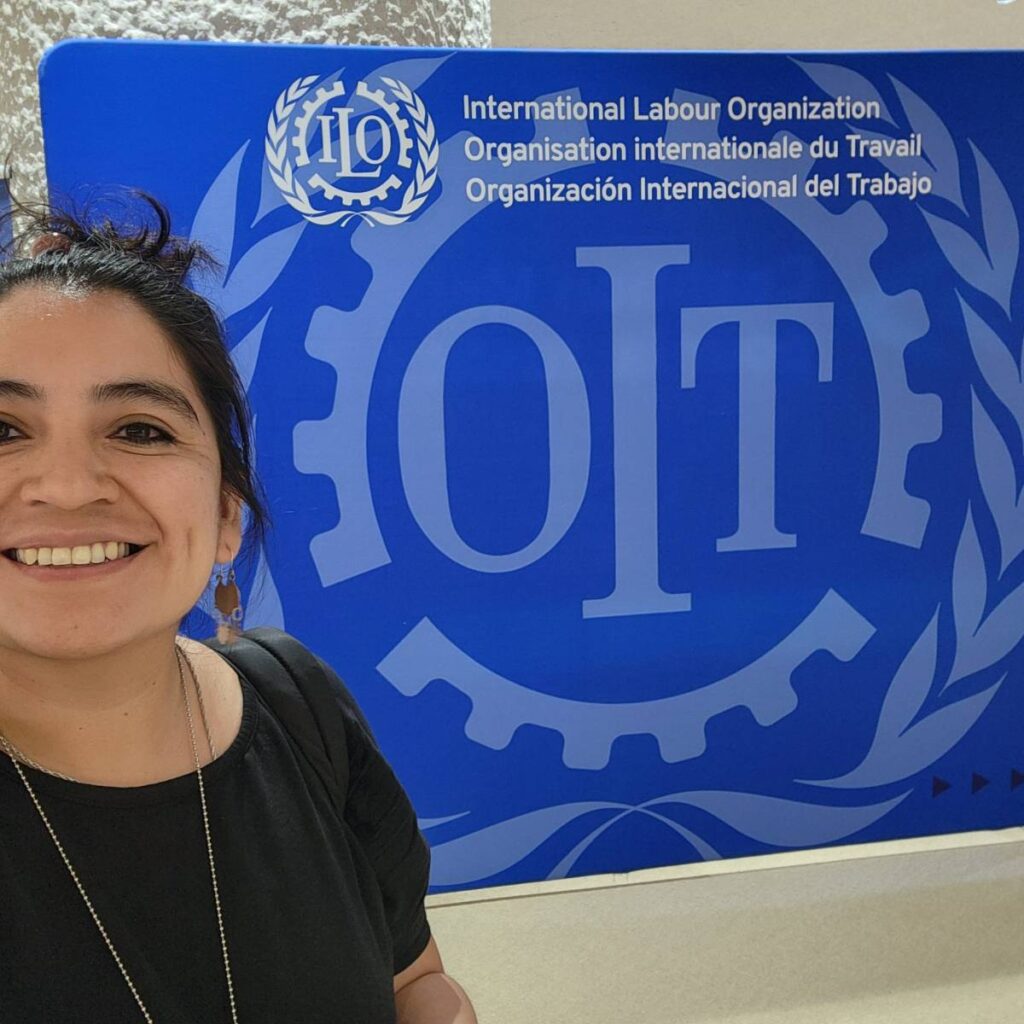
There were many academic learning experiences, such as how to generate documents for the United Nations and what mechanisms we can use to submit an eviction report. We visited the International Labour Organization (ILO) and had a class there on Indigenous Law. We learned how Convention 169 was created and discovered tools we didn't know existed. And basically, we learned about the cultural diversity in the world, the global economic model, and the fundamental problems that are devastating Indigenous communities.
-What would some of those problems be?
Extractive industries. You sit down with a Russian and they tell you, “Putin expelled Daria and Natalia from their territory for defending the rights of Indigenous peoples,” referring to two women who have been detained in a Russian prison for almost a year. Colleagues from Africa recounted how it's common for paramilitaries to enter communities and kill people over territorial disputes. The peoples of Oceania, Samoa, and Papua New Guinea suffer from seismic activity caused by the testing of bomb components at sea—very serious and difficult problems. In such distant and diverse contexts, we have the same thing in common.
And within that framework of heterogeneity, you build networks. You go from seeing the Patagonian territory as the central focus to understanding a broader scope. I remain in contact with my colleagues who are in the Americas, Asia, and Africa. And while there were some tensions within the program, because we didn't all think alike, seeing how to manage from another part of the world helps you grow.
-What issues did those tensions arise around?
– When discussing the rise of the far right in Latin America, internal debates and tensions arose around issues like Venezuela. But also regarding the genocide in Palestine. While it's important to clarify that the UN must guarantee human rights, it can make suggestions or recommendations, but it cannot intervene in countries. Beyond these tensions, extractivism was a common source of concern and a search for solutions, along with climate change and AI.
Another issue that emerged strongly in Indigenous communities is the denial of identity. In every country, there is often contempt for Indigenous people from those of mixed race. For example, a colleague from Ethiopia runs an anti-racism organization. I asked him, "How do you combat racism in a country of Black people?" And he explained that Indigenous people are darker-skinned. In that context, people of color exert pressure and exclusion on the other ethnic group. There is a structural racism that exists in different societies, and it's difficult to understand from our perspective.
-To what extent did you have support and are you able to share those lessons learned in Chubut, where various indigenous communities denounce persecution and there have been violent actions on the part of the provincial government and the Justice system?
On the one hand, this province wants to "make us Indigenous people disappear." It continues selling off our territories with the people still living on them, and dispossesses others. There's a national government that denies human rights in general, and especially those of Indigenous nations. Between the two of them, they've created a lot of fragmentation among Indigenous communities today. There are Indigenous people allied with the Chubut government and national politics, and that generates internal tensions. Personally, I had the support of Indigenous leaders and friends, people who shared their joy that I was participating in this experience. I continue to promote rights; I always have. That was my work before, and now I do it with greater confidence and understanding. I returned a month ago; I haven't been able to give a workshop yet, but I have a lot of school and community work ahead of me.
-As an indigenous woman, how did that month at the UN impact you?
I felt valued. Participation had meaning, a way of inhabiting the world in that space with a level of respect. On a global level, I find it interesting to highlight that the Mapuche people are one of the most autonomous nations. The United Nations has a lot of work ahead in our territories; we Mapuche maintain an autonomy that transcends the organization. It was very valuable to be with leaders who are waging very complex struggles, like the Indigenous women of Guatemala against agribusiness. Women's networks are being created to defend their territories, like the Colombian women who are saving the Amazon. I met a sister who is a protector of ayahuasca. Here, you talk about ayahuasca and it's associated with a hippie trip. She explained it from a spiritual perspective, very far removed from what the capitalist market sells you. All healing is done with healers.
"Education is still magic«
-How do you link this training at the UN with your work as an educator?
“Education is the only job I’ve known since I was very young; I graduated after I turned 20. At the UN, we did activities that I wouldn’t have been able to carry out if I hadn’t been an educator. Education allows you to understand people, to live with diversity. And it gave me this experience. Education has declined due to the current government’s policies. I have good conversations with the teenagers I work with daily; the problem isn’t the kids, it’s more the social context, the families, the institutions. It’s difficult to teach when the kids are hungry, when they arrive angry, and even more so when we don’t have basic equipment.”
-Do you have hungry children in your classroom?
– Kids and young people who are hungry. I usually carry something in my backpack for those situations; it's not a solution, but a nougat bar, a chocolate bar… The kids are frank. They tell you, " I'm hungry." Or, " The power's out," and they arrive with all their belongings to carry. You start to think: how can you educate in a country where there's hunger? And there's no infrastructure suitable for those of us who live in the schools.
– And what answers do you find?
–I believe education is still magical: when a child is learning, you're at the best time of your life. It's incredible when you assess complex topics like the massacres in Patagonia, the Holocaust, the Russian Revolution in oral lessons, and your students can discuss those topics using academic texts. There are moments of gratitude and joy within the school: those. Upon returning, I was also struck by the ability to see things from a different perspective, to deal with certain problems that used to cause me a lot of anxiety. Daily life isn't easy. Being Indigenous or a human rights activist gives you tools to navigate it more effectively.
How to educate in diversity
-What is the main challenge today as a teacher?
–To cope with or endure this period we are going through. The social crisis is being felt in the classroom: a great lack of respect and affection. The children not only have material needs but also emotional ones. Hate speech is constantly circulating on social media and TV, directly impacting daily life. It is a pivotal moment. It is very difficult to be a teacher today; reading and paying attention is difficult for the children and also for the adults.
-What are some of the difficulties you see as a teacher?
-Younger children are experiencing difficulties interacting with each other; they're becoming isolated. We're losing the sense of community, play, and sharing. Kids are growing up with screens, alone, and becoming adults with limited problem-solving skills. They look for solutions on their phones, using AI. In my teens, you'd have a fight and then go out and play together. Today, conflicts are much more intense. They form little islands. I'm worried that we can't experience community in the classroom. The other day we went to a museum here in Esquel; that clears their heads, the non-classroom space has a different effect. We need to think about what kind of education we want to teach, what kind of diversity we want for the future.
-You mentioned hate speech, how are you seeing its circulation in the school?
–Hate speech does erupt in the classroom. It's infrequent, but impactful. I've had conflicts in the classroom stemming from this idea that "in neoliberalism, we are all free and can do whatever we want," implying that we all have the same opportunities, a notion that distances us from reality. It even appears in situations where we're not discussing it. You can provide the tools and the historical context, but you don't always achieve reflection.
There was also a situation regarding the "Yes or No" to the mine. In this area of Esquel, with the expanding deposits, we thought everyone was saying "no to the mine," but now the discourse is "mining creates jobs." We need to rethink what it means to generate employment, what would happen to our mountains, and what is meant by "development." And all of this aligns with the national and provincial policies. The same goes for Indigenous Peoples, where many discourses label us as terrorists, thieves, lazy, and other derogatory terms. That has an impact. I've had to say things like, "I'm teaching you, and I'm not... such and such."
Memory as the cornerstone of education
-The issue of indigenous genocide has historically been made invisible, with few exceptions, in school education. How do you see this link with memory today?
–There are teachers who still adhere to this ideology of denial, and others who don't want to address it due to potential job complications. In my field, these are complex issues: we've had problems with the denial of the 30,000 disappeared during the last military dictatorship in Argentina, with the collective amnesia. If you're afraid of reprisals, as an educator you have limitations; it's a source of income. Not everyone can face what might happen. And there are some people who reject certain topics without justification. Those of us who educate have a curriculum and training in these areas where human rights are still considered cross-cutting knowledge, despite the national government's discourse of contempt and denial.
However, we are in a moment of forgetting our history; here in Chubut, the anniversary of the Trelew Massacre was recently commemorated, and it passed as if nothing had happened. These are issues that are being lost in the construction of this new society.
– How do you deal with that?
—I stand by my convictions through practice, and sometimes that means changing it. I had teenagers who denied the indigenous genocide. I teach them using other sources: we have documents from the Argentine Army that recount what happened. “If you don’t want to read the historian, read the military records”—it’s all documented. But it’s very difficult. It’s easier to talk about the Greeks and Romans than about these issues.
– How do you connect this experience with your teaching work and your own memories?
–The youngest ones struggled to grasp the scale of the place I'd been. I explain to them and tell them about the values of Indigenous communities, my way of inhabiting the world, of living in these communities. The UN gave me a tool to document and develop another form of communication. The mechanisms for defending the territory may or may not be useful, but we know they exist, and from there we can generate change.
I felt so happy to be there. We also have the right to be happy. And there's a whole historical legacy behind me. There, a Filipino gentleman always reminded us of the value of celebrations, of sharing, and of remembering that those of us who got there did so thanks to our ancestors. There's a lineage that comes after you. There's always someone who accompanies you. Some time ago, I summited the Lanín volcano, and I kept thinking about the metaphor of the mountain: you have to climb the mountain, and then you have to come down, return to your place. And this is the path I choose to continue on.
We are present
We are committed to journalism that delves into the territories and conducts thorough investigations, combined with new technologies and narrative formats. We want the protagonists, their stories, and their struggles to be present.
SUPPORT US

FOLLOW US
Related notes
We are present
This and other stories are not usually on the media agenda. Together we can bring them to light.