

Transgender employment quota: the court orders the reinstatement of another dismissed worker
The rulings require the government to incorporate trans workers who had entered the public sector through the employment quota law. The cases that remain unresolved.



Share

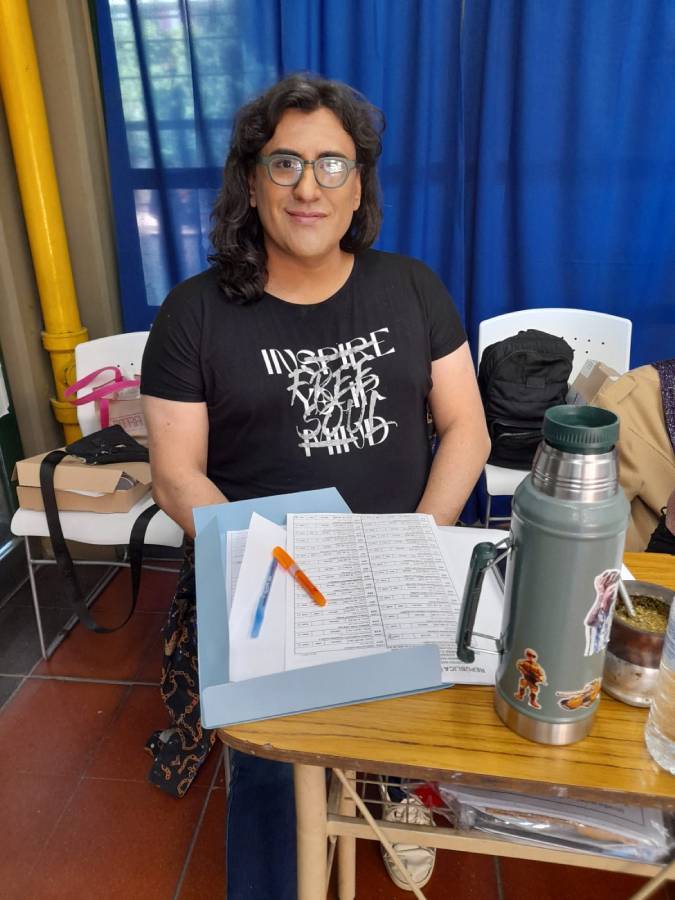
BUENOS AIRES, Argentina. The courts have ordered the reinstatement of Natasha Narmona to her job at the Ministry of Economy. She is the first trans woman to be hired at the Ministry through the Transgender Employment Quota Law , and she was dismissed in November 2025.This favorable ruling joins others in the same vein. However, she has not yet been reinstated. Meanwhile, other transgender and transvestite individuals continue to face cumbersome legal processes.
“This is not a privilege, it is part of defending my rights and my work . It is important that the State not only enables entry, but also guarantees permanence,” Narmona shared with Presentes
The ruling was signed by Judges Gabriel de Vedia and Enrique Catani of Chamber V of the National Labor Appeals Court on August 7. In it, they overturned the lower court's decision and granted Narmona's request. Specifically, they ordered "the provisional reinstatement of Ms. Natasha Narmona to her position under the same conditions as before (...) within five days of notification of this ruling.".
For the trans woman who was fired, it's "a collective victory." However, she also shared that the deadline set by the Judiciary for her reinstatement has passed and there has been no response from the Ministry of Economy.
“Last Friday we sent a telegram denouncing this breach and demanding compliance within 24 hours. But that time has also passed, and the ministry not only hasn't complied, but hasn't even explained why. This is very serious,” he added.
The collective struggle and the particular urgency
The case has collective significance: it involves the non-compliance with a law (No. 27,636) and a court order by a national government agency. In this regard, the case has the support of an amicus curiae brief, a submission through which organizations and individuals with experience in a particular issue can provide the court with arguments and a rights-based perspective. The amicus brief includes the organizations ATTTA, ATE, Mocha Celis, the Argentine Trans and Travesti Movement , and prominent figures from the community such as Pía Ceballos, Sher Lescano, and Alba Rueda.
Since being laid off almost a year ago, Natasha's living conditions have drastically worsened. “My salary was the minimum wage. While it wasn't enough—it was 400,000 pesos—it helped me sustain myself somewhat. From being able to have a meal on my own, now I depend on a soup kitchen here in Munro (Buenos Aires province). My mother and I eat there. I care for my mother, who receives the minimum pension.”
It also impacted her health. “I’m in psychotherapy, and when I was fired, I lost my health insurance. Today, public healthcare is in a serious state, and this revictimizes me. At the time of my dismissal, I also had a fibula fracture. I only had surgery on July 29th.”.
Natasha began working at the Ministry of Economy in October 2021 under the framework of the Law for the Promotion of Access to Formal Employment for Transvestite, Transsexual and Transgender People “Diana Sacayán – Lohana Berkins” (No. 27,636). The legislation enacted in 2021 establishes a minimum job quota of 1% for transvestite, transsexual and transgender people in the national public administration.

Against the law
Both her dismissal and others in the public sector occurred in a context of discrimination. “ She was dismissed while under union protection, she was on medical leave, and she had also been hired through the trans employment quota. Being dismissed in that context becomes discriminatory both because of her union activity and because of her gender. In addition, she was on medical leave,” Narmona’s lawyer, Eliana Bagnera, a member of the legal team of the State Workers Association (ATE) Capital, explained to Presentes
According to the latest available records (January 2025), of the 150 trans, gender-diverse, and non-binary (TTNB) workers dismissed during the first year of Javier Milei's administration, 50 were reinstated. Thirty-three were reinstated through union channels, seven through injunctions, three through administrative channels, and no information is available for the remaining seven.
The strategy being pursued nationally by ATE is to use the courts to reverse discriminatory dismissals. “We filed 21 legal actions in this regard. Seventeen were injunctions and three were lawsuits. We obtained several favorable rulings with very strong arguments. It is clearly stated that work is the gateway to basic rights that are systematically and structurally violated for the LGBTQ+ community,” Clarisa Gambera, Secretary of Gender and Diversity for ATE Nacional , told Presentes .
“We prioritized defending the jobs of transgender people in the state,” Gambera added. “It’s about defending a law that came about after a hard-fought battle and that begins a process of reparation.”
The national ATE union has submitted several requests for information to government agencies to ascertain the status of compliance with the TTNB Employment Quota Law. So far, they have not received a response.
Justice for the workers
So far, the Judiciary has also ruled in favor of the reinstatement of TTNB workers to their positions in the National Social Security Administration (ANSES), the National Institute of Cinema and Audiovisual Arts (INCAA) and the Ministry of Human Capital.
In mid-2024, the National Labor Appeals Court and Federal Administrative Court No. 11, in separate rulings, ordered the reinstatement of two transgender workers who had been dismissed. The ruling issued by Appeals Court Judges Enrique Catani and María Cecilia Hockl ordered the immediate reinstatement of one worker to their position at ANSES (National Social Security Administration). Meanwhile, Federal Administrative Court No. 11 ordered the reinstatement of another worker dismissed from the Education Secretariat of the Ministry of Human Capital.
Last year, the Federal Administrative Court No. 5 ordered the reinstatement of five transgender workers to their positions at the INCAA (National Institute of Cinema and Audiovisual Arts). Furthermore, this year the same court ordered the reinstatement of a transgender worker at the Ministry of Human Capital. The ruling determined that her dismissal was unjustified and violated the obligation to respect the 1% employment quota for transgender and transvestite individuals.
“For the moment, those who received favorable rulings have been reinstated, with the exception of Natasha, whose case is more recent. However, in all situations, the State is reluctant to comply,” explained lawyer Bagnera.
Non-compliance with the law in Chaco
Meanwhile, many people are still involved in legal proceedings to resolve their situations. Julieta Gómez joined the National Registry of Persons (Renaper) in 2022 and was dismissed on December 31, 2025. To date, she has not received any favorable rulings. On April 10, the Federal Court of Appeals in Resistencia, composed of Judges Enrique Bosch, Rocío Alcalá, and Patricia García, confirmed that the courts will not intervene to order her reinstatement.

“When we are fired from a job that we worked hard to get through this law, what happens is that we are forced to have only one choice, which is sex work. Our range of possibilities is taken away. We are never hired. Not for lack of skills or resources, but for being trans women,” Gómez explained to Presentes.
And she demanded: “We want the immediate reinstatement of all the female colleagues dismissed under this right-wing government.”.
We are present
We are committed to journalism that delves into the territories and conducts thorough investigations, combined with new technologies and narrative formats. We want the protagonists, their stories, and their struggles to be present.
SUPPORT US

FOLLOW US
Related notes

We are present
This and other stories are not usually on the media agenda. Together we can bring them to light.
1 Comment