

Queer art and memory: the urgent connection between past and present
The works of Carlos Herrera and Ulises Mazzucca recover the perspectives and histories of dissident lives. A rare discourse in the visual arts.


Share

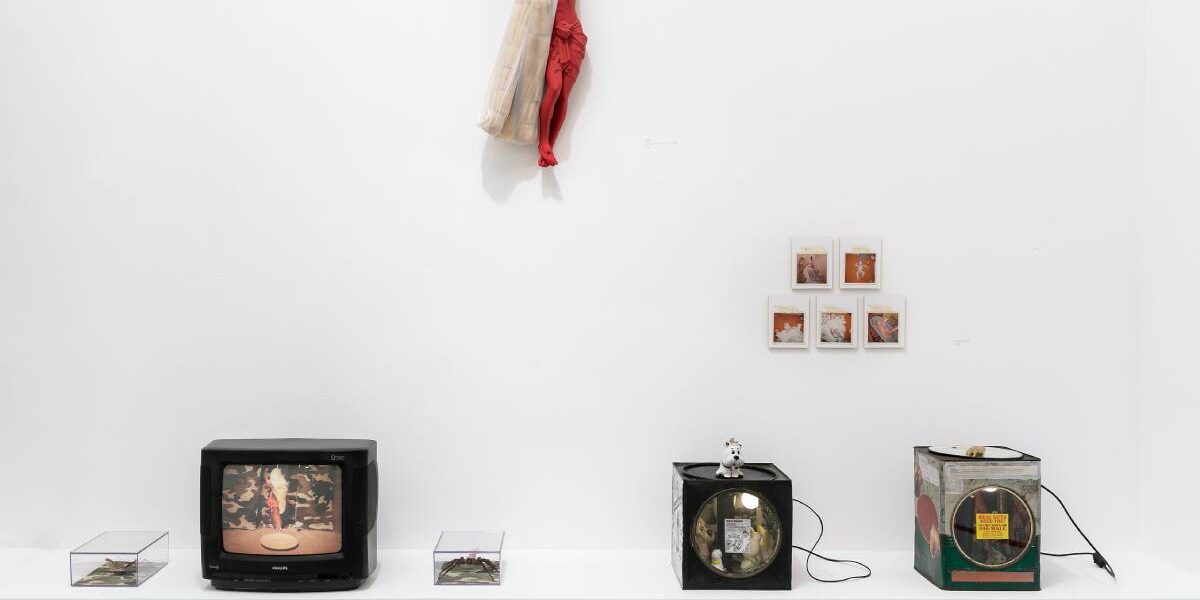
BUENOS AIRES, Argentina. Artists Carlos Herrera and Ulises Mazzucca fill the Ruth Benzacar (Villa Crespo) with activism, biography, outcry, sensitivity, and queerness. Herrera presents a retrospective of his works from 1996 to 2006, ranging from rural horror to religious homoeroticism, all permeated by the viral specter of HIV and AIDS. Mazzucca offers a dance of wooden sculptures that escape their easels, proposing a sensory journey of wounds, fluidity, and unsuffering pride.
Until May 2nd, both exhibitions can be visited free of charge.
A rural VIHography
An art exhibition addressing the urgency of HIV and AIDS, the terror lurking in the countryside that threatens to break down barriers, and the queer response as a vehicle for questioning. INSIDE OUTSIDE by Carlos 'Charly' Herrera brings together a selection of works the artist created between 1996 and 2006, confronting us with a worrying relevance and the poetic vigor of an artist who sustains both rage and tenderness across the decades.
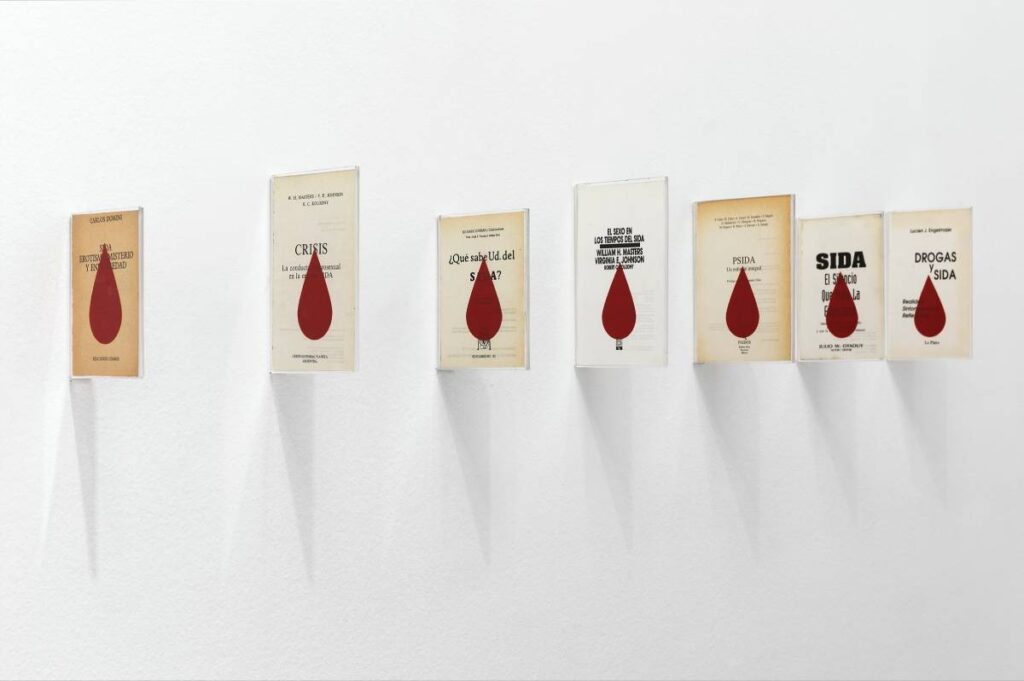
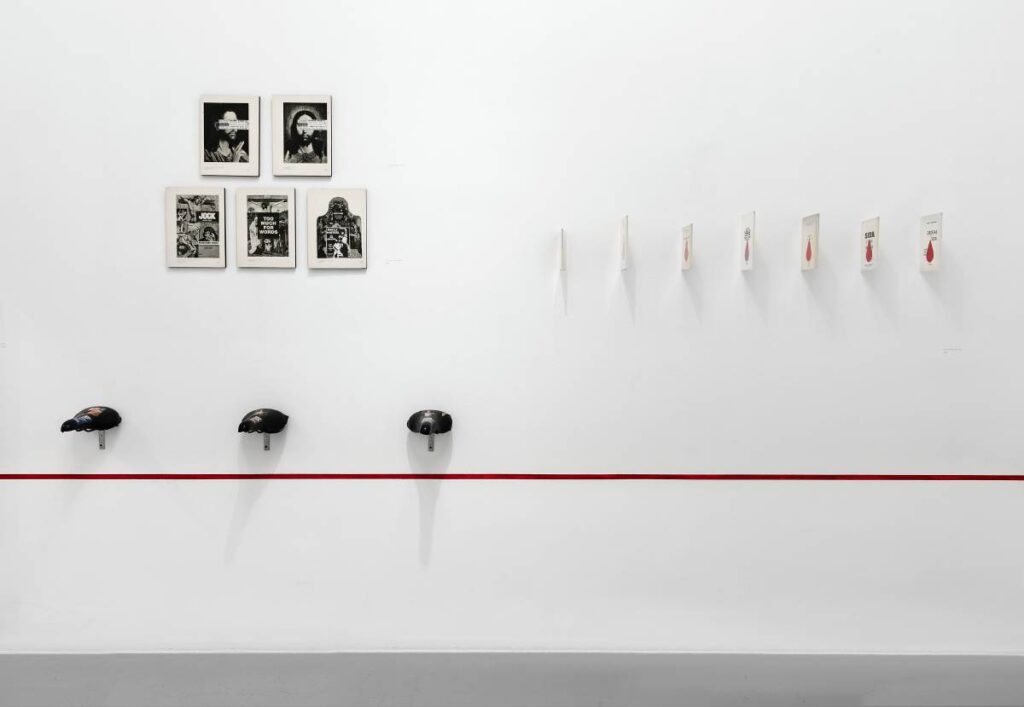
“It was a fear impossible to understand because it was something you couldn't talk about, and there wasn't much information available,” Charly explains to Agencia Presentes. In the mid-90s, his sexual awakening exposed him to that “pink plague” that was widely condemned but about which little was known. “A university professor guided me through these readings, and those are the books that appear in several of the works in this exhibition,” he explains. These books, read today, reflect more guilt than facts. Now they reside in traps for wild animals, also stained with that iconic red; now their metallic mechanisms ensnare time and its prejudices.
The "inside and outside" of the exhibition's title relates to the artist's sense of community and how his own questions resonate and reflect the collective. The process of "revisiting" all the material to select what he included in the exhibition led him to a reflection: "This work provoked a lot of concern, research, and a desire for it to end. What I saw in the past was appalling. Everything that had happened in the previous decade (the 80s) was terrible , and thinking of that as an image of the future was terrifying."
Democracy and what phallocentric art owes
Bruno Mendonça is a Brazilian artist, writer, researcher, and the curator of the exhibition. “After the right-wing backlash in recent years, we realized that some things that activism itself considered resolved weren't,” he says, and he agrees with Charly. The terror of the images combined with the desire produced by “INSIDE OUTSIDE” remains relevant. Although the artists celebrate the advances, medication, and current HIV-positive status, the presence of politicians like Milei, Trump, or, a few years ago, Bolsonaro, is reminiscent of the climate during the Ronald Reagan and Thatcher era.
The HIV/AIDS pandemic emerged in the 1980s, coinciding with the restoration of democracy in several Latin American countries. “In a way, art at that time was generally dominated by male, heterosexual, house painters. So, there weren't many observations about the AIDS pandemic,” Charly explains. It was a time to talk about the restoration of democracy, about the bodies disappeared by state terrorism, and “the artists who demanded visibility regarding AIDS weren't given much attention.”
Herrera recalls and emphasizes the importance of the Rojas Cultural Center, a hub of artistic counterculture in Buenos Aires, and reflects, “I feel that something was lost, and many artists in the provinces were not recognized by the art network that controls our Federal Capital.” That democratic spring, also in art, prioritized male artists who believed that politics could only be serious and solemn (and heteronormative and Buenos Aires-centric).
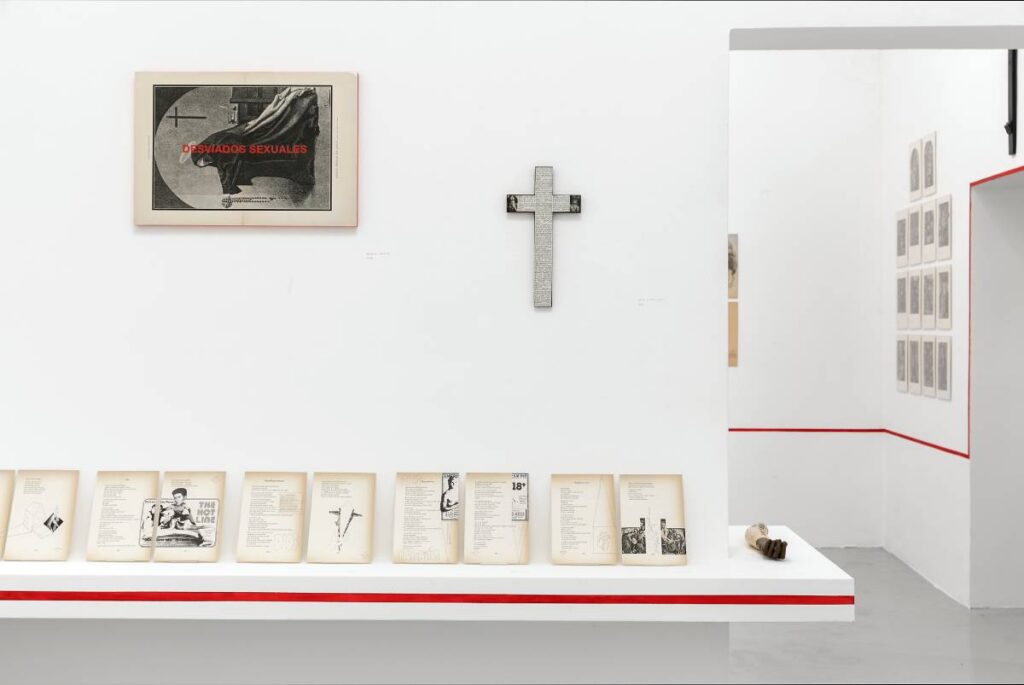
“I feel that showing these works somewhat addresses that era when these themes weren't very receptive to institutions,” says Charly. As he speaks, a red line envelops him and the entire exhibition. It's a line whose beginning and end are indistinguishable, infinite and self-contained. This piece pays homage to the installation by the Group Material collective , which consisted of another red line but depicted the entire history of HIV and AIDS in 1989. Now Charly looks at his creation again and speaks in the present tense: “These works have rage, a violent energy.”
Like a Jesus to a Child
In the late 1990s, George Michael, the towering figure of British pop, was arrested by a police officer in Beverly Hills for alleged "lewd acts." Thus, the world learned (or confirmed) that Michael was gay. Part of Herrera's exhibition celebrates George Michael. "George's coming out helped me reflect on and understand myself. This was the most difficult thing within my family in the countryside. It was the possibility of being different," he says, while on the wall one of the pieces is a songbook with the singer's lyrics in Spanish.
The songbook is filled with saints with enormous penises embedded in them, virgins with the word "AIDS" superimposed on them, and even a urinal with an image of Jesus crucified but without a cross. "The confrontation with religion was one of my first encounters/disencounters that led me to rethink the space that had shaped me," he says. Now he speaks and constructs a memory without time to utter the following phrase: "As if that Jesus had somehow been the first homosexual stimulus since childhood."
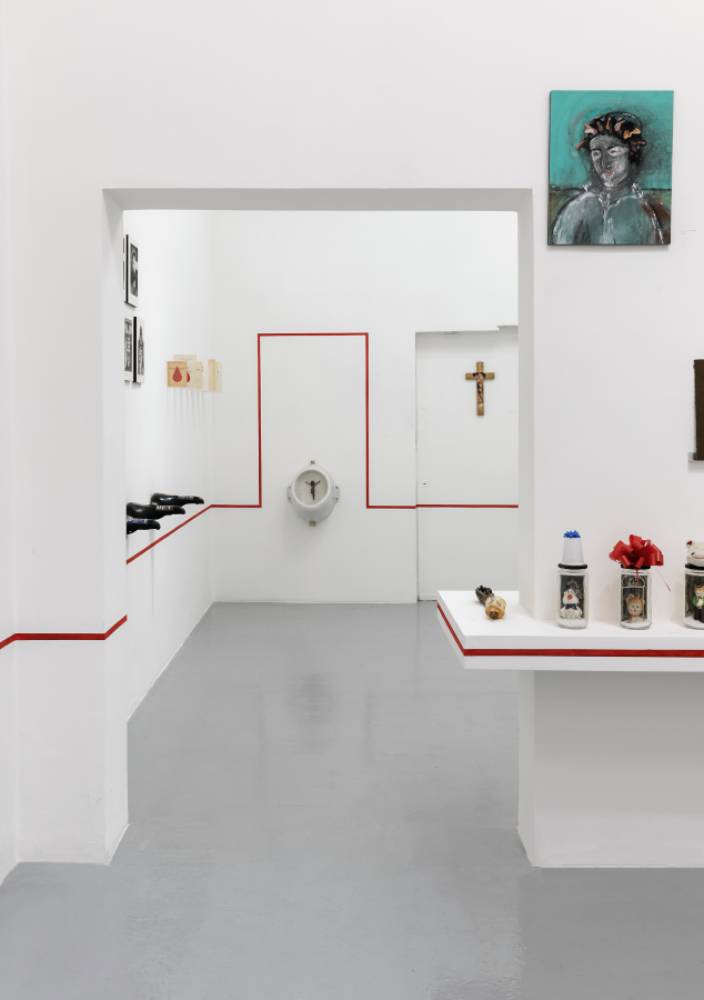
In the other room of his exhibition, Martín Fierro gets really intense, and the wild beasts carry phalluses. Folk horror is a subgenre that uses myths, legends, and rural beliefs to instill panic. What worse fear than a gay son, what more terrifying moment than a sex test? Charly Herrera's work embodies all of this, going back to past decades to find the cries that still need to be amplified today.
Choose your own injury
If INSIDE OUTSIDE screams, the section of the exhibition titled “Anniversary of All My Faults,” curated by artist Ulises Mazzucca, invites introspection and sensory awareness. Since his first solo exhibition in 2021 at the Museum of Modern Art of Buenos Aires, Ulises has been exploring how to bring his drawings into the physical body.
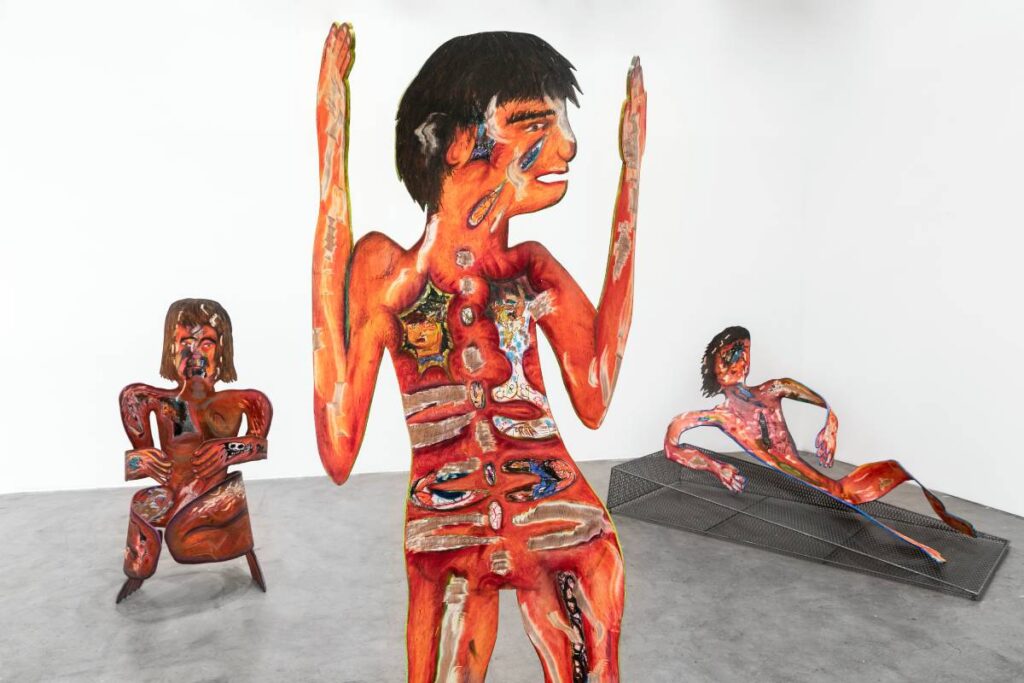
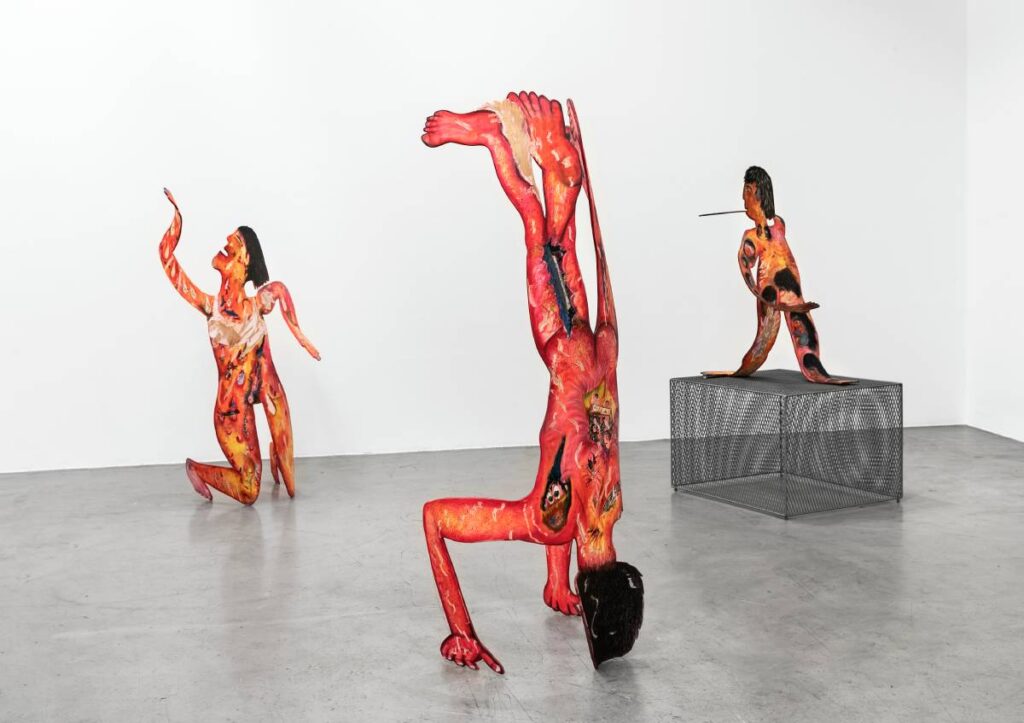
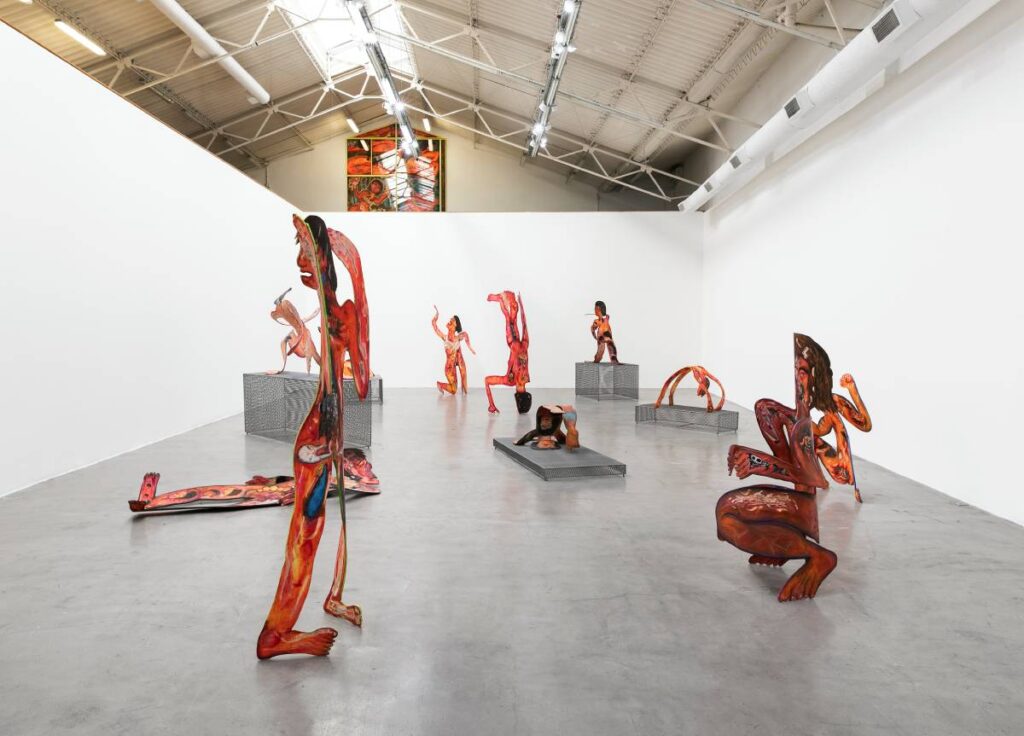
In the first room, a drawn body defies all articulation. It doesn't writhe; it seems to rebel, setting in motion all the tiny skulls that devour it. This is the prelude to a space where three-dimensionality dances and fills with color: blood red, pus yellow, multicolored skin, wounds like portals.
His characters expose all their inner turmoil. “There’s something about returning to pain that I find important. I work a lot with wounds,” Ulises explains. His creations have a certain resemblance to Berni’s Juanito Laguna figures, but set in a kitsch apocalypse. They don’t convey anguish despite disintegrating. “There’s something about suffering that offers a kind of learning experience,” Ulises says.
Faces form bodies. Wood exposed as mutant flesh. The queer feast of their existences is expressed in the subversion of the norms of humanity. “These bodies have more to do with a certain exclusion, and that's why I also stand working as a faggot.”
Who is art for?
In everything the artists say, there's a search to connect with the world and the urgency that exists outside the gallery. They didn't come to shut themselves away, but to expand. At the opening and during the free visits, friends, exhibitions, all the identities that are part of, and even escape from, the acronyms come to explore the space. HIV and AIDS are presented not as a conquest, but as an offense and an urgent matter. Sensitivity and pain dance, inviting us to vent. Ruth Benzacar proposes itself as a meeting place, as a starting point for that red line that has run through history since 1989 and now returns.
Above Ulises Mazzucca's dance studio hangs another work by the artist. It's a kind of sacred stained-glass window with more of those torn figures. It crowns the space and looms above the gallery offices. Instead of prayers, it bears witness to sewing machines, ribbons being cut, and the murmur of visitors. Ending up beneath this cathedral-like stained-glass window after Herrera's erect saints and Mazzucca's mutant bodies is a fitting way to conclude this mass that neither asks nor begs, but rather inspires and proposes.
The exhibitions can be visited until May 2nd in the Ruth Benzacar room of Villa Crespo, at Juan Ramirez de Velasco 1287, from Tuesday to Saturday from 2pm to 7pm.
This news article is part of a research project supported by the IAS (International AIDS Society) through Community Project Grants, as part of the preparations for the AIDS Conference 2026.
We are present
We are committed to journalism that delves into the territories and conducts thorough investigations, combined with new technologies and narrative formats. We want the protagonists, their stories, and their struggles to be present.
SUPPORT US

FOLLOW US
Related notes

We are present
This and other stories are not usually on the media agenda. Together we can bring them to light.