

Anti-fascist and anti-racist march: a wave of Pride said no to fascism
The Federal Antifascist and Antiracist March was a show of support for diversity by Argentine society and several cities around the world. But it was also a political response that marks a turning point in the history of Milei's government.


Share

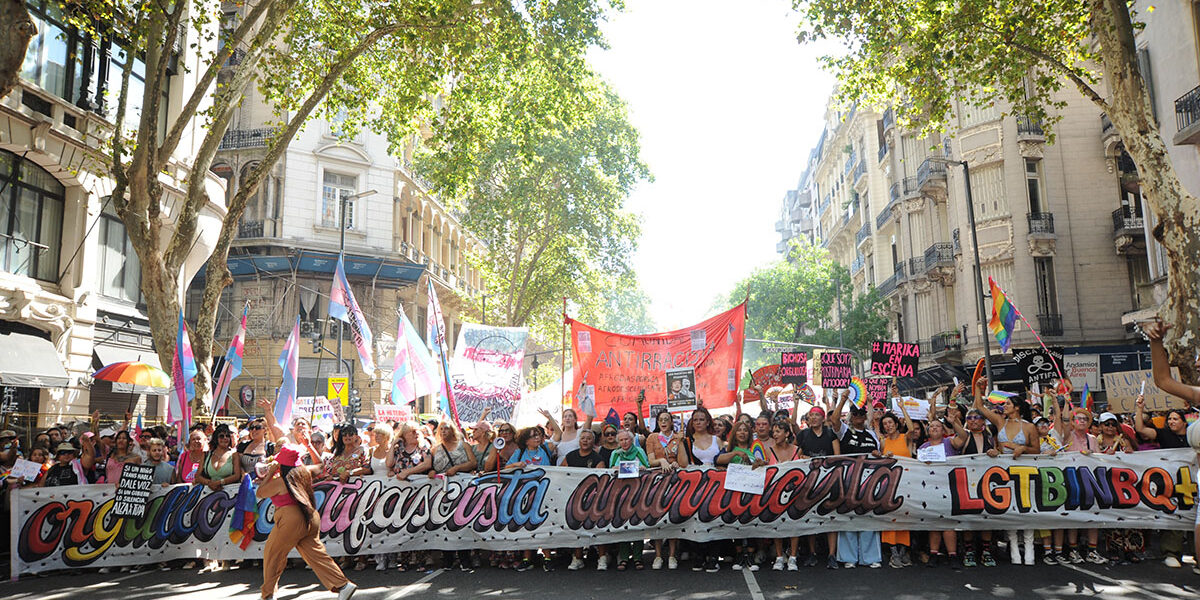
(BUENOS AIRES, Argentina)Plaza de Mayo belongs to the Argentine people. It is the place where the identity of struggle, resistance, and also the democratic construction of Argentinians who are not willing to lose their rights are forged. It is there that they return whenever necessary. As happened yesterday, Saturday, February 1st, with thousands upon thousands of people in the plazas and streets throughout the country and in several cities around the world, joining the Federal March of Antifascist and Antiracist Pride. A demonstration that was self-organized by LGBTQ+ activists, with strong support from the LGBTIQ+ . It spread and grew in just a few days, as a response to Milei's remarks at the Davos Forum, which were full of falsehoods and attacks on LGBTQ+ people and women.

It was the LGBTQ+ community and feminist movements that had been warning about this, even before Javier Milei came to power. His government could represent a setback in terms of rights, achieved after years of activism. But yesterday it also became clear that these movements, which always recognize themselves as heirs to the struggles of the Mothers and Grandmothers of Plaza de Mayo, are not alone and have a great capacity for coordination, not only with human rights organizations, but also with unions, social movements, and political parties.
Nearly 500,000 people participated in the march in the City of Buenos Aires alone, while in the rest of the country, there was an adherence of more than one and a half million people.
Society said enough to hate

"The march was massive. It's the expression of a society that will not give up on diversity and equality. Society, united, said enough to the hatred, discrimination, and violence of Javier Milei's government," said María Rachid, president of the Argentine Federation of Lesbians, Gays, Bisexuals, and Trans (FALGBT), at the close of the demonstration.
At the intersection of Hipólito Yrigoyen and Cevallos, labor unions gathered, including the contingent from the Buenos Aires Press Union (Sipreba). This week, Carla Gaudensi, general secretary of the Argentine Federation of Press Workers, participated in the meeting with the Mothers of Plaza de Mayo, where the labor federation's call for participation in the march was decided. “It was important that Taty Almeida, representing the Mothers of Plaza de Mayo, met with the CGT (as happened on March 24th of last year). That same day, one of its general secretaries announced that a mobilization would take place on February 1st. This call to action came from the women's wing of the CGT, and therefore it was a call from the entire labor federation. We must understand that we are at the forefront globally in terms of rights that improve our democracy. All this president wants to do is intimidate us and make us back down. It's a great start that society has taken to the streets en masse; we will be meeting in the streets for months to come,” Gaudensi told Tiempo y Presentes.


Defend democracy
At the head of the march were LGBT groups, trans women and trans people, mothers and fathers of trans children, but also people living with disabilities, migrants and people of color, and the workers of the Bonaparte Hospital. In other words, many of the people who are stigmatized, attacked, and despised daily by the La Libertad Avanza government were present.
The slogans encompassed all kinds of demands: "Sleeping with the people is what's wrong"; "Imagine them talking badly about us while we're doing this fabulously defending our rights"; "Never again to fascism. Enough with the chainsaw: no to hate speech"; "Tired but never defeated"; "For dignified retirements and pensions"; "Argentina will never be fascist"; "Faggots yes, faggot Nazis no"; "My pleasure doesn't kill, your fascism does.".
"We marched the march of our lives. The government's fascism will not prevail. The Argentine people joined us throughout the country in our commitment to equality, diversity, and freedom," said Ricardo Vallarino, president of 100% Diversity and Rights, part of the Pride and Struggle Front, at the end of the march.

A hug from everyone to everyone


Juana, a non-binary trans woman, marched alongside other young trans people from El Teje. She was part of the human chain protecting the march along Avenida de Mayo by older trans women and survivors, grouped in the Las Históricas column (who continue to demand reparations). “It’s very important that those who led the march were the people Milei attacks and the community embraces. This support is fundamental. Fascism is fought by building networks, embracing and supporting each other. By asking the person next to you how they are and what they need. But it’s important to understand that Milei’s discourse goes far beyond hate. It’s tied to an economic plan,” says Juana.
There were no trans children at this march. "Their families are there, but not the children themselves. We can talk about them, about how they should be able to play and imagine a future, without putting them at risk. Their families are there. They're not a trophy," Juana says.

Facundo, Eric, Katy, and Sofi are blind and participated in the Antifascist and Antiracist March. "It's one of the most important marches we've had to participate in in recent years. We can't allow any government to trample on the rights we've won with the sweat and blood of so many people who came before us," Eric said.
"There are certain agreements that were reached since 1983, when we regained democracy, and we cannot allow any backsliding. The president is talking about 'leftist sons of bitches, they're going to run.' We cannot allow things to be settled in those terms. Anyone who thinks differently, whether they're left-wing, right-wing, or whatever, must be respected," Facundo said.
“Many people voted for this government genuinely believing there would be change, but the change is going backward. We're seeing the results: retirees are becoming increasingly impoverished, there are fewer jobs, far more layoffs, and nothing has changed,” said Katy. “This defense is about future generations. The fact that society is joining in to help shows that we need to continue moving forward with this cultural shift. Our rights and the rights of our children shouldn't be violated by a government's decision,” she added.
“Anti-Fascist Migrant March,” read the sign René carried. Born in El Salvador, he has lived in Buenos Aires for eight years, where he came to study Literature. “I’m marching against the fascist advance and against the hate speech that is being replicated not only in Argentina but throughout Latin America. We have, among others, the case of El Salvador,” he explained. “Minority populations, like migrants, are being made scapegoats.”.


Brian is 25 years old. He's a barber and came from Florencio Varela with a huge sign that reads: "Together against hate."
"I came because I'm worried about the setback represented by President Milei's hate speech. Days after his speech, a man set fire to the house of two lesbians," Brian said.
Many of the people who marched yesterday mentioned the lesbophobic attack perpetrated against a lesbian family in Cañuelas, whose house was completely destroyed by fire, as the most explicit and obvious example of how expressions of hatred, lies, and contempt for sexual diversity enable real violence with complex impacts.


Carmen de Jesús, a 71-year-old woman, sat in Plaza de los Dos Congresos holding a sign that read: “I’m retired (on the minimum pension), a feminist, and a staunch leftist. Any problem with that, Milei?” She came from Moreno, where she lives. The round trip takes her five hours. “Coming here today is very important for many reasons. One, because we can’t allow them to keep taking away our rights. Those of us who have been activists for a long time, since the 70s, knew this was going to happen, but it’s even worse than we imagined,” Carmen told Presentes. However, she has hope: “We’ve been through some very bad things, but we pulled through. We’re going to pull through now too. This will go down in history. This should make us reflect a lot.”
"Make Argentina Gay Again," read the bubblegum pink hat atop the blonde mane and Donald Trump tan of drag king Señoroza. "We're scared, but we're still going out. It's important to protect the younger ones," commented Maruja, adding that it was the first time the march had included a drag contingent.
🇦🇷 ❤️🧡💛 “Make Argentina Gay Again”, Antifascist and Antiracist Pride March in the streets of Buenos Aires pic.twitter.com/Ff2HNFQio2
— @presenteslatam.bsky.social (@PresentesLatam) February 2, 2025
"An anti-fascist and anti-racist country"
Unexpectedly for the government, Javier Milei's speech backfired. The response from an organized populace was immediate and decisive. Faced with disinformation and hatred, the response was political, spearheaded by the scapegoats of a failing economic plan.


In the early evening, the march proceeded along Avenida de Mayo to the Plaza, displaying both unity of spirit and the diversity of its participants at every step. The chant "Wherever you go, we will find you" echoed throughout the march, a way of remembering the struggles that gave birth to us.
Also present were the Mothers of Plaza de Mayo and Mothers Founding Line, along with other organizations such as Grandmothers of Plaza de Mayo, HIJXS, Relatives of the Detained and Disappeared, and Nietes.
At times, the music filled the air, and people danced as if it were a Pride March. From the truck, Susy Shock reminded everyone that the Mothers and Grandmothers of Plaza de Mayo were the example to follow, and upon arriving at Plaza de Mayo, she rallied the crowd: "All struggles have converged in this march. We are going to build an anti-fascist and anti-racist country from top to bottom.".

Applause for Lali and María Becerra

Lali Espósito and María Becerra were the most celebrated artists by the crowd marching towards Plaza de Mayo. Pedro Rosemblat was also among them. The song "Fanático" was one of the most played during the demonstration.

Representatives from a large part of the political spectrum
Among the political figures present were the Governor of the Province of Buenos Aires, Axel Kicillof, and Magdalena Sierra, the Buenos Aires Chief of Staff. "Under Milei's economic and ideological program, not only are the lives of the LGBTIQ+ community at risk, but the lives of all Argentinians," Sierra stated.
Also in attendance were the Buenos Aires Minister of Government, Carlos Bianco, and the former Minister of Social Development, Victoria Tolosa Paz. The Mayor of Avellaneda, Jorge Ferraresi, was also present. "We will take to the streets as many times as necessary to prevent our freedom and rights from being curtailed," he shared.
Representatives of Patria Grande also participated in the federal march. Among them were Juan Grabois, Representatives Natalia Zaracho and Itai Hagman, Senator Federico Fagioli, Representative Victoria Freire, Fernanda Miño, and Mariana González.
Among those participating in the La Cámpora march in Buenos Aires were Máximo Kirchner, Mariano Recalde, Lucía Cámpora, Mayra Mendoza, Paula Penacca, and Wado de Pedro, among others. Mónica Macha, from Nuevo Encuentro, was also part of the massive demonstration. Members of parliament from the Left Front included Myriam Bregman, Nicolás del Caño, and Christian Castillo. "We are thousands in the streets rejecting discrimination as state policy!" Bregman posted on social media.
From New York to Montevideo
The call to action resonated in over 100 locations across Argentina, according to the Antifascist and Antiracist Assembly. Its impact extended beyond Argentina, with Argentine and LGBTQ+ pride flags waving alongside signs protesting Javier Milei's remarks in various languages at at least 20 locations worldwide. Most of the gatherings took place in front of Argentine embassies.
European cities that saw demonstrations and rallies in support of Argentine rights included Amsterdam, Berlin, Geneva, Lisbon, London, Paris, Piacenza, Modena, Rome, Granada, and Madrid.
In Latin America, protests erupted in Mexico City, Cologne, Florianópolis, Rio de Janeiro, São Paulo, and Santiago, Chile. A similar demonstration occurred in New York City.
This article is part of a collaborative coverage between Agencia Presentes and the newspaper Tiempo Argentino. It is published simultaneously in both media outlets.
Coverage: Maby Sosa, Agustina Ramos, Lucas Gutiérrez, María Eugenia Ludueña, Aldana Somoza, Clara Pardi, Martina Delgado, Noelia Torres and Emiliana Delgado.
We are present
We are committed to journalism that delves into the territories and conducts thorough investigations, combined with new technologies and narrative formats. We want the protagonists, their stories, and their struggles to be present.
SUPPORT US

FOLLOW US
Related notes
We are present
This and other stories are not usually on the media agenda. Together we can bring them to light.
1 comment