

Mexico: 87 LGBTI+ people murdered in 2022 according to a Letra S report
The data was published on the International Day Against LGBT-Hate. According to the report, the rate of crimes against trans women is more than double the rate of femicides.



Share

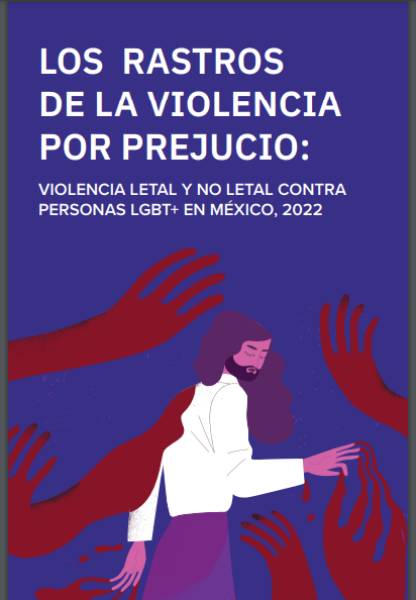
MEXICO CITY, Mexico. In 2022, 87 LGBTI+ people were murdered in Mexico, and more than half of the victims were trans women. Compared to the previous year, there was an 11.5% increase, according to the latest report, "The Traces of Bias-Motivated Violence: Lethal and Non-Lethal Violence in Mexico, 2022," prepared by the organization LetraS.
Letra S is a organization that has been documenting the violent deaths of LGBTI+ people in the country since 1997. Every May 17, the International Day Against Homophobia, Transphobia and Biphobia, its members present an annual report with the results of their research, which is dedicated to documenting and analyzing this violence.
This report is based primarily on monitoring press releases. During 2022, they analyzed more than 300 reports that covered the violent deaths of LGBTI+ people in Mexico.
With that limitation, the organization warns in its report that “the actual figure would be closer to 200 homicide victims during that year, according to a calculation based on a study.” The study compared those press reports with official homicide figures for the general population during that same period.
As of April 30, 2023, Letra S has recorded at least 19 murders against LGBTI+ people in the country.
Trans women, the most numerous victims
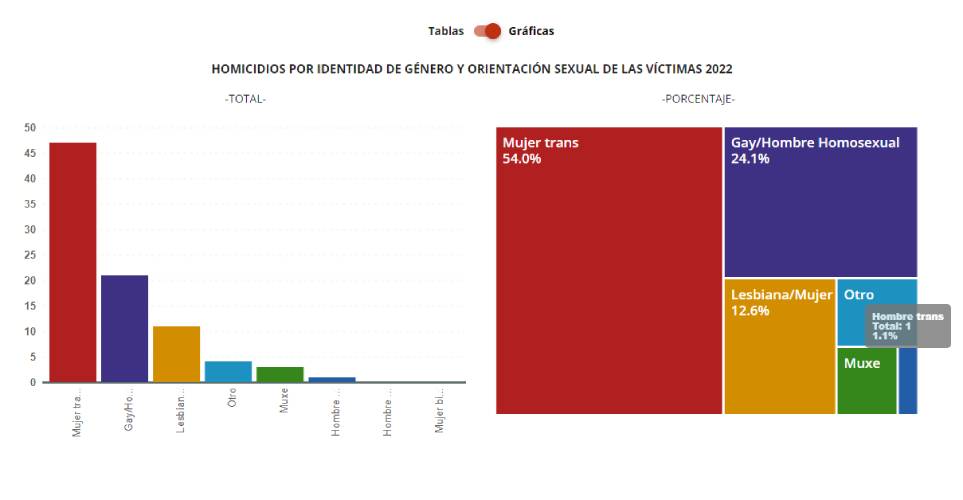
Once again, transgender women were the most numerous victims; 48 of them were murdered. This figure represents 55.2% of all hate crimes in 2022.
“According to these figures, the homicide rate for trans women is more than double the homicide rate for cisgender women in Mexico,” the report states.
Samuel Martínez, coordinator of the research area at Letra S, explained to Presentes, “The production of this index is fundamental to understanding the gravity of such a serious phenomenon in a patriarchal context reinforced by prejudice, where transfemicides must be considered gender-based violence. And they should also be understood within the spectrum of femicidal violence.”
She added that, “in that sense, the rate allowed us to demonstrate the double vulnerability that some women have. This does not mean that they suffer more violence or that femicides should be minimized. Rather, the intersection between these women's gender identity and the representation of sexual diversity that is materialized in their bodies places them in positions of much greater risk.”
On the other hand, a total of 22 murders of gay men were recorded, representing 25.3% of the total, and 11 cases of lesbofemicide, representing 12.6%. The violent deaths of a trans man and a muxe person were also reported.
Those who engaged in sex work and those employed by sex workers were the most frequent victims, with seven each. Six human rights defenders, three journalists, and one person living with HIV were also identified as victims.
“These crimes are gender-based violence rooted in prejudice.”
This year, for the first time, the Letra S report refers to these acts of violence as hate crimes . It's a category the organization seeks to promote in order to highlight that "hate is based on collective prejudices. Hate is social, it has a cultural basis, and this cultural basis legitimizes these types of attacks," Samuel Martínez told Presentes
“With this report, we propose understanding that these crimes are gender-based violence rooted in prejudice. Individual hatred does not explain hate crimes. They are the product of a cultural and social construct rooted in prejudice,” the researcher added.
For this year's report, Letra S also analyzed at least 354 non-lethal hate crimes reported by the Visible platform of the Amicus organization.
Of which 50.6% were verbal assaults; 20.3% physical assaults; 19.8% psychological assaults; 6.5% sexual assaults; and 2.8% correspond to unjustified arrests.
The forms of violence
“One of the trends we identified this year is the increase in victims reported missing before being found dead. In 2021, we identified two such cases; however, in 2022, this number rose to 12. This leads us to consider the possibility that this figure will increase in 2023,” the report states.
At Presentes, we have reported how the crime of disappearance is sometimes the precursor to transphobic and lesbophobic violence. This happened with Ximena Madrid Flores and the young woman Odilia Castillo.
Furthermore, in 27 cases, “it was determined that the victims were subjected to multiple forms of violence, including beatings, sexual violence, and evidence of torture. The bodies were also subjected to cruel treatment after death: decapitated, burned, and run over by moving cars,” the report states.
The states where the most hate crimes were recorded in 2022 were Oaxaca, Veracruz, Chihuahua and the State of Mexico.
More than a third of the crimes were committed with a firearm
According to the report, the murder weapon was identified in 65 of the 87 documented cases. Firearms were used by the perpetrators in 33 cases, representing 37.9%. Bladed or edged weapons were the second most common weapon, used in 17 cases, or 19.5%.
Firearms were most frequently used to attack lesbian and trans women. They were used in 7 of the 11 recorded lesbian femicides, and in 18 of the 48 documented trans femicides.
In contrast, regarding hate crimes against gay men, the predominant weapon used by the aggressors was a bladed weapon in 8 of the 22 recorded cases.
Initiatives that fill the State's void in registering violence
For Samuel Martínez, the main issue that the Mexican State has with regard to hate crimes is not addressing the recommendations of the Inter-American Commission on Human Rights (IACHR) for the construction of official information systems differentiated by sexual orientation and gender identity for LGBTI+ victims.
“We would expect that the task of officially documenting, registering, and analyzing this information is the duty and work of the State, but not as a way to replace or relieve the work, but to try to fill that gap, since civil society initiatives arise,” he says.
“With this report, we were able to demonstrate that these information systems, both Visible by Amicus and Letra S, complement each other. They allow us to produce a much more accurate picture of the severity of this phenomenon. That is why partnerships and the development of new information mechanisms that can be replicated locally are fundamental. And that will allow us to build a national system,” he emphasized.
Pending: investigate hate-motivated violence and prevent these crimes
Despite the existence of the National Protocol for Action for Personnel of the Justice Administration in cases involving Sexual Orientation or Gender Identity and others at the local level, Martínez denounces that these are not implemented.
In that sense, Samuel Martínez believes that “to achieve a much higher level of access to justice,” the Mexican State must investigate according to the gender identity and sexual orientation of the victims, apply the protocols that already exist and generate new ones according to the needs of the LGBTI+ population in the country.
“The Mexican state still needs to promote violence prevention and eradicate it in its less lethal forms, such as assaults, harassment, and arbitrary arrests; these are the root causes of lethal violence. The state must guarantee prevention and address this problem from its earliest stages,” the researcher concluded.
We are present
We are committed to journalism that delves into the territories and conducts thorough investigations, combined with new technologies and narrative formats. We want the protagonists, their stories, and their struggles to be present.
SUPPORT US

FOLLOW US
Related notes


We are present
This and other stories are not usually on the media agenda. Together we can bring them to light.