

The prosecution is seeking a conviction for transvesticide in the trial for the murder of Alejandra Salazar Villa
The trial was scheduled for March but was postponed until August. The investigation indicates it was a gender-based hate crime.



Share

BUENOS AIRES, Argentina. The prosecutor in the trial for the murder of Alejandra Salazar Villa, a trans woman killed in her home in the Once neighborhood of Buenos Aires in December 2020, is seeking a life sentence for the accused man. She will also consider the crime a transphobic hate crime.
Diana Goral is in charge of the General Prosecutor's Office No. 6 before the Oral Criminal and Correctional Courts. She considers the crime committed against Alejandra Salazar to be a case of "aggravated homicide motivated by hatred of gender identity." Therefore, she is seeking the maximum sentence (life imprisonment) for Rodrigo Alejandro Keilis, the perpetrator.
The first hearing of the trial was scheduled to begin on March 7. However, it was postponed because Judge Marta Aurora Yungano, of the Oral Criminal Court (TOC) 26 of the Federal Capital, retired. Yungano is the same judge who sentenced Marian Gómez to one year in prison.
The trial is finally scheduled to begin in August of this year, according to judicial sources who spoke to Presentes.

What the prosecution says
The investigation that led to the trial was carried out by the National Criminal and Correctional Prosecutor's Office No. 35. Its head, Prosecutor Ignacio Mahiques, together with Mariela Labozzetta, in charge of the Specialized Prosecutor's Unit for Violence Against Women (UFEM), requested the elevation to trial of case No. 53,405/2020 in January 2021.
Both prosecutors considered that the accumulation of evidence was sufficient to accuse Rodrigo Alejandro Keilis of "aggravated homicide due to hatred of gender identity in real concurrence with simple robbery" and Pablo Isaac Getar as a "necessary participant".
While the charges against Keilis remain, those against Getar could be modified during the trial, according to sources from the Public Prosecutor's Office.
What happened to Alejandra
Alejandra Salazar Villa was a 54-year-old trans woman who had come to Argentina from Peru. She earned a living as a sex worker and lived alone in her apartment located at 2200 Corrientes Avenue, in the Once neighborhood.
On December 6, 2020, he went out to buy apples at a supermarket near his home. Once he had finished shopping, around 6:30 p.m., he was returning home when he crossed paths with Rodrigo Keilis and Pablo Getar.
Keilis was 20 years old at the time and worked unloading trucks. That day she was with her uncle, Pablo Getar, a day laborer and cardboard collector who was 40 years old at the time. Both were homeless.
The men escorted Alejandra to her house, and one of them, Keilis, went upstairs with her, presumably to have sex. Getar crossed the avenue and sat down to wait.
Once there, Keilis "placed one of the nylon bags brought from the supermarket, specifically the one containing the apples, and grabbed her tightly around the neck, causing a fracture of the hyoid bone and death by neck compression and suffocation." This is according to the indictment, signed by the prosecutors.
The man then took some of Alejandra's belongings, such as the electronic device for opening the building's door and a television. Getar was no longer outside—he had left ten minutes before Keilis left the building—so she took a taxi to the Constitución neighborhood where she met up with her uncle again.

The arguments
Both Mahiques and Labozzetta framed the case under Article 80, paragraph 4, of the Penal Code. This states: “Life imprisonment or life detention shall be imposed, and the provisions of Article 52 may be applied, on anyone who kills: For pleasure, greed, racial, religious, gender-based hatred or hatred based on sexual orientation, gender identity or its expression.”
Furthermore, they considered that the crime should be classified as a transvesticide since Alejandra's death "expresses the discrimination and violence that transvestites suffer in our society because of their dissident gender identity and the way in which they express it."
“It is neither necessary nor correct to attribute to Kelis a special quality of being 'transphobic' or 'trans-hating'. For the criminal offense under study, it is sufficient that he internalized the discriminatory prejudices that operate against trans women in society and externalized them in the way he did, brutally murdering Alejandra Salazar,” they argued.
In this regard, the prosecution focused on the concept of "bias-motivated violence." This is understood as "a concept that aims to understand violence as a social phenomenon, as opposed to violence understood as an isolated incident."
“Hate crimes constitute rationalizations or justifications of negative relationships, for example, towards expressions of non-normative sexual orientations or gender identities. Such violence requires a context and social complicity, is directed towards specific social groups, such as LGBT people, and has a symbolic impact,” they explained.
Furthermore, they pointed out that Alejandra, having died at the age of 54, "has not been able to escape the predetermined fate of most transvestite trans women who manage to overcome a life expectancy that in most cases does not exceed forty years."
A population at constant risk
In this sense, among the 335 people who changed their gender on their ID card in the last 10 years and are deceased, the average age of death was 40 years and 75% died before the age of 53.
These data demonstrate the low life expectancy that characterizes this group. They were collected for the report “Sociodemographic Characterization of People Who Corrected Their Identifying Data in Accordance with the Gender Identity Law,” published in April of this year by the Population Directorate of the National Registry of Persons (Renaper).
If a conviction for transvesticide is handed down, this would be the fourth trial with a sentence for a hate crime against gender identity in Argentina.
The background
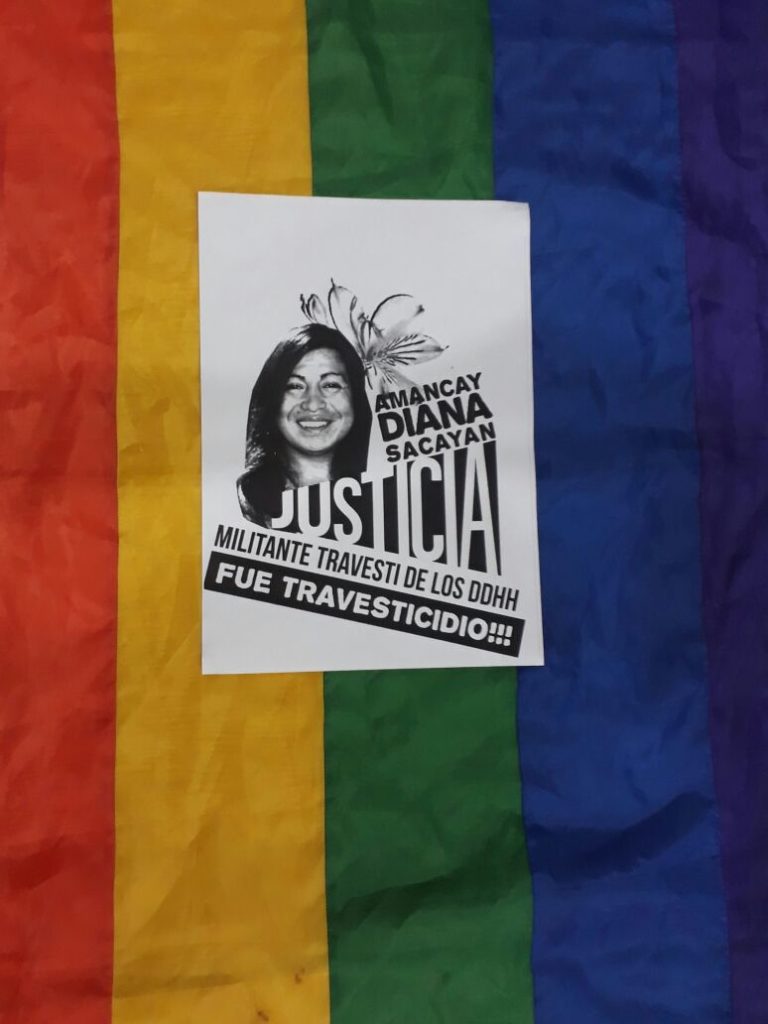
The first conviction was for the transvesticide of activist Amancay Diana Sacayán on June 18, 2018. There, the Oral Criminal and Correctional Court No. 4 of the Federal Capital sentenced Gabriel David Marino to life imprisonment.
Then came the life sentence, also for aggravated homicide motivated by hatred of gender identity (transfemicide), that Oscar Biott received in June 2019. He and Angel Azzolini were accused of murdering the young trans woman Marcela Chocobar. The judges of the Criminal Court of Río Gallegos reached the decision unanimously.
The third is recent. On March 17 of this year, the Criminal Court No. 1 of Posadas sentenced Ramón Da Silva to life imprisonment for homicide due to the relationship between the couple, hatred towards her gender and expression, and for femicide, after the murder of Evelyn Rojas.
In the prosecutor's opinion on the transfemicide of Alejandra Salazar, the prosecutors finally emphasized that the State is under the "obligation to investigate with a gender perspective and with a differentiated or intersectional approach that captures the vulnerabilities of transvestite-trans women."
We are present
We are committed to journalism that delves into the territories and conducts thorough investigations, combined with new technologies and narrative formats. We want the protagonists, their stories, and their struggles to be present.
SUPPORT US

FOLLOW US
Related notes


We are present
This and other stories are not usually on the media agenda. Together we can bring them to light.