

The profession of caregiving: A group of trans people prepares for caregiving in old age
Around 30 trans people are being trained to learn how to care for the elderly.


Share

BUENOS AIRES, Argentina. A course for caregivers of the elderly aims to provide more job opportunities for the trans community and redefine this stage of life. The training is offered by the National Directorate of Policies for Older Adults (Dinapam), the University of Tres de Febrero (UNTREF), the Red Cross , and the Federico Lacroze Community Development Association, in partnership with the Mocha Celis Trans Community High School. Its objective? To rethink aging from the perspective of sexual diversity and serve as a bridge to accessing formal employment.
Starting February 14th of this year, a group of 30 people, 80 percent of whom belong to the transvestite and trans community, will attend classes three times a week, five hours each time.
They are doing so in a space provided by the Federico Lacroze Association in the Buenos Aires neighborhood of Chacarita and are expected to complete their studies in mid- to late May.
“My expectations for the course are to learn, to gain knowledge, and to achieve a fulfilling future career. This work must be done with dedication. I hope something good comes out of it, whether it's a job or graduating and getting to know the elderly more deeply: their care, treatment, and rights,” says Luciana Micaela Méndez, a 33-year-old trans woman from Ciudadela, Buenos Aires, who is attending the training.
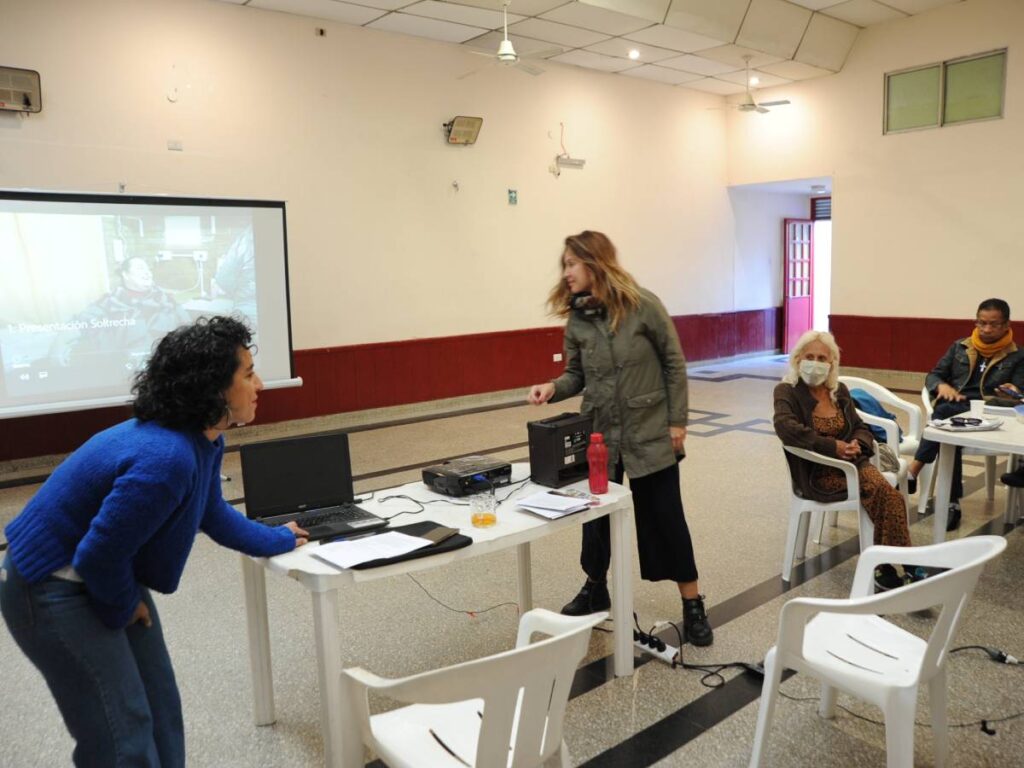
Photo: Ariel Gutraich.
Rethinking care
Mocha Celis emphasizes that this course addresses two essential areas: firstly, the issue of employment, and secondly, considering aging from a gender and diversity perspective.
“They finish the course and receive an official certificate, in addition to being registered in the National Registry of Caregivers. This implies real access to formal employment and allows them to see themselves as professionals with specific knowledge,” explains Agustina Ayub, a member of the Access to Rights team at the high school and coordinator of the care course for the elderly.
Agustina works as part of a team with Andrea García, a social worker. Regarding the topic of aging, she adds to her colleague's words that it is a "super important" subject with little visibility.
“What used to happen is that the life expectancy of the trans community was 35 years. Now it has started to increase, and with that, people are beginning to think about how they will be cared for. This possibility never existed before because with such a short life expectancy, it was difficult to think about the future. Now it's an opportunity to understand ourselves as older people and with the possibility of a good quality of life and a healthy aging process,” says Andrea.
Mónica Navarro, a member of the Ancestras , adds: “It’s important that we think about, deconstruct, and enact alternative ways of aging outside the patriarchal, heterosexist model.” She also points out that her team is working toward “this cultural shift, toward dignified and diverse aging.”
Luciana, for example, told Presentes that she wants "peace and quiet" in her old age. "I want to rest at a certain age, not be lazy, but not work. To get away from the madness of the city. To be in a small house, very peaceful, on some large property," she imagines.
The course made her reflect on the importance of supporting older adults so they can thrive. And in this regard, the work of caregivers becomes crucial. “The elderly people I speak with are very lonely. Caregivers are a great help in providing companionship and interacting with them. Their role is very important, which is why I believe it should be more valued, more recognized, or better known,” she says.
Luciana's words align with current data. Ten percent of people over 60 (approximately 743,000) are in a situation of basic dependency, meaning they cannot independently perform essential activities such as feeding, bathing, or dressing. This is illustrated by the National Survey on Quality of Life of Older Adults conducted by INDEC in 2012.
At the same time, Argentina's population is aging, so the need for care will continue to grow. By 2040, the population aged 60 and over will increase by almost 3.5 million people, while the population under 19 will remain the same, according to projections from INDEC (National Institute of Statistics and Censuses).
Photo: Ariel Gutraich.
Caring is a matter of state
In line with the need to recognize the work of caregivers, the national Executive Branch sent to Congress this week the bill known as “Care in Equality”.
This project aims to create a Comprehensive Care Policy System for Argentina (SINCA) with a gender perspective. This entails “a set of policies and services that ensure the provision, socialization, recognition, and redistribution of care work among the public sector, the private sector, families, and community organizations, and among all gender identities, so that everyone has equal access to the rights to care and be cared for.”
Furthermore, among other things, it recognizes and promotes paid care work. In this regard, it would require the National Executive Branch to create a national registry of paid care workers to facilitate the implementation of the SINCA (National System of Care Work). It would also seek to promote “training, skills certification, adequate remuneration, and the recognition of professions, tasks, and trades considered care work.”
A place of learning and meeting
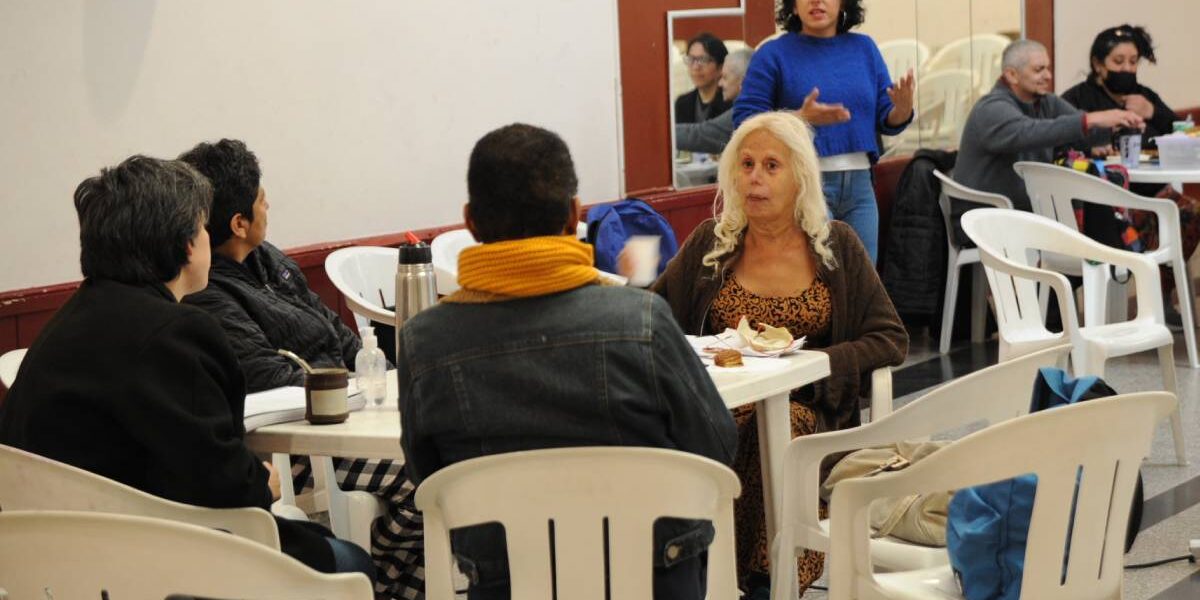
In the spacious room where the care training takes place, a whiteboard displays the message “Welcome!!!” written in marker. Students, including Tamara Mori, sit around two white plastic tables, notebook and pen in hand. She is 42 years old, Peruvian, and married an Argentinian 15 years ago, which prompted her to settle in the country. She lives in the Balvanera neighborhood of Buenos Aires and works as an event decorator, but the pandemic forced her to close her small business. For this reason, she began looking for training programs “where I can re-enter the job market.”
“I was told about this caregiver course and I said, ‘Great,’ because it’s something I enjoy. I cared for my grandmother for a long time and I gladly accepted,” she tells Presentes. She also highlights the environment in which the training takes place: “I like that it’s offered in an LGBT community space where I feel comfortable and not stared at or judged, perhaps as I might have been elsewhere.”
For her, “while the course focuses on elder care, it also helps us to see how we envision ourselves later on, in old age. Not only how we see ourselves, but how to care for ourselves, how to be prepared to face that stage of life. Fortunately, thanks to laws that have been created in favor of this group, along with the existence of places where one can go not only for advice but also to obtain health treatment, those 35 years of life expectancy have been extended for many of us. Although there are still many needs,” she says.

Photo: Ariel Gutraich
On Friday, April 27, eight people signed up to attend the class on worker cooperatives taught by Florencia Cascardo, a professor and researcher at the Center for Social Economy Studies at UNTREF. Andrea García believes that the cold weather prevented all the students, who number around 30, from attending.
For Florencia, “the creation of a collective entity, which is the cooperative, strengthens care work,” especially because “it is work that, being carried out within homes, is exposed to situations of vulnerability or exploitation.” Furthermore, she considers it an interesting work organization to explore within the framework of labor market inclusion for transvestites and trans people, given the difficulties they often face in accessing employment.
“Who handles the finances in cooperatives?” asks a student who participates actively throughout the class. The teacher quickly responds, explaining that it depends on each cooperative, but that what they all have in common is that they represent “a different way of thinking about economics, one that is centered on people and not on capital.”
The stories
The student is Freditica Murillo, and she is 53 years old, “although many people don't believe it,” she clarifies. “I am an older person, although I look very young on the outside. I carry the weight of age on the inside,” she tells Presentes. She is wearing a denim jacket, a mustard-colored scarf, and drinking from a mug with the Brazilian flag, although this doesn't match her origins since she arrived in Argentina 10 years ago from the capital of Peru.
In her first months in the South American country, she worked in supermarkets until, thanks to other trans women, she had the opportunity to work at the Estilo Diversa LGBT textile cooperative. She stayed there until, “unfortunately, it had to close during the pandemic,” she says.
“This course has been a blessing because I’m learning more, improving my skills, and enjoying it. I hope that my classmates and I will be lucky enough to have the opportunity to experience this through employment so that this learning can be put into practice,” Freditica says.
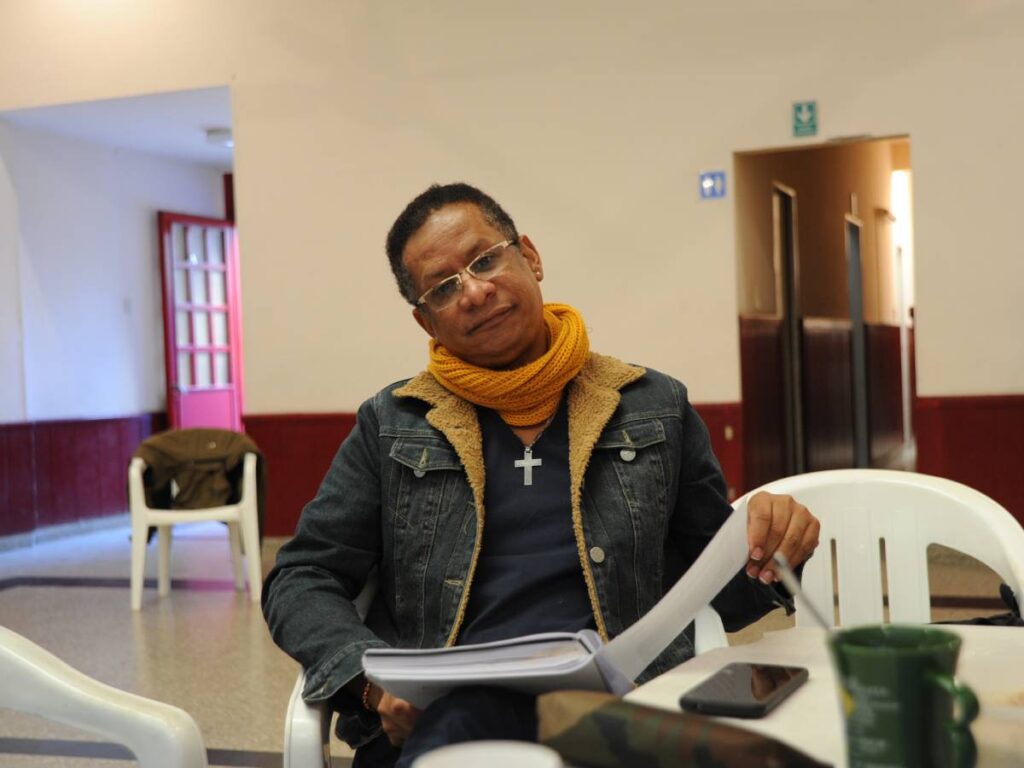
Photo: Ariel Gutraich.
Paris Donatella Del Valle echoes this sentiment, stating that this course “is a source of employment.” Paris comes from a military family and left home at 15 because her gender identity was not accepted. She also came to Argentina from Peru and has lived in the country for 13 years..
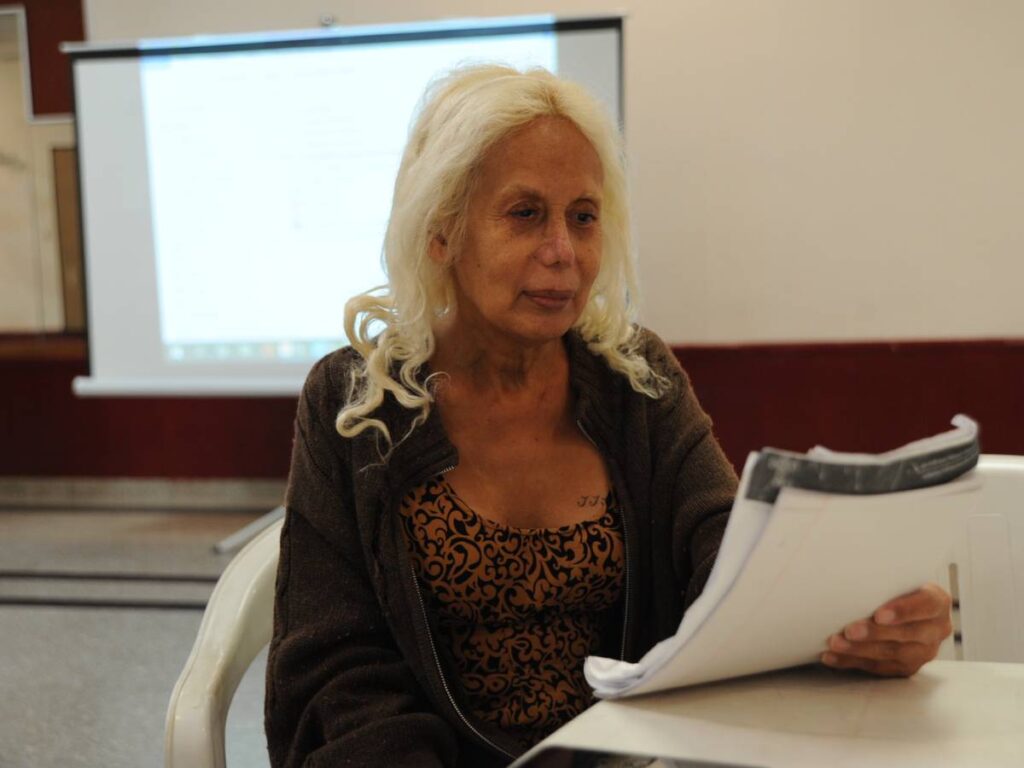
Photo: Ariel Gutraich.
She is currently unemployed. “I’m a stylist, but I couldn’t find work here. I applied, but everything was already full; they didn’t need staff. That’s why I didn’t work; I’ve put my profession aside,” she says, adding that she believes it was “difficult to find work because I’m trans.” “We’re labeled as the worst,” she maintains.
She is about to start her first year of high school at Mocha Celis High School. Afterward, she would like to study journalism and work in the entertainment section.
She came to the course to learn how to care for the elderly. “I’m very interested, it’s my first time,” she says, adding, “God willing, we’ll be able to find jobs after the course ends.”
We are present
We are committed to journalism that delves into the territories and conducts thorough investigations, combined with new technologies and narrative formats. We want the protagonists, their stories, and their struggles to be present.
SUPPORT US

FOLLOW US
Related notes


We are present
This and other stories are not usually on the media agenda. Together we can bring them to light.