

The Peruvian court ruled in favor of a gender-focused approach in schools
By Verónica Ferrari, from Lima. Photo: Esteban Marchand. The Peruvian Supreme Court declared the lawsuit filed by the group "Parents in Action" "unfounded." With this ruling, it reaffirmed that the gender perspective will remain in the school curriculum after two years of legal proceedings. In one of its sections, the Supreme Court's decision states…

Share

By Verónica Ferrari, from Lima. Photo: Esteban Marchand
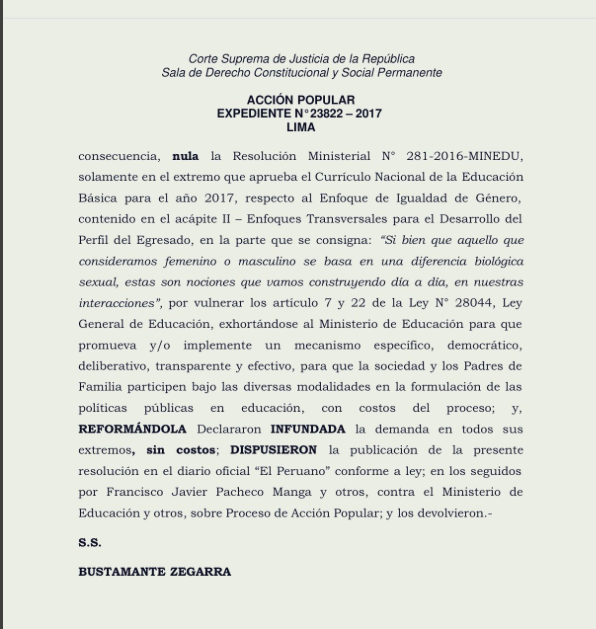
The Peruvian Supreme Court declared the lawsuit filed by the group "Parents in Action" "unfounded." This decision reaffirmed that the gender perspective remains in the school curriculum after two years of legal proceedings. In one of its sections, the Supreme Court's ruling refers to the LGBTI population and states that it must be respected: Twenty-eighth: "The matter, therefore, beyond the categories that may be formulated and the conceptual discussions that these may raise, boils down to very simple terms: if we find heterosexual, homosexual, transgender, or intersex people in our society, it is our obligation, by human, conventional, and constitutional mandate, to give them the same respect and consideration as any other human being. Consequently, the national basic education curriculum cannot be accused of being unconstitutional for instilling in our students respect for the different forms of sexual expression."
The Supreme Court has declared unfounded in its entirety the class action lawsuit filed against the #GenderApproach in the National Basic Education Curriculum. pic.twitter.com/ZKnFr5iFoT
— Peruvian Judiciary (@Poder_Judicial_) April 3, 2019
The demand
In January 2017, the conservative group "Parents in Action" filed a lawsuit against the gender equality approach in the national basic education curriculum. They argued that the mainstreaming of the gender perspective in educational policy had not been consulted with parents. This action followed demonstrations that began in late 2016 in response to the disinformation campaign "Don't Mess With My Children." The campaign sought to instill fear in the population about a supposed "gender ideology" that was allegedly being imposed on children and adolescents to force them to be homosexual or change their gender identity.
[READ ALSO: #Peru: The ideology of hate against the LGBTIQ community]
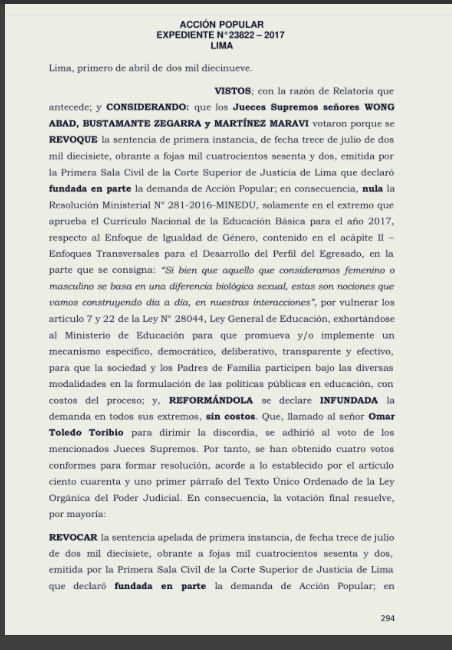
The process lasted approximately two years and three months due to the diverse votes cast by the judges, after the Superior Court of Lima partially upheld the class-action lawsuit filed by the group "Parents in Action." The court had ordered the annulment of Resolution No. 281-2016-MINEDU insofar as it approved the 2017 curriculum regarding the gender equality approach, and the removal of the following phrase from the educational policy: This phrase annulled a section of the pedagogical guide that stated: "While what we consider feminine or masculine is based on a biological sex difference, these are notions that we construct day by day, in our interactions."
[READ ALSO: “Being a lesbian in Peru means your life is in danger”]
That decision paralyzed educational instruction and the distribution of printed materials intended for gender-focused sessions in Peru's public schools. The Ministry of Education and the "Parents in Action" group appealed the decision. The latter sought to have the entire curriculum declared null and void, not just the sections related to the gender perspective, and therefore took the case to the Permanent Constitutional and Social Law Chamber of the Supreme Court. This Chamber voted three in favor of the Ministry of Education's position, two in favor of the "Parents in Action" lawsuit, and two dissenting votes. Each vote involved months of analysis by the justices appointed to decide the case. Had Justice Omar Toledo voted against the Ministry of Education, another justice would have had to be called in to break the tie. However, Toledo voted in favor of the gender perspective, and with this decision, the legal process, which had caused so much harm to Peruvian education, came to a definitive close.
Main characters: Mother in action
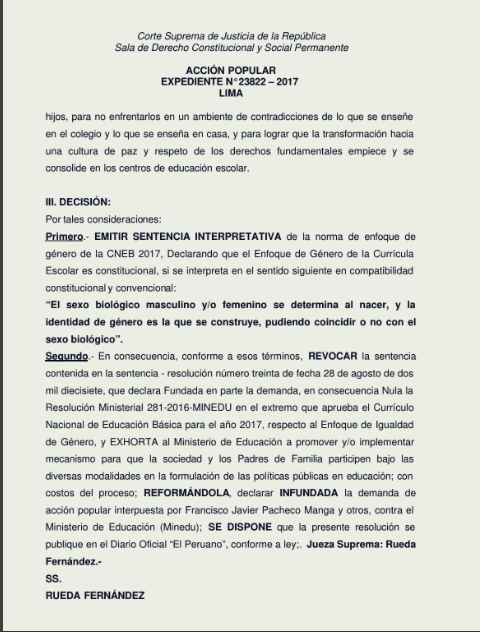
In response to this conservative onslaught against the rights of women and LGBTQ+ people, the Madres en Acción (Mothers in Action) collective was created, made up of women who had never been involved in activism before, but were deeply concerned about the violence prevalent in Peruvian society. They organized sit-ins and appeared in all the media outlets. Presentes spoke with Ayesha Dávila, one of the collective's members: "We are happy because we will finally have an education with gender equality, and it is necessary to talk about this issue to stop imposing and controlling the behavior of men and women, so they can develop freely, free from violence. Finally, this demand will no longer interfere with education, and boys and girls will be able to grow up with this new way of thinking. This demand threatened many of our rights and sought to perpetuate inequalities. It's great that the Supreme Court finally declared it unfounded. Those who voted against the gender perspective are involved in acts of corruption, which says a lot about who the anti-rights movement allies itself with." The new generations are going to be better, we couldn't be happier, this is a victory for the citizens.”
We are present
We are committed to journalism that delves into the territories and conducts thorough investigations, combined with new technologies and narrative formats. We want the protagonists, their stories, and their struggles to be present.
SUPPORT US

FOLLOW US
Related notes
We are present
This and other stories are not usually on the media agenda. Together we can bring them to light.