

Transvestite-trans memory: “Carnival was the only moment of freedom”
Photos and testimonies from the Trans Memory Archive explain why the parade was the moment that transvestites and trans people waited for all year.

Share

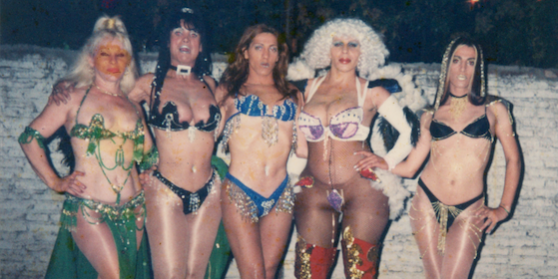
Persecuted and criminalized by police edicts, they lived confined because they were arrested simply for being out in the street: the six days of carnival parades were the moment they awaited all year. With photos from the Trans Memory Archive and testimonies from some of its workers and collaborators, we remember how they lived those days.
Photos and testimonies: Trans Memory Archive: Ivana Bordei, Carla Pericles, and Magalí Muñiz.
Texts compiled by: Paula Bistagnino.
From exclusion to center stage, from the confinement of houses and boarding houses to the applause and feathers in the street. Carnival has historically been the only popular celebration for transvestites and trans people: those six nights a year, two weekends from Friday to Sunday, were the only times when wigs, makeup, and high heels didn't make them outcasts or criminals, but rather the divas of the parades and carnival processions in the neighborhoods of Buenos Aires Province and the capital city.
“We waited all year for the six days of Carnival parades when we could go out into the streets and be ourselves, free: we met up, we had fun, we wore everything. It was like a diva's dream, something you could only experience at Carnival or in exile.” “It was six days of freedom and 350 days of prison. I'm not exaggerating. That's how it was for us. That's how it was before and after the dictatorship, even worse after the dictatorship. Those days were magical: because from being discriminated against, we went on to be like divas. If there weren't any trans women in a parade, it was like something was missing.”
 “Back then, there were what were called police edicts: they’d arrest us under Article 2F: wearing clothes deemed inappropriate for our sex. So we’d go out to the store or to buy cigarettes and they’d pick us up. You couldn’t even walk half a block in a skirt without getting arrested, so imagine what it was like going out in a sequined bra and pasties! It was a real party for us.” “We lived like gypsies those days on buses: sometimes we slept there. We’d arrive around 4 p.m. to get to the houses where the parades were being organized and we’d finish in the early hours of the morning.”
 “We spent a lot of time making our costumes: we sewed them ourselves. On the day of the carnival parade, we’d always meet at one of our friends’ houses to get ready together. The carnival groups would send a bus to pick us up: and we’d go to four or five different parades in one night, like a tour. Some even paid us.” “Back then, in the 70s and 80s, it was all about hormones, and Moria Casán was all the rage. So we'd use foam padding to make our hips look bigger, wear four or five pairs of stockings on top, and a sequined bra.”
 “It was like the fairy tale where the magic fades: Carnival would end, and you'd have to run because the police would grab you right then and there. The parade would finish, and there'd be a van, a truck, or a bus waiting to arrest us.” “We'd go to various places where there were parades: Tigre, San Isidro, San Fernando, Béccar, all over the northern suburbs. But they were everywhere: all over the province and in the neighborhoods of the capital. It depended on the parade group you were in or the one you were invited to. But it was like an unmissable event: our daily fantasy.”
 “People applauded us, shouted nice things, and took pictures with us. We were like the stars of the party. Sure, some people laughed or made jokes, but we didn't care: we enjoyed it, we were happy… Why would I care, with everything I was used to putting up with?”
 “When I was little, my mom wouldn't let me participate and told me never to, because they took us along just to laugh at us. Later, I was in a relationship with a guy who played the bass drum in a carnival group, but he was jealous and wouldn't let me participate. I'd go all covered up next to him… But when I could, I put on the feathers and went.”
 “You started when you were little, and as a teenager you were already performing: people from the neighborhood would invite you because they knew you. And you'd spend the whole year making your costume. One carnival would end and you'd already start thinking about the costume you were going to make for the next year.” “Still, there was a sad part, which was that when you went there you realized that some of our friends were no longer there: from one summer to the next, many had gone into exile, but many were also already dead. We were never the same again.”
 “My group was called 'Las Divas' (The Divas), there were eight of us, and I was actually the only transvestite: the others were all what we called 'maricas cicharras' (faggots), which are those very effeminate gay men who dressed more like men.”
 “A murga (carnival troupe) absolutely had to have trans women, otherwise it was boring. People would crowd around to see us because it was the only opportunity. We were like an attraction, because all year round we were hidden away due to police repression. People came to see us and take pictures with us. And many said nice things to us, showing support, because they knew what we went through, which was going into a supermarket or a restaurant and having someone call the police to throw you out.”
 “I kind of miss that carnival atmosphere. But things are better now, things still happen, but not like that. Back then you never knew if that carnival was your last.”
We are present
We are committed to journalism that delves into the territories and conducts thorough investigations, combined with new technologies and narrative formats. We want the protagonists, their stories, and their struggles to be present.
SUPPORT US

FOLLOW US
Related notes

We are present
This and other stories are not usually on the media agenda. Together we can bring them to light.