

"We are the seed of Marielle Franco that has already sprouted against Bolsonaro."
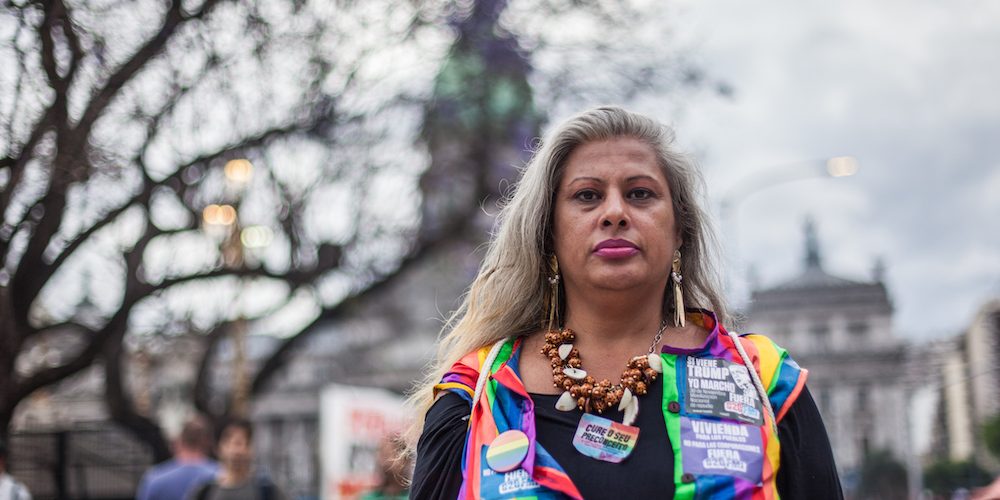
Interview with trans activist Indianare Siqueira, alternate trans councilwoman in Rio de Janeiro. "With Bolsonaro, the worst possible scenario is unfolding for LGBT+ people in Brazil; our lives are at risk."

Share

Photos: Luciana Leiras
When trans activist Indianara Siqueira won a seat as an alternate city councilor in Rio de Janeiro, she celebrated it as a crucial victory for the LGBTI+ community. Her post about the triumph—and about her life story—went viral in Brazil, the most dangerous country in the world for trans people (according to the Trans Murder Monitoring Project). Indianara began injecting hormones at age 12 (“I did many things without knowing the harm they would cause me, but it was necessary”). She left her home in Paranaguá, where she was born, at 16, and at 18 she left the state of Paraná to settle in São Paulo and later in Rio de Janeiro.
 "I am resistance. I am resilience."
 "I am resistance. I am resilience."
“My appointment as a trans councilwoman in Rio is a victory for the bodies of trans and travesti people who fell for me. Who survived for me. Who fell by my side. For the bodies that can say: yes we can, they did. I am resistance. I am resilience. Because they live on in me. We will be in all the public spaces that have been denied to us.”
[READ ALSO: Lana from Holland: “Being trans in Brazil means living in danger every day”]
Indianara was in Buenos Aires to participate in the activities of the Feminist Forum against the G20, and spoke with Presentes. At 47, she leads the organization Transevolution and Casa Nem. “It’s a shelter in Rio de Janeiro for LGBT people who have been kicked out of their homes—trans, lesbian, or bisexual. The idea is that they don’t have to live on the streets, suffer from drug abuse, or experience police violence.” Casa Nem opened three years ago and recently received a small grant from the Open Society Foundations. Indianara also coordinates a support project for transvestites and trans people who want to attend university.
[READ ALSO: #Brazil Wave of LGBT weddings before Bolsonaro takes office]
Indianara explained that she hasn't yet had the opportunity to take the seat she assumed in 2017 for the PSOL (Socialism and Liberty Party): she could only do so if something were to happen to the current occupant. For any cisgender, white, middle-class man, this would have been a minor matter. But for Indianara, for trans people, for the LGBTQ+ community, it revealed some crucial issues about politics. One of the main supporters of her candidacy was Marielle Franco, the lesbian, feminist, and Black councilwoman murdered in March 2018.

She became an activist “when trans and travesti people started dying of HIV in the 80s.” “I wanted to know what they were going to kill me with.” That’s how she began advocating for LGBT+ rights. “Then the medications arrived, and people with HIV could become protagonists in their own fight. I livewith HIV because my sister had HIV and died. And today my partner lives with HIV. They are very invisible people; their voices are not usually heard,” she says, while participating in the protests against the G20 in front of the National Congress. She also defends the rights of sex workers.
[READ ALSO: Elections in Brazil with a record number of transvestite and trans candidates]
"Politics is sexist and racist."
-In the 2018 elections, despite Bolsonaro's victory, Brazil had a record number of trans and gender-diverse candidates. But very few actually win seats. What's going on within the parties that tend to allocate them so low on the lists?
–Politics is sexist and racist. There is LGBTQ+phobia and transphobia in political parties. Even in left-wing parties. We still have this problem. Mônica Francisco (elected deputy for the PSOL in the October elections), a woman, a feminist, and Black, didn't have the full support of the party. She had been an advisor to Marielle Franco, so people wanted her there. Her candidacy was won through activism and collective effort. At least two Black trans women won in São Paulo: Erica Malunguinho (PSOL) and Erica Hilton (Activist Caucus).
-What changes when there are more LGBT+ people holding positions in politics?
-Very much so. Even if we don't like those people because they belong to right-wing parties, when they're there and visible, the rest of society becomes aware that we exist and are part of politics. We're there, occupying that space.
-Were you a witness to how Marielle Franco, one of the driving forces behind your candidacy, dealt with this?
Marielle and I were political friends. We didn't go out for drinks or food, but we were always together in the political struggle. For her, it was very difficult as a woman, a lesbian, Black, from the favela, to occupy those spaces. They were constantly trying to silence her. When we were all together, she felt stronger. She always called on trans women to bring our voices into those spaces, and being there also strengthened her own voice.
[READ MORE: Who is Erica Malunguinho, elected as Brazil's first transgender congresswoman]
-Did they think they could kill her?
No, because they can't kill her: you can't kill an idea. We are the seed of Marielle that has already sprouted against Bolsonaro.
"With Bolsonaro, the worst-case scenario unfolds."
-What scenario opens up for LGBTI+ people with Bolsonaro?
-It's the worst. Because when our lives are at risk, Bolsonaro has campaigned with messages against our lives and our identity. It's already very difficult to be an LGBT+ person in Brazil. We know that we are criminalized, along with Black people or those living with HIV.
[READ ALSO: #Brazil A trans woman was stabbed to death while shouting “Yes to Bolsonaro”]
Brazil leads the world in the worst statistics for violence against trans people. In November 2018, the Trans Murders Observatory revealed that of a total of 369 reported homicides of trans and gender-diverse people between October 1, 2017, and September 30, 2018 (an increase of 44 cases compared to the previous year), the majority were perpetrated in Brazil: 167, followed by Mexico with 71. And after the electoral victory, the media reported that two trans people were murdered with hate speech invoking Bolsonaro.
And as of today, there are already more than two. In 2018, up to October, there were more than 140 murders of trans people in Brazil. It's the country that kills the most trans people. Brazil is very sexist and religiously fundamentalist. But this isn't talked about, it's not discussed. People are afraid that we're going to transgender girls and boys, which is completely untrue.
-What does politics owe to LGBT+ people in Brazil?
Brazil has a historical debt to LGBTI people, especially to those who died due to a lack of public policies. We have achieved respect for our names, but we need everything else: the right to go to school, to be with our families, to have housing. And we need respect when people talk about us so that in the future society truly understands its diversity. We live and are part of society; they have to stop silencing and making us invisible.
-How are you organizing yourselves against this hate speech?
“I already had to leave the country in the 90s. Several times they tried to kill me, other times they threw me off a bus. I live with a security protocol; I have cameras in my house. Sometimes I say we live in the prison of our homes; we go out into the streets for a moment, but we have to return to our fenced-in homes. I don't plan to leave the country. We are already preparing. We are organizing the resistance to continue fighting and gathering resources for those who need help. We are also training LGBT people to defend themselves against violence and physical attacks, for example, with martial arts. Let there be no doubt: we are going to organize, we are going to resist.”

Photo: Media Ninja. Indianare was arrested several times for marching topless to defend the rights of sex workers.
Share
We are present
We are committed to journalism that delves into the territories and conducts thorough investigations, combined with new technologies and narrative formats. We want the protagonists, their stories, and their struggles to be present.
SUPPORT US

FOLLOW US
Related notes
We are present
This and other stories are not usually on the media agenda. Together we can bring them to light.