

The "historic ruling" that condemned a neo-Nazi gang in Mar del Plata
“It is a historic ruling. For the first time, these Nazi practices are condemned, actions based on ideology are proven, and the danger this group poses to society as a whole, beyond these victims who were seriously injured, is assessed.”

Share

Photos: Courtesy of Daniela Reboiras.
The Federal Court No. 1 of Mar del Plata sentenced seven young members of a neo-Nazi gang to prison terms of up to nine and a half years for violent attacks perpetrated between 2014 and 2016 in the city against various individuals and minorities, including the LGBTQ+ community.
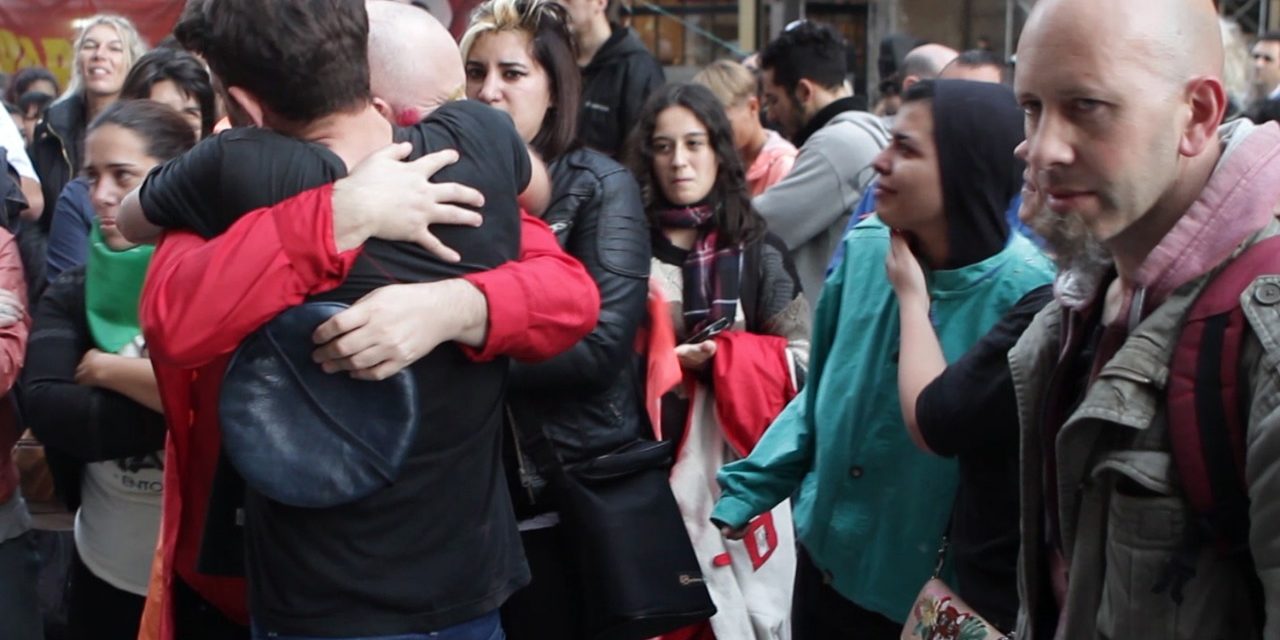
 While the full sentence will be read on May 10, the court announced the sentences and its main arguments on the afternoon of May 3. Outside the Mar del Plata courthouse, a large crowd listened to the sentences and celebrated the verdict. Claudia Mariela Vega is a lawyer and member of the Mar del Plata Equality Association (AMI). On Thursday afternoon, she was there, supporting the trial from the street. “The atmosphere was tense at the beginning. The prosecutor had requested very lenient sentences. But we jumped for joy when we heard the verdict. Some of the defendants who had been granted house arrest arrived at the hearing arrogantly and were taken into custody,” she told Presentes. “The ruling recognizes what we said from the beginning: that these young people were part of an organization that discriminates against LGBT people, punks, anarchists, atheists, immigrants, and people in vulnerable situations,” said Fernando Esteban Lozada, a leader of the Assembly for a Society Without Fascism and an activist with the Argentine Coalition for a Secular State.
 “It’s a landmark ruling, both for its reasoning and because it recognizes the existence of an organization created to impose its ideology through neo-Nazi and fascist violence. This ruling will allow us to move forward. We still have more than 30 cases to try, and there are more than 20 people involved who will eventually have to stand trial,” Lozada told Presentes. Vega added: “It’s a historic ruling. For the first time, these Nazi practices are being condemned, their actions are being proven to be based on an ideology, and the danger this group poses to society as a whole is being recognized, beyond just these victims, who were seriously injured. All of society should celebrate this.”
The grounds for the judgment
Judges Roberto Falcone, Mario Portela, and Bernardo Bibel determined that this public trial proved the crimes committed "that incite hatred and violence. These are dangerous crimes for society, poisoning the social climate and endangering the system of coexistence." They also emphasized that the victims were not chosen at random: they belonged to minorities and vulnerable groups. "The law can never treat hatred with leniency. In this sense, inciting hatred toward specific groups creates a real danger of generating a climate of violence or hostility," stated Falcone, the presiding judge. They also accepted as proven the existence of the gang: "The organization itself already poses a threat to the normative society," Falcone said during the reading of the verdict. "These are not isolated incidents," Vega emphasized from AMI. “If at some point these incidents were isolated, they are not now. And that is why they are condemned. Because it constitutes the actions of an organization with this ideology. Determining that it was a group of people with an ideology that harms society and deserves condemnation makes the ruling historic. These ideologies are not exclusive to this time or this country. But precisely for that reason, they deserve condemnation.” In 2016, when these neo-Nazi attacks and graffiti were on the rise in the city, the Mar del Plata City Council condemned “the serious events that have been occurring in the city of Mar del Plata since 2011, where neo-Nazi groups have attacked and threatened various social actors and institutions, based on their contempt for diversity.” The only bloc that did not join in the condemnation was that of Mayor Carlos Arroyo’s party, Agrupación Atlántica-PRO.Assembly against fascism
“The ruling reflects many of the principles we laid out in the assembly’s founding document,” says Lozada. The Assembly for a Society Without Fascism, she explains, was created in October 2014, when graffiti and groups advocating Nazi ideology began appearing in Mar del Plata. It was founded to bring these acts to light and ensure they were understood as a criminal organization based on hate ideology. “The regular justice system treated them as isolated incidents, which were usually filed away. Punks don’t believe in bureaucracy, and trans women in prostitution couldn’t even go near a police station,” says Lozada. In October 2014—when the violence began to escalate—the Assembly for a Society Without Fascism comprised 15 organizations, which have since grown to 130: political, civil, cultural, and social groups, labor unions, and political parties.The sentences
The sentences handed down to the members of the organization far exceeded those requested by federal prosecutor Juan Manuel Pettigiani. Heavily criticized by the organizations that supported the trial, Pettigiani had asked for several acquittals and a maximum sentence of two years and six months in prison. The sentences imposed on the convicted individuals are: nine years and six months for Oleksander Levchenko, nine years for Gonzalo Paniagua and Alan Olea, eight years and six months for Nicolás Caputo, five years and six months for Giuliano Spagnolo, and four years and six months for Franco Pozas. Because he was a minor at the time of the events, Marcos Caputo, Nicolás's brother, was ordered to undergo supervised treatment for two years. One of the defendants was acquitted: Giordano Spagnolo, brother of another of the convicted men. All of them remained in custody at the end of the hearing.Share
We are present
We are committed to journalism that delves into the territories and conducts thorough investigations, combined with new technologies and narrative formats. We want the protagonists, their stories, and their struggles to be present.
SUPPORT US

FOLLOW US
Related notes

We are present
This and other stories are not usually on the media agenda. Together we can bring them to light.