

What is the purpose of the anti-NGO law passed by the Paraguayan Senate that puts human rights at risk?
The "Cartista steamroller" passed the anti-NGO law in the Senate, threatening the legal survival of many civil society organizations. What does it seek to achieve, and why does it jeopardize human rights standards and protections?


Share

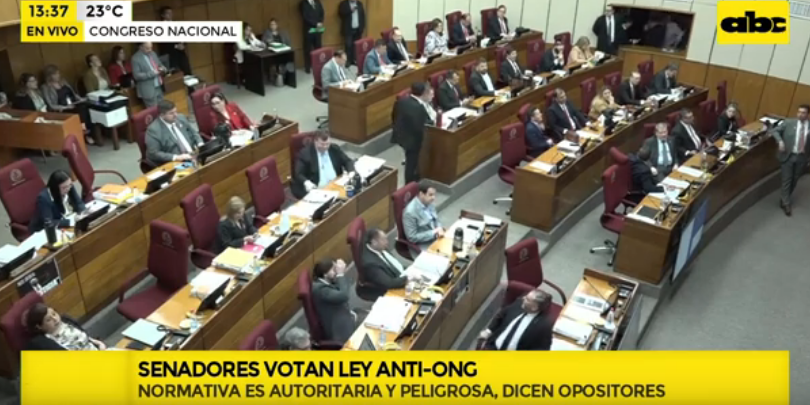
ASUNCIÓN. The Senate passed the bill, modified by the Chamber of Deputies, that establishes “control, transparency, and accountability for non-profit organizations,” threatening the legal survival of organizations already under rigorous state oversight. The so- called “gag law,” as it is known, was approved with 31 votes in favor, 10 against, and 2 abstentions. The bill now goes to the Executive Branch, which must decide whether to enact or veto it.
This bill was approved by the Chamber of Deputies on October 1st, with “suggestions” from the Executive Branch. Opposition legislators denounced that the bill was not officially submitted. “They treat us like a pantry. As if we could read the proposed budget modifications. I mean, in fifty minutes I have to evaluate and trust that the modifications made in a committee are correct—a committee that met this morning at eight o'clock,” stated Deputy Johanna Ortega of the País Solidario party.
The audio that reveals other interests
Government lawmakers defended the amendment, citing the need for “transparency.” But the true motives behind this initiative were revealed the following day with the leak of an audio recording of Senator Gustavo Leite, the project's sponsor.
In the audio, Leite said: “We stood firm at the end, and you already know who we got to twist our arm. I'll send you the summary” (…) “This is going to get bogged down in unconstitutionality at some point, because they obviously can't give us the data, because if they give us the data, they die politically and socially in Paraguay.”
The senator, a supporter of the Colorado Party and a member of the Bicameral Commission of Inquiry (CBI), not only admitted to sending the audio recording, but also urged the continued dissemination of private information about workers who had provided services to civil society organizations. These documents—primarily from journalists and activists—circulated for days on social media through Colorado Party profiles with the aim of exposing, discrediting, and undermining the organizations and their former employees.
An attack on freedom of expression
The Paraguayan Journalists' Union (SPP) issued a statement condemning the use of journalists' private data by sectors linked to the ruling party. "In particular, we condemn the leak of information obtained from the Money Laundering Investigation Commission related to journalists, which represents a serious attack on freedom of expression and the right to practice journalism," they stated.
Gina Romero, the United Nations Special Rapporteur on Freedom of Association, stated in an interview with Radio Monumental that the anti-NGO law does not seek transparency, but rather a power struggle against certain organizations to allow for discretionary application of the law. She further explained that it imposes very high penalties. “It is completely outside the bounds of international standards for the defense and protection of human rights,” she noted.
Civil society organizations are demanding a veto of theso-called "gag law." They argue that it imposes unconstitutional restrictions and excessive controls on civil society organizations. At a press conference this morning, Dante Leguizamón, Executive Secretary of the Human Rights Coordinating Committee (Codehupy), stated that the law continues to have fundamental deficiencies and an unconstitutional structure. "It is necessary to establish a technical working group to evaluate the existing controls and registries and to be able to sit down and have a frank dialogue," Leguizamón said.
What rights does the "gag law"
Amnesty International published an open letter addressed to Santiago Peña, urging the president to veto the bill. It denounces the violation of the Mexican Constitution and international human rights standards. The organization also points out that the law infringes upon the rights to freedom of association, freedom of expression, privacy, the right to participate in public affairs, and the right to defend human rights.
“The proposed legislation subjects privately funded organizations to unnecessary state interference, establishing registration requirements and sanctions that jeopardize their existence and ability to operate. Furthermore, it threatens the privacy and security of these organizations, their donors, and the people they advocate for,” the letter states.
This initiative is similar to others adopted in countries such as Venezuela, Nicaragua, El Salvador, Mexico, Guatemala, Georgia, Hungary and Russia, with the intention of persecuting and stigmatizing by causing disproportionate sanctions and arbitrary closures of organizations.
We are present
We are committed to journalism that delves into the territories and conducts thorough investigations, combined with new technologies and narrative formats. We want the protagonists, their stories, and their struggles to be present.
SUPPORT US

FOLLOW US
Related notes

We are present
This and other stories are not usually on the media agenda. Together we can bring them to light.