

The 36th Meeting of Women and Dissidents put sexual and cultural diversity at the center
Chronicle of the 36th Plurinational Meeting of Women, Lesbians, Transvestites, Trans, Bisexuals, Intersex and Non-Binary People in Bariloche/Furilofche.


Share

At the 36th Plurinational Meeting of Women, Lesbians, Transvestites, Transgender, Bisexual, Intersex, and Non-Binary People, it is clear that cultural and sexual diversity has not only strengthened but is a crucial part of the agenda. Indigenous women haven't forgotten that it was transvestites who helped them climb onto the stage in Trelew in 2018. Trans women haven't forgotten that they had to push their way in and were even beaten in 2019 when they tried to get on stage at the closing event in La Plata . At that time, the "plurinational" designation was being debated, but the more than 100,000 women and gender dissidents participating in this meeting since Saturday confirm that these intersections of identity have been key.
Spiritual ceremony of the 36th Meeting
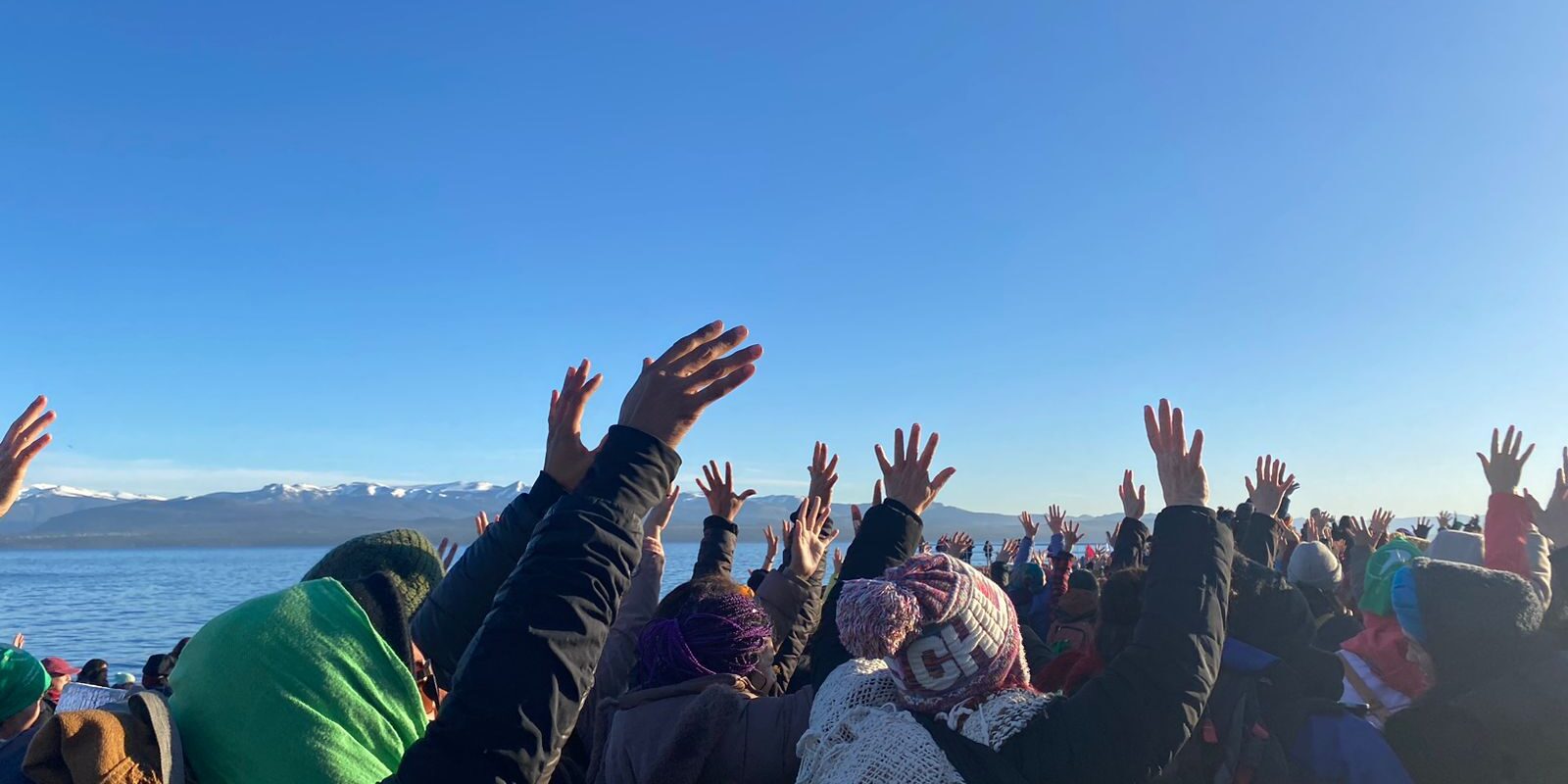
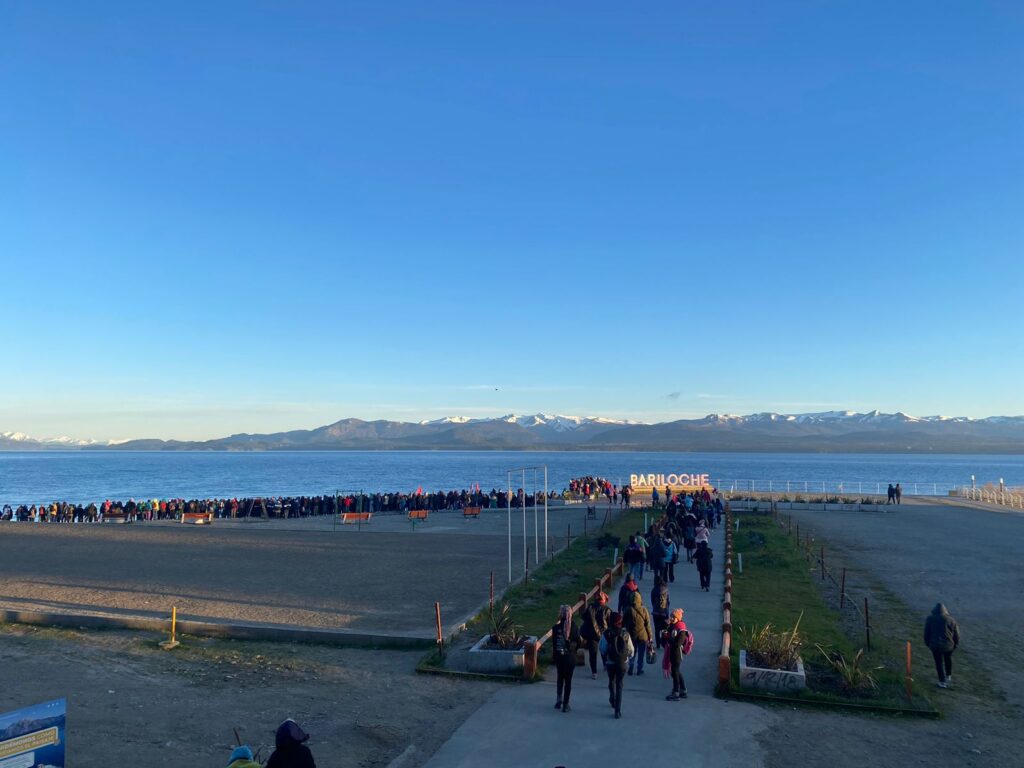
The power of the Gathering was strongly felt yesterday at dawn. In the opening ceremony, Wixa xipan (greeting to the sun), we went down to the shore of Lake Nahuel Huapi in pairs—representing the duality of feminine and masculine forces in the Mapuche worldview. Then we covered our heads with a scarf. If in San Luis we participated in a ceremony in a circle of fire, here the connection between feminism and spirituality took a step that goes beyond gestures and is felt in the body.
This ceremony was led by Mapuche spiritual authorities, to the rhythm of the kultrun—a percussion instrument . They walked along the shore of the frozen lake, singing softly in Mapuzungun, asking permission of the forces as a silence enveloped us in the rosy air of dawn. We could hear the sound of the crystal-clear water forming small waves as it lapped against the rocks. They distributed bowls of offerings to us, and each of us held a handful: fragments of petals, strands of lavender, leaves, seeds, orange flowers like those that in this city burst forth in the most unexpected places, emerging in abundance from the cold earth.
Together we threw those handfuls into the water, with our collective pains and hopes.
“We are welcoming them, thanking the strength of this territory for allowing our sisters to arrive from afar. We ask that this strength accompany us for a Plurinational Gathering in balance and harmony,” said Felisa Curamil, from the Mapuche women's group Witralein Pu Zamo and national representative of the Mapuche Parliament. Indigenous people teach us to be brief and punctual.
“It is important to include our opinions, proposals, and perspectives, and to make our historical territorial claims visible. There have been violent evictions. We believe that society has understood and has taken seriously the violence in Mapuche territories, coveted by political, real estate, and other interests.”
“We are fighters, resistance, and territory.”
One of those evictions he referred to is the one suffered by the Lof Winkul Mapu.
On October 4, 2022, a group of Mapuche women were arrested, including the machi Betiana Colhuan, a spiritual authority, and several children . This event permeated the gathering in San Luis, with the slogan: Freedom for those imprisoned for fighting .
The machi led a ceremony yesterday morning attended only by Mapuche and Indigenous women. She was one of the speakers at the opening ceremony of the Velodrome: “They call usurpers, but we are Mapuche, a people who existed before the states of Argentina and Chile.” She invoked the newen (spiritual power) of the “burned machis” and of Rafael Nahuel, her cousin, who was shot in the back and killed in a Coast Guard operation in 2017. She expressed gratitude for the struggle “of the women who resist in every space and for the solidarity of all.” She declared: “We are the resurgence, the new generation. We are fighters, we are resistance, we are territory. We face bullets, tear gas, death. We are Mapuche, we are warriors.”
At the opening of the Encuentro, in addition to the voices of various women from Indigenous nations, members of the organizing committee read their statement: “ To the right-wing forces that seek to govern the country, we say that we are not willing to take a single step backward.” Among the dozens of workshops on care, sexuality, and political organization, the novelty was the workshop on antifascism, in keeping with these times of rightward shift.
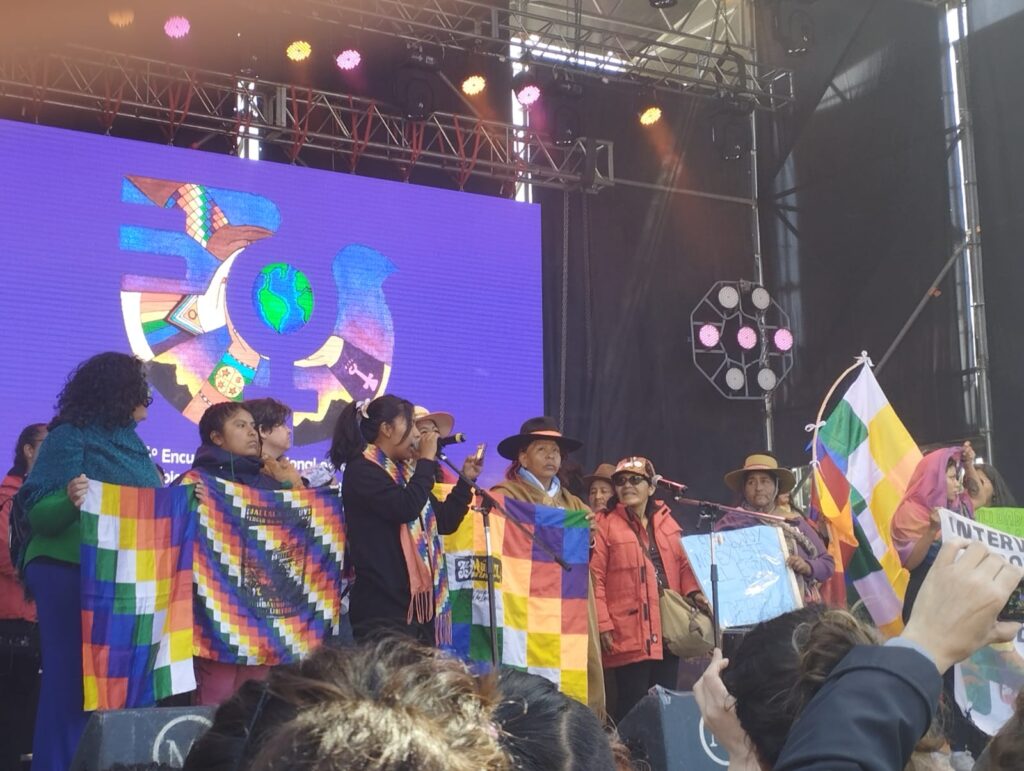
And the women of the Third Peace March closed the event, receiving a standing ovation at the velodrome. Milagros Lamas, 19, explained that the Third Peace March has been fighting for four months. “There is no justice in Jujuy. We went to Buenos Aires to demand it, but there is still no justice. Prison for Morales, justice for Jujuy!” And Aurora Choque, from Coranzuli, denounced once again: “In Jujuy, Gerardo Morales has implemented an unconstitutional reform to steal our natural resources.”
"We don't want them to romanticize our identity"
The Bariloche gathering is being led like never before by Indigenous women, both on stage and in workshops. “I think it’s very important to be here and that the gathering is finally becoming more and more plurinational. In unity with women and diverse groups, we want to try to decolonize and rid ourselves of patriarchy,” Moira Millán, a Mapuche weychafe (warrior) and one of the pioneering promoters of this plurinational spirit, told Presentes. Today, Sunday, she will present her book “The Train of Oblivion” and will speak about racism and literature.
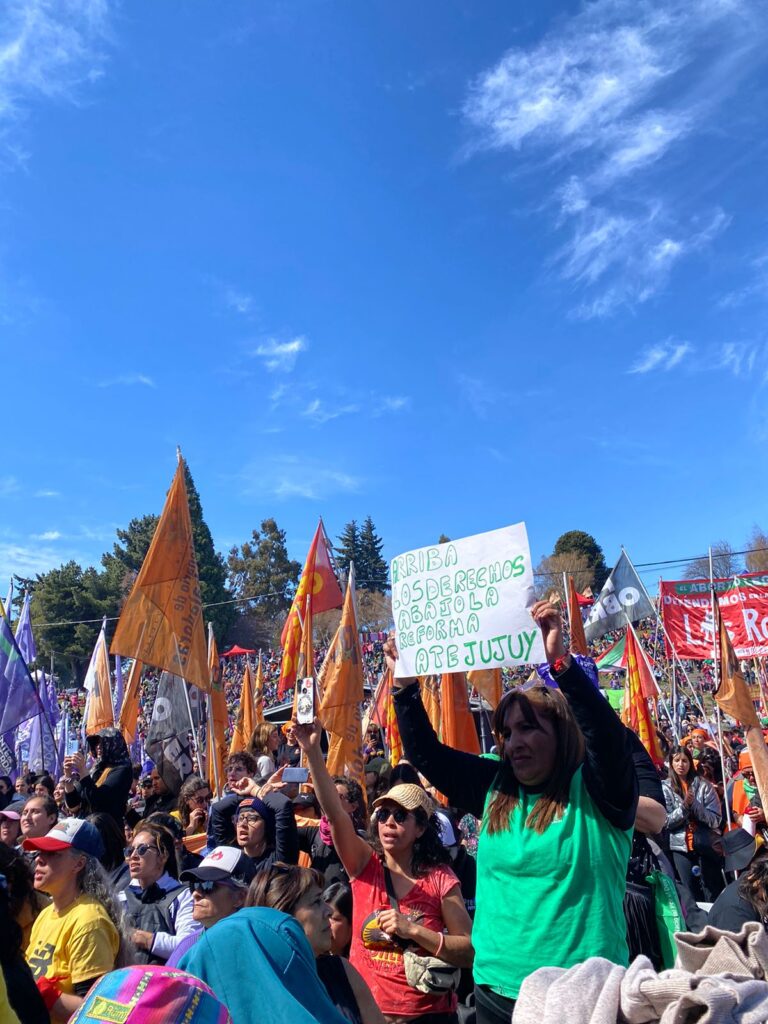
The struggles for territory are a crucial part of this Encounter where the Plurinational is felt not only in the voices that take the stage but also in the workshops.
While the political climate is focused on the struggle for electoral power, and anti-rights ideas are being preached that target precisely the central agenda of this gathering: the rights of women, diverse groups, and Indigenous peoples, here the agenda is being set, and debates are taking place about Mother Earth, the meaning of democracy, and the anti-patriarchal struggle: anti-colonial, anti-capitalist, and anti-extractivist.
Each of the Indigenous women's voices on stage carried a profound political significance and a sense of struggle for their bodies and territories. As one of them, Melisa Cabrapan, from the Mapuche Confederation of Neuquén, said, “We are happy to make our presence visible in a real and political way; we don't want our identity romanticized. We want this gathering to be truly plurinational. We are all a little bit of you.”
The march against transphobic murders
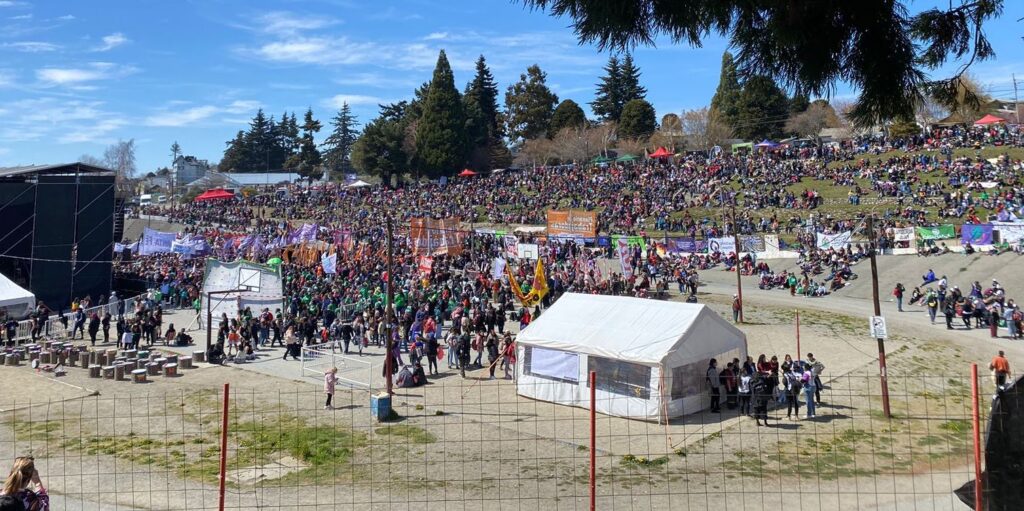
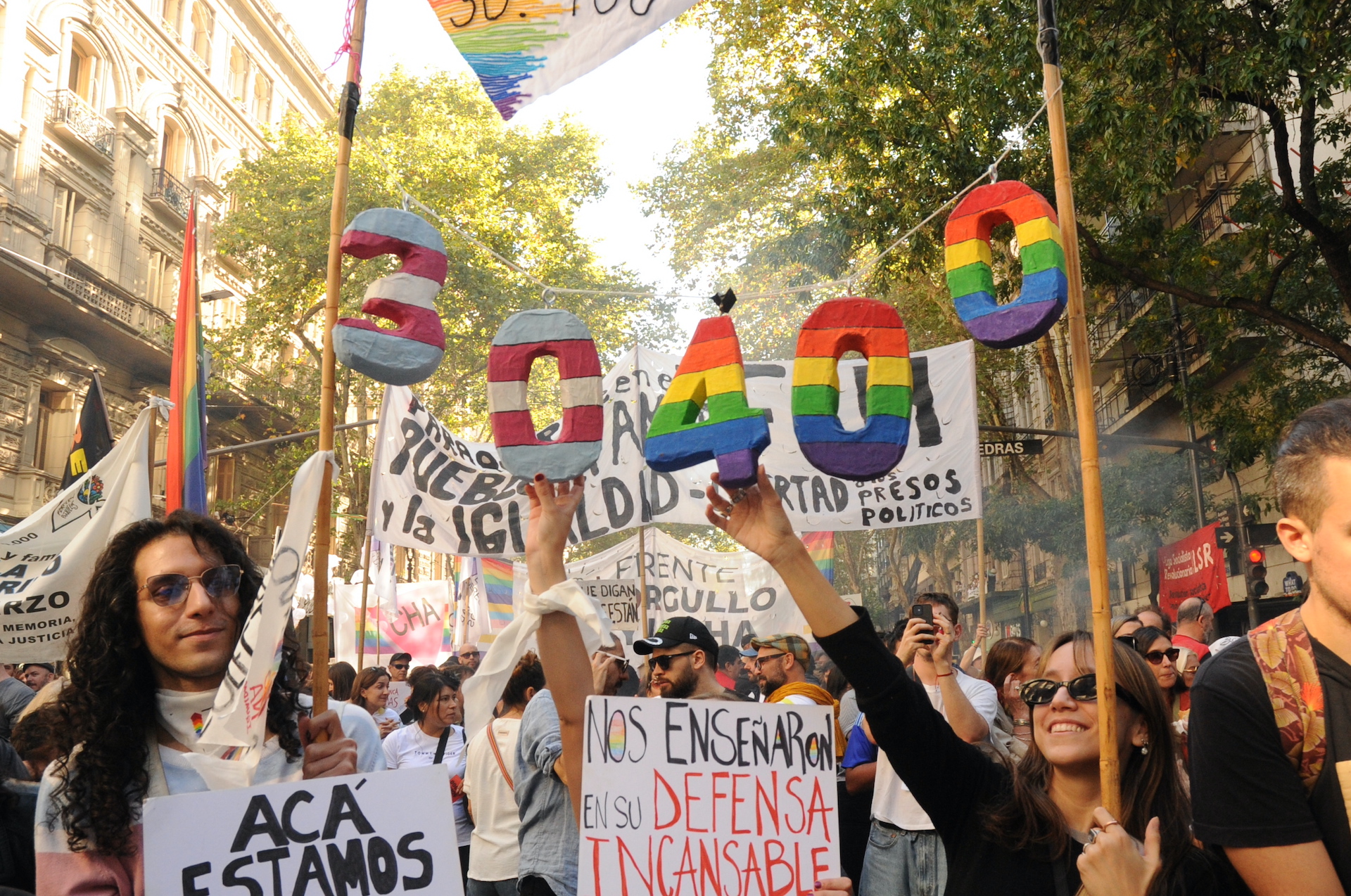
It is estimated that more than 100,000 people attended the Encuentro. The city streets, usually filled with high school graduates and tourists, were teeming yesterday with lesbians, bisexuals, trans women and men, transvestites, and non-binary people. They were filled with flags and green scarves.
After the workshops, which took place in very diverse spaces in Bariloche, at 7pm the march "Stop transvesticides and transfemicides" left the civic center, full of craft stalls, tents and a number of people that made it almost impossible to walk through.
The march "Stop Transvesticide and Transfemicide"—which has been held at the Encuentros since 2017—led by trans and travesti activists, including Marcela Tobaldi and Say Sacayán, walked along the shores of Lake Nahuel Huapi and for more than 2 kilometers circulated its slogans, chants, and shouts through the city. "Church and State, separate matters," they chanted as they passed by the barricaded cathedral. The question "Where is Tehuel?" was posed on banners, signs, and chants. It has been repeated since March 2021 when the young trans man was last seen.
The historical reparation of transvestites and trans people was one of the strongest demands, especially (but not only) in the column of the historical ones.
Megaphone in hand, trans activist Alma Fernandez led the crowd in chanting the names of historical figures: Lohana Berkins, Diana Sacayan, Claudia Pia Baudraco. She carried a sign that featured in many photos: Milei Is Not My Law.
The march culminated at the Velodrome where the activists took to the stage and shared their demands.
Today's march will take place in Bariloche, and tomorrow, Monday, the venue for the 37th National Women's Meeting will be chosen. However, one possibility is already gaining traction: all signs point to the next meeting being held in Jujuy.
We are present
We are committed to journalism that delves into the territories and conducts thorough investigations, combined with new technologies and narrative formats. We want the protagonists, their stories, and their struggles to be present.
SUPPORT US

FOLLOW US
Related notes


We are present
This and other stories are not usually on the media agenda. Together we can bring them to light.