

LGBT+ Candidates in the 2019 Argentine Elections
General elections are being held in Argentina on October 27. In addition to the president and vice president, half of the Chamber of Deputies will be up for election—130 national deputies (out of a total of 257)—whose term will last four years. A third of the Senate will also be up for election—24 seats (out of 72).

Share

General elections will be held in Argentina on October 27. In addition to the president and vice president, half of the Chamber of Deputies will be up for election—130 national deputies (out of a total of 257)—whose term will last four years. A third of the Senate will also be elected—24 seats (out of a total of 72) for the next six years.
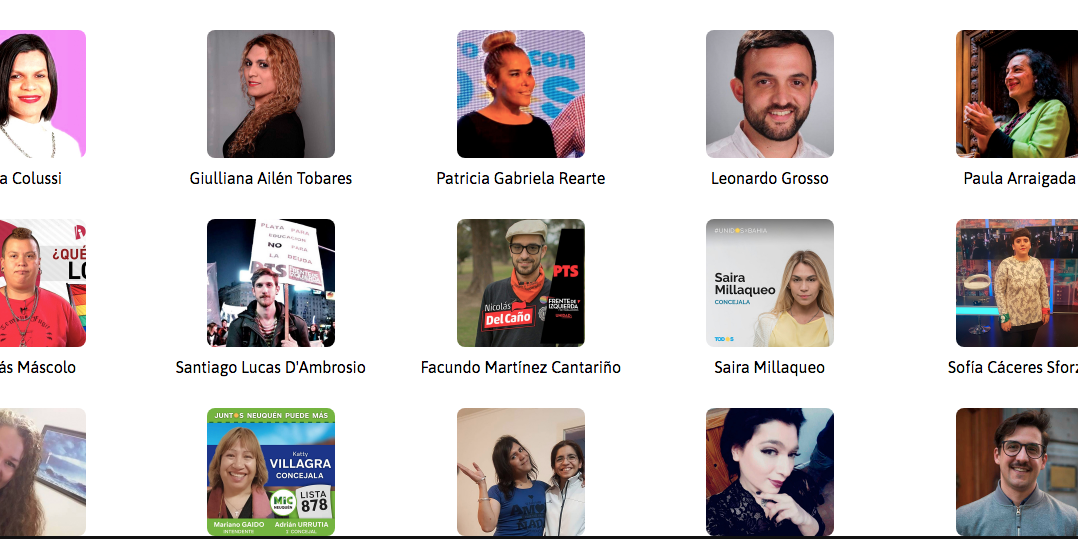
Following the 2019 Open, Simultaneous, and Mandatory Primary Elections (PASO), Presentes conducted a survey of LGBTI+ candidates across the country who will be competing for various positions in the general elections. A list of 21 visible LGBTI+ candidates emerged (there may be more who do not appear in media records as part of the community). Less than half have very little realistic chance of winning the position they are running for, given their final placement on the ballot. Of those 21,
This data may be related to another finding from analyzing the list of LGBTI+ candidates registered by Presentes in the lead-up to the 2017 primaries . That registry included 32 names of pre-candidates, of whom only three appear on the current ballots. The others did not win any positions at that time nor did they run again this year, despite demonstrating active involvement in neighborhoods and social organizations on their social media.
Symbolic candidacies?
So what is the real commitment or intention of political parties in creating spaces for LGBTI+ people when previous data indicates that the candidacies are mostly symbolic? Because the concrete chances of holding a position of power are reduced by placing these names at the end of the ballots, or under the subheading of alternates.
Despite Argentina having laws such as marriage equality and gender identity recognition, and one of the most powerful sexual diversity movements in the region, journalist and poet Gabriela Borrelli Azara wondered two years ago, “Why aren’t these figures among the top candidates on the final lists?” She continued, “Why doesn’t the most vibrant of political movements, alongside feminism (because they support each other), include more gay, lesbian, and trans people on the lists of the main political parties?”
“We have conquered a space”
María Pía Ceballos, director of the Observatory of Violence Against Women in Salta and an activist with Mujeres Trans Argentina (Trans Women Argentina), was a candidate for provincial deputy (Seamos Libres) in the elections held in Salta on October 6. She was not elected, but she sees her candidacy and those of others as a significant step forward. “Although LGBT+ candidates are still a minority within political organizations, we have conquered a space from which we will not be taken back . This first electoral experience was profoundly enriching and positive,” she told Presentes. “Perhaps prejudice leads some to think that in conservative Salta, an LGBT+ candidate would not be well received: that wasn't the case. There were moments of anxiety, but the warmth we received from our neighbors was clearly stronger.”
For Ceballos, in this “symbolic struggle it is necessary to set precedents so that other trans people are encouraged to occupy public decision-making spaces and transform more normalized views in pursuit of a future friendly to diversity and the different other. This is just the starting point and we will continue the fight for the diverse and inclusive Salta that we dream of.”
“Solitude and secrecy will no longer be our home”
Keili González, a trans activist from Nogoyá, was a candidate in the primary elections for provincial deputy of Entre Ríos for the Socialist Workers' Movement (MST). “It was a great challenge and it yielded results: out of seven lists, we positioned ourselves as the third strongest force in the province. What motivated me to run was the understanding that history must also belong to trans women and trans people . For that, I had to politicize my life in every possible way, making it a collective action. To transform unease, anguish, and suffering into a transformative force,” Keili told Presentes. She added: “The trans and travesti community no longer has to endure having our lives stolen so that those pieces can be used to build the machinery of capital and exploitation for the benefit of a few and to the detriment of the majority. We must be part of those decisions that improve the lives of the oppressed.”
She is grateful “to every person from Entre Ríos who believed in my voice and to every body that uttered my name.” And she takes stock: “I fought to be in the Lower House by adopting a counter-hegemonic form of commitment as a paradigm shift in the conservative ways of conceiving politics. What those elections revealed is not only that solitude and secrecy will no longer be our home, but also the realization that there are many of us who want to change the economic, political, social, and environmental reality for workers, youth, women, lesbians, transvestites, and trans people, the excluded .
The Latin American context
It is estimated that more than 70 LGBTI people held elected and government positions in Latin America in 2017, according to estimates from the Third Meeting of LGBTI Political Leaders for Latin America and the Caribbean . “Today, the number of openly lesbian, gay, bisexual, transgender, and intersex people in positions of power is growing rapidly,” the organizers said at the time. “Five years ago, they could be counted on one hand. These leaders are on the front lines in the fight for equality.”
In 2018, Brazil held elections that saw a massive surge for the right wing but also a record number of trans and gender-diverse candidates . It was the same year that Marielle Franco, the lesbian, feminist, and Afro-Brazilian city councilwoman . Marielle, in turn, had supported the candidacy of Indianaire Siqueira, a Brazilian trans activist, who in 2017 won a seat as an alternate city council candidate in Rio de Janeiro .
Despite the sexism and racism that Indianaire denounces in politics, the post she wrote about her victory—and about her life story—went viral in Brazil, the most dangerous country in the world for trans people. “My election as a trans councilwoman in Rio is a victory for the bodies of trans and travesti people who fell for me. Who survived for me. Who fell by my side. For the bodies that can say: yes we can, they did. I am resistance. I am resilience. Because they live on in me. We will be in all the public spaces that have been denied to us.”
Journalistic investigation: Soledad Mizerniuk and Victoria Rodríguez.
We are present
We are committed to journalism that delves into the territories and conducts thorough investigations, combined with new technologies and narrative formats. We want the protagonists, their stories, and their struggles to be present.
SUPPORT US

FOLLOW US
Related notes


We are present
This and other stories are not usually on the media agenda. Together we can bring them to light.