

Banfield school accused of violating Gender Identity Law
Following media coverage of the case of a transgender teenager who was denied his rights at school, LGBT+ organizations intervened to ensure compliance with the law.

Share

By Alejandra Zani
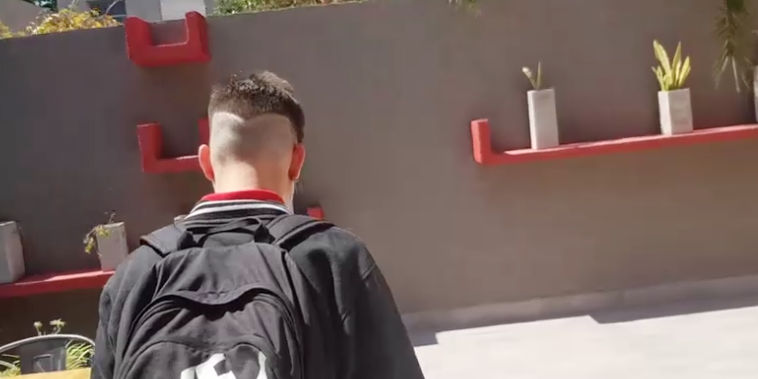
Photo: TV screenshot
Following media coverage of the case of a transgender teenager whose rights were denied at school, LGBT+ organizations intervened to ensure compliance with the law. The school insisted on referring to the teenager with female pronouns and did not allow him to use the boys' restroom, among other discriminatory acts. Ultimately, the school complied with the law.
Tomás, a 13-year-old teenager, realized he wanted to transition in mid-2018. The first to know were his classmates at the Ricardo Güiraldes Institute in Banfield. “Tomi never received any negative comments from his peers. When he was able to tell his family what was happening, he expressed his dissatisfaction with the treatment he received from some teachers and school authorities, and that's when Mom got to work,” Selene (24 years old), Tomás's sister, tells Presentes.
At school, they refused to call him by his given name and continued to refer to him using feminine pronouns, the name listed on his National Identity Document, violating Article 12 of the Gender Identity Law. They also did not allow him to participate in gymnastics with his male classmates and forbade him from using the restroom during recess, unlike the other boys. He was only allowed to use the girls' restroom during class time.
“This is an important issue because the school had promised to draw up a document so that all teachers would be aware of this supposed benefit they granted him, allowing him to go to the bathroom during class time. But the first time Tomi asked his language teacher for permission, she said no. In other words, the school didn't keep its word, and the document never existed,” Selene explains.
READ MORE: Schools ordered to respect trans identities: "A milestone in school coexistence"
When Tomás told his family what was happening at school, Mariela (Tomás and Selene's mother) took matters into her own hands. “At first, Mom encountered complete resistance from the school, who suggested that she, too, confused pronouns. And the school said they wouldn't make any hasty decisions because Tomás could still 'change his mind.' It took a third meeting, which Dad also attended, for anything to change. At that meeting, the principal and vice-principal greeted them with the Gender Identity Law in hand, with utter cynicism, and asked my parents to respect the school's timeline. Although they never clarified what that timeline was.”
Dr. Carlos Sanz, who heads the Transgender Children and Adolescents team at Elizalde Hospital—where Tomás is receiving support during his transition—also had to call the Institute to explain what identity formation entails during adolescence. According to Tomás's sister, the doctor also perceived "the ignorance of the authorities, who should be knowledgeable about the issue as administrators of an educational institution." Finally, according to Tomás's sister, "the administrators ultimately turned a deaf ear" to these complaints.
"Everyone should uphold the law."
Tomás's case reached the LGBT Ombudsman's Office, which contacted the school. “We can assume that if the authorities approached a child demanding recognition of his identity in this way, and treated him this way, it's because the approach hasn't been comprehensive regarding Comprehensive Sexuality Education (CSE), which is the most basic element. Because when we talk about trans children and adolescents, there's a lot of misinformation circulating regarding the legislation,” Flavia Massenzio, coordinator of the LGBT Ombudsman's Office, explained to Presentes.
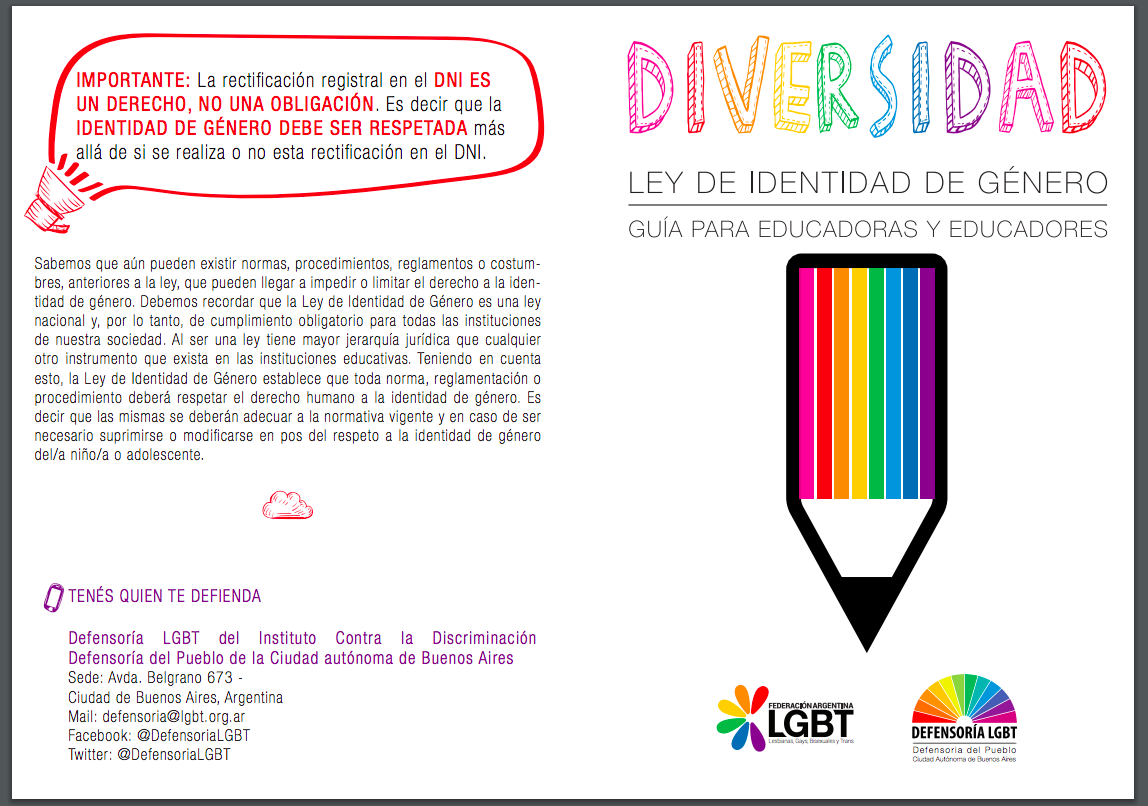
“We take direct, immediate action. We call the relevant agencies to enforce existing legislation. When children or parents bring this legislation to the attention of the authorities, they are often ignored. But when a specialized organization communicates this information, they are taken into account. This is unfortunate, because the law should be known by everyone, and everyone should uphold it,” Flavia continues. “In this case, we offered the school our services to provide awareness workshops. If the authorities handled it this way, it's because they haven't been informed. And if we don't get a response, we send official letters or file complaints that culminate in recommendations from the Ombudsman.”
Yesterday afternoon, following the media coverage of Tomás's story, authorities at the Ricardo Güiraldes Institute summoned his parents to the school. In a WhatsApp audio message sent to Presentes by Tomás's family, Mariela, Tomás's mother, stated that the principal and vice-principal agreed to uphold her son's legal rights.
“From today onwards, the entire school community will refer to him by his chosen name. The lists will be updated to include his last name, the initial of the name registered on his ID, and his first name. He will also be able to use the boys' restroom during recess, like all the other boys, and starting next year he will be able to participate in physical activities with the boys. All of this stems from the interview Selene gave to TN, in which she expressed her frustration with the school's failure to comply with the gender equality law. In just over 24 hours, Selene's fight for her brother has yielded the results I hoped for during my own struggle at the school over the past few months, and that's why I feel so happy,” Mariela summarized in the WhatsApp audio message.
“Tomi thanked me for the article published in TN, but I saw him reading the comments on the same page and on social media, and I know it affected him a lot. There isn't a single positive comment there, no one is objecting to the law or saying anything coherent, and no one seems to realize that they're saying terrible things about a minor,” Selene concludes.
“Listen, don’t assume”
When it comes to supporting trans children and adolescents, Juan Duncan, from the Trans Youth Movement (JT), believes the last thing to do is make assumptions for others. “Everyone knows what’s best for them. It’s not up to others to decide for us, but if they’re so worried that we might ‘make a mistake’ or face discrimination, they can certainly support us to make this process as smooth as possible.”
Juan Duncan is a university student. He met Tomás and his mother, Mariela, because they attended several workshops given by the MJT (Movement of Transgender Youth) on transgender adolescents. “What happens to Tomás is something that transcends the school environment. Most transgender people experience it in almost every space we inhabit,” he explains to Presentes.
“This problem of institutions refusing to change names is usually due to three reasons: bureaucracy, misinformation about the law, or simply transphobia. Most of the people I know had trouble getting their names changed at their schools or universities, and I recently did too. Basically, what happens is that you're being denied your right to identity within a space that should be caring for you and helping you grow. It erases you.”
For Duncan, this has a huge emotional impact. “Basic rights like going to the bathroom are restricted. You're treated like a second-class citizen. Someone else tells you that you can't be who you are, even though there's a law that protects you. Many institutions don't care about the law; their transphobia weighs more heavily on them than the legal repercussions they might face. There's a terrible drain on you when you're not allowed to exist. It's impossible to study if you have to see yourself being belittled every day. Many people end up dropping out or suspending their studies because of this.”
Institutions often lack awareness of the emotional damage they cause. “Especially in such important areas as academia. Instead of looking out for their students, they push them away. It doesn't occur to them that they might be depriving a young person of the opportunity to study. They are playing not only with their present, but also with their future. If you see that they are violating the rights of a colleague, student, or acquaintance, don't be indifferent. Try to offer support, because it can be a very lonely experience.”
For free childhoods and adolescences

“Whether or not comprehensive sexuality education (CSE) is taught in schools makes no difference. CSE today doesn't include trans identity. Their bodies aren't even represented in the materials. Therefore, we haven't found many teachers who know how to support the transition or how to register and respect trans children and adolescents,” explains Gabriela Mansilla, mother of Luana (the first trans girl in Argentina to obtain her national identity document after the Gender Identity Law was passed) and founder of the Civil Association for Free Childhoods, which promotes equal rights for trans children and adolescents.
READ MORE: Gabriela Mansilla: “The battle for trans children doesn’t end with the document”
“Infancias Libres has supported more than 150 families of transgender children and adolescents. In 90% of cases, schools have not respected the names of any of these children. We have been the ones to approach the schools to demand compliance with Article 12 of the law. Education and training in this country are binary and biologically based. We must transform education so that transgender children and adolescents are respected,” Mansilla continues.
Mansilla emphasizes: this doesn't depend on the school's willingness; it's mandatory. Therefore, it's not a matter of waiting for them to act. “The rights of minors are violated constantly in schools. We don't need time; it's urgent. Until schools receive training, the harm minors suffer is sometimes irreparable. That's why the Association doesn't advise, but rather demands compliance with the law that establishes dignified treatment. They need to know that it's not necessary to expedite the processing of ID cards, since the identity of individuals, especially children and adolescents, must be respected upon their request.”
ARTICLE 12. — Dignified Treatment. The gender identity adopted by individuals, especially children and adolescents, who use a first name different from the one recorded on their national identity document, must be respected. At their sole request, the adopted first name must be used for summonses, registration, files, calls, and any other procedure or service, in both the public and private sectors.

We are present
We are committed to journalism that delves into the territories and conducts thorough investigations, combined with new technologies and narrative formats. We want the protagonists, their stories, and their struggles to be present.
SUPPORT US

FOLLOW US
Related notes
We are present
This and other stories are not usually on the media agenda. Together we can bring them to light.