Illustrations: Jim Cheung, Bienal do Livro and Patricio Oliver
Even before assuming office in 2019, Jair Bolsonaro made no secret of his outright opposition to and rejection of the LGBT+ community. Nevertheless, the machinery he and his team have built to undermine the rights won and regained by the community in Brazil in recent years is still shocking.
The latest example of this occurred during the Bienal do Livro (Bianco Book Biennial). On the orders of Rio de Janeiro's mayor, Marcelo Crivella—who is also the highest political authority of the Universal Church of the Kingdom of God—police officers entered the premises to identify, mark, and cover up any books that might contain pornographic or "inappropriate" content. This stemmed from the Biennial's refusal to allow a search of copies of the comic book Avengers: The Children's Crusade, claiming that a kiss between Wiccan and Hulkling, two gay heroes, was pornographic.
Legal battle over a kiss
Leading the "clean-up" operation at the Biennial was prosecutor Wolney Dias, who justified the action as a request from the mayor's office, which he asserted was far from considering it an act of censorship. Any vendor who refused to comply would have their inappropriate and offensive material confiscated. Unsurprisingly, Wolney Dias's team focused on stalls featuring LGBTQ+ content and on bargain bins of comics, where the comic that had enraged Crivella was sold.
Publishing houses like Editora Galera, run by Rafaella Machado, which has published LGBTQA+ material since 2014, clashed with authorities after consulting with their legal team. They printed copies of the Constitution and distributed them to vendors at the fair, advising them to ignore the three teams of officers searching for offensive material. This prompted a threat from Crivella to revoke the organizers' license to hold the event.
In protest against Crivella's censorship, YouTuber Felipe Neto decided to buy all 14,000 LGBTQA+ books at the biennial. He then distributed them for free at the event on Saturday. Neto wrapped each book in black plastic and labeled them "inappropriate material," warning that they were "unsuitable for backward, retrograde, and prejudiced people."
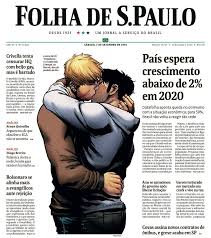
The image, which started the witch hunt, where the sorcerer Wiccan and his companion Hulkling kiss in an embrace fully clothed, reached the front page of the Folha de S. Paulo newspaper, the best-selling in Brazil, generating the opposite effect that its detractor expected.
The agents were forced to retreat empty-handed after their second inspection. All copies of Avengers: The Children's Crusade had already sold out within minutes of news of the raid becoming public.
On Sunday, from the Supreme Federal Court (STF), its president, Dias Toffoli, stated that the measure to censor LGBT+ content was illegal because it violated the principle of equality guaranteed by the Brazilian Constitution.
This is not the first time superheroes and comics have been the target of criticism and attacks from totalitarian and censorious governments. During the 1950s in the United States, at the height of McCarthyism, psychiatrist Fredric Wertham published his essay *Seduction of the Innocent*, focusing on the negative effects of this genre on young people of the time. Among the series of theories he presented, he argued that the relationship between Batman and Robin was homosexual and that these publications unconsciously initiated gay fantasies in young readers. Following the same logic, Wertham maintained that Wonder Woman's strength and independence were clear indications that the Amazonian warrior was a lesbian.
The reach of this book led to my being the key witness before the Senate subcommittee on juvenile delinquency. The final report recommended that the comic book industry voluntarily reduce its content. As a result, the Comics Code Authority, a self-censorship body, was created.
From the increasing inclusion of LGBTQA+ comics in major publishers like DC Comics and Marvel to independent publishing projects, the LGBTQA+ community is finding greater visibility and representation in comics year after year. In Brazil, trans comic artist Laerte is a leading figure in her country and around the world for her work. Laerte served as a juror for the 2018 Trans Comics Competition organized by the Directorate of Sexual Diversity of the Municipality of Rosario and EMR. The selected material was compiled in the anthology *Poder Trans Historieta Latinoamericana* (Trans Power Latin American Comics), which includes the work of various Brazilian and Latin American authors.
In a genre where stories were told by others and where they were often subject to problematic representations or loaded with negative and stigmatizing constructions, the presence of our own voices, both from the authorship and the editing, opens a path towards a space of identification, very valuable especially for young readers.
Categorizing a scene like the Young Avengers kiss as pornography, under the guise of a false sense of protection, is a thinly veiled way of establishing censorship and criminalizing relationships that fall outside the cis-heterosexual canon. It also sets a precedent in a region clearly experiencing a strong anti-rights trend.
We are committed to journalism that delves into the territories and conducts thorough investigations, combined with new technologies and narrative formats. We want the protagonists, their stories, and their struggles to be present.