

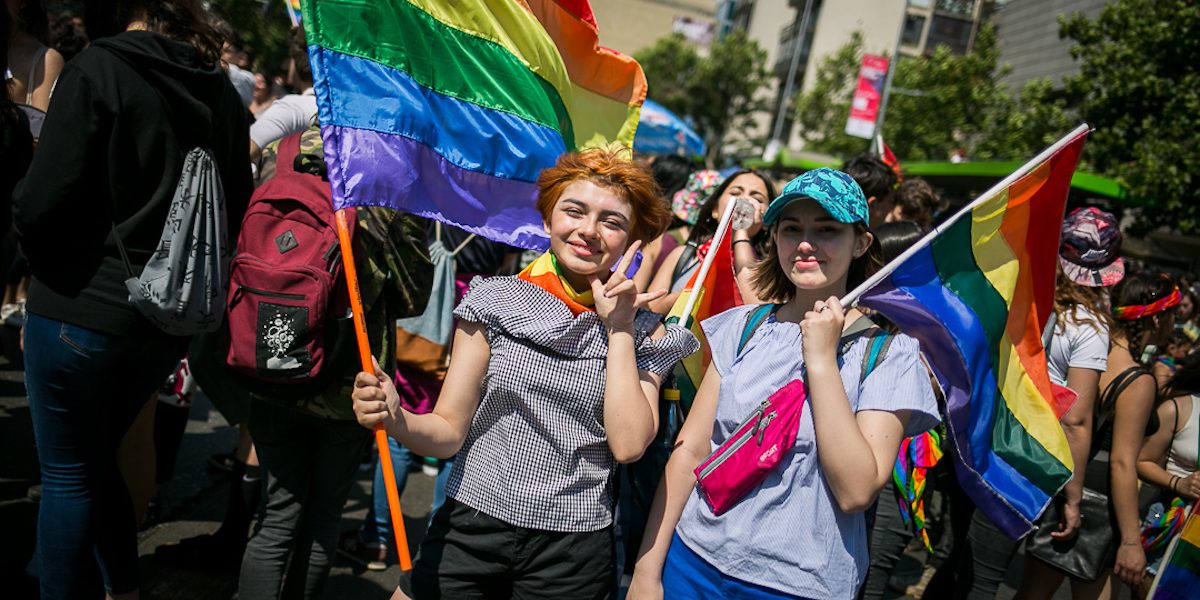
IN PHOTOS #Pride2018 Color and protests in the streets of Santiago
The Chilean capital celebrated its second LGBT+ march of the year, the Santiago Parade 2018, convened by the Movement for Homosexual Integration and Liberation (Movilh).

Share

By Airam Fernández, from Santiago, Chile
Photos: Josean Rivera
This Saturday, the Chilean capital celebrated its second LGBT+ march of the year, the Santiago Parade 2018. Organized by the Movement for Homosexual Integration and Liberation (Movilh) with the slogan “No more blah-blah!”, thousands of people took to the streets to demand equality and make diversity visible.
 Around 2 p.m., Plaza Italia began to fill with glitter and music. No well-known activists attended, nor were the typical columns of the various organizations formed in Chile lined up, except for that of the Selenna Foundation, which led the march.
 The march began precisely at 3 p.m., with a noticeably smaller crowd than on previous occasions. But the demands remained the same: marriage equality and same-sex adoption.
 Despite the Gender Identity Law being passed in September , this march did not forget the issue: children were excluded from the document approved by the Chamber of Deputies . Yesterday, children from the Selenna Foundation attended, along with their parents. They marched with a banner bearing the slogan of their struggle: “ If you name me, I exist .” And they chanted slogans such as “We are more than a name, we are more than a sex, we are trans children fighting for rights.”

 [READ MORE: The challenges of the gender identity law in Chile ]
 “We came because we think it’s important to continue participating in these marches, regardless of who organizes them. These are times to keep taking to the streets to celebrate what we’ve already achieved and to keep fighting for what’s still missing . The fact that children were left out of the law motivates us more than ever to continue raising awareness about this issue. For now, this is all we can do, and we’ll continue to support in any way we can, especially through education,” Evelyn Silva, the organization’s director, told Presentes.
“The State must align itself with our rights.”
 “The State must align itself with our rights.”
  Last week, the Chilean government made a series of modifications to the Human Rights Plan created during the administration of former President Michelle Bachelet . One of the changes concerns same-sex marriage, which will no longer be "promoted" but only "monitored" by the Executive branch, as the bill progresses through the Senate .
The march was announced before this decision was made public. “Today we are demanding that the Chilean State align itself with our fundamental human rights. This means legislating for marriage equality, same-sex adoption, and other urgent laws and public policies ,” said Rolando Jiménez, a leader of MOVILH.
 That was one of the reasons many marched, like Sergio Castillo, who traveled down Santiago's main thoroughfare in his wheelchair. "I always come to these marches, but this time I'm even more determined because of what the government did by changing the priority of same-sex marriage . Now we have even more reason to make our voices heard," he said.
“I was expecting a more political and rebellious march”
 “I was expecting a more political and rebellious march”
The migrant community also marched. Flags from Venezuela, Colombia, and Brazil joined the rainbow and trans flags. Luis Atencio marched with the Venezuelan tricolor, surprised by the turnout: “This never happens in my country. I came to live in Chile three years ago and I'd never been able to come to a march. I'm very happy and very grateful to be able to walk like this, with total freedom,” he said.
 But Klebiane Bezerra, a Brazilian who has lived in Santiago for eight months, expected more: “In Brazil, the marches are enormous. It’s a much bigger country, and that’s understandable, but there’s much more commitment from the community. I thought more people would come today. I also expected to find a more political and rebellious march.”

That tone was set by the feminists of the "dissident bloc" or the "queer counter-march," a group of young lesbians who throughout the march shouted slogans against the patriarchy and even against Movilh, the organization that hosted the event. They also raised their voices for Nicole Saavedra, the young woman murdered more than two years ago in Limache , a town near the Chilean capital.
 “Nicole was murdered and there are still no culprits. It’s unacceptable that they keep killing us while people here continue dancing and celebrating without any conscience,” said one of the girls, before walking through the crowd gathered in front of the final stage, shouting in unison with her companions: “ Lots of partying, little protest! ” The demand was ignored and the people continued dancing.
 Many felt that the turnout was low compared to previous marches, due to an incident that occurred last Thursday in Plaza Italia, when Carabineros repressed a protest over the death of Camilo Catrillanca , a Mapuche community member killed by Chilean police gunfire in the La Araucanía region on Wednesday.

 A few signs with his name joined the slogans of the Santiago Parade.
 “I am part of the LGBT community. I see that there are fewer people than usual, but I don't understand what those who are here today are celebrating, when Camilo was killed two days ago. The whole country should be in mourning ,” he said at the end of the event, which concluded with a party in Plaza Los Héroes.


We are present
We are committed to journalism that delves into the territories and conducts thorough investigations, combined with new technologies and narrative formats. We want the protagonists, their stories, and their struggles to be present.
SUPPORT US

FOLLOW US
Related notes



We are present
This and other stories are not usually on the media agenda. Together we can bring them to light.