

#24M “The faggots”, memoirs of the repression of gays and trans people
Cordoban filmmaker Daniel Tortosa explains why his documentary "Los Maricones" (which can be viewed in its entirety here) addresses the repression of gay and trans people during the last dictatorship, but it doesn't end there. Released in 2016, the testimonies recover marginalized voices and warn of the return of punitivism and police harassment of dissident sexual identities.

Share

Cordoba-based filmmaker Daniel Tortosa explains why his documentary, Los Maricones (The Faggots) – which can be viewed in its entirety here – addresses the repression of gay and trans people during the last dictatorship, but it doesn't end there. Released in 2016, the testimonies recover marginalized voices and warn of the return of punitivism and police harassment of dissident sexual identities. By Alexis Oliva, from Cordoba. Photos courtesy of Los Maricones.
In March 2009, as the organizational meetings for what would become the first Gay Pride March in Córdoba were beginning, a young man approached Daniel Tortosa and asked: "Hey, what's this about the urban myth of homosexuals being arrested?" "I thought: 'This is a mistake of my generation, because if we don't talk about what happened to us, it will remain an urban myth,'" says the audiovisual producer and teacher at the Film School of the Faculty of Arts of the National University of Córdoba Presentes
Cordoba's double standards
Since its premiere on May 29, 2016—the anniversary of the Cordobazo uprising in 1969— Los Maricones has participated in the international film festivals Asterisco (Buenos Aires), Llamale H (Montevideo, Uruguay), Luces, cámara, acción! (La Paz, Bolivia), the Invicines Social Film Festival (Córdoba), and the DOCA Documentary Filmmakers Showcase (Buenos Aires). It received a Special Mention at the Asterisco Festival and the award for Best Documentary Short Film at the 9th Roberto Di Chiara International Short Film Competition (Florencio Varela, Buenos Aires, 2017).
-What inspired this film?
My personal experience and my path as an activist. It was about making this issue visible and not letting it be forgotten: the arrests of homosexuals by the police, which took place from the 1930s until 2000. There was an edict, 2H, that allowed homosexuals to be detained for up to thirty days if they were found in public offering sexual services, or with a minor, or in a gathering, etc. This opened the door for the police to adopt an extortionate, blackmailing attitude towards homosexuals.
-What did you experience during your detention?
"Where we were, we could hear people being tortured. In the cell, there was a guy who was completely disfigured. They didn't torture me, but they kept me awake for almost the two days I was there. It was a very difficult situation, in the cell, in the yard… They would take you out, question you, put you back in, question you again, where they had parties, who you knew… It was completely repetitive.".
-From 1930 to 2000 there were dictatorships and democracies. How did that persecution vary?
-It didn't change, it was always like that. When it was most terrible for the trans community, according to testimonies, was after the return to democracy, in the 80s and 90s. My idea is that it was due to the appearance of AIDS, which awakened terrors and increased discrimination and stigma.
-Were the persecution and cruelty against gays and trans people tolerated by the society of Cordoba?
"Yes, I grew up with that, and it was the norm. It was normalized. If you were openly gay and wanted to go to meetings and hang out in the streets, the police were there to arrest you. It was part of the game. Otherwise, you had to live locked up in your house. Anyone who went out, sooner or later, ended up in a cell. And in Córdoba, there's a double life, a double standard, and a double discourse. Last night we had a great party, and this morning we're going to mass, and if you see me on the street, don't say hello. It's the weight of the Church. In Buenos Aires, that wasn't as noticeable. I suppose it happened the same way, but it wasn't as obvious. From the pedestrian street to the jail cell."
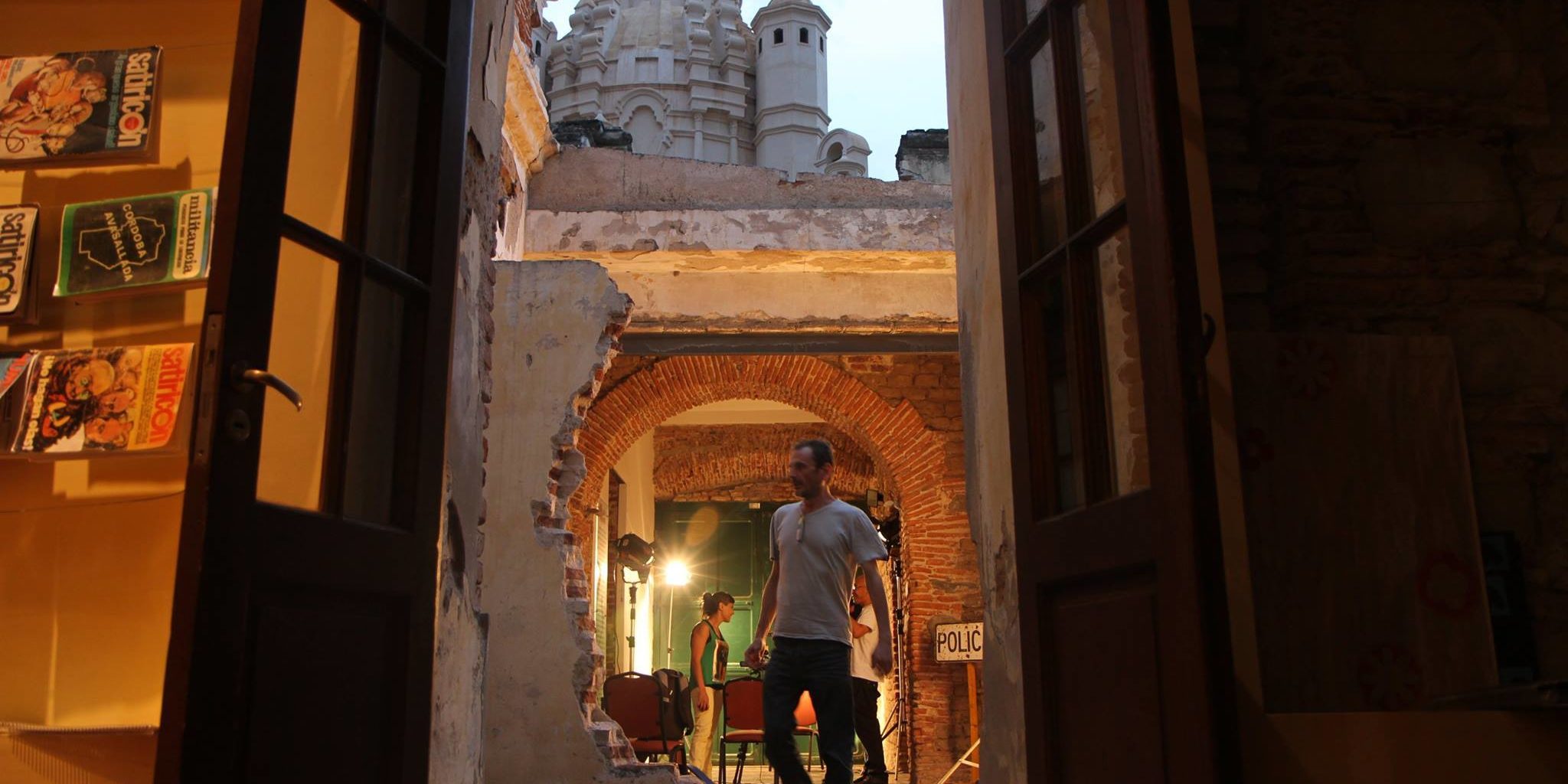
Tortosa went to the Provincial Archive of Memory (APM) to offer his testimony about his arrest in 1980. At that time, the Information Department (D2) of the Córdoba Provincial Police operated there, during the height of the civic-military dictatorship. Natalia Magrin interviewed him there.
In the first scene of Los maricones, Natalia walks with him along San Martín street, towards the Historic Cabildo of Córdoba.
“What was it, Dani, that made you take this step to do this now?” she asks him. “Everything that’s happening. I want people to know, the younger generations need to know. (…) We were standing with two other friends, just messing around and talking. Then two guys with sunglasses, suits, and jackets appeared and approached us. ‘What are you doing?’ They showed us the gun. ‘What were you doing here?’”
—We were hanging around, we were looking for a hookup. This was the meeting place for gay men. You'd meet here, see each other, pick someone up, like each other, wink at each other, and go for a coffee. Daniel and Natalia walk through the arcade of the Cabildo and turn onto the Santa Catalina Passage towards the former D2.
He continues his story: —And these cops here greet each other. “Ha ha ha. Look, they bring these faggots here.”. 
Hell and the Bells
In February 1974, the “Navarrazo”—a police coup led by Antonio Domingo Navarro—overthrew the democratic government of Ricardo Obregón Cano in Córdoba. From then on, the D2 became the epicenter of espionage, persecution, and repression of all forms of activism, with its Investigations Brigade divided into the “Street,” “Factory,” and “Faculty” groups.
After the coup of March 24, 1976, it was converted into a clandestine detention center. It operated under the directives of the Third Army Corps and the recently deceased former general Luciano Benjamín Menéndez. It was the first station in the Córdoba repressive circuit.
[READ MORE: Nobody knows what a body can do: the story of La Condesa]
The dark, sordid place with its intricate architecture accentuated the oppressive atmosphere and the violence inflicted upon prisoners held incommunicado, bound, hooded, and subjected to hunger, thirst, cold, and deprivation of sleep. Crimes against humanity were committed there, crimes that would only be judged ten years into the 21st century: illegal raids and detentions; torture involving brutal beatings, electric shocks, waterboarding , and waterboarding ; forced labor; and premeditated murders. Sexual assaults, primarily against women but also against men, were routine in that hell, its sound punctuated by the tolling bells of the neighboring cathedral.
Those bells, which those who passed through there will never forget, continue to ring, and Tortosa didn't want to leave them out of his film's soundtrack. "How naive I was... I thought: If I scream, the priests will hear me and come to rescue me, because they are good people," he recalls in that first scene.
[LGBT memories persecuted and silenced under dictatorship]
Marginalized from Memory:
At the time of filming, psychologist Natalia Magrin worked in the Oral and Audiovisual History department of the APM (Association of Psychologists of Madrid), whose Oral History Archive had created the thematic collection Sexual Diversity and State Terrorism .
“ Why were the arrests, abuses, and tortures of men, women, transsexuals, transvestites, and sex workers within police stations and prisons during the state terrorism, all centered around the signifier 'homosexual,' not included in the public denunciations of the material and symbolic violence of the repressive power ? Why were they not incorporated into the repertoire of memories of the human rights movement? What conditions of production led to this silence and indifference?” These were some of the questions that guided her research.
In that context, Magrin emphasizes that “the encounter with Daniel Tortosa and the members of Los Maricones was an experience of encountering testimonies, life stories, and narratives that have historically been marginalized in memory works. This experience allowed us to approach some of these questions, to construct meanings about the systematic violence against homosexuals, transvestites, lesbians, transsexuals, and transgender people during the state terrorism and its continuation in democracy. Los Maricones is one of the first productions focusing on the violence perpetrated by state repressive forces against members of the LGBT community .”
The prophecy fulfilled
The location chosen for the documentary interviews is the area in front of the former D2 detention center's cells, with their metal doors painted a peeling military green. There, the story unfolds in its rawest form: raids, beatings, rapes, and a wide range of abuses, mockery, and humiliations. And murders, like that of Vanessa Lorena Ledesma, a trans woman arrested on February 11, 2000, and killed in prison five days later.
“At the time of Vanesa’s tragedy, I thought: ‘I don’t have to go through that too,’” says Vanessa Piedrabuena. “That thought crossed my mind: ‘ It could be me next, and I can’t let it happen.’ ” This prompted her to photograph her friend’s body with “the bruises, the marks, everything she had… the skull fracture,” evidence that supported her complaint to Amnesty International, accompanied by the Argentine Homosexual Community (CHA) .
[“The LGBTI struggle is also part of Memory, Truth and Justice”]]
“And I have great respect for our worn-out shoes, for my elderly women, our trans women. We also have missing persons. The fact that there is no record of their existence does not mean that their blood is not crying out for justice, because if there was no way to detect where a student was, imagine what it was like for a trans girl, who was considered the scum of society ,” reflects Agostina Quiroga.
There is also a premonition, expressed in 2013 when the interviews were filmed. Eugenio Cesano, a member of the CHA and president of the Association Against Homosexual Discrimination (Acodho) in the 1990s, warns: “Police pressure, now that it is being questioned, will possibly decrease somewhat. But it's only a matter of time; it will rise again and things will be the same. Because it is an institution, a structure that is prepared to do this, and this is how it lives, how it thrives. And society seems to be demanding this.”.
“And it came to pass,” Cesano acknowledges today, with a bitter smile. “There was a global right-wing shift brewing, and it was clear it was coming. It’s something that’s starting all over again. The fight for human rights is ongoing, and we must always be vigilant. Those in power are bothered by the fact that certain people they consider inferior have rights. This has worsened. The police have ever-increasing power and are killing. The oligarchy kills for pleasure. That’s why this film is a reminder and an inexhaustible source of experience.”
For Magrín, Los Maricones “is, in this present moment, an act of resistance. A shaking of the margins, an aesthetic, political, and narrative operation that lifts the veil, exhibits discursive performativity and the liminal spaces of memories, while questioning us about the continuities of such biopolitical mechanisms and devices of control and violence . It is an act, an ethical and political treatment of our memories and their dignity as a compass for thinking about and contesting the future.”
Towards the end of the film, Nadiha Molina says: “I became too empowered with information, and that was a major obstacle for them in preventing them from continuing to exercise that boundless violence against the community.”
“Does education transform?” the director asks her.
“Yes, absolutely.”
To watch the full movie : https://www.youtube.com/watch?v=L0kl1JCnDGY&feature=youtu.be
Trailer: https://www.youtube.com/watch?v=vgvIsfPs82Y&sns=fb
Facebook: https://www.facebook.com/Los-Maricones-227760710926717/
]]>
We are present
We are committed to journalism that delves into the territories and conducts thorough investigations, combined with new technologies and narrative formats. We want the protagonists, their stories, and their struggles to be present.
SUPPORT US

FOLLOW US
Related notes


We are present
This and other stories are not usually on the media agenda. Together we can bring them to light.