

How to become an artivist: Lisa Kerner, from Casa Brandon
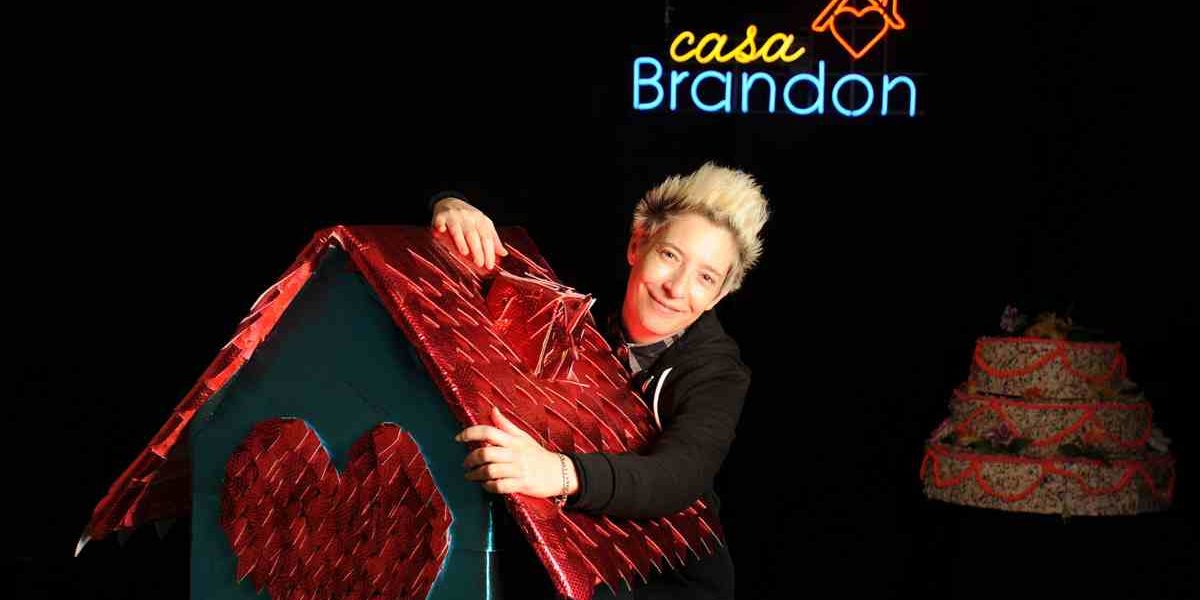
Lisa Kerner is one of the mentors and hosts of Casa Brandon, a crucial hub for LGBTQ+ artivism in Buenos Aires. Her exhibition-installation, 'Todo liso, mi familia yo-yo' (All Smooth, My Yo-Yo Family), explores her own biography through pieces, drawings, and paintings, and can be seen at the Ricardo Rojas Cultural Center.

Share

Lisa Kerner is one of the mentors and hosts of Casa Brandon, a crucial hub for LGBTQ+ artivism in Buenos Aires. Her exhibition-installation, "Todo Liso, mi familia yo-yo" (All Smooth, My Yo-Yo Family), explores her own biography through pieces, drawings, and paintings, and can be seen at the Ricardo Rojas Cultural Center. By Lucas Gutiérrez, from Buenos Aires. Photos: Ariel Gutraich and Alejandra del Castello/Centro Cultural Rojas. The blonde bangs, the glasses, the tattoos, and an electric body always on the move. The one moving forward is Lisa Kerner, one of the creators of the LGBTQ+ cultural center "Casa Brandon." There, she can be found curating and organizing cultural activities that empower artivism. An activist and visual artist, she inaugurated her exhibition "Todo Liso, mi familia yo-yo" at another venue, the Ricardo Rojas Cultural Center. An autobiographical journey where each piece speaks of a path, of a Lisa with the experiences and events that bring her to this present. All Lisa.
“I wanted to be Charles Ingalls, not Laura.”
On the wall of the Ricardo Rojas Cultural Center, we see the medical check-up tag to hang on the two-piece mesh bag, toys and bottle caps, the eraser for ink and pencil. Universes enclosed by specific theme in glass boxes that allow us to peek into Lisa as a child. “I wanted to be Charles Ingalls, not Laura,” Lisa says. And hanging there is a picture of the Ingalls family where Charles isn't Charles, he's Lisa. And in another, we see Tarzan, but he isn't Tarzan, he's Lisa. The alpha males, protectors of their clan, are her. Lisa used to draw while watching all those TV shows: “Drawing was the way I found to never get bored,” she explains. Lisa, like a version of Quino's comic strip Mafalda, asks questions and complains, gets bitter and learns. “I didn't feel hostility from the world for being a lesbian, I felt different or queerNow I can say queerThat word resonates with me in many ways. It's not just about sexual orientation; it's about a Mafaldaism”
"After the '90s we ran out of cool places to go."
As a teenager, Lisa began taking acting classes at age 14. At 16, she discovered the Parakultural art center in the San Telmo neighborhood. Between Batato Barea and Gambas al Ajillo (garlic shrimp), she began to inhabit a world of art and freedom that still resonates in everything Kerner creates. Back when communication was analog, a hungover Lisa said to someone, “I have your number in my pocket and I don’t know who you are.” “I’m Enrique Symns,” replied the editor of the iconic magazine 'Cerdos & Peces' (Pigs & Fish). Lisa was 19. She started by creating the illustration for the magazine’s letters to the editor section and later contributed to several issues. This Mafalda-Lisa-Tarzan is the same one who worked and frequented nightclubs that are now emblematic of 90s history: La Age, Ave Porco, and Morocco. “The gay scene circulated with total freedom and euphoria, but when all that ended, in 2000, Brandon began. We were left without any cool places to go,” she says.

From Nebraska to Buenos Aires: love, visibility and respect
Word of mouth was what told you which places were "the place" and which weren't. Someone had to pass on the information; neither the supplements nor the guidebooks announced it out loud. That's why, when the first events emerged and it was necessary to give this movement a name, it wasn't just 'Brandon.' No. It was: "Brandon Gay Day." The name Brandon was chosen in honor of Brandon Teena, an American trans man murdered in a hate crime in Nebraska in 1993. His story inspired the film Boys Don't Cry (for which Hilary Swank won an Oscar). Seventeen years ago, Lisa and Jorgelina, her partner and business partner at the time, began to spread the word about the movement. They spoke of Teena as 'a murdered lesbian,' lacking the theoretical framework they now possess. "At that time, when we understood little, we did the best we could. And with a brutal level of honesty, that makes me very proud of that young Lisa and Jorgelina," she says. Over time, and with the voices Brandon gathered, they learned. They continue to learn and share. That's what Brandon is all about: love, visibility, and respect. Activities began in different spaces. Wednesdays were Brandon Gay Day. Those were the days of a phone booth with internet access, handing out flyers advertising '3 pesos entry,' and film screenings in another space. Later, a website was created to explain what Brandon Gay Day was all about: celebration and visibility. The time came to find a real, dedicated space, a place where they could dance but also had what they called a 'chat room.' And when city laws took away their dancing, that chat room acquired a kind of mutant magic, capable of uniting everything that happened there, and "by the power of the Fantastic Twins, in the form of a film series, live bands, a book publishing house, a fanzine, in the form of whatever you want," says Lisa.
 Brandon is the embodiment of all the people he met along the way. Especially his "fantastic twin," Jorgelina De Simone, with whom he still runs "the little house" today. Brandon—declared of social and cultural interest and for the promotion and defense of human rights by the Buenos Aires City Legislature—is also all those who have appeared in the story over these 12 years, which were celebrated in May.
The Kerner Tarot
Until June 12, some of these journeys take the form of illustrations on the walls of the Ricardo Rojas Cultural Center. Lisa says they are born without a preconceived idea. It is she, the canvas, and the impulse that materializes. The first paintings could be read as arcana of a Kerner tarot, with characters detailing their Stations of the Cross: the walker, the exquisite corpse, the one depicting her own queer funeral, the vacationer. All of them lead toward the newest work. On the opposite wall, a stage with reliefs and textures is depicted next to a Brandon House. Sometimes it hurts, but more often than not, it embraces it. At the end, there's a Lisa Kerner made of lines similar to a fingerprint. For the first time in all the pieces, her gaze is fixed on whoever is in front of her. It's Lisa. And as always, she challenges.
The World According to Lisa
“There’s a resurgence of heteropatriarchal male chauvinist violence. On the one hand, it’s much more visible. The question is: was it already there but invisible, and now that it’s visible, does it seem to be more prevalent? Or is it actually more prevalent, and is it also more visible? I think it’s a mixture of both,” she says. And she emphasizes that we live in a paradox: an absent state that, when present, is appallingly ferocious toward women. Regarding the LGBT movement: “I see it as very stagnant in general, especially among gay men. Reclaiming the figure of Carlos Jáuregui, an LGBT activist, seems very necessary and beautiful to me, always. But I don't see them involved in supporting or even raising awareness of other causes.”
[READ MORE: Carlos Jáuregui, the unforgettable faggot]
"A trans identity disappears and it's not mentioned anywhere."
She asks herself many times a day: why. Why is it that “a girl disappears and it gets retweeted, but if it happens to a trans person, it doesn’t appear anywhere. And if it does, it’s not retweeted. Nobody shares it, nobody echoes it. What’s happening there with that otherness?” From Lisa’s herbariums to the identity-based perspective of the digital footprint, this exhibition shares a journey in which Lisa was both witness and learner. The lack of empathy, of identification with the victim, the abandonment of the trans community, are part of her journey and the questions she shares:There's a loneliness within that group that I find shameful as a person. And I'm no better than anyone else, because I don't internalize this either. Well, let's question it, and let's question this as feminists too.”. Lisa says. Lisa does. Lisa can't be bored. Until June 12th, traces of her life can be found in the exhibition "Todo Liso, mi familia yo-yo" (All Smooth, My Yo-Yo Family). Beyond that date, as she has for the past 12 years, you'll find her at Casa Brandon, dedicated to fostering cultural and artivist initiatives. Lisa live, pure Lisa.
Casa Brandon is located at Luis María Drago 236, City of Buenos Aires.
Lisa says. Lisa does. Lisa can't be bored. Until June 12th, traces of her life can be found in the exhibition "Todo Liso, mi familia yo-yo" (All Smooth, My Yo-Yo Family). Beyond that date, as she has for the past 12 years, you'll find her at Casa Brandon, dedicated to fostering cultural and artivist initiatives. Lisa live, pure Lisa.
Casa Brandon is located at Luis María Drago 236, City of Buenos Aires.
 ]]>
]]>
We are present
We are committed to journalism that delves into the territories and conducts thorough investigations, combined with new technologies and narrative formats. We want the protagonists, their stories, and their struggles to be present.
SUPPORT US

FOLLOW US
Related notes
We are present
This and other stories are not usually on the media agenda. Together we can bring them to light.