

Caring for free childhoods: a podcast and a guide for foster homes and families
How can we protect the rights of LGBTIQ+ children and youth who live separated from their families of origin and under state protection? This question gave rise to this podcast and a guide to best practices within the alternative care system.


Share

Chris lived in foster homes from the age of ten. At 19, he got a job and was able to move into a transitional home. Along the way, he transitioned. Since he was 16, he has identified as a trans boy. His journey included episodes of violence, such as the one he suffered at a women's shelter: “They wanted me to leave, they didn't understand. To them, I was different. And the staff didn't know how to handle it.” Only in the final stretch of his long journey as an unaccompanied teenagerwas Chris able to live in a place designed to respect diversity: Hogar Libélula (Dragonfly Home).
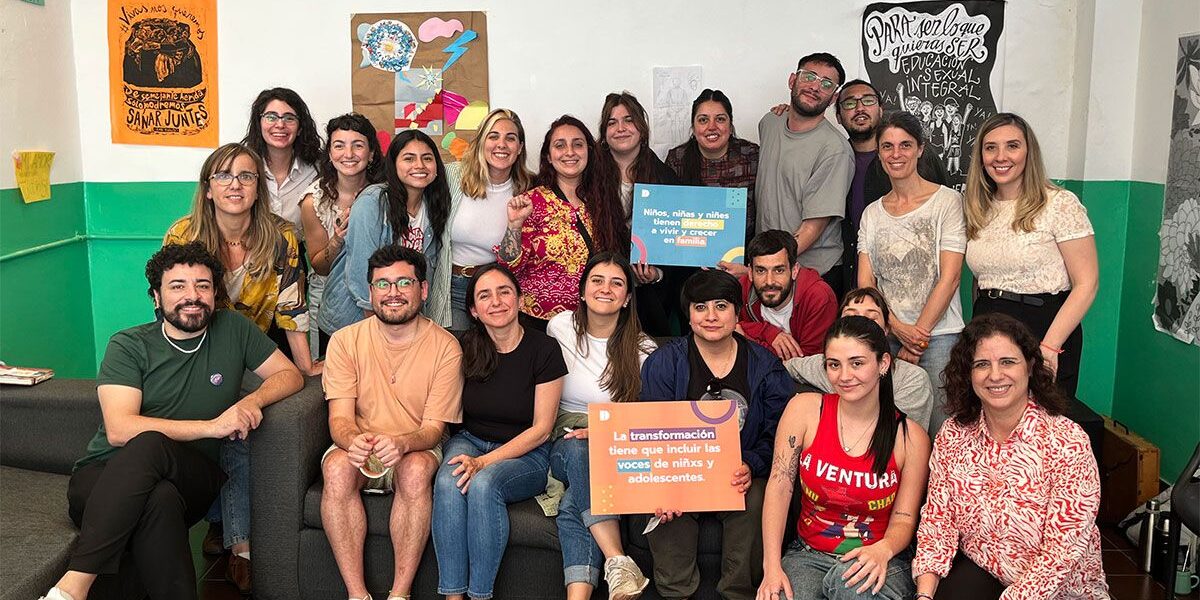
The space began operating in 2024 in Buenos Aires, as part of a cooperative that also manages other homes. During Pride Month, teenagers living there, along with their care teams and the Doncel, launched the project "Cuidar Infancias Libres" (Caring for Free Childhoods), which aims to develop tools for respectful care in foster homes and families.
“We want to focus on a little-seen reality: how the rights of LGBTIQ+ children and adolescents are guaranteed within the alternative care system, where today more than 10,000 children and adolescents live separated from their families of origin and under the protection of the State,” the NGO states.
According to official data, there are more than 600 residential alternative care facilities in Argentina, but only one is specialized in housing trans, non-binary and gender-fluid adolescents: Hogar Libélula.
Caring in diversity
The project "Caring for Free Childhoods" resulted in two complementary productions: the Good Practices Guide for the care and support of LGBTIQ+ children and adolescents in alternative care settings, and the fourth season of the podcast "At Home We Were 32," featuring testimonials from teenagers in that home. It was made possible after being selected by the 2025–2026 Local Initiatives Fund, a joint initiative of the Embassies of Canada, Australia, and New Zealand, with support from the Argentine Network for International Cooperation (RACI).
“On the podcast, we were able to talk about things that some kids don't talk about at home. Because they can't, because they're ashamed. Hearing from someone else who's been through it can help them,” Chris says about the project's objective. Just days away from graduating and working at one of the cooperative's homes, she's finishing high school and plans to train in recreation and care afterward.
“We believe that there are logics outside of the binary, beyond Libélula. That there don't have to be exclusive spaces for that. It will take time. But the intention is to promote it and circulate information for it,” emphasizes Constanza Hornos, institutional head of Libélula, which works through agreements with the Council for the Rights of Children and Adolescents of the City.
“Libélula emerged from the understanding that there were many young people staying in shelters who couldn't find accommodation from a more symbolic perspective: trans, non-binary, gender-fluid teenagers,” Hornos explains. “What they expressed most was related to living conditions. Boys' and girls' rooms, conflicts over bathroom use, a lack of networks with inclusive spaces. Simple issues in terms of living conditions, but it was necessary to be open to thinking differently. It wasn't being considered,” she summarizes.
“The guide starts from a simple but profound idea: care is a right in itself and a necessary condition for exercising other rights. Incorporating a gender and diversity perspective requires listening, training, and a constant review of our practices,” notes Dana Borzese, executive director of Doncel.

“They told me I was different.”
The National Census of Residential Care Facilities was conducted for the first time in 2022 and is the latest official statistical information available on the subject. “It identified around 600 facilities in the country and only one specialized in caring for LGBTIQ+ adolescents,” says Samuel Villena, advocacy coordinator at Doncel.
“Through the work the association has been doing, we’ve learned that many care practices in residential centers perpetuate gender stereotypes. Many of the activities offered do as well. We’ve heard stories of boys and girls who lacked support. Many of the adults providing care are unaware of legal frameworks such as the Gender Identity Law,” she points out. The next step for the Caring for Free Childhoods project is a webinar with experts from different jurisdictions to disseminate information to all care facilities across the country.
“I entered a women’s shelter, and being trans, you’re not seen as a feminine figure. They kept me away from those rooms and only let me spend time with my sister.” “It’s awful not being able to cry or talk about your transition because you’re alone and don’t know who to turn to.” “They always told me I couldn’t spend much time with the girls because I was different. They never gave me the space to say, ‘This is who I am, I’m not going to hurt you.’” These are some of the testimonies from the podcast, which addressed the right to identity, privacy, participation, progressive autonomy, and to affection and respectful treatment.
“Based on this experience in a specialized home, we believe that more specialized homes are not needed. Rather, the homes that are currently operating and those who are already caring for children and adolescents should adopt this gender and diversity perspective,” Villena emphasizes.

Photo: Doncel Organization
“You don’t have to be part of the group to understand.”
According to the Care Device Census, in December 2022 there were 9,062 children, adolescents, and young people under its care. The report indicates that 52.9% (4,794) identified as female and 45.8% (4,151) as male. 1.3% (117) identified as non-binary. “But other types of diversity are not characterized,” Villena points out regarding the lack of data.
The stories that reached the NGO Libélula show that, in some cases, the transition processes or the decisions regarding identity and self-perception were part of the reasons why the rights of those people who ended up without parental care, under the protection of the State, were violated.
“It wasn’t the only violation, but most of the time it was part of the issue with their families. When relatives come to visit, it’s common for them to call them by their deceased name, and we work to ensure that the chosen name is respected,” Hornos explains.
“Discrimination and mistreatment are always there. If it doesn't change, it's because people don't want it to. We're in the 21st century, but some people just don't care. Discrimination is always there and it's getting worse because we're losing our rights. There were jobs where I wasn't hired because I'm trans. It's getting worse and worse,” Chris laments after leaving the Dragonfly Shelter. And she concludes: “You don't have to be part of the community to understand. Empathy and human awareness are enough to help someone progress.”

Photo: Doncel Organization
Less accompaniment
In the first months of Javier Milei's administration, it came to light that around 3,500 young people without parental care were not receiving subsidies from the Leaving Care Support Program (PAE), which assists those who reach adulthood while living in foster care and must face adulthood alone. Today, the payments are almost back to normal. However, Doncel warns that the legally mandated training for mentors is not being provided: “The ability to be a PAE mentor depends on having this training. Because it isn't being renewed, there is increasingly less support available to strengthen the autonomy of those leaving the system.”
This article was originally published by Tiempo Argentino and is reproduced in Presentes through our agreement as media partners.
We are present
We are committed to journalism that delves into the territories and conducts thorough investigations, combined with new technologies and narrative formats. We want the protagonists, their stories, and their struggles to be present.
SUPPORT US

FOLLOW US
Related notes
We are present
This and other stories are not usually on the media agenda. Together we can bring them to light.