

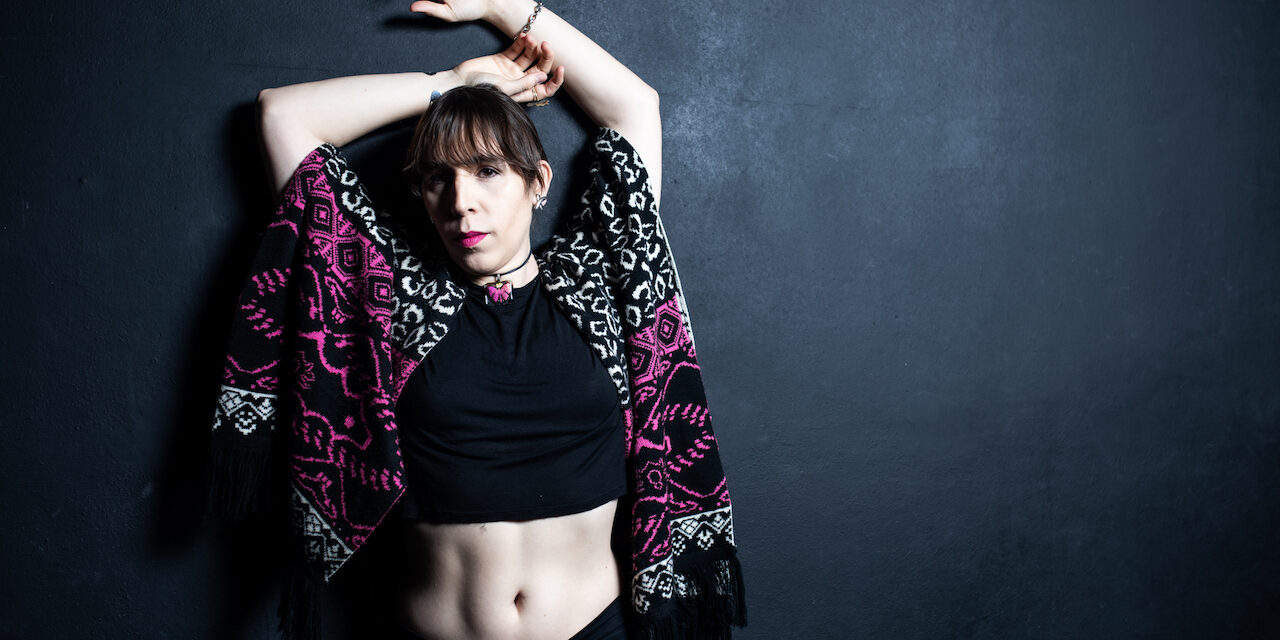
Eug Krla: “I tried being a transvestite on stage and it encouraged me to be a transvestite in real life”
Actress and playwright Eug Krla explains why *Aquí va una canción para ti* (Here's a Song for You) is the first play in which she presents herself as a trans woman. She also discusses how her work with disability led her to the discourses of Maite Amaya, Lohana Berkins, Diana Sacayán, Susy Shock, and Marlene Wayar, as well as her relationship with her father and with social media.


Share

BUENOS AIRES, Argentina. When she understands that "this is the way," Eug Krla goes all in. This happened with theater and disability, the two areas to which she dedicates her professional life, and later, with transvestism. This triad—theater, disability, and transvestism—shaped her identity: one led to the other and the other.
In Here Goes a Song for You, Eug Krla, for the first time, takes the helm of one of her own creations, identifying herself as a transvestite. Although many believe this is her debut, she has directed ten plays and acted in eighteen. But this one is particularly different from her previous work. She has moved from scripts that were a slap in the face to one with more light: it deals with her identity, but also with her current relationship with her father, her connection with the audience, and her desire for another kind of humanity to exist.
He's 35 and comes from a loving and rather queer family, with a lesbian sister and a sister who has been visibly bisexual since she was young. He was always the dramatic one in the family, although he wasn't an effeminate child, "the typical sissy." He grew up surrounded by board games, Final Fantasy, manga, movies, and TV series. "A nerdy kid," he says. Neither in his childhood nor adolescence did he question his identity.
He wanted to be Leonardo DiCaprio. At his elementary school's end-of-year concerts, he always wanted to play the lead roles. It didn't always happen, and to "calm the child," they would create supporting characters so he could participate. "What I remember most was being overwhelmed with emotion at the end of the play. I would cry during the curtain call while they applauded us. The feeling of being on stage, the connection with the audience—everything was so emotional for me," he recalls.
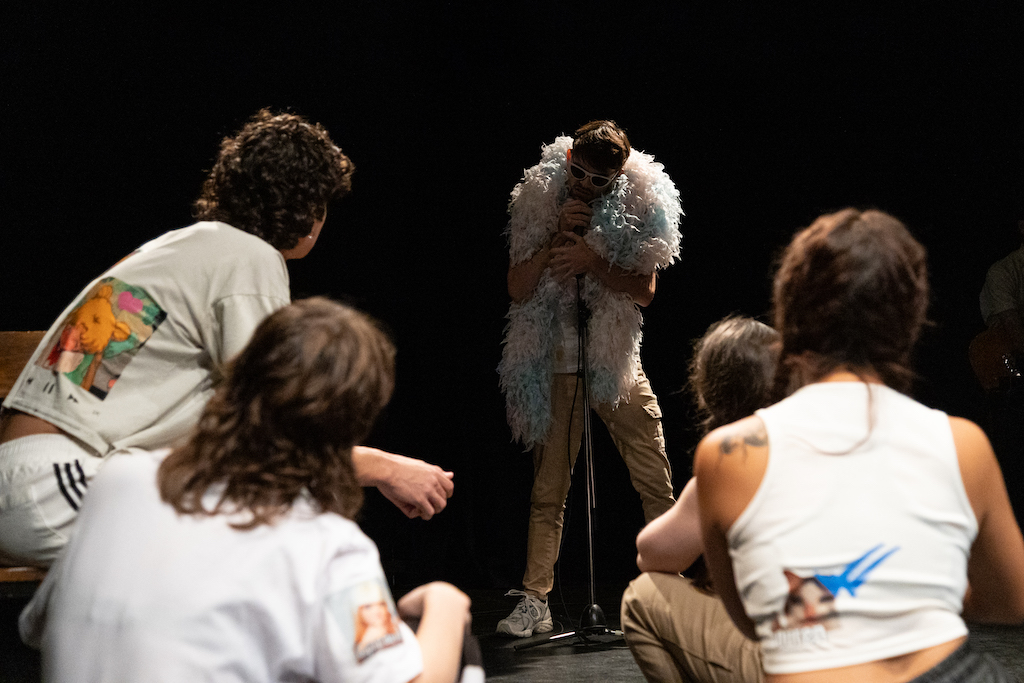
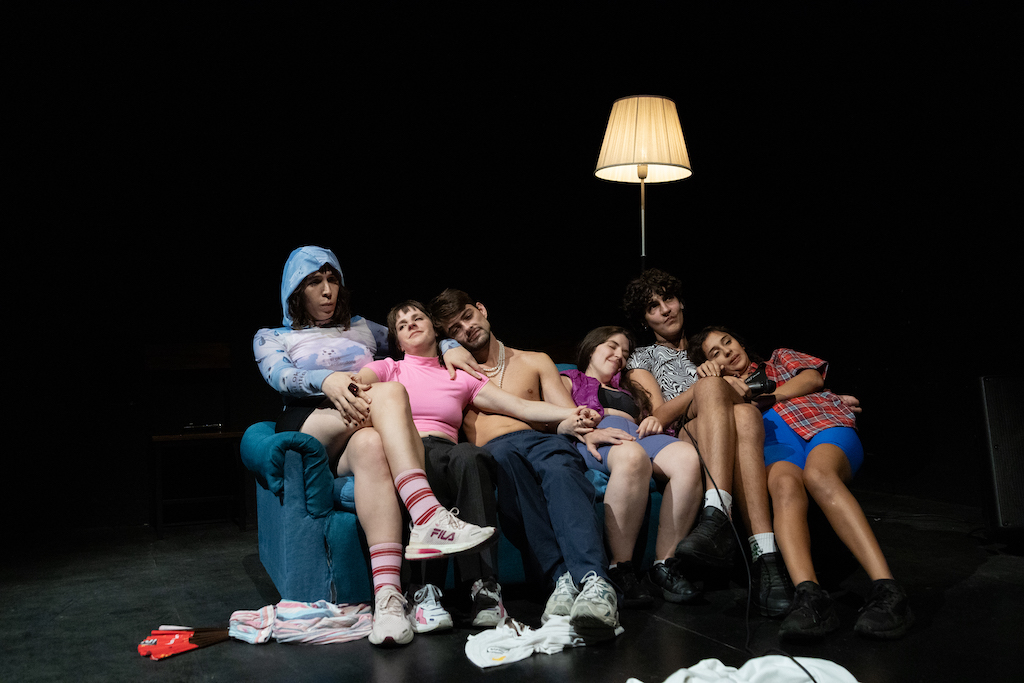
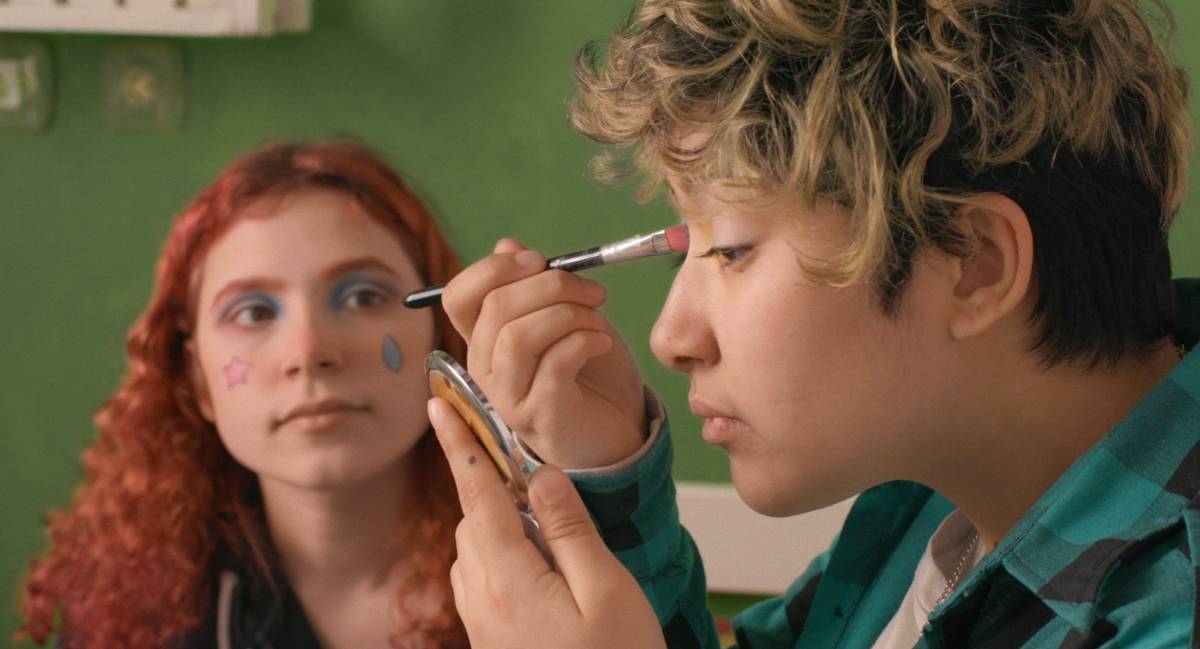
A lifetime passed in between. She premiered " Aquí va una canción para ti" (Here's a Song for You) in 2026. She directed it—with assistance from Belén Italia Caprara—and wrote the script, and she plays a trans woman. Through fragmented conversations, silences, and WhatsApp stickers, she tells the story of a young woman's transition, the support of her friends, and a father who tries to accept it.
To shift one's gaze upon humanity
Her first teacher was Patricia Palmer from Teatro Taller del Ángel. She then had an interrupted experience at the University of Salvador: she didn't finish her degree, but she met her second teacher, Corina Fiorillo. At the National University of the Arts, she met those who would accompany her on her first projects. She earned a degree in Acting and later completed a Diploma in Playwriting at the Paco Urondo Cultural Center.
One of her friends from that time, Agus Grova, introduced her to the Inclusive Theater Space of the Municipality of San Martín in 2015. She was captivated by the sensitive world of people with disabilities. Since then, she has worked in inclusive theater workshops. One of the actors she met at that space is Ricardo Goldberg. Ricardo has Down syndrome and is an actor in several of her plays.
“I was drawn to the expressive singularity. That's when I understood that there isn't just one expressive or aesthetic form. Theater that insists on a specific structure is too rigid; it closes off the possibility of things that profoundly affect you. When you encounter someone who functions in an unexpected and absolutely unique way, it profoundly affects you. It sensitively invites you to shift your gaze from yourself, and from what humanity is supposed to be,” she shares.
“The world made no sense until I understood the transvestite position”
Presentes spoke with Eug Krla to learn about his vision on the role of art in difficult times; the intersections between disability, theater and identity; and the possible future he imagines for the community.
–What role did theater and the world of disability play in your question about your identity?
Working with people with disabilities, I gradually became interested in ableism: the idea of a world designed for certain people who are capable of certain things. It's a worldview that doesn't consider the diversity that makes up human beings. That completely opened my mind:humanity has an infinite capacity in terms of how to inhabit this planet. One thing led to another: from understanding ableism and difference, I ended up discovering trans discourse. That's how I met Marlene Wayar, Susy Shock, Diana Sacayán, Lohana Berkins, and Maite Amaya. All of them voices that ultimately gave meaning to the sensitivity I was already perceiving in relation to the world, to how I saw and felt myself.
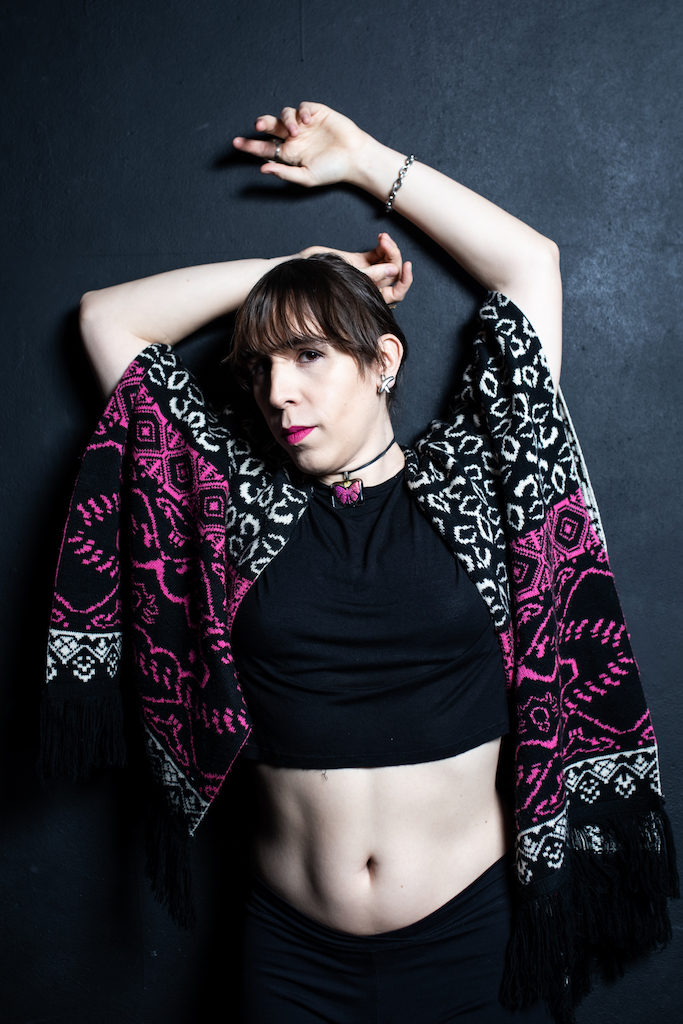
–What did it mean to start recognizing yourself as a transvestite?
UntilI understood the transvestite position, the world made no sense to me. It was the only time I began to feel that there was a glimmer of hope in living life, that there was a life worth living. For many transvestites, the mandate of masculinity is sometimes an unbearable oppression to which one must rebel vehemently, even if it means risking one's life. And other times it's such a subtle trap that one falls into it without even knowing what's happening to them. That's my case, but also the case of many other trans women I know: we grew up for 30 years of our lives as functional and happy men, without ever questioning what it means to be a man. And with rampant depression.
The construction of his identity went hand in hand with his theatrical development. “There were three processes where I was able to accompany my transition with my creative work,” he says. In 2019, he performed in "¿Y qué vamos a hacer con esas manos?" (And What Are We Going to Do with Those Hands?) . The play focused on how the mandate of masculinity kills. A gay boy named Tierno tries to survive in a sad and oppressive world. It takes place in a magical vacant lot that produces music at night. All the young people in the neighborhood gather to dance clandestinely, while a group of women collect signatures to close the lot and cover it with cement. Right under the nose of a father who watches the world pass him by, the women finally manage to pour cement on the lot. The ending is tragic: Tierno is trapped and crushed to death.
From theater to life
Leading a research group of actresses—at age 27—also left its mark. “The work was very sensitive, very vulnerable, about sharing and embracing. That's where I began, gradually, to allow myself to transform my gender expression.” Eventually, an acquaintance invited her to direct a show in the LGBT Classics series. She reworked Anton Chekhov's The Seagull into a piece she called I Am (a Seagull). Shemerged two characters and created Niné, a non-binary person, whom she decided to portray. “First I tried being a transvestite on stage, and then I dared to be a transvestite in real life,” she confesses.
–How are you today? Here's a song for you
–This work is the first in which I position myself as a transvestite creator. Not only that, but I also assume the role of the transvestite character who accompanies the queer woman. For many years I was that queer woman on stage. Today I am the trans woman who accompanies that queer woman in her transition.
–It is a work in which something of the bond with your family appears in that transition.
“There are conversations with my mom that are almost word for word the ones I had with my own mother. The communication dynamic with my dad, through messages and links to songs, is the connection I still have today. What’s changed is that now I reply to his messages. It’s not so hard for me to listen to him anymore, to pay attention to him. One of the biggest tensions I had was that I had changed a lot, but he communicated with me as if I hadn’t changed at all. That’s where I felt my father was denying my transition. From a place that wasn’t violent, but rather has more to do with his life journey: my father has historically had the need to crystallize us into an image of our childhood that no longer belongs to us.”.
–The format of the work puts contemporary communication, messages via WhatsApp, at the center, why did you make this decision?
There is a critical element in the lack of communication, in the misunderstandings, the silences, and the voids left by communication in a virtual world that simulates a presence that isn't real . However , it also reveals its power: the possibility of being—even if it's just a fantasy—a message away . It offers a degree of hope in being able to alleviate, in some way, the feeling of being less alone in a world that wants you to feel alone.
–Why is it so different from your previous works?
–There's been a change in my relationship with the audience. I've made a decision about that. I could continue creating works that leave the audience devastated, that are a slap in the face. I take on Susy Shock's words: "We don't want to be this humanity anymore." But, while darkness is something that accompanies us, I've also begun to understand that theater is a way to illuminate certain things and bring light into the lives of the people who make the effort to go to the theater to see the play.
It also has to do with the change in my relationship with my dad. And because I love my dad (she gets emotional). He's a pain, but a wonderful pain. I'd choose the dad you want to get rid of any day over the dad who kicks you out onto the street at 15. What I really wanted to convey to the public is a vision of what's possible. Sometimes we do what we can, and I think it's important to value that effort.
–The work speaks of a possible conversation within difference. How do you think it fits into the context of a country governed by the far right?
My guiding lights have always been and still are Marlene (Wayar) and Susy (Shock). They, along with the entire historical trans movement, have been saying for years that we need to change the image of the world we're dreaming of. We have to stop falling in love with the fantasy of the apocalypse and start seriously dreaming of the world we want to build.
My whole life I've worked on the power of encountering difference. And today there's a confrontation—which Lucrecia Martel recently discussed—that's linked to the logic of war. They sell us this radicalism with only one interpretation: being against the other. Occasionally, giving in to the urge to burn everything down isn't wrong. But there's a trap in what they're selling us: not only are we the enemy, but we also have an enemy.
For years I've felt that humanity has proven its failure. I still have hope that another humanity is possible, and I believe that only from emptiness and silence, from disidentifying with that war—which is disidentifying with the hetero-cis-patriarchal narrative—can a conversation be possible.
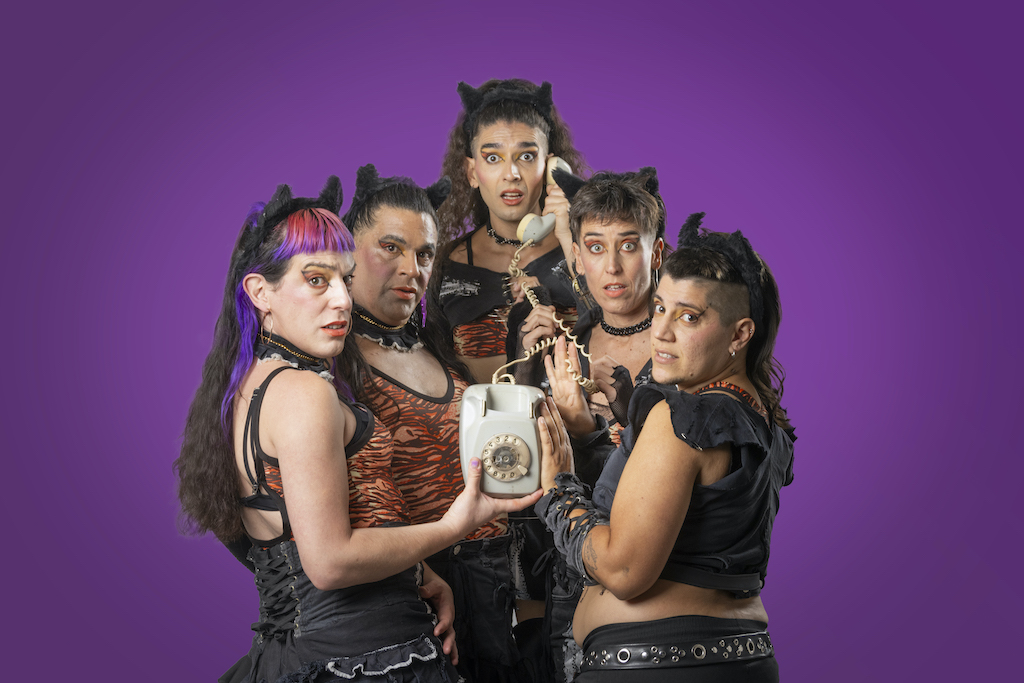
Here's a song for you can be seen on Sundays at 8 PM at Teatro del Pueblo, Lavalle 3636 (CABA). The cast includes Agustina Sena, Aldana Hilen, Amilcar Ferrero, Julián Vila Graca, and Rocío Caldés. Sound design and live music are by Tomas Pol, with assistant direction by Belén Italia Caprara.
Photos: Lina Etchesuri (Eug Krla) and Florencia Tagliabue (work).
We are present
We are committed to journalism that delves into the territories and conducts thorough investigations, combined with new technologies and narrative formats. We want the protagonists, their stories, and their struggles to be present.
SUPPORT US

FOLLOW US
Related notes
We are present
This and other stories are not usually on the media agenda. Together we can bring them to light.