

Labor Reform: How does it affect women and diverse groups?
How does labor reform affect women and diverse groups? Why does it imply setbacks in rights and caregiving responsibilities?



Share

The labor reform bill promoted by Javier Milei's government, which has already passed the Senate, drastically changes the way labor relations are conceived, with setbacks that will affect all workers in Argentina. The extension of the workday, modifications to severance pay, and restrictions on collective bargaining are just some of the proposed changes.
If approved, how will it affect women and diverse groups, who have the highest rate of informality in a labor market marked by the gender gap?
Why the labor reform is taking a step backwards in care work
“Although most of us are in informal employment , which might make it seem like the reform doesn't affect us, it does. The dismantling of historical labor rights guarantees—like the eight-hour workday— will not only affect trans and travesti people who entered formal employment through trans quotas , but will also enable more layoffs and make the pre-existing social disadvantage harder to overcome through eroded wages,” says Quimey Ramos, a travesti activist and human rights worker.
“By lowering the conditions for formal workers, this will also mean a new level of precarity for informal workers who depend on the daily economy and who, faced with the impossibility of maintaining the current consumption standard of salaried workers, will also see their income significantly reduced.
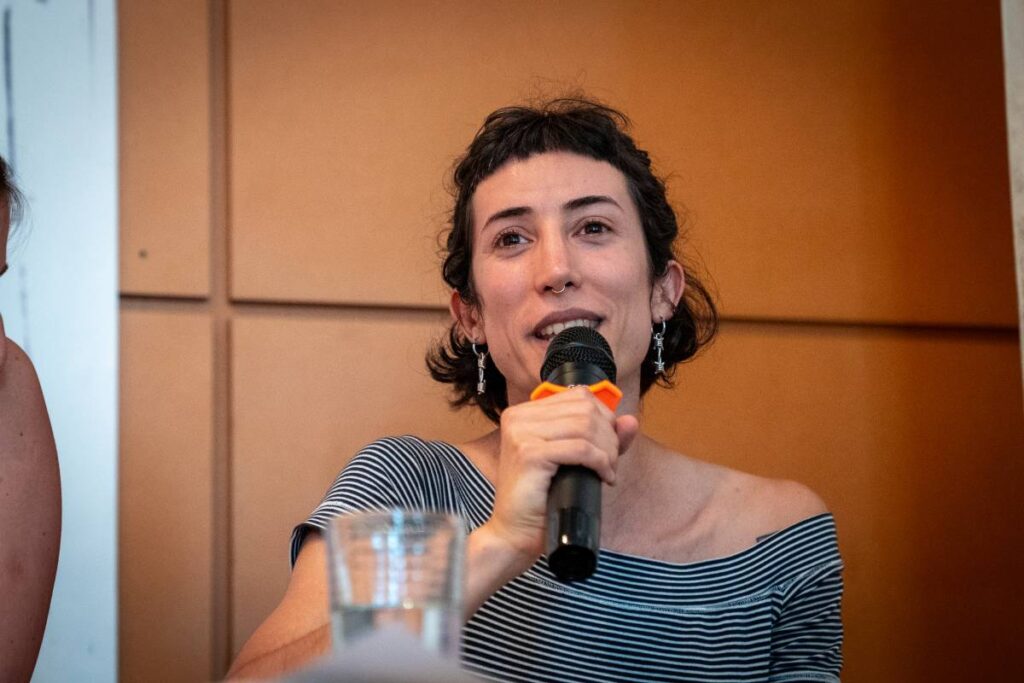
Quimey points out something that has been denounced since the project was first announced. “The reform attacks central aspects of care work and social reproduction, exacerbating the existing crisis surrounding these tasks. It’s serious; we, as gender and social dissidents, are the ones who primarily carry out care work . Faced with the possibility of having pay cuts in cases of sick leave, a caregiver will have to choose between staying home to care for their child or elderly relative when they get sick and losing a pay cut, or going to work and leaving that person to fend for themselves,” Quimey explains.
Greater fragmentation and fewer relational networks
“If our elders and our children are going to grow up more alone because those of us who perform caregiving tasks are going to have to work longer hours, the labor reform will also lead to greater fragmentation and destruction of the networks of affection and care that sustain us . There is no way these measures can be sustained without a great deal of repression. The only way to prevent an alternative to this model from emerging is by repressing, especially, those who dissent from sexual, racial, economic, and political norms. That is why we find transvestites, trans people, lesbians, gays, bisexuals, activists, and militants. We must build unity in which, by expressing our political differences, we can reach a synthesis.”
No overtime or collective bargaining
“The care system as we imagine it for the future never existed. Caregiving is still largely a family affair and largely feminized. This reform will only result in those who bear these responsibilities earning less,” explains Lucía Cirmi, economist (UBA), a leading figure in Futuros Mejores and former Undersecretary of Equality Policies.
“Whether it’s because of the pension cuts—because contributions to ANSES are being reduced—or because with the ‘bank of hours’—where overtime hours that are currently paid are accumulated—many of us will be the ones who don’t want to stay late or will opt to leave earlier the next day instead. But also because of collective bargaining, which will take place after hours and on a company-by-company basis. In the most feminized companies, the same wage inequality will be reproduced. The most important advances regarding care rights in collective agreements are negotiated sector by sector.”.
Cirmi also points out that the care system has practically disappeared. “Forty-seven out of fifty public policies have been repealed or defunded. From now on, any non-contributory policy—the AUH (Universal Child Allowance), the moratorium, pensions—will be affected because ANSES (National Social Security Administration) revenue will also be affected.”.
A model of exclusion and discarding
“Since Milei’s government took office, we’ve already had 2,000 layoffs, more than 70% of them women and gender-diverse people, despite the trans and travesti employment quota. They consider those of us who are defending not only our jobs but also care work, and with that, a way of life and a way of being workers, to be their main enemies,” says Ingrid Manfred, general secretary of ATE in Social Development.
From Ciudad Evita, María Figueroa, a retiree, says: “I’m 75 years old, I worked all my life, and the labor reform is making me anxious. I live in Ciudad Evita, in a very vulnerable neighborhood, and I see our neighbors wandering around; many don’t have enough money. I see the FATE factory closing and I remember when YPF was privatized. Back then I lived in Tartagal. With their severance pay, people opened bakeries or taxi services. At one point there were a hundred bakeries, but there wasn’t enough money to buy bread. All that history comes flooding back. Or 2001, but much worse. I hope this reform isn’t approved.”
“Saying ‘No to labor reform’ is not enough. We need to be able to speak to the new subjects of the precarious, informal world of work, to the new subjectivities that no longer think of themselves in overalls going to a factory, but with a cell phone, a virtual platform, shaped by other market logics, by another society where the economic and the individual have materialized over the collective and the community,” analyzes Georgina Orellano, General Secretary of AMMAR and a leading figure in the sex workers' movement in Argentina.
“It’s a reform framed in regressive terms. Women face the greatest difficulties entering the workforce. The deterioration of current conditions, coupled with the increase in these inequalities, will be much more critical for us and for people in the LGBT community,” says Karina Nicoletta, Gender Secretary of AGTSyP (Subway and Premetro Workers' Union) and Metrodelegada.
“The Milei government implemented labor reform on this sector, on the informal economy, and on us from the moment it took office. A model of exclusion and marginalization is being discussed,” says Dina Sánchez, deputy secretary of UTEP (Union of Workers of the Informal Economy).
We are present
We are committed to journalism that delves into the territories and conducts thorough investigations, combined with new technologies and narrative formats. We want the protagonists, their stories, and their struggles to be present.
SUPPORT US

FOLLOW US
Related notes


We are present
This and other stories are not usually on the media agenda. Together we can bring them to light.