

Fires in Patagonia: key voices to understand what is happening
Fires are raging again in Patagonia: we spoke with scientists, firefighters, and affected residents. They all warn that governments aren't investing in prevention policies or forest management, but are looking for someone to blame. Here are some key points to understand what's happening.


Share

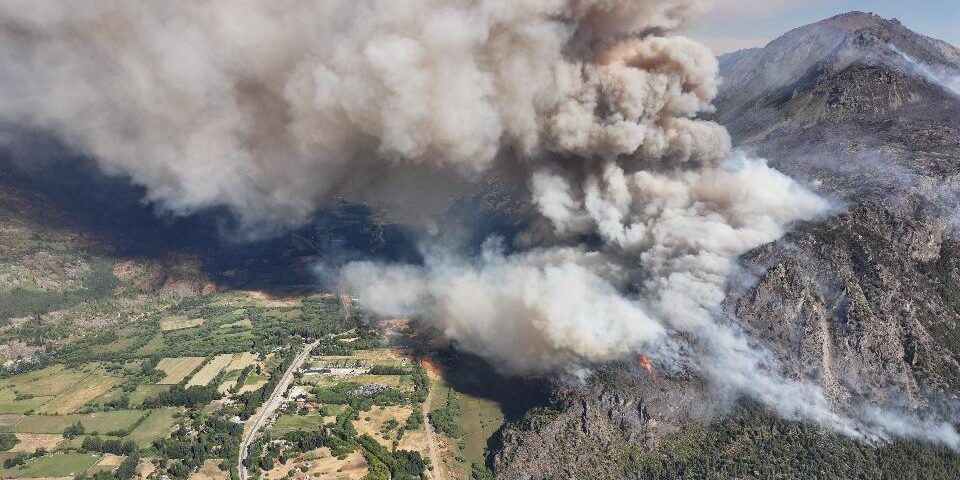
The fires have been raging again for several days in Argentine Patagonia. The flames are concentrated in Puerto Patriada, a popular tourist destination in the Andean region and the heart of the Epuyén Forest Reserve in the Cushamen Department (Chubut Province). This is currently the main focus of the fires, but there are also two other critical blazes: one in the same province, in Los Alerces National Park, and another on Cerro Huemul in Santa Cruz Province, within Los Glaciares National Park.
More than 2,000 hectares have been devastated in Puerto Patriada alone. "Thousands of hectares of ancient paradises are being devoured by fire, dozens of families have lost everything, lives of all species are dying, many do not survive the flames, tears and despair have taken hold in our hearts. The government, which invests in warplanes, has not been able to incorporate more water bombers. Despite everything, the organized community is doing what it can, as far as it is allowed, to activate aid to mitigate the fire," warns a public statement from Puelwillimapu/Chubut.
Why does the same thing happen every year? Presentes spoke with scientists, firefighters, and local residents, who warn that governments don't invest in prevention policies or forest management. Instead, they look for scapegoats and point to a known internal enemy.
Preventive policies are lacking and the budget is under-executed
High temperatures, lack of humidity, and winds are spreading the fires these days and hindering firefighting efforts. Fire management services are overwhelmed. Specialists warn that inaction and a lack of preventative policies and forest management also contribute to the problem . It also doesn't help that during Javier Milei's two years in office, funding for the environment has decreased. In 2024, only 22% of the budget allocated to fire management was spent .
From the Center for Argentine Political Economy (CEPA), political scientist and deputy (Union for the Fatherland) Julia Strada warned that “in 2024, in real terms, it executed 81.0% less than in 2023; in 2025, 70.8% less and in the 2026 budget (if 100% of what was budgeted is executed) the real adjustment of 70.7% vs. 2023 would be consolidated.”
In addition to denying climate change, the president has tried and promised to repeal the Fire Management Act, claiming that it hinders productive activity.
The strategy of accusing the Mapuche people
Last summer, and the summer before, the national and provincial governments' strategy was to blame the Mapuche communities. This year they are trying to use similar arguments.
Under the title “Your actions have consequences: you do them, you pay for them,” the Ministry of National Security issued an official statement affirming that “deliberate acts with possible links to self-proclaimed Mapuche terrorist groups are being investigated in the area. These groups have a proven history of attacks against public safety and private property, perpetrated as environmental terrorism.” Meanwhile, Ignacio Torres spoke of the existence of “violent individuals with revolutionary and anarchist delusions.”.
Last year, in a similar strategy, and following a series of twelve simultaneous and violent raids against the Mapuche-Tehuelche people, Victoria Núñez Fernández , a lagmien (sister) of the Lof Pillan Mahuiza, was arrested. Torres spoke about her and other Mapuche people at a press conference, showing their faces and labeling them terrorists and responsible for the fires that burned thousands of hectares. However, the Judiciary did not charge her with the forest fires, but rather with setting fire to machinery in Trevelin , without any evidence for either charge. Therefore, she was released on parole.
“Fear that the fire will reach us and the government will accuse us”
Marilin Cañio, a 33-year-old Mapuche woman, lives with her partner in El Pedregoso, at the foot of Pirque Hill. In desperation, she went out to find gasoline for her motorcycle and borrow a water pump. “Here, everything is a column of smoke; you can’t see anything but the trees and the houses. Although we are surrounded by rivers and lakes, we don’t have a water reservoir to fight this giant. We are surrounded by fire: it’s coming at us with full force,” she told Presentes .
“The fear today is that the fire will reach us and that after the fire the government will send thugs to harass us, to beat us, to fabricate unjust charges against us for something that has nothing to do with us. We are all suffering from this. It is illogical to say that we Mapuche are the ones who threaten life in the territories because we are defending them,” says the Mapuche woman Marilin.
Lack of response to a new dynamic
“These large forest fires no longer surprise us because they are part of a new dynamic unfolding in Northern Patagonia: the increasingly extreme climate, more frequent droughts, high temperatures, and the historical lack of forest management . We used to talk about one major fire every ten years, and now we're seeing four or five major fires in a single year. It's here to stay, and we have to confront it,” Javier Grosfeld, PhD in Biology, researcher at CONICET, and former director (in 1999) of the Strategic Management Plan for the Lago Epuyén Forest Reserve, coordinated by the Andean-Patagonian Forest Research and Extension Center, told Presentes.
“Intentional fires are a minority of the fires in Northern Patagonia,” adds researcher Grosfeld. “If you were to rank them, most are due to negligence. In the case of Chubut, for example, they are related to the lack of maintenance of power lines, which is the responsibility of the provincial company .”
“It’s the easiest thing to do: the governor says, ‘This is the culprit.’ Proof? None. He goes to jail for three months. The courts release him because there’s no proof. But, that’s it, ‘someone responsible’ has been found. What happens after that? Paralysis, nothing else gets done.”.
“ We need to think about forestry policies, ” he concludes. “We can’t keep repeating the same things that lead to these results. We need to prepare the landscape for fire. First, to prevent it; but once it has already happened, so that we know what to do.”
Patagonia, "a match every summer"
Flavia Broffoni, an activist and resident of Epuyén (Chubut), signed up as a volunteer firefighter, as did many others in the area. “Last year we had a very large fire, but I had never seen what I saw this year in Pirque, an image very similar to the gates of hell. Added to this is the desperation of accompanying families defending their homes and the absolute lack of support in the face of official assistance,” she told Presentes . She added: “With no snowfall, water reserves are extremely scarce. And on top of that, they are trying to mine on the glaciers, which are the only source of water recharge in the Andean provinces. It's a whole combination of bad public and social decisions that turn Patagonia into a tinderbox every summer.”
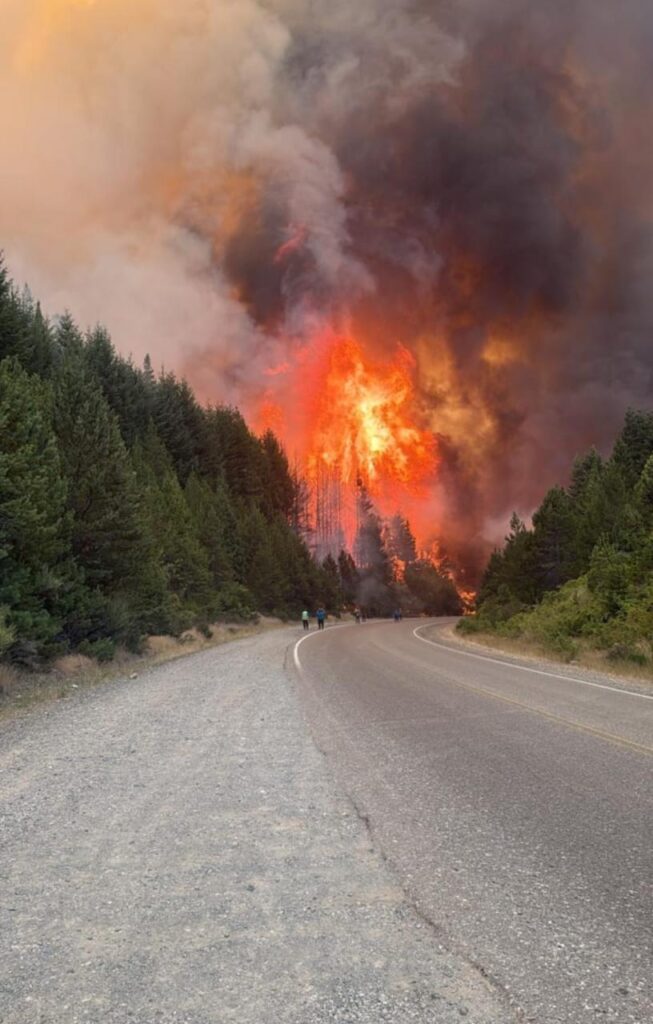
“ These fires were bound to happen at some point. Puerto Patriada was a ticking time bomb . It's an area with many pine trees, a pyrophytic species that thrives in fire and needs it for proper reproduction. It was a forest that had burned before and then returned with even greater force, something that often happens with pine trees. This species surrounds the entire entrance and exit to a tourist area,” Hernán Ñango, a forest firefighter with the National Fire Management Service, explained to this agency.
“Generally, what we do with these fires is contain them,” he adds. “Not fight them, but mitigate the damage as much as possible. And look for any window of opportunity where the fire slows its spread. The scale of the fires is such that it takes weeks of work, and the days ahead aren't very favorable.” For this reason, he believes it's crucial “to work on resilience, in the lead-up, not just once the fire has started.”
There are currently at least three major active wildfires in Chubut and Santa Cruz, while a fourth has been brought under control. The Federal Emergency Agency reported that the provinces of Mendoza, San Luis, Córdoba, Buenos Aires, La Pampa, Neuquén, Río Negro, and Chubut are under fire alert .
Prevention, the most necessary policy
“Prevention begins with being informed, knowing what forest fires are, knowing that they can affect us and that they can happen at any time, even if we follow good practices. It means having defensible homes and communities that know what to do. When fires of this magnitude occur, whether in Argentina, Canada, or Greece, resources are overwhelmed,” says researcher Grosfeld.
He also believes it's necessary to develop policies that prepare the ground for fire control. “Policies are generally very short-sighted. We need to think about what we have to do after a fire for the following year. First and foremost, we need to address the issue of the presence of a species like pine, which has these fire cycles in Patagonia. Pine was brought from the United States in the 1920s, which had a different climate. It was planted alongside other species and is very competitive. So, we can invest, for example, in hiring people to remove the pines to prevent that landscape from burning again. We can also carry out controlled burns to reduce the immense amount of fuel present.”.
More firefighters, less precarious work, and better equipment
The other essential need for responding to the forest fires is having the necessary resources. Governor Ignacio Torres announced, with great fanfare, the addition of the Boeing 737 FireLiner water bomber, “the largest in Latin America,” to combat the fire in Puerto Patriada. However, the smoke prevents the deployment of aircraft most of the time. And firefighters warned that an hour of flight time for an aircraft costs around $5,000, equivalent to the salaries of seven firefighters.
In this context, specialists emphasize the need for more trained and equipped firefighters . “ Public spending shouldn't just be on buying planes, but also on hiring more personnel. We need to professionalize them and eliminate precarious employment. There are also issues with pensions. There are 65-year-olds who continue working on the front lines because their pensions aren't commensurate with the type of work they do, which is classified as carcinogenic,” says Ñanco.
The hotspots in Chubut and Santa Cruz as of January 9
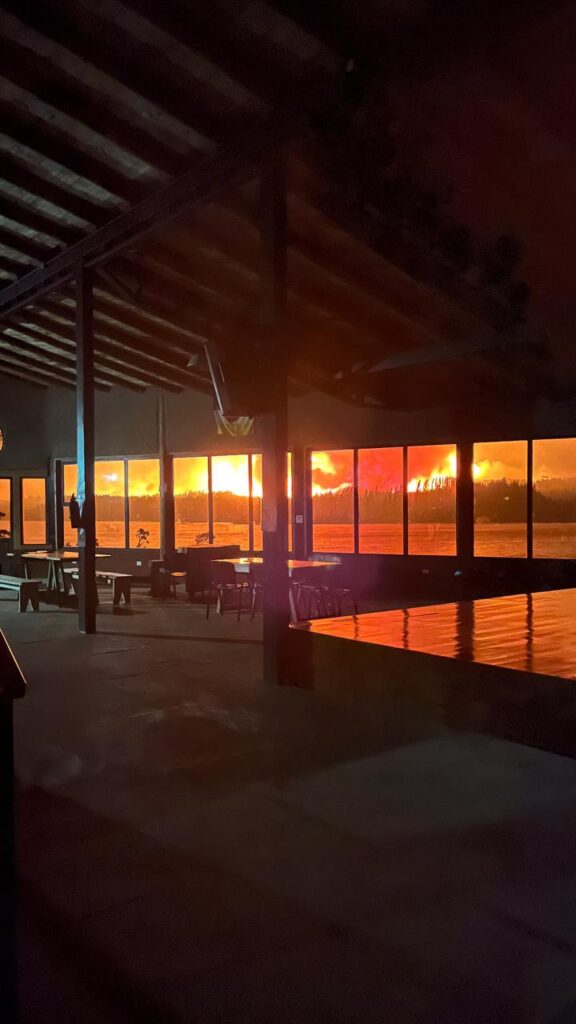
The fire in Puerto Patriada, in the Chubut province town of El Hoyo, began last Monday. It advanced across Pirque Hill and is heading towards Epuyén, prompting the evacuation of some 3,000 people. It is currently the main focus of the fire, having already burned approximately 2,000 hectares. This is also because it is located in a "wildland-urban interface" zone, where forested and urban areas coexist, and the fire has already reached some homes.
The fire in Puerto Café, in Los Alerces National Park (Chubut), is also still active, stretching from Lago Menéndez to Lago Verde and Rivadavia. The fire is also advancing on Cerro Huemul, in Los Glaciares National Park, in El Chaltén (Santa Cruz). Both parks are UNESCO World Heritage Sites. Meanwhile, the fire in El Turbio (Chubut), which started on December 1st and burned 3,000 hectares, has been brought under control.
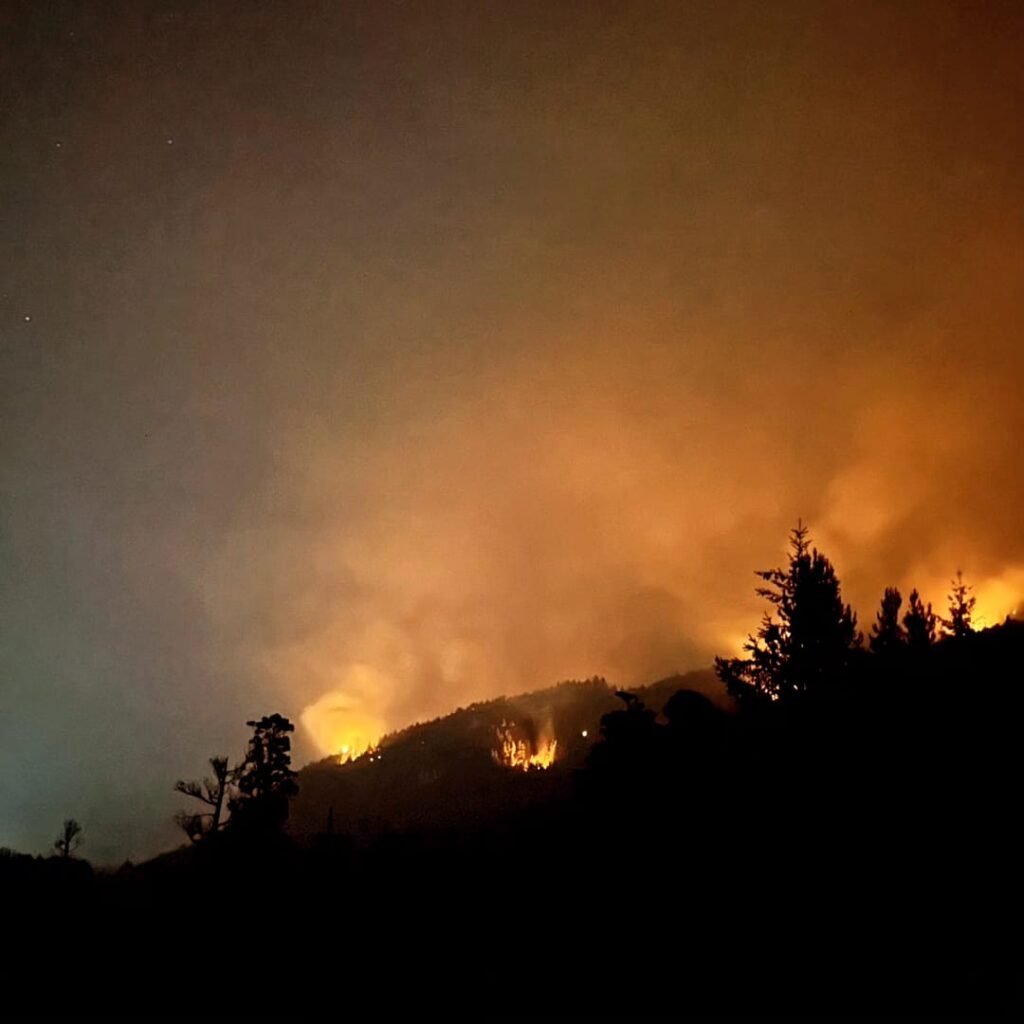
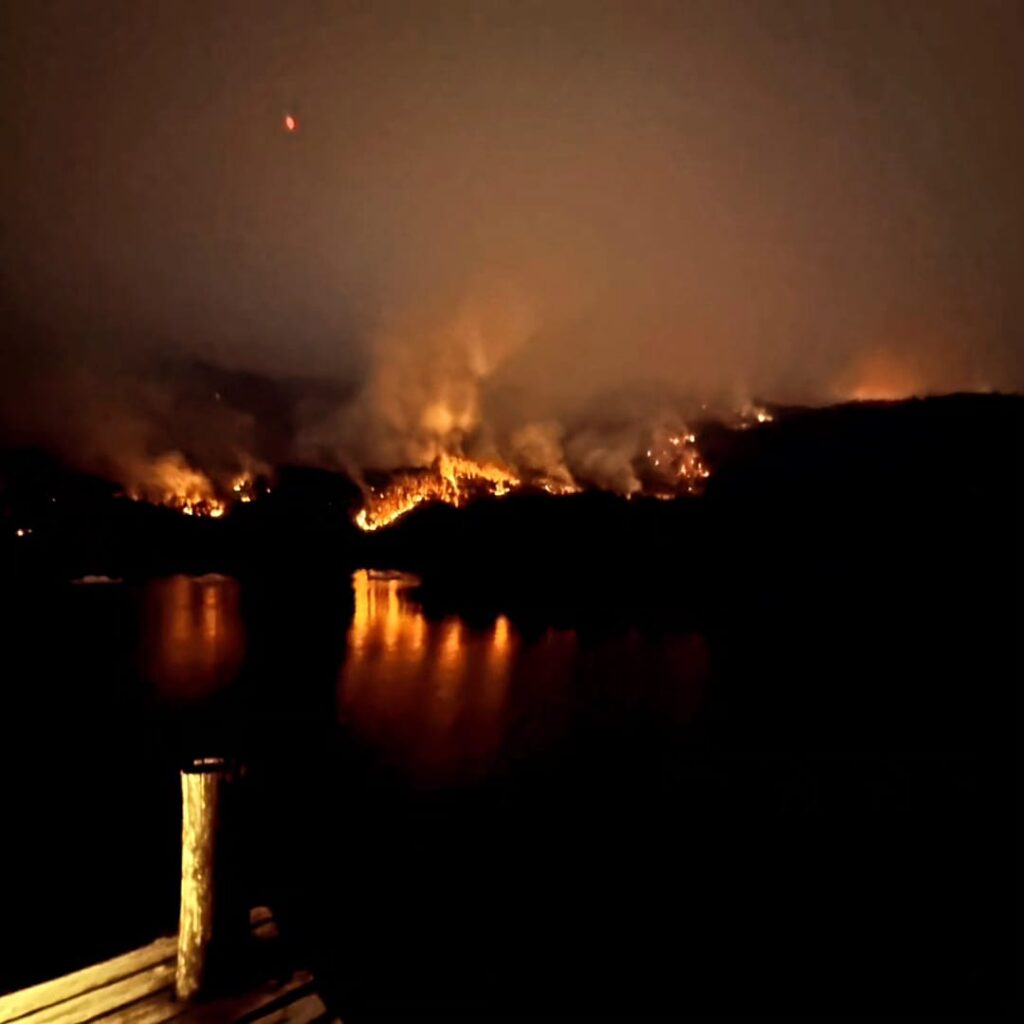
The photos illustrating this article were provided by the people interviewed and taken during the first days of January 2026.
We are present
We are committed to journalism that delves into the territories and conducts thorough investigations, combined with new technologies and narrative formats. We want the protagonists, their stories, and their struggles to be present.
SUPPORT US

FOLLOW US
Related notes



We are present
This and other stories are not usually on the media agenda. Together we can bring them to light.