

Venezuela: a look from the perspective of diversity and human rights
The United States' intervention in Venezuela demands a broad perspective on sovereignty and autonomy. The role of LGBT organizations. Opinions shared by Siobhan Guerrero, Raúl Caporal, and other voices from diverse and feminist movements.


Share

MEXICO CITY, Mexico. On January 3, 2026, the U.S. military bombed Fort Tiuna, the main military base in Caracas , at least 80 people have been reported by the U.S. military.
Since Monday, January 5, Maduro has been on trial in New York on charges of drug trafficking, terrorism, corruption, and conspiracy , in which he has pleaded not guilty . His wife, one of his sons, and other high-ranking officials in his government are also on trial.
This comes after Donald Trump presented his National Security Strategy (NSS) on December 4. In it, he explicitly revives a “ Trump corollary” to the Monroe Doctrine, asserting that the United States will enforce its regional dominance by excluding “non-hemispheric competitors” such as China and Russia. The document prioritizes U.S. national security to curb mass migration and takes a militaristic view of the war on drugs, labeling cartels as terrorist groups .
Voices of Latin America
Feminist and LGBTQ+ leaders spoke out about the events in Venezuela. Even the ILGALAC Regional Council expressed its "concern about the United States' military intervention in Venezuela and the escalation of threats against countries like Colombia, Mexico, and Cuba.".
In Argentina, the Indigenous Women's Movement declared: "We know and understand that there are fatal, destructive interests behind these disguised actions and the danger they represent for all life. Our Indigenous sisters and brothers in the territories are not wrong to have long denounced the repressive and anti-democratic imperialist apparatus crushing the culture and freedom of the peoples in Indo-America and other countries of the world."
A well-known story in the Region
This US military attack on Venezuela reopens the memory of US interventions in Latin America during the 20th century . The last time the US government intervened militarily in the region was on January 3, 36 years ago. It invaded Panama and captured President Manuel Noriega , also to try him for drug trafficking.
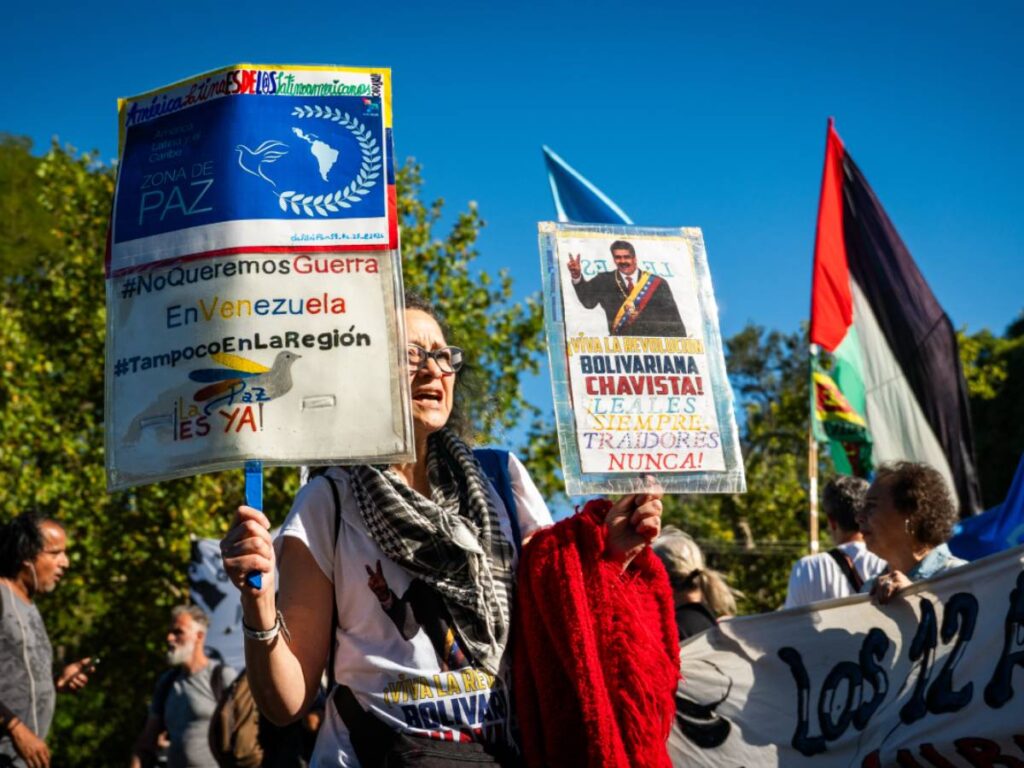
The events sparked a narrative dispute fueled by the polarization perpetuated by the US government regarding "liberating" a people and "protecting democracy." On the other hand, there is the alarm raised by actions in which the US government intervenes with its armed forces and authoritarian rhetoric in the region.
In Presentes, we spoke with Siobhan Guerrero, a researcher and philosopher of science, and Raúl Caporal, an activist and president of Casa Frida —an organization dedicated to the protection and support of LGBTI+ migrants and those displaced from their homes—about the repercussions of this event. We explored how this intervention not only affects Venezuelan and regional sovereignty but also serves as a “laboratory for an ‘anti- woke ’ ideology that seeks to dismantle collective resistance.”
The trap of limited agendas
For Siobhan and Raúl, the current scenario in Venezuela and the international response led by the United States represent a warning sign that forces a rethinking of resistance strategies from a much broader and less fragmented perspective.
One of the most critical points they raise is the urgent need to overcome the "narrow vision" that has historically shaped gender and diversity agendas. This has allowed these issues to be isolated from the global political context.
“ This fragmented construction serves outside interests because it doesn't show how LGBT and feminist movements are intertwined within more complex geopolitical landscapes. This is detrimental to us precisely because it obscures the fact that these are not minority issues, nor are they exclusively women's issues. They are issues related to complex geopolitical matters, human rights, international law, and the rights of coexistence—not only between states, but also between populations,” Siobhan explains.
He adds, “What happened in Venezuela represents a violation of international law and prioritizes economic interests, not even those of a country, but those of its ruling elite. When that is placed above international law, and done in such a cynical way, saying, 'we're here for the oil,' it sends the message that all human rights frameworks are losing their normative force. That is the serious issue. And I understand that some Venezuelans are celebrating, that they feel they are witnessing the liberation from an authoritarian regime, but everything indicates that this is not what happened. In fact, Trump is not interested in anything related to human rights or collective interests. It is very clear, then, that there is no liberation from anything.”
Militarization is not democracy
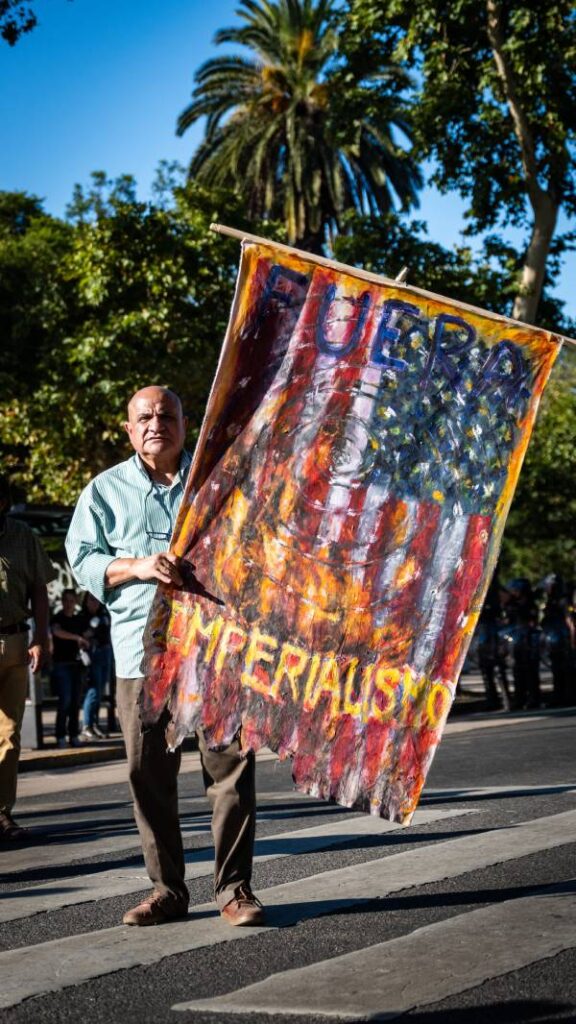
From his experience working with humanitarian aid organizations like Casa Frida, Raúl offers a perspective shaped by his support of Venezuelans fleeing poverty and persecution. While acknowledging the “hell” endured under Nicolás Maduro’s regime, he cautions that “a militaristic solution is not a path to freedom.”.
" No democratic system can be restored through force of arms. We are opposing the narrative that democracies are restored through military interventions. Diplomacy over the decades has taught us that there are other ways... In the end, I believe that nothing will justify the use of military force for this."
For Raúl, the problem isn't just Venezuela, but a regional trend toward the military takeover of institutions. This phenomenon is observed in El Salvador, Nicaragua, Ecuador, and also Mexico. "History has shown us this many times. The forceful takeover of democratic institutions, in addition to weakening them, stems from militarization, and Mexico is no exception ."
The success of the "anti-woke" ideology
Another consequence that Siobhan and Raúl observe is the effectiveness of far-right rhetoric in gaining popular support in Latin America. They explain that there is a direct connection between this geopolitical phenomenon, which acts as a catalyst for the rise of the far right, and the dismantling of human rights for LGBT+ people and women throughout the region.
“ -woke narrative is becoming a bridge to legitimize imperialist interventions . It serves as a laboratory for an anti-woke ideology that seeks to dismantle collective resistance,” Siobhan comments.

“The United States is indeed fighting an ideological war. It’s no longer just talking about communism, but creating other kinds of enemies. And it’s being terribly successful because it’s capturing not only the elites, but also broad sectors of the population in countries like Chile, Argentina, Brazil, and Mexico.”.
“This anti-LGBT, pro-racist, anti-immigrant, anti-feminist discourse they have constructed has served to legitimize this intervention in Venezuela. That is why we see far-right regimes celebrating. The LGBT population, especially the more critical voices, as well as feminism, does see this connection between the advance of imperialism at the geopolitical level and the setbacks in LGBT and women's rights.”
The urgent need for education about the people
This “ideological capture” that Siobhan speaks of is largely fueled by a crisis of historical memory in the region regarding the dictatorships and human rights violations brought about by US interventions in Latin America.
Specifically, Siobhan explains that the majority of the Latin American population has not been educated to recognize that invasions and violations of the international order infringe upon the autonomy of nations and directly affect individuals. Nor is there room for reflection when the actors involved in these events are questioned.
“It would seem that memory is confined to certain spaces. We haven’t been able to create a transversal memory. We see it in Argentina, how despite all the construction of memory of the dictatorship, someone like Milei comes along and kicks that memory to the curb. And he has enormous popular support from people who also don’t seem interested in that memory. Furthermore, many times the challenge isn’t received successfully as an invitation to reflection, but rather as a symbolic attack that leads to responding through denial.”
What can feminist and LGBT movements do today?
Siobhan and Raúl agree that building effective resistance requires a cross-cutting alliance between feminist, LGBT+, and decolonial social movements, rather than isolating their causes . This necessitates integrating knowledge and "combining narratives," as Siobhan explains.
"To the extent that all these struggles are intertwined, understanding what is happening requires combining narrative elements from all the resistance movements . This requires stepping outside our narrow confines of 'I fight for this, you fight for that.' We need to learn about geopolitics from LGBT populations, and those who engage in anti-imperialist activism will have to learn about feminisms and LGBT activism. And we are going to have to cross-reference narratives."
Complementing this perspective, Raúl focuses on the issue of migration. He denounces the fact that even within social movements, LGBT+ rights organizations still resist including migration as a priority on their agendas
“This lack of maturity in the political agenda prevents us from seeing that the forced displacement of thousands of Venezuelans is not a separate issue. It is a direct consequence of the erosion of democratic institutions and the systematic violence that disproportionately affects trans people and people with diverse sexual orientations. Overcoming this narrow view, then, implies understanding that the defense of LGBT rights in Mexico or any other country is inseparable from regional solidarity and critical analysis of how military interventions are being normalized under the pretext of 'restoring democracy'.”.
We are present
We are committed to journalism that delves into the territories and conducts thorough investigations, combined with new technologies and narrative formats. We want the protagonists, their stories, and their struggles to be present.
SUPPORT US

FOLLOW US
Related notes



We are present
This and other stories are not usually on the media agenda. Together we can bring them to light.