

Four out of five countries lack laws protecting LGBT+ youth from bullying at school
A report published by ILGA Mundo reveals that there has been progress, but currently only six UN member states have adopted laws protecting LGBT youth and children.


Share

BUENOS AIRES, Argentina. Four out of five countries worldwide lack laws protecting young lesbian, gay, bisexual, transgender, and intersex people from bullying. This was reported by the International Lesbian, Gay, Bisexual, Trans and Intersex Association (ILGA World) in a press release. Despite the rise of far-right and anti-gender movements globally, there has been progress in recent years. Chile is currently debating a bill, and in Brazil, the Supreme Federal Court declared in 2024 that educational authorities must prevent and address bullying against these identities.
“Bullying harms the mental health of LGBTI students and reduces their academic and employment prospects. Its consequences increase healthcare and social care costs. If states are serious about creating a more economically prosperous future for all, they must understand that their inaction is harmful not only to LGBTI people, but to society as a whole,” shared Gurchaten Sandhu, Director of Programs at ILGA World.
According to the ILGA World Database , only six United Nations (UN) member states have adopted laws against bullying that protect young people based on their sexual orientation, gender identity, gender expression, and sex characteristics (SOGI) . Furthermore, at least one of these grounds is explicitly mentioned in the national laws of 40 UN member states: only one-fifth of the world.
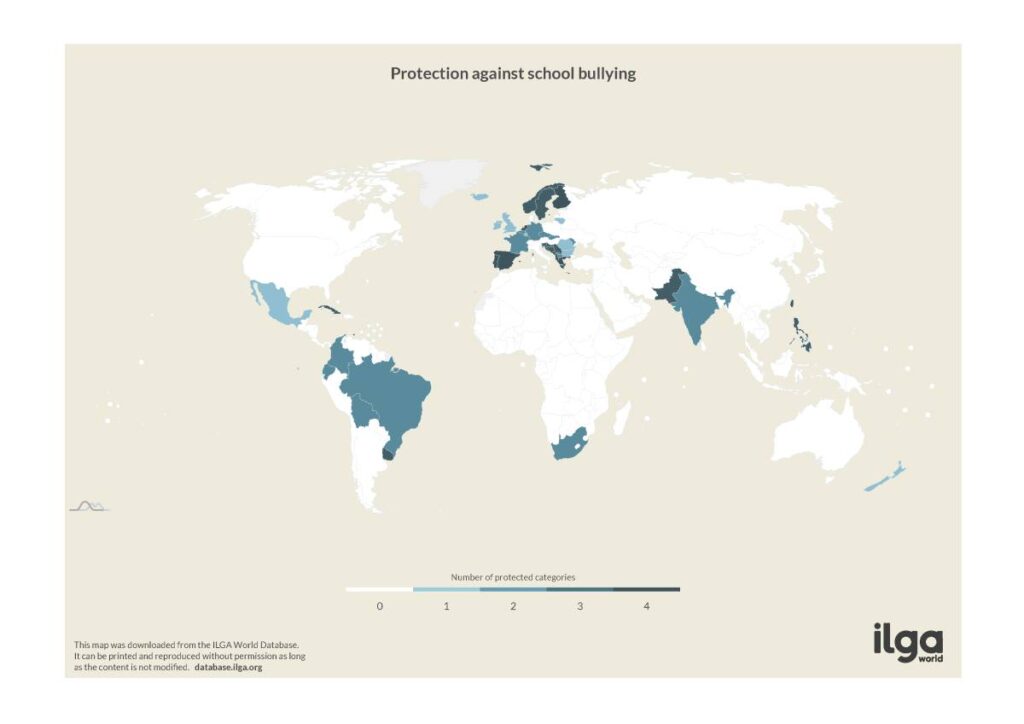
(Source: ILGA World Database ).
What is the global outlook?
Most of these countries use education or equal treatment laws to protect against bullying. They prohibit bullying based on sexual orientation, gender identity, gender status, and sexual orientation in educational settings or legally require institutions to incorporate LGBTI+ bullying into their codes of conduct and policies.
Some jurisdictions have included harassment against diverse identities in laws that specifically protect children as a group. Meanwhile, only in one case (France) can punishments include prison sentences.
“These laws suggest that states may understand bullying as a very particular form of violence that not only has young people as its main victims, but also as its main perpetrators,” stated Curro Peña Díaz, Research Consultant at ILGA Mundo. “For this reason, jurisdictions often resort to educational approaches to educate bullies and provide some redress to victims within the school system, rather than resorting to criminal penalties.”
Latin America
Despite the hostile environment for LGBTQ+ people, marked by the rise of far-right governments and anti-gender movements globally and regionally, Latin America has seen some progress in recent years. However, several countries still lack laws addressing harassment against LGBTQ+ individuals, including El Salvador, Haiti, Honduras, Nicaragua, Paraguay, Peru, and Venezuela.
Chile is currently engaged in a legislative debate. In June 2024, President Gabriel Boric presented a bill to the Chamber of Deputies establishing regulations for peaceful coexistence, fair treatment, and the well-being of educational communities. Its objective is to prevent and eradicate harassment, discrimination, and all forms of violence in educational institutions.
If approved, it would amend Article 16b of the Education Law. It would require schools to adopt preventative measures and protocols for addressing bullying, including bullying based on sexual orientation, gender identity, or gender expression. The initiative was approved by the Chamber of Deputies, and this year the Senate unanimously approved the bill in general. The Senate Education Committee now needs to open a debate on the specifics of the initiative .
Meanwhile, Brazil's Supreme Federal Court declared in June 2024 that educational authorities must prevent and address bullying based on sexual orientation and gender identity as part of their legal obligation to guarantee everyone the right to education without discrimination.
With regard to Latin America, many countries adopted regulations that address harassment for one or more of these reasons between 2013 and 2014, a date that coincides with the presence of progressive governments in the region.
School bullying: Four out of five countries lack laws protecting LGBTI youth, according to new data published today by ILGA World.
— ILGA World (@ILGAWORLD) November 5, 2025
Visit the new section of the ILGA World Database for more information : https://t.co/j9vtDrJGuY
In Argentina , following the 2013 approval of the Law for the Promotion of Coexistence and the Management of Conflict in Educational Institutions , the Federal Council of Education published in 2014 the “ Federal Guide of Guidelines for Educational Intervention in Complex Situations Related to School Life .” This guide contains a section on discrimination or harassment based on sexual orientation or gender identity.
In Bolivia, Article 151 of the Children and Adolescents Code (2014) prohibits violence in the education system, expressly mentioning violence motivated by gender identity and sexual orientation. In this sense, it prohibits any type of distinction, exclusion, restriction, or preference within the education system and also protects against other types of violence, such as verbal and cyber violence.
Furthermore, Law on the Rights of Children and Adolescents (2014) urges educational authorities to adopt measures to prevent and respond to bullying. According to Article 10, authorities must pay special attention to children and adolescents who are vulnerable due to their sexual orientation. In addition, several Mexican states, such as Hidalgo, the State of Mexico, Michoacán, Morelos, and Nayarit, have adopted laws protecting against bullying based on sexual orientation.
In Colombia, Article 4 of Law 1620 (2013) created the National System for School Coexistence and Training for the Exercise of Human Rights, Sexuality Education, and the Prevention and Mitigation of School Violence. It established mechanisms for the prevention, protection, early detection, and reporting of all behaviors related to bullying and school violence. Article 2 specifies that discrimination based on sexual orientation and gender identity is prohibited.
Uruguay was a pioneering country in addressing violence against the LGBTI+ community. In 2004, it passed the Law against Racism, Xenophobia, and all other forms of discrimination . Article 2 prohibits all "physical and moral violence" based on sexual orientation and gender identity in any sphere of public life.
In 2023, the National Public Education Administration promoted the “ Roadmap to situations of violence against children and adolescents in early childhood and primary education ” in which it recognized that “gender violence is also expressed through the non-acceptance and disrespect of sexual diversity, homophobic and transphobic discrimination; it is a form of violence towards [children and adolescents].”
In turn, and more explicitly, Articles 15 and 16 of the Comprehensive Law for Trans People (2018) require educational authorities to adopt measures to ensure the inclusion of trans people.
Later, in 2021, Ecuador amended its Organic Law of Intercultural Education and defined sexual harassment as any type of aggression or harassment that, among other possible motivations, is based on sexual orientation and gender identity.
More states with laws
“We encourage more States to follow these promising paths. Most of us work hard for our families, no matter what they are like,” shared Kimberly Frost and Yuri Guaiana, co-secretaries general of ILGA World.
“But today, a few powerful people are stoking divisions among us and blocking efforts to ensure safe and welcoming schools. We must unite and advocate for laws that guarantee all young people can enjoy a high-quality education that allows them to pursue their dreams, without exceptions or obstacles,” they concluded.
We are present
We are committed to journalism that delves into the territories and conducts thorough investigations, combined with new technologies and narrative formats. We want the protagonists, their stories, and their struggles to be present.
SUPPORT US

FOLLOW US
Related notes

We are present
This and other stories are not usually on the media agenda. Together we can bring them to light.