

Why is September 30th LGBT Remembrance Day in Paraguay?
LGBT organizations in Paraguay recognize this date as the first public demonstration of activism for sexual diversity, which predated the Stonewall riots in the United States by 10 years.


Share

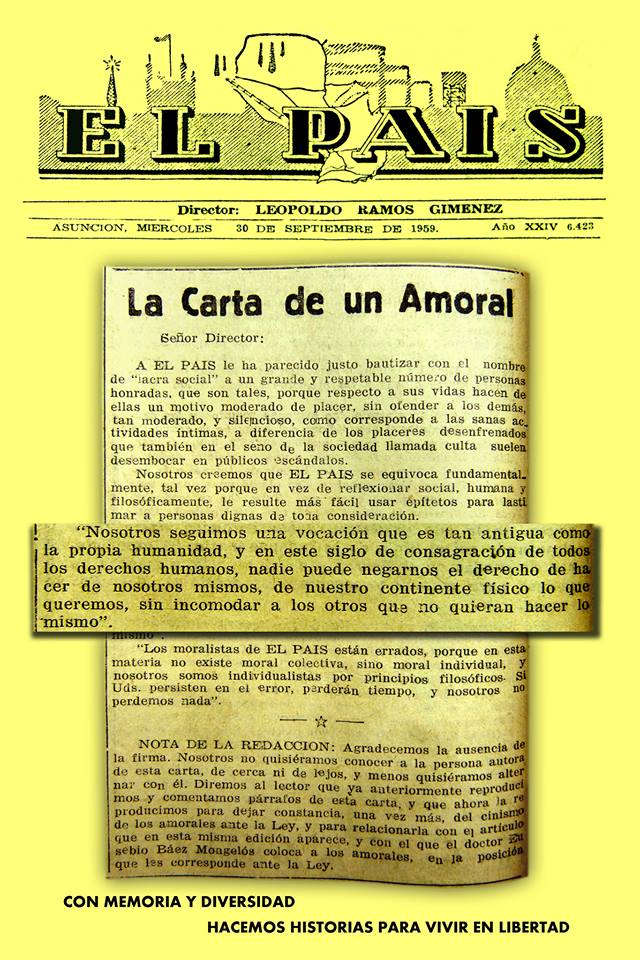
On September 30, the newspaper El País published a letter titled “Letter from an Immoral Man,” which became a landmark in the history of the struggle and resistance of the Paraguayan LGBTI movement. This letter is claimed by LGBTI organizations in Paraguay as the first known public demonstration for sexual freedom in the country, even predating the Stonewall riots (New York, USA, 1969) by 10 years .
That is why the rights of LGBTI people are commemorated in Paraguay during the month of September. Thanks to historical research and the construction of local memory, it has been demonstrated that voices of protest already existed in Paraguay during the dictatorship. Today, 108 is no longer a "cursed number." It is a symbol of struggle and a tribute to the victims who suffered repression, torture, exile, and death because of their sexual orientation and gender identity.
From insult to Pride: history of the 108
The number 108 functions as a symbol in Paraguay. From insult to pride. From number to word. It was erased from traditional hotels, from houses, from license plates, from the internal numbers of public institutions. They tried to make it disappear, just as they made homosexual people, diverse bodies, and identities that don't fit the molds of good morality disappear. 108 is also called the "cursed number" because of its historical and symbolic weight, and to this day many still use it as an insult.
Where does the 108 come from?
Bernardo Aranda, a 25-year-old radio announcer for Radio Comuneros, was found burned to death in his home located at the corner of Estados Unidos and Novena Proyectadas streets in the Barrio Obrero neighborhood of Asunción. This occurred on September 1, 1959, five years after the start of Alfredo Stroessner's long dictatorship (1954-1989). Although the circumstances of Aranda's death were never clarified, the police stated it was a "crime of passion.".
Among the reasons why the case acquired so much public relevance were Aranda's popularity and the public's insistence on finding those responsible for the crime.
This case was used as a pretext to persecute 108 gay men identified as “suspects.” In addition to suffering exposure and stigma from Asunción society, they were captured and tortured.
Beginning on September 2, the police violently and arbitrarily arrested people they suspected of being homosexual under the pretext of investigating the case. According to research by lawyer and LGBTI human rights activist Erwing Szkol, on September 7, 1959, five days after the investigations began, the premise that those arrested had "dubious sexual conduct" was publicly stated for the first time. This was an attempt to link these "immoral" individuals to the crime, justifying further arrests.
On Saturday, September 11, the newspaper El País , which was aligned with the Stroessner dictatorship, published an article about the arrests made that morning with the headline: “108 People of Dubious Moral Conduct Are Being Interrogated. Intense Police Action. Results Expected.” This was the first time the number 108 appeared in connection with the arrests of “immoral” people . From then on, the number 108 ceased to be just a number and became an insult directed at people considered homosexual.

Echo of a journalistic record
The press echoed the police reports and, as described in Szokol's report "108 One Hundred Eight," also called for a campaign of "moral cleansing," urging the authorities to use de facto criminal prosecution to eradicate this "vice." However, one aspect often overlooked when recounting the historical events surrounding the origin of the name/number 108 is that it was not an official figure, but rather a record made by a reporter during their coverage.
The number 108 comes from a list of homosexuals accused of being involved in a crime. And all the people who appeared on the list were arrested and tortured . But it wasn't the only list published during the years of the dictatorship, nor the only instance of abuse against homosexuals. Many other lists circulated with names that weren't even linked to Aranda.
This crackdown on opposition figures and entertainment venues linked to the gay community was carried out for 10 years. On October 13, 1963, to cite just one of the many incidents, a series of leaflets were distributed throughout Asunción listing 43 people accused of being “immoral.” It was signed by the “Parents’ Committee, for the cleansing of our society.”.
We are present
We are committed to journalism that delves into the territories and conducts thorough investigations, combined with new technologies and narrative formats. We want the protagonists, their stories, and their struggles to be present.
SUPPORT US

FOLLOW US
Related notes



We are present
This and other stories are not usually on the media agenda. Together we can bring them to light.