

Feminist and diverse groups demand justice for Lara, Morena, and Brenda
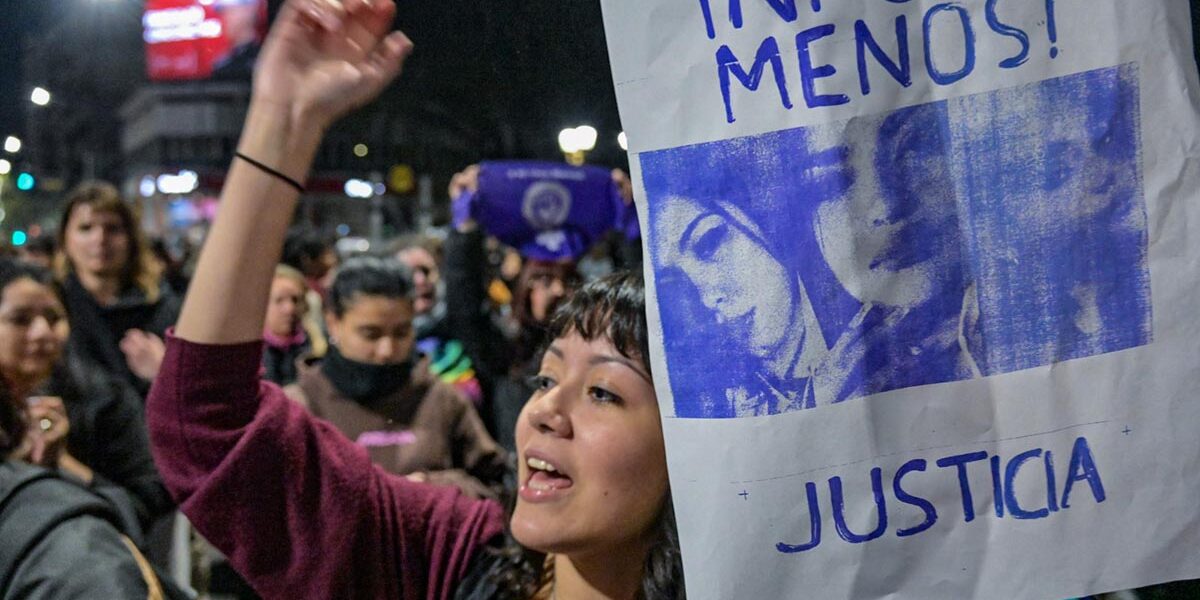
Hundreds of women marched in Plaza Flores to demand justice for the three girls murdered in Florencio Varela. They are calling for another demonstration on Saturday in front of the National Congress.


Share

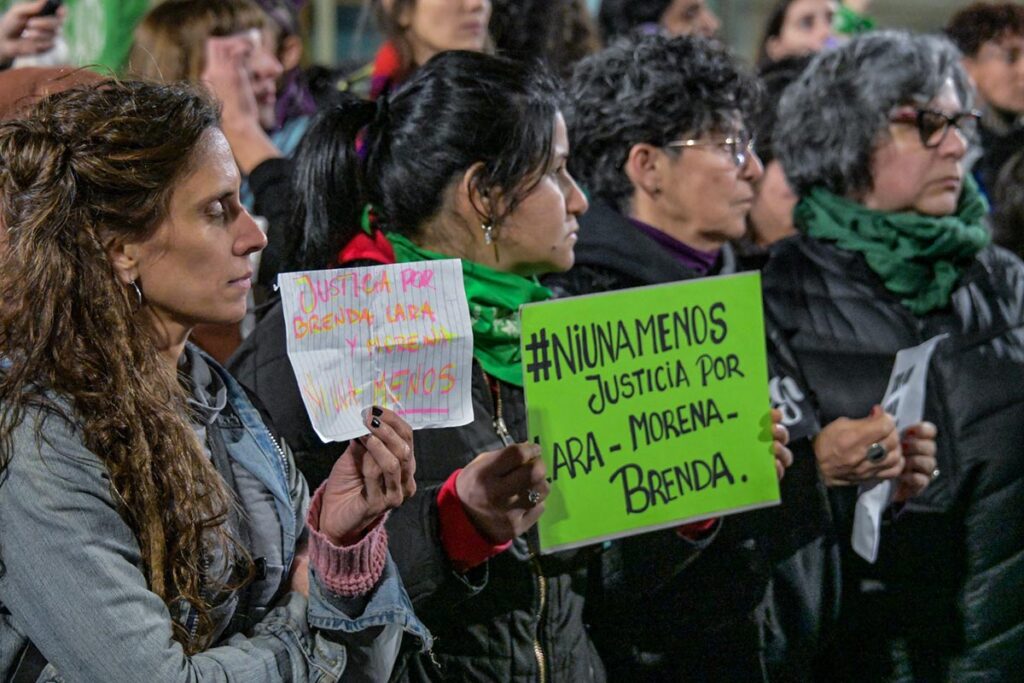
BUENOS AIRES, Argentina. A multitude of women, girls, men, organizations, and individuals gathered this Wednesday in Plaza Flores to demand justice for Morena Verri (20), Brenda Loreley Del Castillo (20), and Lara Morena (15) Gutiérrez. They had been missing since Friday and were found murdered and dismembered on Wednesday, September 24, in Florencio Varela. Similar demonstrations took place in different parts of the country.
After the news broke in the early hours of Wednesday, self-organized groups gathered to protest and shout: “Stop killing us!” The main demonstration was organized by the Association of Sex Workers of Argentina (AMMAR) Yo No Fui collective in the Flores neighborhood of Buenos Aires.
The gathering was scheduled for 7 p.m., but people began arriving throughout the afternoon, and by that time there were already hundreds of participants. Traffic around the plaza was congested due to the large number of people wanting to join. After finding a suitable place to stop the march, a circle formed around some prominent figures in transfeminist activism.
“Today there are three fewer. Today there are three families that are broken, and there will be many more if we don't mend the broken social fabric . If we don't acknowledge that this doesn't happen to just anyone. It happens to poor women. Poor women are the disposable subjects of this national government. It is us, and it is our lives that are at stake. Justice for our sisters, and let it never happen again!” said Georgina Orellano, a sex worker and general secretary of AMMAR, in front of the crowd that formed a circle in the center of Plaza Flores.
“We’re here because our colleagues used to frequent this neighborhood. It’s where they worked and where they were expelled from. They had been reporting police harassment for a year,” Orellano explained. One of the investigation’s hypotheses is that the neighborhood is the strategic location where the perpetrators met some of the women.
“Justice means taking to the streets.”
Orellano continued: “Justice means taking to the streets and ensuring that feminism once again places the cross-cutting nature of what happens to poor people firmly on the agenda. Put your bodies on the line, girls. Get off social media.”.
Alejandra Rodríguez, a member of the Yo No Fui collective, also spoke, describing a collective grief. “We believe all of this is happening because of the precariousness of life to which these death policies are pushing us, this State that has turned its back on our lives.”
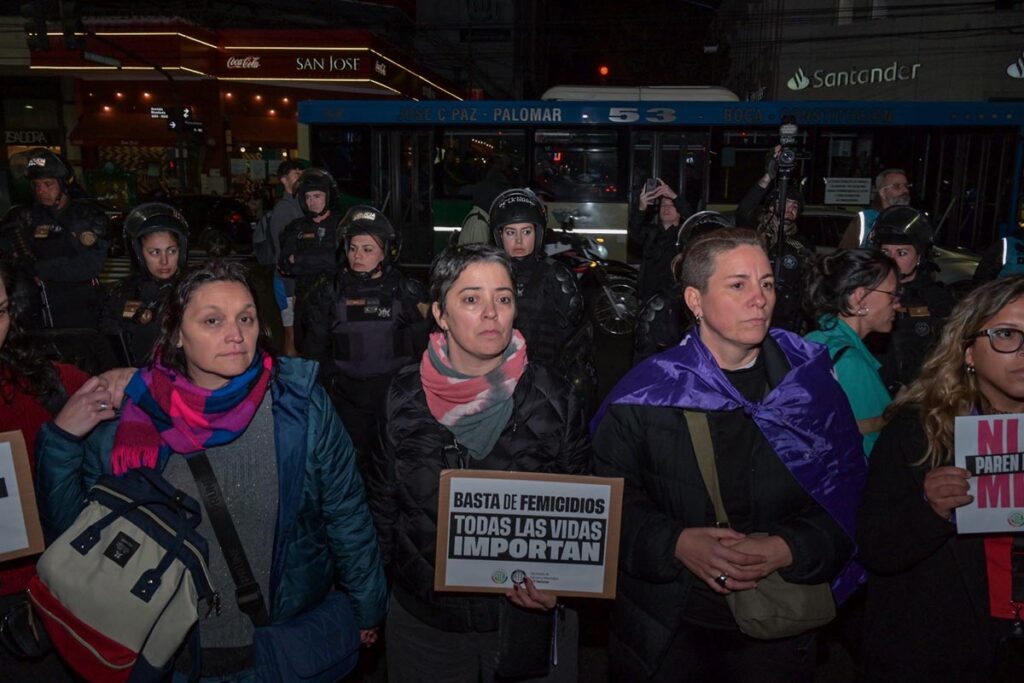
“Let’s block the street! Let’s block the street!” the chant grew louder and louder in the Plaza. After activist Nina Brugo spoke, the crowd moved toward Rivadavia Avenue and blocked it, right in front of the Flores Cathedral. A march then began around the Plaza, behind a black banner bearing the slogan “Stop killing us. All lives matter.”
Marcelo Ferrari walked hand in hand with his teenage daughter. “I understand that we must mobilize and support this so that it can be made known, expressed. Today I came mainly to accompany my daughter.” Beside him, as the march moved along the side, Azul Ferreira added: “We must stop killing each other. Every person has a family, has a life to live, whether they are a woman or anyone else. Enough with femicides, people.”.
Patriarchal violence on the rise
The triple murder occurred within a context of escalating violence. From January 1st to August 31st, there were 164 femicides, according to the Adriana Marisel Zambrano Observatory of Femicides in Argentina, which is run by La Casa del Encuentro. Furthermore, the National Observatory of Hate Crimes recorded a 70% increase in hate crimes in the first half of 2025, compared to the same period last year.
“This triple femicide of young women occurs in a context where economic violence fuels the growth of drug trafficking networks and destroys grassroots organizations. Three women murdered amidst political and media violence fueled by hatred against us,” the Ni Una Menos collective stated on social media.
The National Campaign for the Right to Legal, Safe, and Free Abortion was also present with its large green banner. “ The State is dismantling gender policies. It ignores, questions, and denies the possibility of femicide. We are seeing a woman murdered every 36 hours. This is also linked—and this is no small matter—to complicity with human trafficking and drug trafficking networks, both in the City of Buenos Aires and in the province of Buenos Aires,” stated Viviana Norman, a member of the Campaign.
All victims are equal
Some mass media outlets, mainly television, introduced a “debate” on the agenda about whether the murdered women were black widows and/or prostitutes, which generated outrage from various organizations. “Everyone’s investigating whether they were prostitutes or black widows. What the hell does it matter? Did they deserve to end up murdered in a body bag?” AMMAR (Association of Women of Martyrs of Argentina) denounced on social media. And they emphasized: “There are no good or bad victims. There are femicides.”
“We are in the streets condemning three atrocious crimes and denouncing the cruelty in the media. This continued violation of those who have already been violated in their lives, this revictimization, is unacceptable. We demand that the State be present, defending women's rights, and we ask many media outlets to be respectful of the three young women who have been brutally murdered, and that justice be served,” said Victoria Montenegro (Union for the Fatherland), a legislator for the city of Buenos Aires.
Also present was Myriam Bregman (PTS), candidate for national deputy. “It’s more important than ever to be in the streets, to continue demonstrating and demanding justice for these three girls,” she stated, adding, “They want to deny that hate crimes have increased.”
Triple femicide
The bodies of Morena Verri, Brenda Loreley Del Castillo, 20, and Lara Morena Gutiérrez, 15, were found buried in the backyard of a house in Florencio Varela on Wednesday. They had been missing since last Friday in Ciudad Evita, when they left their homes to go to a YPF gas station across from the La Tablada roundabout. There, they got into a white pickup truck and were never seen again.
Police arrested two men and two women in connection with the crime. In the vicinity of the house where the bodies were found, forensic experts detected bloodstains and a strong smell of bleach.
On Wednesday afternoon, Lara's family and neighbors reported that the facade of the victim's grandmother's house had been shot at, and Lara's mother requested police protection.
The Security Minister of the province of Buenos Aires, Javier Alonso, asserted that the triple murder was “a drug-related revenge killing.”.
The Ministry of Women and Diversity of the Province of Buenos Aires issued a statement calling for "the urgent clarification of the facts" and for the process to be carried out with a gender perspective. They also clarified that "according to the initial hypotheses of the investigation, they were victims of a drug trafficking organization."
“Femicides are the most extreme expressions of gender violence and, in the context of drug-related crime, a stark and ferocious expression of dehumanization, cruelty, and exclusion,” they stated, while detailing that the ministry is currently working “in coordination with the Prosecutor’s Office, the municipality of La Matanza, and the Provincial Ministry of Security.”.
Around 9:30 p.m., when many of the self-organized protesters had left the Plaza, a large police operation was deployed, resulting in the arrest of nine people, who have since been released, the City Police reported.
The autopsy, released just hours ago, revealed that the victims were tortured and brutally murdered. At a community meeting, it was decided that a march will be held on Saturday to the National Congress to strengthen the demand for justice.
The coverage was done jointly with our partner media outlet, Tiempo Argentino.
We are present
We are committed to journalism that delves into the territories and conducts thorough investigations, combined with new technologies and narrative formats. We want the protagonists, their stories, and their struggles to be present.
SUPPORT US

FOLLOW US
Related notes



We are present
This and other stories are not usually on the media agenda. Together we can bring them to light.