

To denounce and to cancel: between denunciation and the illusion of justice
The word "funa" didn't originate on Twitter or TikTok, but on the street. Today we face another term: "cancellation," which emerged in the United States. They are related but very different phenomena.


Share

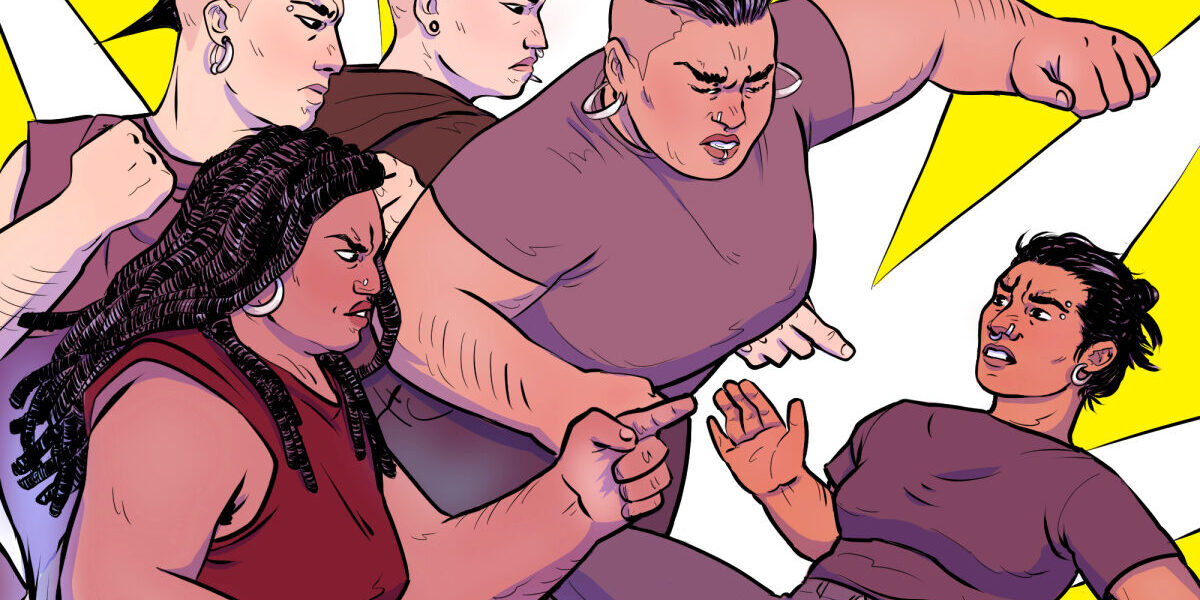
Illustration: Paula Dacal
In southern Chile, decades ago, the word "funa" was born . It didn't originate on Twitter or TikTok, but on the streets. In the 1990s, human rights groups began to publicly denounce the repressors of the Pinochet dictatorship. When the official justice system refused to act, the community organized to point the finger, make visible, and denounce them. "Funar" meant denouncing the torturer, the human rights violator , the powerful figure who had escaped justice thanks to impunity. Funa became a political weapon of the people against silence. In Argentina, escrache played a similar role: groups like Hijos de Desaparecidos (Children of the Disappeared) denounced the military personnel and officials of the dictatorship who walked freely through the streets. In the absence of institutional justice, community justice emerged: to point the finger was to resist.
Today, however, we face another term: cancellation. This word became popular in the United States and Europe through pop culture and social media , where people talk about "canceling" a celebrity, influencer, or politician for racist, sexist, transphobic behavior, or simply for being unpopular. To cancel someone is to withdraw support, stop buying their products, boycott their online spaces, and turn them into a digital pariah.
While public shaming and cancellation are related phenomena, they are not exactly the same. Public shaming originated as a tool for grassroots political denunciation, a response to institutional silence. Cancellation, on the other hand, emerged as a cultural practice within the media ecosystem of the Global North, amplified by algorithms that transform punishment into spectacle.
The digital mutation: from political outcry to spectacle
On social media, canceling or shaming no longer necessarily means denouncing an untouchable abuser; it also means exposing and punishing anyone who makes a mistake, expresses an unpopular opinion, or dissents from the majority.
The practice of public shaming and canceling has become a spectacle. A kind of digital consumption ritual where the important thing is not to transform the conditions of structural violence, but to get retweets, validation, and a brief sense of having achieved justice. As Rita Segato in *The War Against Women* , “punishment does not transform, it only reaffirms the punitive logic.” In this new ecosystem, public shaming and canceling are as swift as oblivion: today someone is a trending topic of hate, tomorrow no one remembers what happened.
I've also been the one who called people out and the one who called them out. I've participated in that symbolic lynching that produces a strange sense of power: the power to be a judge without due process, to point fingers without sufficient evidence, to believe that a screenshot equals the truth. And I've also been on the other side, receiving insults, blocks, and cancellations. I know what it means to be reduced to a mistake, a phrase taken out of context, a rumor amplified by hundreds of strangers. That experience forced me to ask myself: what are we building with this dynamic? Public shaming and cancellation offer no space for healing or transformation. They only open a new wound.
Public shaming campaigns were created to denounce power, not to destroy those of us who survived it
We've come to demand more rigor from an Instagram post than from an official news outlet . We scrutinize racialized activists on social media with a fine-tooth comb, but we let xenophobic headlines in the press slide. That's the paradox: we demand perfection from those of us fighting on the front lines, while institutionalized hate speech is normalized.
It's also worth remembering something that seems to be forgotten: public shaming was born to denounce those in power, not to tear each other apart—those of us who barely survive it. When the practice becomes trivialized, it loses its political force and becomes just another form of horizontal violence.
What can we do now?
I don't want to romanticize the "original public shaming." I know there were mistakes, excesses, and harm done. But they had a clear political intention: to break the cycle of impunity. Today, however, many public shaming campaigns and cancellations are more like a reality show : consume, get outraged, and move on to the next topic.
Perhaps the question we should be asking ourselves isn't "who should we cancel or shame?", but rather "what do we transform with each act of shaming or cancellation?". Because if the answer is "nothing", then what we're doing isn't justice, it's spectacle.
Today I write this with the certainty that I am not outside of this dynamic. I have been on both sides, and that experience compels me not to fall into the cynicism of those who believe that everything is the same. It is not the same. It is not the same to denounce abuse as it is to cancel someone for an unpopular opinion. It is not the same to expose impunity as it is to reinforce a throwaway culture. Let us differentiate between the power that must be challenged and the human error that requires dialogue.
To commit to transformative justice processes, to listening, to reparation. To understand that it's not about protecting reputations, but about not becoming what we claim to fight against.
Because if there's one thing I learned from being both the one who called people out and the one who was, it's that punishment gives us adrenaline, but it rarely brings us justice.
*This article was originally published in Pikara Magazine – quality journalism, with a feminist perspective, critical, transgressive and enjoyable – and is published in Presentes as part of our agreement with this partner media outlet.
Rudy Bruña is a Colombian social communicator and journalist. He is an activist for the rights of diverse Black and gender-nonconforming people. He has worked in community research with a decolonial and participatory approach, as well as in training processes on anti-racism, sexual diversity, and violence prevention.

Share
We are present
We are committed to journalism that delves into the territories and conducts thorough investigations, combined with new technologies and narrative formats. We want the protagonists, their stories, and their struggles to be present.
SUPPORT US

FOLLOW US
Related notes
We are present
This and other stories are not usually on the media agenda. Together we can bring them to light.