

Why popular feminisms and diverse groups support Cristina Kirchner in the face of "patriarchal punishment"
Feminist and LGBTQ+ groups mobilized in response to the ruling that upheld Cristina Kirchner's conviction. The reasons and opinions behind the slogan they carried to the corner of the former president's house: "Feminist strength against proscription, we want you alive and free."


Share

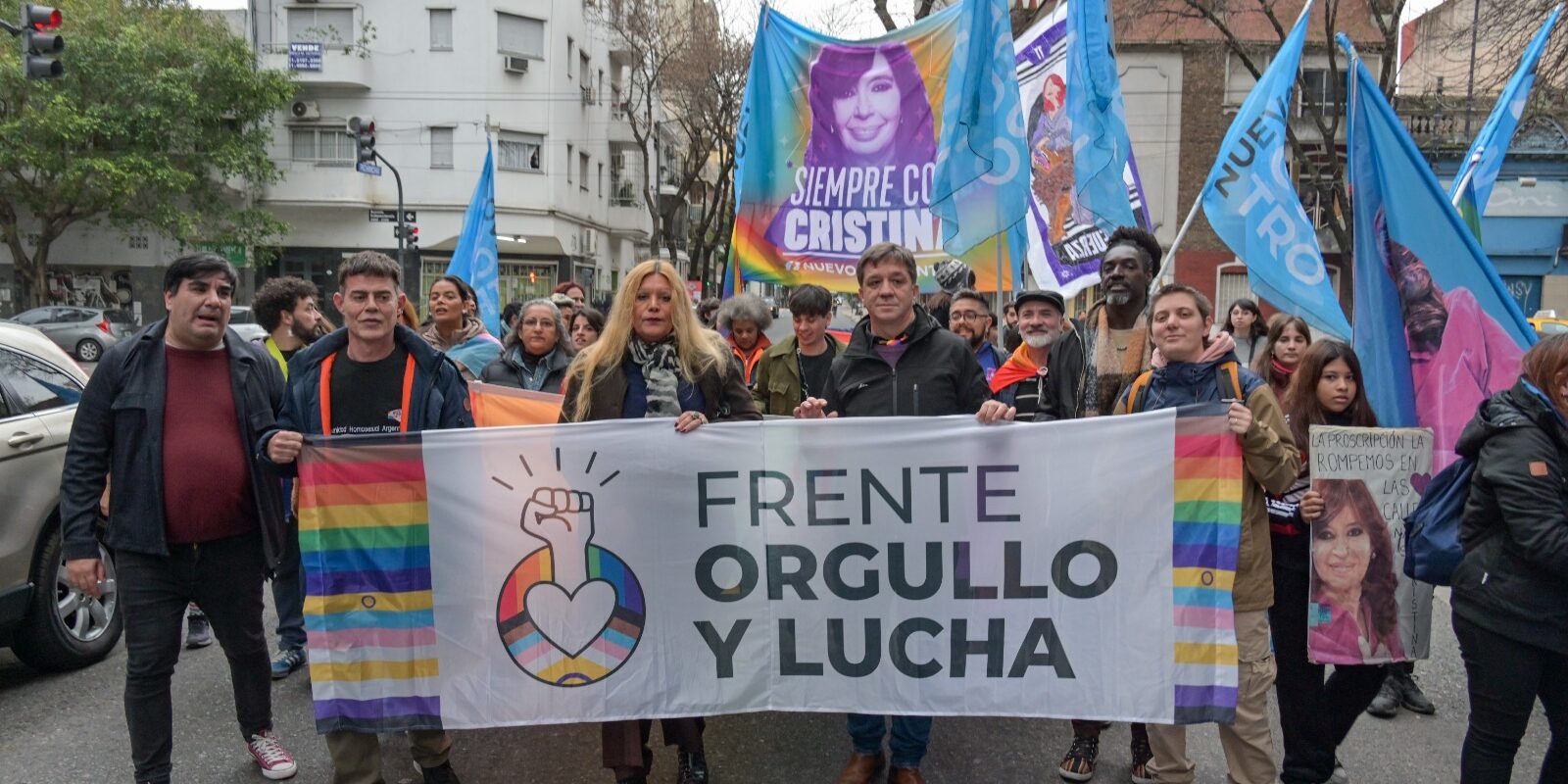
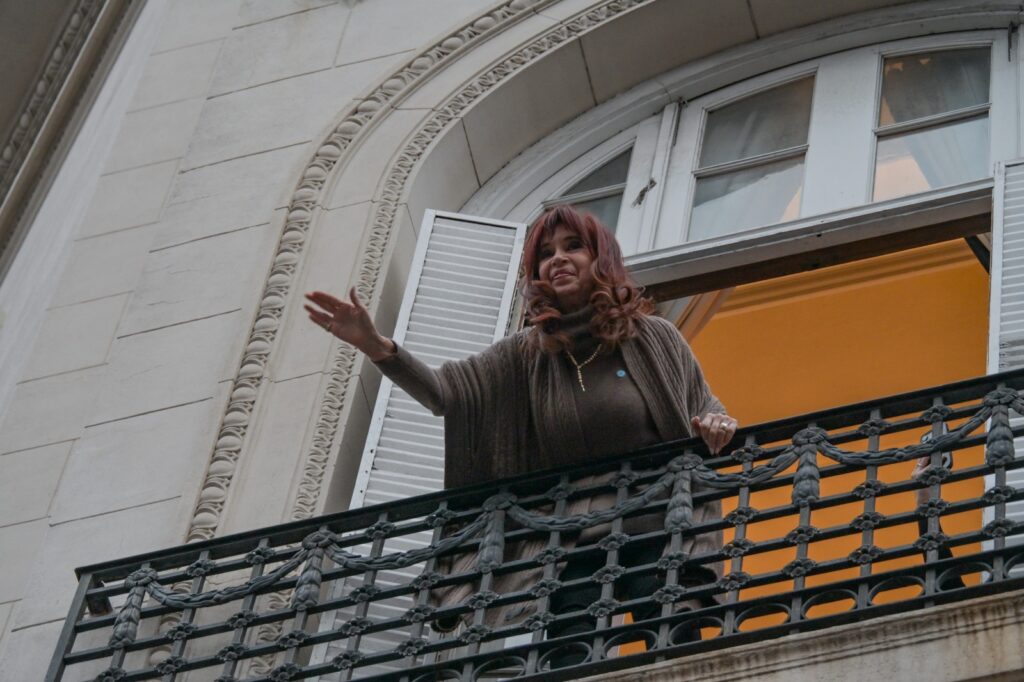
BUENOS AIRES, Argentina. A giant banner was unfurled at the corner of San José and Humberto Primo streets (Buenos Aires), below the balcony of the house where Cristina Fernández de Kirchner currently resides. She came out to greet the crowd and read: “Feminist strength against proscription, we want you alive and free.”
Since the Supreme Court of Justice of Argentina ratified the sentence of the former president to six years in prison - in a process in which all kinds of irregularities have been denounced since the investigation began in the courts - and disqualified her for life from holding public office, that corner became a meeting point and support for self-organized groups and organizations.
On Monday, June 16, trans feminists took center stage. After a meeting at the headquarters of the Justicialist Party (Matheu 130), they marched to Cristina Fernández de Kirchner's house. The demonstration included social leaders, union members, senators, representatives, and members of the Union for the Fatherland coalition, as well as LGBTQ+ activists. Among them were also many people who are not party members or who identify with parties of other political persuasions but who feel that the legal proceedings against Cristina Fernández de Kirchner are yet another affront to democracy.
For Cristina and for democracy
“It’s a step forward that the Peronist Party is opening its doors to historically excluded sectors, such as sex workers and the LGBTQ+ community. It’s a step forward that it’s broadening the reach of Peronism, including and giving space to other groups that may not feel represented by Peronism or within the broader national and popular movement,” says Georgina Orellano, from the Association of Sex Workers of Argentina (Ammar).
The world's first transgender high school, Mocha Celis School, was also present at the meeting and the demonstration. “Only in the streets, raising our voices, will we be able to defend democracy. It's crucial that everyone understands that this isn't a proscription against Cristina, but against the entire Argentine people,” says Virginia Silveira, president of the Mocha Celis Civil Association, as she posts signs on the door of 1111 San José Street. “We trans women know a lot about proscription. For many years, police edicts have outlawed us. And when we broke free from those edicts, and when Cristina helped us build the Gender Identity Law and defend it, that's when we understood true freedom. We trans women are here to defend Cristina; we don't want her to go through what we went through from the 1990s until 2012,” she explains.
For the rights achieved
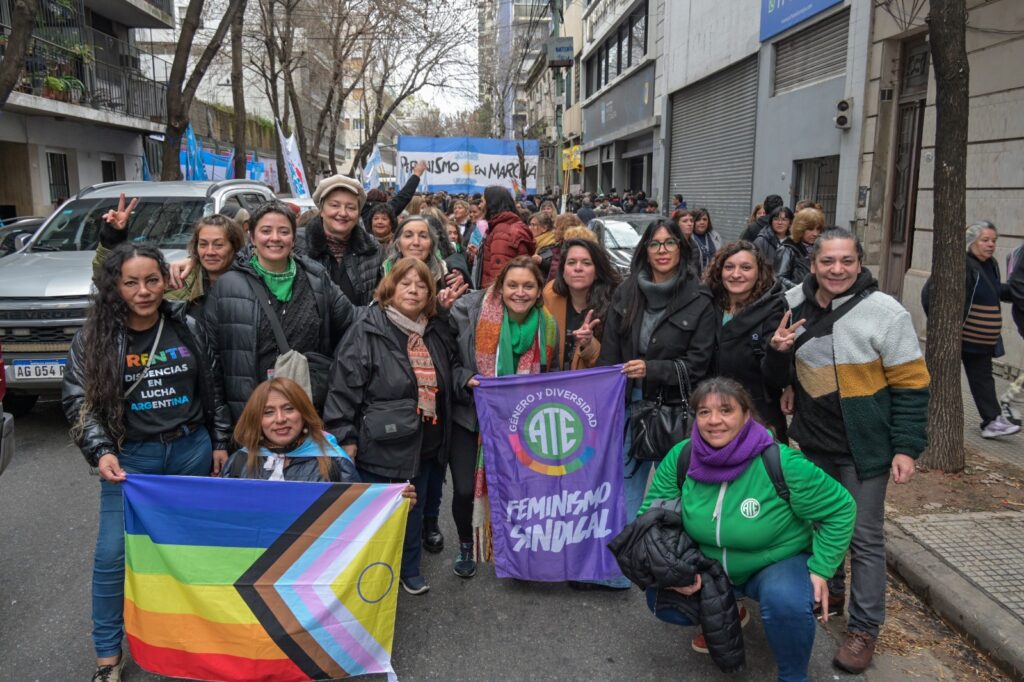
During the march to Cristina Fernández de Kirchner's house, Norma Morales, a leader of the Union of Workers for the Popular Economy (UTEP), recounts that they were discussing the importance of the former president's presence in working-class neighborhoods. “Being here at her door and seeing her with such tremendous strength gives us so much power, so much energy. And it also gives us hope, knowing that all is not lost. There are so many sisters and brothers here at her doorstep, and that's also a hug we need in such a critical moment,” she adds.
Morales knows that in working-class neighborhoods, Cristina's image resonates deeply. “Many of my comrades received pensions through public policies implemented by the Néstor and Cristina administrations, or through programs like the Universal Child Allowance—such essential rights,” she says. “It empowered us because we were hidden away in closets, stuck at home, changing our children's diapers, taking care of our husbands. And when we saw Cristina leading the country, we said, ' If Cristina can do it, why can't we? ' It gave us that hope of one day leading our own country.”
Orellano emphasizes the power of the rights achieved. “For many of our comrades, Cristina represents identity and dignity. Identity, because many of our comrades were able to obtain a national identity document under Cristina's government thanks to the Gender Identity Law. Comrades from the trans, migrant, and transvestite communities fled their countries and arrived in an Argentina that embraced them. And this gave dignity to their families, to their children, dignity in their homes.”
Francisco Quiñones Cuartas, secretary of Mocha Celis, emphasizes that the LGBT community has been subjected to numerous attacks by the Milei government and its officials. “That’s why we feel it’s important to be here. Cristina represents democracy; we’ve achieved the creation of laws and spaces for completing education, like Mocha Celis, and so many others that emerged later thanks to these public policies,” he lists. “At Mocha, we’re receiving more and more people who are falling through the cracks, losing rights we had gained recently.”
Diversities as political subjects
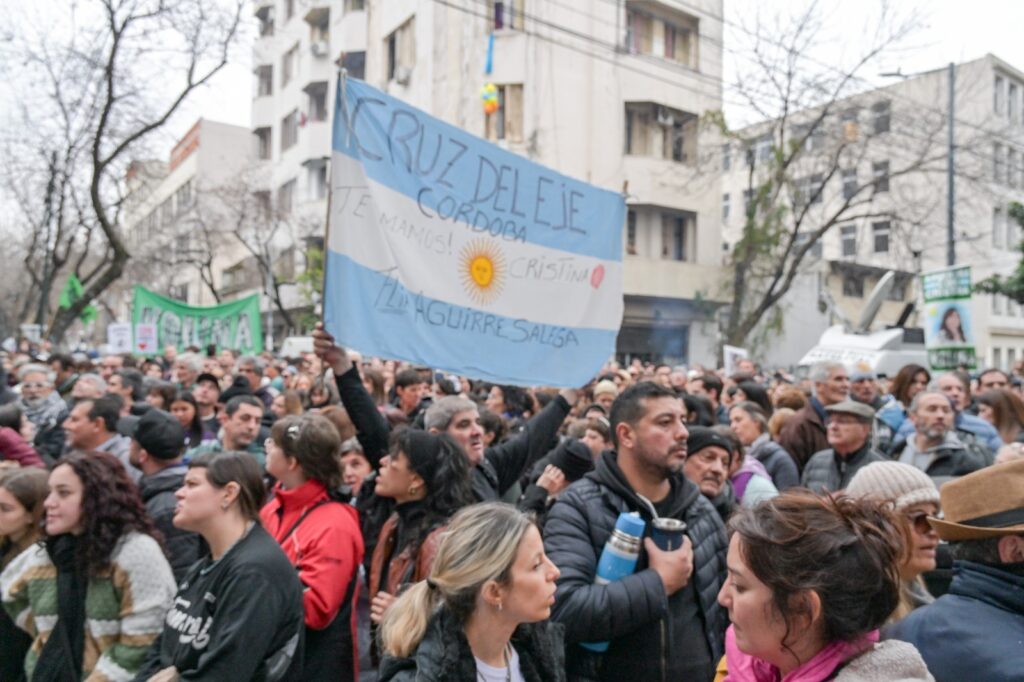
On Tuesday, June 10, while the verdict that condemned Cristina was being announced, the LGBT activist from Identidad Marrón, Bruno Bazán, was one of the speakers during the demonstration that took place in San Miguel de Tucumán in front of the Federal Courts.
She arrived in Buenos Aires this weekend to join the vigils for Cristina and today's march. “We have to support Cristina in the streets. As queer people and Peronists, we have to be grateful that, thanks to the Equal Marriage and Gender Identity Law, we are the political subjects of democracy and have the strength to support her.”
Regarding the situation of LGBTQ+ people in the northern province, she stated that there is a complete lack of support. “There is no resource, office, or point of contact within the Provincial Government for LGBTQ+ people. We are taking self-protection measures because the violence that had begun to decrease thanks to public policies has reappeared. We are in a situation of extreme vulnerability. There are no trans women with job quotas in Tucumán, and the Micaela Law is not being applied. We are surviving without a State to support us.”
A patriarchal punishment
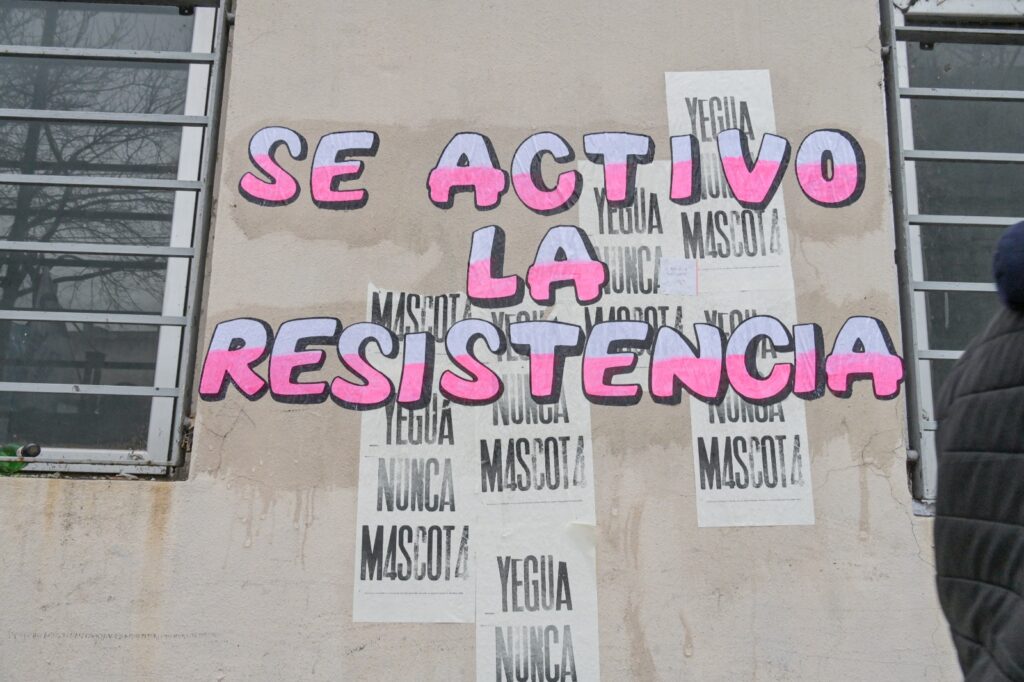
“This ruling is a patriarchal punishment,” says Luci Cavallero from Ni Una Menos. “The gender dimension of what they are trying to punish is crystal clear: a woman who is not afraid, who has always confronted economic powers, who does not give up, and who has meant for many of us a lot of very important policies such as the Gender Identity Law, pension moratoriums, the nationalization of YPF, Aerolíneas Argentinas, and others.”
Congresswoman Mónica Macha adds: “We are well aware that all of this is directed against a woman, one who dared to bring about change, and who is now being persecuted by a judiciary that acts as the armed wing of Argentina’s economic elite. For the next people’s government—when we manage to reclaim the state—one of the fundamental challenges will be the reform of the judiciary. We in the feminist movement have been advocating for years for a feminist judicial reform, and this remains an urgent and necessary challenge for future people’s governments.”
“What we are repudiating are several things: first, the proscription, because it is a turning point in the institutional decay of our country; second, because what it implies is that no lesbian, transvestite, or trans woman in our country will be able to participate in institutional politics without having an organic agreement with economic powers. That is what Cristina is being criminalized for: not having organic agreements with economic powers,” says Cavallero from Ni Una Menos. What we see in the streets is that “many expressions of support for Cristina have emerged, along with a strong desire to resist. We want feminism to be a platform for resistance, for unity, that goes beyond political parties. To recover the possibility of dreaming of a sovereign, independent, and profoundly feminist homeland.”
This article was originally published in the newspaper Tiempo Argentino . A shorter version is published in Presentes through a strategic alliance between the two media outlets.
We are present
We are committed to journalism that delves into the territories and conducts thorough investigations, combined with new technologies and narrative formats. We want the protagonists, their stories, and their struggles to be present.
SUPPORT US

FOLLOW US
Related notes



We are present
This and other stories are not usually on the media agenda. Together we can bring them to light.