

Former student of El Colmex reports rape and claims the University is not supporting him
Diego filed the complaint at the University, but El Colmex has responded slowly, without properly applying the protocol against gender violence, and has disclosed his data and private information.


Share

Diego is a young man originally from San Juan de los Lagos, Jalisco. In 2024, he moved to Mexico City to study Politics and Public Administration at El Colegio de México (Colmex), one of Mexico's most prestigious public universities dedicated to the study of social sciences and humanities. Last July, Diego was raped by Sebastián 'N', a fellow student at the same university. El Colegio de México has responded slowly to his complaint, failing to properly implement the protocol against gender-based violence, and has disclosed his personal data and private information. The Mexico City Attorney General's Office has also revictimized him.
“After what happened, I was very confused. I didn’t know what had really happened. I didn’t understand… It was very difficult for me to accept this and that what had happened to me wasn’t right, that he shouldn’t have done that to me, much less if I didn’t want it. And that the authorities’ actions were not correct,” Diego shares.
The process of acknowledging what happened was long and painful. Initially, he saw it as abuse, but after receiving psychological support, he understood that he had been a victim of rape. Diego's search for justice has been marked by institutional indifference, revictimization, and a lack of a gender perspective with particular attention to sexual diversity.
Diego grew up in an environment where talking about sexual diversity has not been easy, and today he prefers to call himself a "non-heterosexual man".
A path of obstacles: the lack of support at Colmex
On October 8, 2024, Diego made the difficult decision to withdraw and informed the academic coordinator of the Center for International Studies (CEI), Naín Martínez, of his situation. The director of the CEI, Fernanda Somuano, was also present at this meeting. Diego explained that the reason for his withdrawal was that he felt at risk due to having experienced sexual assault.
Both the coordinator and the director of the CEI told her that in her resignation letter she should not mention sexual violence but rather argue that her reason was "for personal reasons".
On October 9, Digo submitted his resignation. “I explained that I had been sexually abused and that I was prioritizing my emotional well-being.” However, this time no one from the university met with him personally. He simply left the letter with the secretaries and had no further contact with the authorities at El Colmex.
“I didn’t like being at school, I didn’t like seeing Sebastián in the cafeteria, in my language classes, seeing him go on with his life as if nothing had happened, while I felt destroyed. It made me realize that I was no longer comfortable, and for my safety and well-being, I made one of the most difficult decisions of my life,” Diego recalls.
The institutional response was cold and bureaucratic. After his dismissal, El Colmex withdrew all assistance: psychological, financial, and food support. Furthermore, his institutional access was revoked, completely isolating him.
"The response from El Colmex has made me feel completely alone," he adds.
Despite the fact that Colmex has a gender violence protocol, the Protocol of El Colegio de México to prevent acts of gender violence and to address cases of sexual harassment and sexual abuse, Diego says that at no time during the meeting when he presented the reasons for his resignation, neither the director nor the academic coordinator of the CEI informed him about the mechanisms to activate it.
It wasn't until December that Diego formally decided to activate the protocol. But even then, he was asked to explain why he was doing it "so late" and told he had to wait until the holiday period was over.
“When I filed my complaint using the protocol, they told me I had to wait until they returned from vacation and complained, 'Why now?' Why do I have to wait three weeks to demand justice? In January, they even kept giving me the runaround. I was the one who had to go to the legal department to find out about the progress of my case. And nothing was happening,” Diego recalls.
By then, Sebastián 'N' had already received authorization from El Colmex to go on an academic exchange to Poland, which practically guaranteed his impunity.
The response from El Colmex
On February 13, El Colmex issued a statement expressing that since they attended to the activation of the protocol against gender violence (in January, although Diego activated it in December), both the director and the academic coordinator of the CEI, “offered the student their support and made available to him psychological and legal support and the corresponding procedure was initiated.”
Diego was already receiving psychological support from El Colmex while he was a student. After the sexual violence he experienced, he approached his psychologist at the time to discuss what had happened and received four sessions. However, after he submitted his academic leave due to feeling his well-being was at risk from living with his attacker, the university withdrew those services.
This led Diego to seek external psychological support at Nube (Urban Center for Emotional Wellbeing of the Institute for Care) of the Mexico City government.
At Nube, her case was treated as a psychological emergency, so she began psychological treatment from the very first session. “They referred me as an emergency. I wasn't feeling well at all, I didn't even understand what I had experienced, I was just feeling a lot of pain and I couldn't even name what had happened to me because I trusted that person,” she recalls.
“Once the formal complaint was received at El Colegio de México in January of this year, in accordance with the Protocol, actions were taken to guarantee and preserve the safety and integrity of the complainant; among them, the offer of the necessary psychological and legal support was reiterated, and the corresponding procedure was initiated, which is currently underway,” the institution's statement reads.
Diego says it is false that he was offered such support and even today, more than a month after activating the protocol, he still has no answers.
In its statement, El Colmex insists that it “safeguards the dignity and integrity of the parties involved,” but it has even denied Diego information about his own complaint. He has also been denied entry to “dialogue sessions” held by university authorities with Diego’s friends.
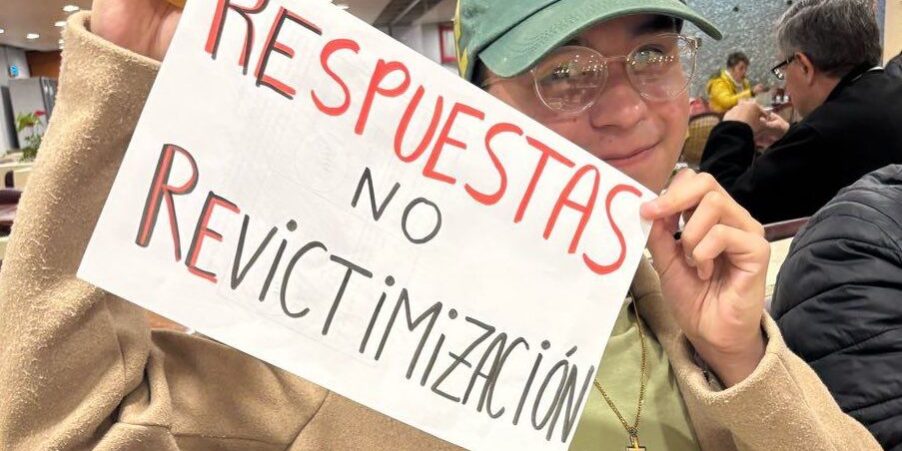
On Tuesday, February 19, his friends and other students held a protest inside El Colmex. Diego says he is moved by these actions but also fears there will be reprisals against those who protest and demand justice for him.
Revictimization by the Mexico City Prosecutor's Office
On December 20, Diego filed his complaint with the Sexual Offenses Investigation Prosecutor's Office Number 2 in Álvaro Obregón. There, he faced a series of revictimizing questions.
“They made me write down everything that had happened to me. I expected them to listen to me, to tell me what to do, to guide me. But it was the complete opposite. They made me feel like I had to justify myself, that if I said anything wrong, Sebastián could take action against me. At that moment I broke down. I felt completely alone,” Diego says.
During his statement, he was warned that if he didn't tell the truth, his attacker could sue him. He was also subjected to an invasive medical examination. Regarding his sexual orientation, Diego believes that because he is a man filing a complaint for a sexual offense, the Prosecutor's Office undermined his account and his complaint.
"It's not something that makes you feel comfortable, and here we go again: I didn't ask for it. I didn't want this to happen to me. What was my fault? Well, yes, letting someone into my house, but it was someone I trusted.".
Like El Colmex, the Prosecutor's Office has not contacted Diego to follow up on his complaint. He has had to persist in seeking information, without receiving any concrete answers.
Consequences of reporting
Since speaking out, Diego has faced reprisals both inside and outside of El Colmex. He has seen job opportunities closed to him, such as at the National Electoral Institute (INE), where, after learning of his case, they stopped considering him for a position. Diego fears that speaking out will have this and other repercussions for his future.
Furthermore, he has been the victim of a leak of his personal information and conversations within the university. It is currently unknown who leaked Diego's private conversations, which distort his story, and how. During the protest on Tuesday, February 19, he was recorded without his consent by Patricio Solís, a member of El Colegio de México (Colmex).
“I’m not going to be the only victim, that’s why I’m raising my voice. We have to raise our voices.”
Despite everything, Diego remains steadfast in his fight. He has publicly denounced the negligence of El Colmex and demands that those responsible for his case, including the director of the CEI, Fernanda Somuano, and the academic coordinator, Naín Martínez, be removed from their positions.
"I no longer want the director of the CEI and the academic coordinator in those positions. They didn't do what they were supposed to do. They don't deserve to be in charge of an institution that should be protecting its students," says Diego.
Within the university, Diego is also being supported by Unidas Colmex, a trans-inclusive feminist collective, and Todes Colmex, a student group focused on sexual diversity. Both groups have denounced the lack of a gender and diversity perspective in the application of El Colmex's protocol.
“I won’t be the only victim. There are many more who haven’t received justice. That’s why I’m speaking out, we have to speak out. We can’t keep letting this continue,” Diego concludes in an interview.
Diego also hopes to bring his case to La Mañanera, the daily press conference held by the President of Mexico, Claudia Sheinbaum, in order to obtain justice.
We are present
We are committed to journalism that delves into the territories and conducts thorough investigations, combined with new technologies and narrative formats. We want the protagonists, their stories, and their struggles to be present.
SUPPORT US

FOLLOW US
Related notes

We are present
This and other stories are not usually on the media agenda. Together we can bring them to light.