

How the Argentine government seeks to overturn the gender identity law
A bill seeks to prohibit gender reassignment for minors. Alba Rueda writes about how the government and mainstream media are paving the way to overturn the gender identity law, a global model in human rights.


Share

For months, activists have been warning that the government of Javier Milei and its far-right allies were setting the stage to attack the Gender Identity Law. Unfortunately, this affront was confirmed yesterday. Deputy Álvaro Martínez of La Libertad Avanza introduced a bill to prohibit minors from legally changing their gender marker. This would modify Gender Identity Law 26.743, a symbol of diverse democracy that recognizes the rights of all.
In recent weeks, Argentine officials have posted anti-LGBTIQ+ and anti-trans messages on their social media accounts. This adds to the government's systematic attack on diversity since taking office. The trigger was a conference on trans children organized independently by La Casita Trans, a civil association in Córdoba that works for the rights of trans and non-binary children and youth.
The first to react was Ramiro Marra, a legislator from La Libertad Avanza. He posted a message on social media, sharing the flyer for the event and calling it an “atrocity.”.
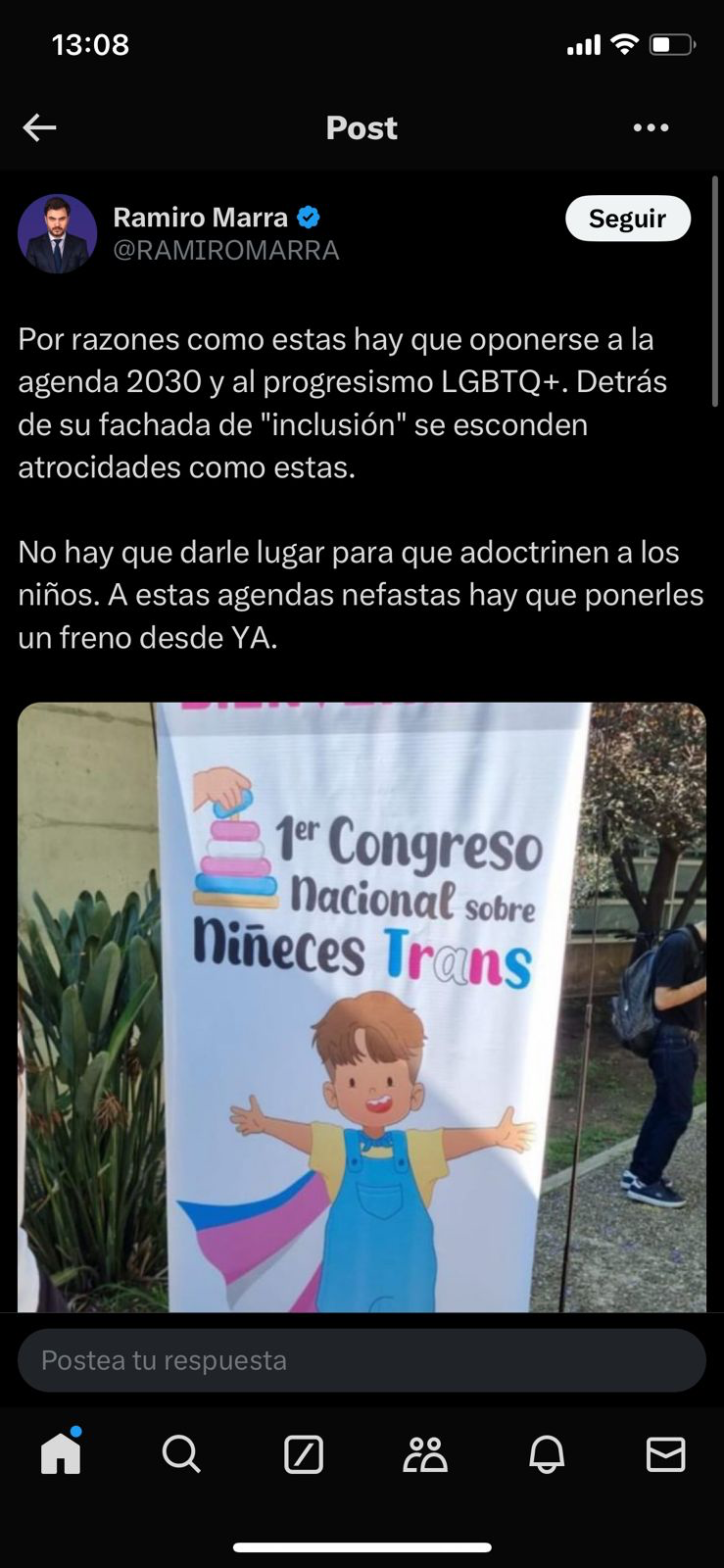
Let us remember that, up to this point, the recognition of transgender or non-binary children is a right developed under national regulations and international treaties with constitutional status. This is established by the Convention on the Rights of the Child, which recognizes individuals under 18 years of age as subjects of rights. It safeguards their free personal development and, above all, protects the best interests of the child and ensures non-discrimination.
The other congress
But Marra's outburst was not an isolated incident. A few days later, on November 7, the Citizen Services Department—a department that works with social organizations, shaping demands to be useful to the current administration—organized the Second Seminar entitled “Gender and Identity: The Problem of Child Sexualization.” There, journalist Claudia Peiró invited the organization Manada: mothers and fathers of adolescent children with “accelerated-onset gender dysphoria.” This seminar shared Marra's transphobic stance on children and adolescents, but with nuances of pathologization.
One of the focuses of this seminar was to promote “the early detection of accelerated gender dysphoria and the rights of minors and their parents in the context of the gender identity law” and the other is an accusation of “indoctrination” by the Comprehensive Sexual Education Law.
The organization has long been critical of the Gender Identity Law. It seeks to prohibit it for all children based on a pathologizing view of trans children and adolescents. Manada works with “families broken by gender ideology,” “rescuing their children from this madness,” and connecting parents of trans children with conversion therapies. They report having “detransitioners” of gender identity and guidelines for parents: “recognize your mistakes,” “set new boundaries,” and “respect the name you gave your children at birth”; “then the improvements begin,” they promise.
Comprehensive Sexuality Education (CSE), another enemy
These parents interpret their children as victims of societal pressures based on stereotypes, especially for girls. Growing up and having a developed body makes their daughters uncomfortable, so they wear baggy clothes and cut their hair the same way. This sensitivity to violence, plus "trauma," plus anime, leads them to "body mutilation," says Patricia Galarza, a member of Manada.
In a lackluster speech, met with the approval and applause of Vice President Villarruel, they also criticized the Comprehensive Sex Education Law. This controversy reached the mainstream media when major outlets reported that books containing pornographic and hypersexualized content were being distributed by the Comprehensive Sex Education program in the Province of Buenos Aires.
Sileoni clarified in a discussion with journalist Eduardo Feinmann that the books are not pornographic, that they are meant to be read and discussed with adults, that they are not given to children but rather to school libraries, and that they serve as supplementary reading material for teachers. He further explained: “The school does not deny the difference between men and women, it does not teach sexual practices, it does not encourage homosexuality or transsexuality, it does not teach about abortion. It accepts you as you are; in that respect, it is better than society. It does not discriminate, it does not persecute them, it does not imprison them.” In the end, Feinmann agreed with what the Second Seminar sought to convey: “Isn’t it better to leave this to the parents?”.
Political and media apparatus
Staying within the theme of Gender Identity, we return to Córdoba for a few more days, partly due to a sentence handed down on October 31st, but which only recently reached national media. It concerns a person who, at the end of 2016, was detained in Bouwer prison for gender-based violence against their former partner. In 2018, they legally changed their gender and sex, which led to their transfer to the women's section of Bouwer prison. They were again charged with violence, threats, and sexual abuse against one of their fellow inmates.
This news provoked a reaction from Vice President Villarruel. Through her social media account, she stated: “This is clear and simple: anyone who supports gender ideology is a degenerate, and anyone who supports the sexualization of children is a potential pedophile. Our government will fight them until we have no blood left in our veins.” Without mentioning the seminar “Gender and Identity: The Problem of Child Sexualization,” the jumble of gender identity-related topics she expresses is incomprehensible.
Argentina's Vice President, Victoria Villarruel, shared an article from Infobae and said she will fight "gender ideology" that "sexualizes children." This spreads misinformation and stigmatizes diverse groups. pic.twitter.com/VPkjnqJ5mb
— Presentes Agency (@PresentesLatam) November 12, 2024
And Milei, also on X, takes the opportunity to repost someone who says: "A convicted abuser said he identified as a woman in order to go to a women's prison and ended up raping his cellmates. A victory for feminism.".
This week, the newspaper La Nación also published a story about a drug lord who allegedly asked to change his gender identity in prison.
In this way, trans people are stigmatized based on specific cases, and the gender identity law is also presented as a tool for criminal use and not for what it is: an instrument to guarantee the human right to identity.
The context since Milei's assumption of power
The Argentine government has been attacking the LGBTIQ+ population since it took office, through its rhetoric and policies.
Examples: the closure of the Ministry of Women, Gender and Diversity, the virtual closure of INADI, the prohibition of the use of inclusive language, the prohibition of broadcasting cultural content on sexual diversity, the representation abroad of LGBTIQ+ policy, the dismissals due to trans quotas, the lack of minimal or zero reduction of the Comprehensive Sex Education and Micaela laws, and the total closure of policies with a gender and diversity perspective, although there are still areas that provide attention to gender-based violence, although all are reduced in staff, resources and attending almost exclusively to cis people.
The introduction of this anti-rights agenda to the National Congress is neither surprising nor new at this point in the year. From the outset, the Millenniumist movement has attempted to reach agreements with center-right parties to achieve governability in the Chamber of Deputies and the Senate.
But we also witnessed LLA's constant flirtation with the perpetrators of genocide in Congress from the very beginning. Sadly, this year saw a chapter of impunity granted to the deputies advised by these genocidal figures, without any further reproach from those who hold convictions about Human Rights and the role of our society in demanding Memory, Truth, and Justice.
This point also needs to be addressed critically because this year we saw that large sectors of Argentine society are comfortable with the cuts, the blackmail—if we don't take away some people's rights, then there's no money for others—and the vindictive measures, looking on with indifference at a government that is driving poverty to over 50%, and those of us who live in urban areas painfully witness the destitution hidden under the Macri administration's rug in the city.
False freedom
Milei's anarcho-capitalism doesn't seek freedom but rather the economic redistribution of wealth for a small sector of society, destroying other sectors, such as by closing some ministries, dismantling public policies, and laying off their workers. He develops this position from within the State itself, using the power granted by democratic elections to distribute resources to areas that benefit the most powerful sectors. An example of this redistribution is the increased budget for SIDE (the State Intelligence Secretariat), which uses undeclared funds, allows for internal investigations, and enables governance through cover-ups. Another example is policies like RIGI (the General Income Tax Regime), which directly benefit large transnational corporations, leaving nothing for the state.
In foreign policy at the OAS General Assembly they promoted conversion therapies, refused to develop the 2030 agenda with the development goals, and systematically voted against the rights of women in all their diversity.
The persecution of the LIG
Regarding what follows, I think the last few months have been quite telling, especially concerning the Gender Identity Law. On the one hand, in terms of public policy, the government has not sent the tender documents for the purchase of hormones for next year. Several provinces are using what they have, but without national purchases, Article 11, guaranteeing access to comprehensive healthcare by 2025, will likely not be met.
Similarly, social welfare organizations gained discretion because their state regulatory body, the health services superintendency, stopped issuing rulings related to the Gender Identity Law for social welfare organizations. Therefore, we can expect a further deterioration of public policies related to diversity.
Unfortunately, neither grassroots feminists nor trans people are represented in Congress defending our rights. Surely, trans senators and representatives would not only be educating their colleagues, but events like the Second Seminar wouldn't be met with impunity, silence, or indifference. And this leads us to a question about party politics.
An urgent debate
We've needed a debate within progressive parties for a long time, because the LGBTIQ+ movement isn't in Congress defending our rights and Argentine democracy. This is problematic because we can't just come and go based on electoral interests. It's not all the same; cisgender heterosexual people aren't put at risk of losing their vitality or their sense of urgency. The impunity enjoyed by Milei and those who vote with him stems from ignorance and the absence of social movements in democratic institutions. Marra's horror of the Trans Children's Congress in Córdoba dissipates when this group and others maintain a dialogue, a presence, in the institutions that represent all the people.
Finally, the resistance movements of social movements, shaped by the TikTok era, have taken turns staging a series of events, actions, and mobilizations that seek to break the isolation and indifference of the media. The exceptions are undoubtedly the student movement and the pensioners' mobilization. But with many losses of political issues and agendas—that is, rights—such as the demand for the recovery of lands constitutionally belonging to Indigenous nations, environmental protection, the rights of people with disabilities, among many other vital issues.
Within this complex and often problematic context, Argentine democracy unfolds, characterized by weak institutions and government-violated fundamental rights. One striking aspect of the libertarian agenda is their aversion to the genuine exercise of freedom, understood as a fundamental right for all.
We are present
We are committed to journalism that delves into the territories and conducts thorough investigations, combined with new technologies and narrative formats. We want the protagonists, their stories, and their struggles to be present.
SUPPORT US

FOLLOW US
Related notes

We are present
This and other stories are not usually on the media agenda. Together we can bring them to light.