

Buenos Aires will be the next venue for the world's most important LGBT activism gathering.
The ILGA World Conference in Cape Town, South Africa, was the largest in the organization's history. At its closing, Buenos Aires was voted the next host city, embracing diversity in the face of the far-right advance of Milei's government.


Share

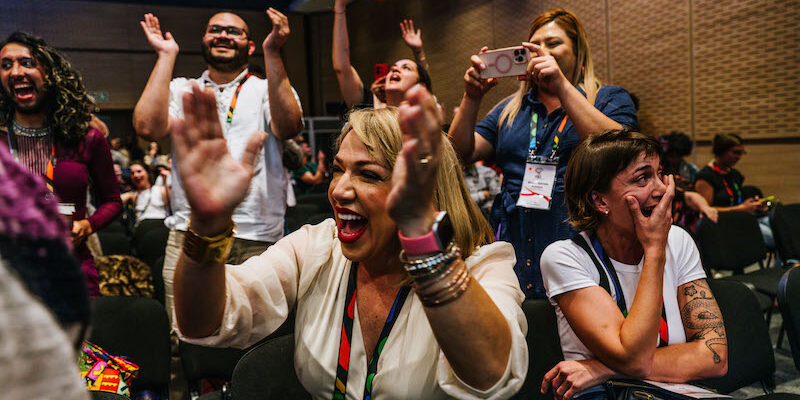
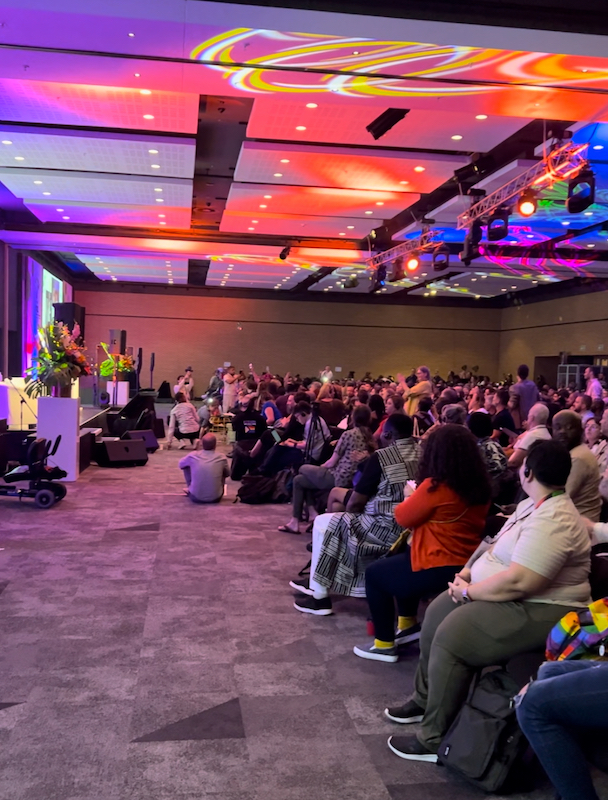
CAPE TOWN (South Africa), Special Correspondents. ILGA World Conference in Cape Town, South Africa, was filled with meetings, debates, and celebrations for sexual diversity. It was the largest in the organization's history: 1,450 people participated in the largest global gathering of activists, bringing together proposals to shape the LGBTIQ+ agenda. At the close, the collectives decided to embrace the situation in Argentina by voting Buenos Aires as the next host city for the conference. This will take place in two and a half years (2027): a way of resisting the rollback of rights under the government of Javier Milei.
“We in Latin America and the Caribbean are thrilled that Buenos Aires has been chosen to host the next ILGA World Conference, the world’s largest network of LGBTI organizations. It’s a show of support from activists and organizations worldwide. And it’s a show of solidarity with the situation in Argentina, where progress is being eroded by the current government, which is cutting back on our rights every day. This is important to strengthen our struggles in this difficult context,” Darío Arias, ILGA LAC Co- and founder of Conurbanes por la Diversidad, .
Buenos Aires' candidacy was initially proposed by this organization along with CHA and 100% Diversity and Rights, as members of ILGA. It was later supported by the region through ILGALAC (Latin America and the Caribbean). Buenos Aires had also been nominated in 2022, but ultimately withdrew its candidacy to support South Africa's.

The 31st ILGA World Conference was held under the theme Kwa Umoja (We Rise), a reference to a Swahili phrase—Swahili being the most widely spoken language in Africa—that celebrates unity and collective progress. From November 11 to 15 at the Century City Conference Centre in Cape Town, 64 sessions, 20 pre-conferences, and 6 panels took place, with participants from 100 countries. Among them was Graeme Reid, the United Nations Independent Expert on protection against violence and discrimination based on sexual orientation and gender identity.

Presentes, one of the media partners , covered the meeting. María Eugenia Ludueña participated in the Pre-Conference on media and the digital divide, along with colleagues from Reuters (UK) and activist groups from Jamaica and Uganda .
Latin America made a strong showing during the Conference, although due to visa difficulties and distance its participation was less than that of other regions such as Africa, whose presence was indeed prominent.
Host Africa

After 25 years, Africa once again hosted this global event. It was supported by the local organizations Iranti and Gender Dynamix . “In the global context, we see a world of increased conflict. There are rapes and genocide that are becoming normalized. In light of these situations, we welcome the need to respect human rights and recognize the political history and the struggle against apartheid here in South Africa,” emphasized Liberty Matthyse, a member of Gender Dynamix.
Every meeting space at the Conference was imbued with an identity deeply rooted in ancestry, collective bonds, and African hospitality. There was an opening ceremony, where Indigenous peoples prayed for prosperity and harmony, as they did at the closing ceremony.
Voices and activism in Latin America
“I saw so much diversity around me. I love being able to share with so many activists worldwide. It’s a space to share our experiences, the situation in our countries, to develop joint projects, to unite across countries, and to learn from each other,” said Dayne, from the Sexual and Gender Diversity Collective of Bolivia.
🌹🇵🇪 👠“This is the first international forum I’ve attended where they’ve mentioned sex work, with its challenges and rights for us. I’m from Lima, from TS Rosas Mujeres de Lucha, an organization for and by people who do sex work,” Demian Aguilar Portal tells us in… pic.twitter.com/ZQgGobCF7X
— Presentes Agency (@PresentesLatam) November 15, 2024
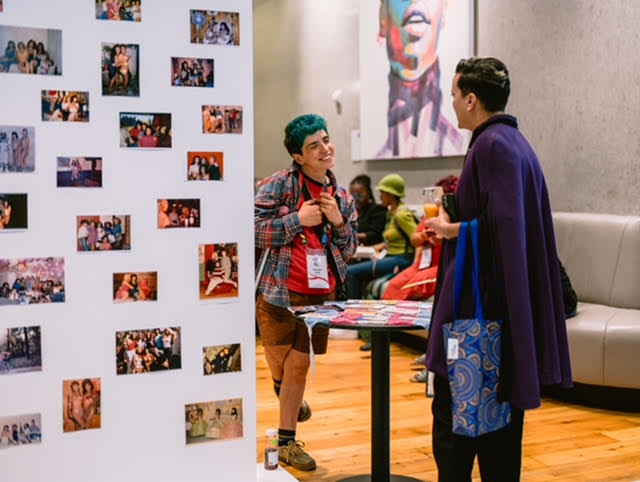
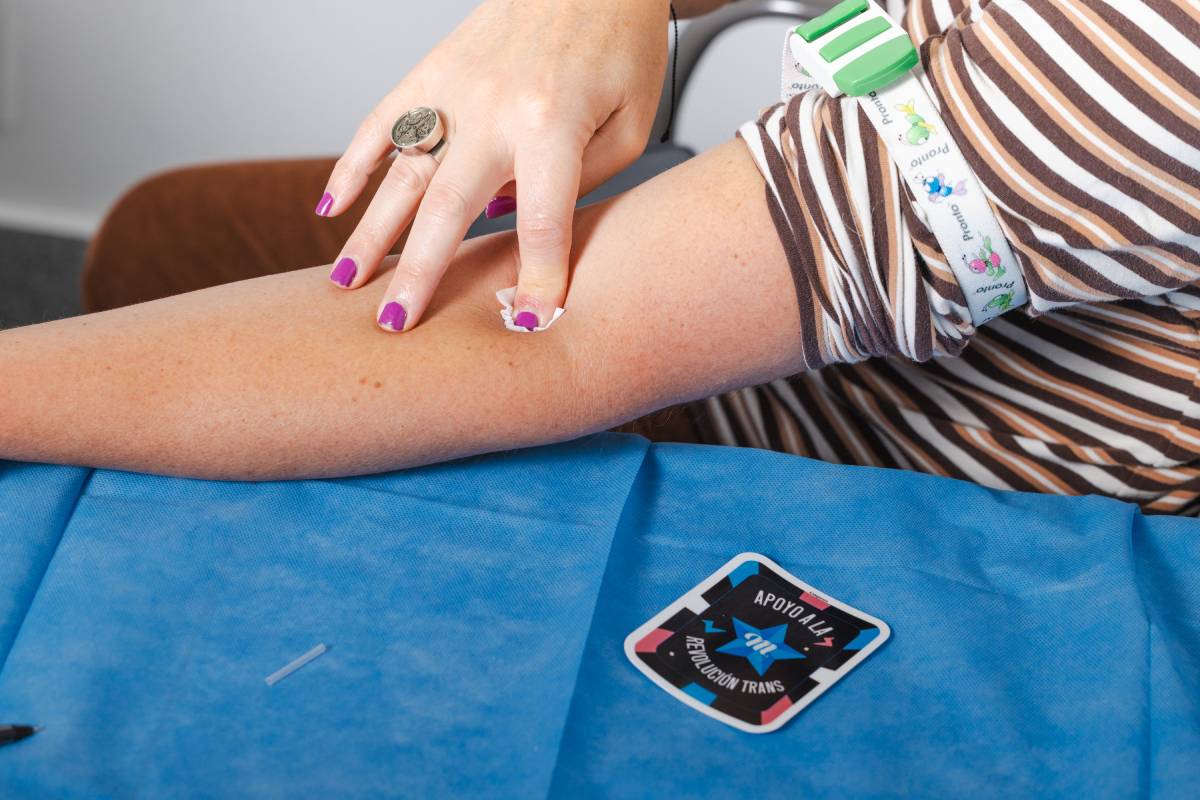
Among the Latin American projects was the Argentine Trans Memory Archive , which had a table in the center of the venue offering stickers, pins, t-shirts, and photographs. Every afternoon, Carolina (Carola) Figueredo and Luciana Leiras, members of the Archive, led a guided tour. People from all over the world were moved by Carolina's stories of what she and her companions had endured, the violence they suffered during and after the dictatorship, and the importance of the Gender Identity Law, which, as Carolina recounts, changed their lives.
Also participating from Argentina were the Tolomocho Disabled Art and Activism Space and Argentina Intersex , which took part in the panel on the Global Intersex Movement where activists from different regions shared the challenges they face: the rise of the right wing, advocacy strategies, the situation of refugees, among others. From Corrientes, Solange Ayala, a trans activist and member of Fundheg, an organization that works for sexual and reproductive rights, participated in the Conference for the first time. "I am very excited to meet my trans sisters from around the world. To seek political alliances that support and embrace us," she told Presentes.
LGBT people and humanitarian crises were the focus of a panel discussion on how to improve coordination among multiple stakeholders. Participants included Argentinian activist Mariano Ruiz (Human Rights and Diversity), Andrea Ayala (RFSL, El Salvador), and activists from the Equal Asia Foundation and Rainbow Railroad.

The Colombian media outlet Sentiido hosted a special session where co-founder Li Cuellar presented Transpoderosas, an innovative card game designed to teach about transfeminism.
Shane Cienfuegos, a non-binary trans activist from Chile, also presented “Cuerpas”, a project that explores the memories and lives of trans women, transvestites, transmasculine people, transvestites and non-binary people, managed by OTD Chile.
🇨🇱📸📽️ @ShaneCienfuegos presented "Cuerpas," a project that explores the memories and lives of trans women, transvestites, transmasculine people, transvestites, and non-binary individuals. Managed by @OTDChile and funded by @ShareNetIntl pic.twitter.com/HDnzet2Zlc
— Presentes Agency (@PresentesLatam) November 15, 2024
For the first time in the history of this Conference, trade unions from around the world had a strong presence. “The LGBTIQ+ community is part of the working class. Their struggle is also our struggle,” said Jordania Ureña Lora, representing the International Trade Union Confederation, on the event’s opening panel. She added: “We will continue fighting for change within our internal structures, including the inclusion of LGBTIQ+ people. Solidarity must be real.”
When it came time to vote for the new representatives of ILGA World, Latin Americans won two positions. Alejandra Collette Spinetti Nuñez, from the Trans Collective of Uruguay, was elected president of the Trans Committee. Gabrielle Escobar, from the organization Comcavis in El Salvador, was elected head of the Youth Committee.
“That means a great responsibility because my activism is about being the voice of the voiceless. My idea is to contact the different trans, non-binary, and gender non-conforming communities around the world regularly to bring that voice to the ILGA World steering committee,” Spinetti Núñez told Presentes after being elected.
🇺🇾 Alejandra Collette Spinetti Nuñez ( @profcollette ) from the Uruguayan Trans Collective was elected president of the Trans Committee of @ILGAWORLD pic.twitter.com/dZmK0wKH35
— Presentes Agency (@PresentesLatam) November 15, 2024
The other nine representatives elected by ILGA World member organizations were Kimberly Frost (United States) and Yuri Guayana (Italy) as co-secretaries. Meanwhile, Hamlet Nkwain assumed leadership of the Bisexual Committee; Obioma Chukwuike of the Intersex Committee; and Angelica Polmonari of the Women's Committee.
🇦🇷🗣️ @quimeysolramos , trans activist from Argentina, member of @CELS_Argentina : "Among the most important things I take away is the demonstration that genocides around the world, in Palestine but also in Sudan and in Congo, cannot be ignored… pic.twitter.com/m5hPgl5n0F
— Presentes Agency (@PresentesLatam) November 15, 2024
More unity, more intersectionality
From the very opening of the Conference, the words that propose a direction—intersectionality and unity—resonated. In a global context marked by the rise of the right and far right, with movements that threaten the integrity and dignity of the LGBTIQ+ community, various voices emphasized the need to work to strengthen the unity of the movement and to develop comprehensive approaches.
“My call is for us to think about how our differences have brought us here. They have made us great, they make us unique. They connect us with other people. My call is for us to put our differences aside and rise up in unity,” shared Luz Aranda, a Mexican bisexual activist and former co-secretary of ILGA World.
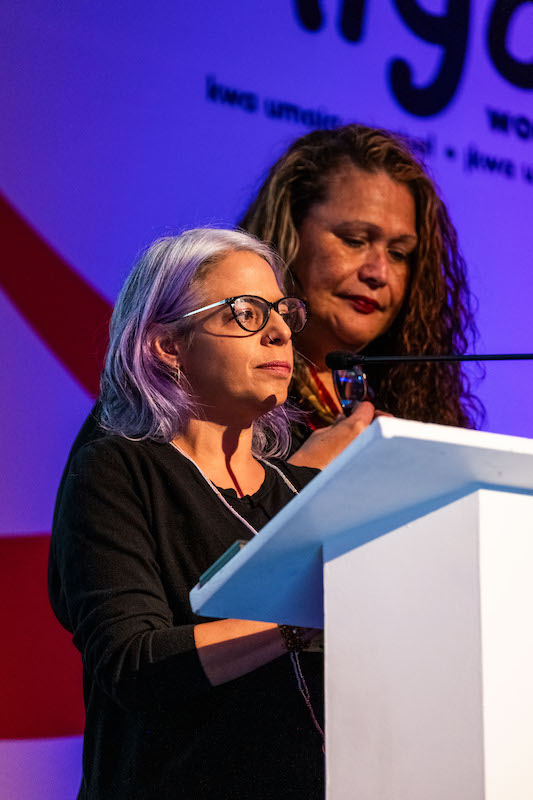
Julia Ehrt, the executive director, echoed this sentiment, adding a warning: “We need to be aligned in our approaches and objectives. We have a tendency to dwell on our disagreements instead of focusing on our shared goals. And that’s a problem. We’re facing anti-rights and anti-gender actors. They’re uniting against the common enemy that is us.”

One of the most applauded speeches was given by Mpho Tutu van Furth, a human rights activist, Anglican pastor, and daughter of the clergyman, anti-apartheid activist, and Nobel Peace Prize laureate Desmond Tutu. She warned of the growing conformism she observes, especially among young people, but also among people of other ages. She described it as a scenario of “a resurgence of conservatives with nationalist ideologies who oppose minority rights” and who “present themselves with ‘good’ and ‘fresh’ ideas, but who are in reality supremacists and are killing us.”
“Democracy is not a sport, and voting is not an entry ticket. It is a receipt that obligates us to demand accountability from our elected representatives,” she emphasized, while acknowledging the need for an intersectional approach to activism. “It is crucial to recognize that the LGBT community is also part of marginalized groups. Issues such as class and race intersect with sexual orientation and gender, creating unique challenges that must be addressed holistically. Our advocacy must be intersectional, addressing the multiple facets of discrimination and oppression,” she maintained.
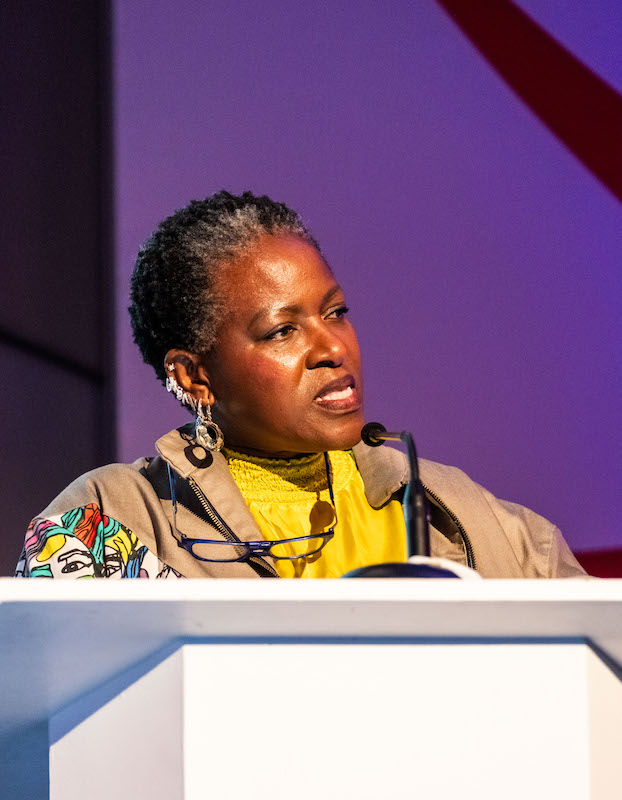
Representatives from the United Nations and South African government officials also participated in the opening ceremony. Mmapaseka Steve Emily Letsike, Deputy Minister for Women, Youth and Persons with Disabilities, representing South African President Cyril Ramaphosa, entered to enthusiastic applause. He emphasized that there has still been no meaningful discussion of class and race within the LGBTIQ+ community. He also acknowledged that human rights are not "a matter of political ideology, but of life and death, of freedom and oppression."
“Everyone would be much happier in a more equal world.”.
During the meeting, calls were made for the liberation of all oppressed peoples, especially for Palestine, Sudan and Congo, but also for Haiti, Uganda, Ukraine, Mozambique, New Guinea, Niger and other countries in struggle.
In addition to the panels and talks, the event offered plenty of opportunities to get involved. Two nights and a workshop, which ran for two sessions, focused on ballroom dancing. Participants recounted the history of ball culture, born clandestinely and in resistance to the mainstream culture that excluded them, while also holding dance competitions in categories such as Runway, Vogue, and one where they showcased traditional clothing representing their countries or communities.
The day began and ended with a meditation for personal and community well-being. A mental health service and a digital safety clinic were available upon request. There was also a quiet space to disconnect from the frenetic pace of the sessions.

Alongside the conference, activist groups in South Africa, united in the Pavement Special Collective, adopted a critical stance. They held meetings with ILGA but also organized demonstrations to protest the conference. Some of these protests took place inside the building hosting the event, with participants carrying red umbrellas to symbolize sex work and calling for the liberation of Palestine. In a statement, these organizations expressed their discontent, arguing that such events perpetuate colonialism and the suppression of Indigenous identities.
Other local organizations gave a very positive assessment. “We are proud to have welcomed the global LGBTI community to Africa and to have created spaces for them to witness what activism looks like in our context, our work with grassroots communities, and how we continue to move towards equal rights for all. May this event be a testament to the true solidarity that can come to life when diverse movements work together and forge alliances,” concluded Liberty Matthyse and Jade Jacobs-Wort, members of Gender DynamiX and Iranti, respectively, the host organizations in South Africa.
The World Conference included the presentation of the International Pride Awards, a joint initiative between the United Nations Development Programme (UNDP) and ILGA World. The five awards went to Ruslan Savolainen of Russia; Lize Ehlers (in the ally of the community category); Imanni da Silva of Angola; Sonia Correa of Brazil; and Aaditya Rai of Nepal.
Sonia Correa, an activist and researcher on rights, feminism, gender, and diversity, joined via video call to express her gratitude. “We shouldn’t fight for equality simply because it’s ideological or a principle of justice, but because it’s a path for everyone to be happier and more joyful in complex societies,” she said. “Everyone would be much happier in a more equal world .
We are present
We are committed to journalism that delves into the territories and conducts thorough investigations, combined with new technologies and narrative formats. We want the protagonists, their stories, and their struggles to be present.
SUPPORT US

FOLLOW US
Related notes


We are present
This and other stories are not usually on the media agenda. Together we can bring them to light.