

How does violence impact the mental health of LGBTQ+ and intersex people in Peru?
A report conducted for the second time in Peru reveals the consequences for the mental health of LGBTIQ+ people after suffering violence and discrimination.


Share

LIMA, Peru. The second LGBTIQ+ Mental Health Study by Más Igualdad (More Equality) reveals alarming figures regarding various types of violence, discrimination, and "conversion therapies" suffered by the community. Consequently, there are high rates of mental health problems. The main victims are trans, non-binary, intersex, and bisexual people.
“This person—the one who sexually abused me—made me look in the mirror and say that I would never kiss a woman again. I remember I was naked, and he stood me in front of the mirror and made me say that I was anatomically made for a man, and that I couldn't kiss a woman. He told me to cover my mouth and said he was cleaning me,” Andrea, a 31-year-old cisgender and bisexual woman, tells Más Igualdad about the sexual assault she suffered due to sexism and hatred toward her sexual orientation.
Agencia Presentes obtained access to the final report from the NGO Más Igualdad, which reveals mental health problems among LGBTIQ+ people due to various forms of abuse and the constant stigmatization they face, even from professionals who should be protecting their emotional well-being.
Violent practices
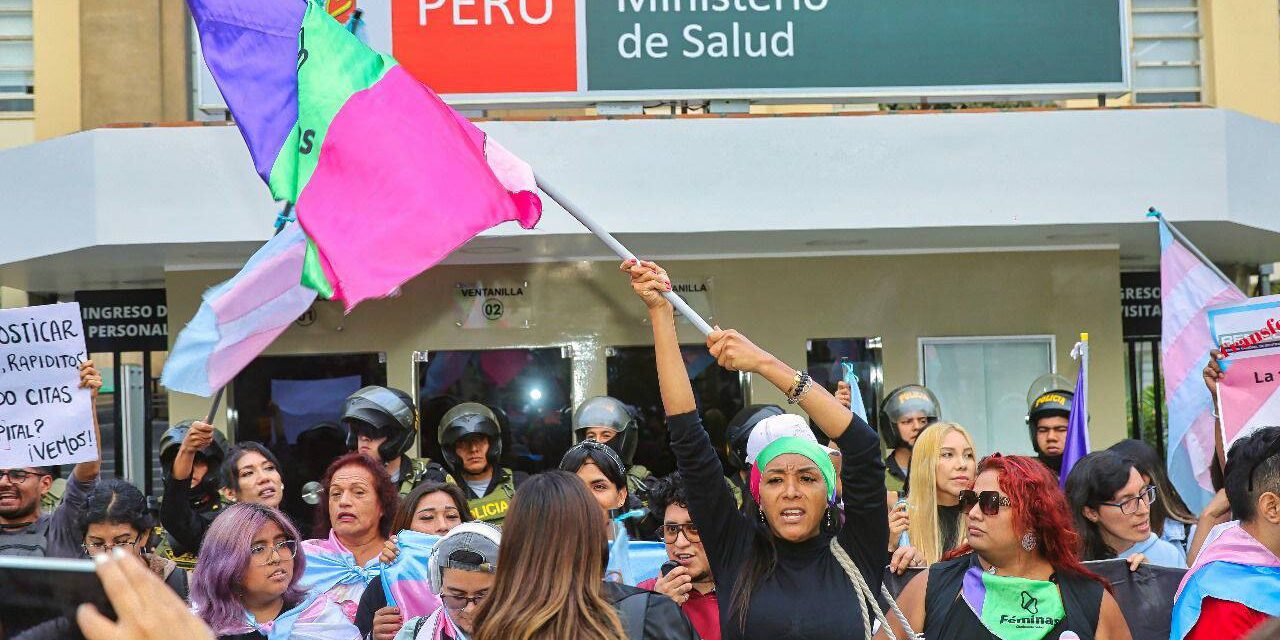
The publication of this study takes on greater relevance in the current context. 2024 will be remembered as the year the Peruvian Ministry of Health issued a Supreme Decree that considers trans identity an illness. It is yet another year in which the prohibition and punishment of “conversion therapies” has not been included in the Mental Health Law.
As long as this does not change, Peruvian children will continue to be victims of cruel practices, such as the one that occurred a few months ago with children tortured with nettle plants for having "feminine behavior", in the Awajún community, Amazonas department.
The study surveyed 1,267 LGBTQ+ individuals, or those questioning their identity, in Lima and other regions. This group identified as trans (15%), non-binary (13%), and intersex (2%). Regarding sexual orientation, they identified as bisexual (40%), gay (45%), lesbian (11%), and asexual (10%). These percentages may exceed 100% because some individuals may identify with two labels simultaneously. For example, someone may identify as intersex and lesbian, or as non-binary and bisexual.
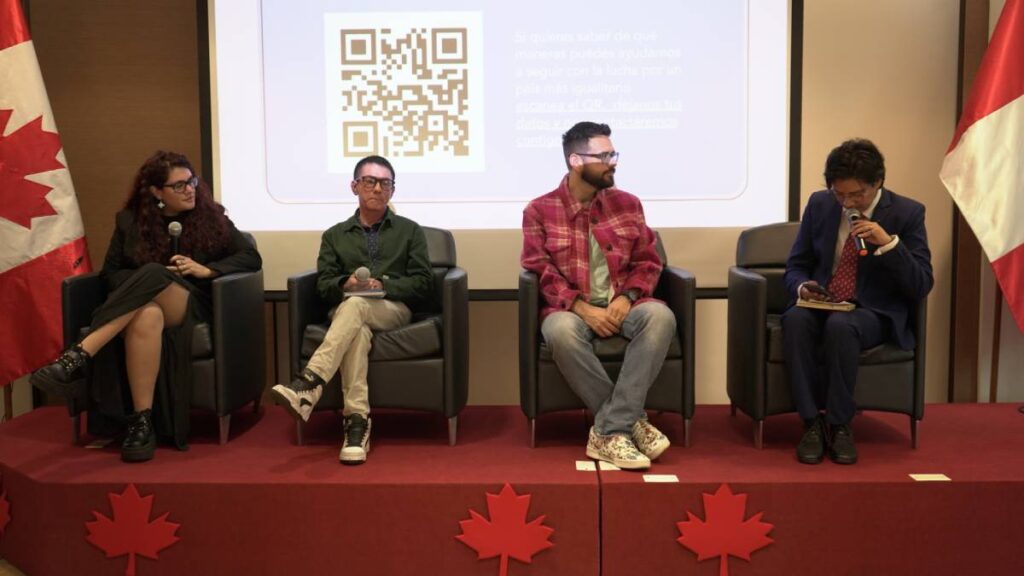
Photo: Más Igualdad.
Harassment and sexual violence
“When I go out, I try to dress up, depending on my mood. So, if they literally see a woman, just as I am, aggression is present, which is something most women experience every day. But when I go out as a trans man, things change. Because it's like they want to play a game to see if I have breasts or not,” Demian, a 21-year-old non-binary trans man, shares with Más Igualdad.
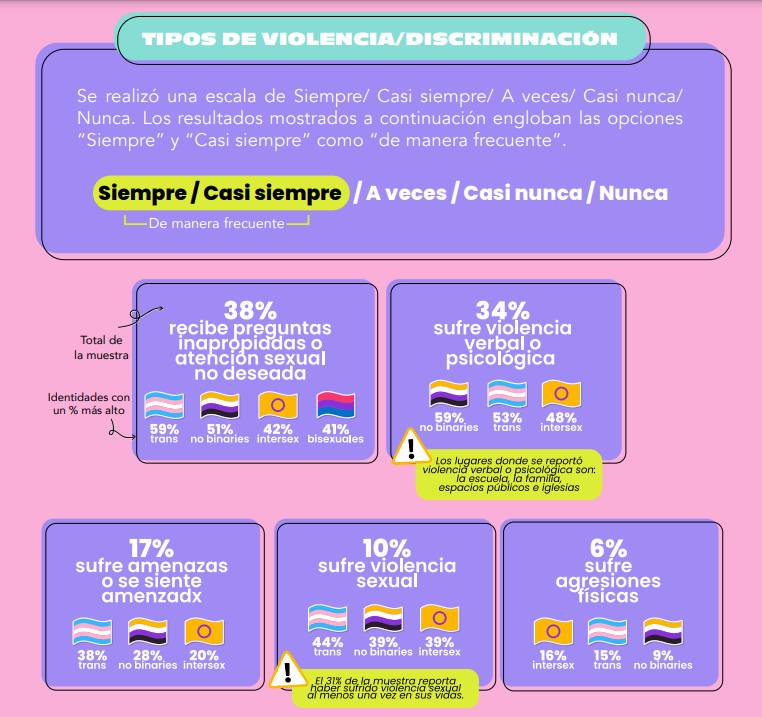
Demian's testimony highlights the sexual harassment frequently experienced by 38% of the LGBTIQ+ community. Of this number, the identities with the highest percentages are trans people (59%), non-binary people (51%), intersex people (42%), and bisexual people (41%).
an activist with Fuerza No Binaire , explains to Presentes that there is a preconceived notion that a non-binary (NB) person “is synonymous with a person who is open to any kind of sexual experience. Or who enjoys receiving sexually suggestive comments. This puts us in a vulnerable position in both heterosexual and LGBT spaces,” he states.
The study also found that 34% of the community experiences verbal or psychological violence always or almost always. This figure increases among non-binary (59%), trans (53%), and intersex (48%) individuals. The numbers also rise for these three groups regarding physical assaults, threats, and feeling threatened. Furthermore, it was reported that 10% of the community frequently experiences sexual violence, with these numbers increasing among trans (44%), non-binary (39%), and intersex (39%) individuals. It should be noted that 31% of the LGBTQ+ sample reported having experienced sexual assault at least once in their lives.
“Peru is a sexist country. Anything that deviates from the masculine stereotype is socially punished. That's why people who are part of the gender diversity movement suffer more violence and discrimination,” Leyla Huerta, a trans woman and founder and director of Féminas Perú Presentes . “We are not accepted as citizens, but rather as objects of pleasure. That's why trans women are often forced into prostitution,” she explains.
For Alex Hernández, a researcher on the study, psychologist, and bisexual activist with Más Igualdad (the other researcher is psychologist and gay activist Rodrigo Flores, from the same NGO), sexual violence against the LGBTQ+ community is often used as a “corrective weapon.” She adds that “in the case of trans masculinities, as in the case of lesbians and in the case of any person assigned female at birth who has a diverse identity, the risk of being victims of ‘corrective rape’ is always present.”.
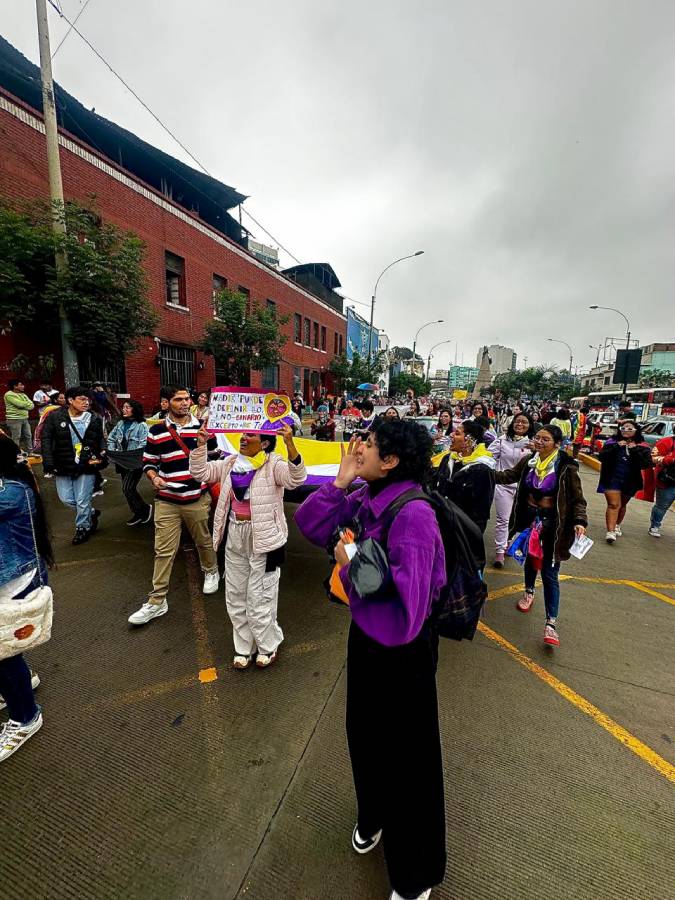
Photo: Yacila Y. Sprungli
“Minority” stress
The researchers in the study measured "minority" stress in the survey participants. This "minority" stress is a theoretical model that recognizes the adverse conditions and events experienced by LGBTQ+ people due to their status as a "minority" group (understood as opposed to the "majority" group in society). This generates specific and additional stress that can affect their long-term mental health. This type of stress manifests in the following thoughts and attitudes.
48% of the community frequently reported that their most recurring thought is having to “mentally prepare themselves to be disrespected for being LGBTQ+.” 46% worry repeatedly “about what will happen when people find out I am LGBTQ+,” and 36% almost always or always reported being “on alert and on guard because I have feared that something bad will happen to me for being LGBTQ+.”.
It was also observed that 63% of the sample experience distress always or almost always due to living in a country that does not recognize their rights, which impacts their life plans. This percentage increases to 80% for the trans population and 71% for the non-binary population.
Percentages skyrocket among trans people
Thirty-eight percent of those surveyed have received a clinical diagnosis related to their mental health at some point. These figures increase in the bisexual (45%), trans (54%), and non-binary (55%) communities. Furthermore, the report indicates that “anxiety and depression are the most frequently diagnosed disorders (34% and 27%, respectively) in the community.” It highlights that “the levels of anxiety disorders identified in the bisexual (91%), trans (91%), and non-binary (90%) sample are concerning.”.
Más Igualdad also asked respondents questions about their mental health, based on their self-assessment of their emotions and experiences. “Emotional dysregulation is present at high and very high levels. In 66% of the sample, symptoms of depression are at high and very high levels in 44%, and finally, a worrying 26% experience suicidal ideation almost always or always,” the report states.
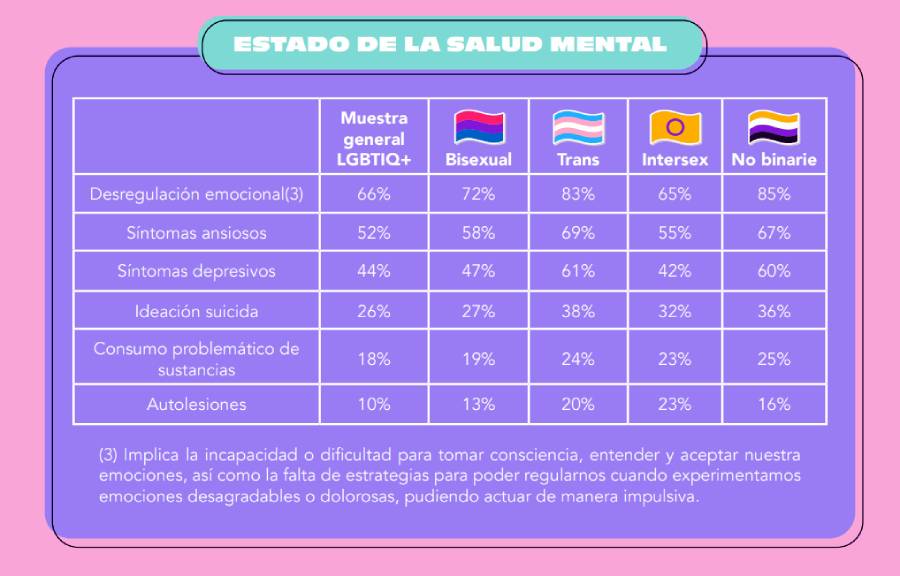
In all the measured indices, trans people registered higher levels than the general LGBTIQ+ sample, including suicidal ideation. For Leyla Huerta, this situation is due to “the constant bombardment of messages against us, that you're not part of it, that you shouldn't have been born. Violence in all spaces. This makes these figures so high in a community that is attacked from a very young age,” she explains to Presentes .
Nearly 1 in 4 LGBTQ+ people have undergone “conversion therapy”
“A psychiatrist told me the solution was to give me estrogen, so I would stop feeling like a boy. That with female hormones everything would be fixed,” Manolo, a 32-year-old transmasculine and bisexual man, tells Más Igualdad. His testimony highlights one of the perverse techniques—hormone therapy—used in “conversion therapies,” whose aim is to “change,” by any means necessary, sexual orientation, gender identity, or gender expression that does not conform to heteronormativity.
Prestigious international institutions such as the World Health Organization , the Pan American Health Organization (PAHO) , and the American Psychological Association (APA) , among others, have condemned these therapies because they pose “a serious threat to people’s health and well-being.” The UN has also concluded that they employ methods considered torture.
The study reveals that nearly one in four people surveyed (23%) have undergone conversion therapy at some point in their lives, either voluntarily (11%) or under duress (15%). The most frequent reasons given by those who went voluntarily were that they “were afraid of not being able to be happy” (57%) and “didn’t want to disappoint my family” (57%). These percentages are higher among trans and non-binary people.
Meanwhile, 15% of the sample who reported being forced into these therapies said that they were taken as teenagers (66%), primarily by their parents or primary caregiver (75%). 72% said they underwent the therapy at a mental health center or were administered by a mental health professional. 47% indicated that it took place in a church or was administered by a religious authority. The most frequent techniques used were psychological (84%), religious (16%), hormonal treatments (9%), and electroconvulsive therapy (5%).
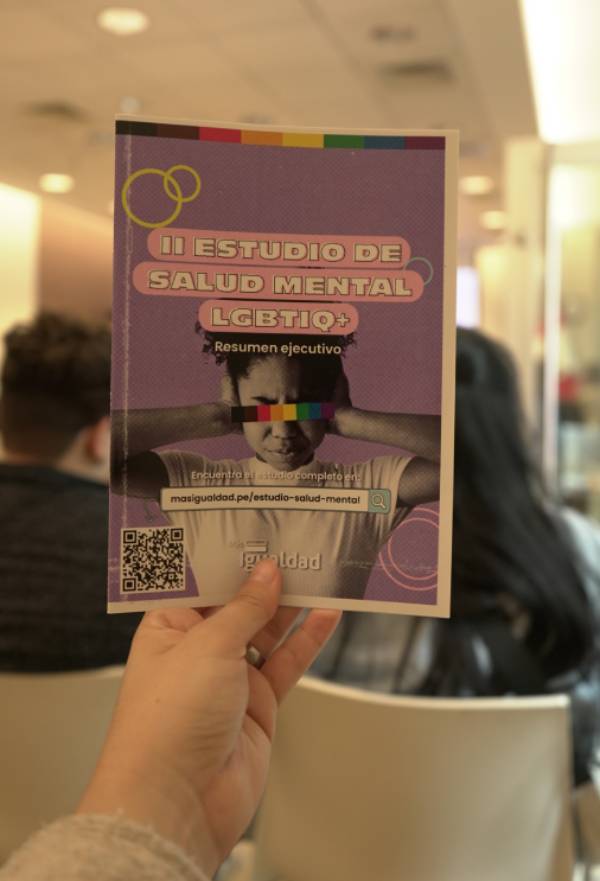
Almost all reported lasting effects after the “conversion therapies”: mental health problems (71%), depression (36%), and post-traumatic stress (24%). The study found “an association between having undergone ‘conversion therapies’ and a higher rate of suicidal thoughts and ideation, as well as problematic substance use.” These figures are reflected in the testimony given to Más Igualdad by Majo, a 30-year-old lesbian: “The consequence was that I became extremely depressed and attempted suicide again.”.
Exclusionary health
“It’s unacceptable that LGBTQ+ people should have to hide their identity to receive care. I’ve had to wear a skirt or a dress. I’ve had to present myself in a feminine way to receive care,” Alexander, a 26-year-old trans man, told Más Igualdad about a public health center he visited. Alexander’s testimony exemplifies the data collected on the barriers to non-discriminatory mental health care. “The biggest obstacle is the cost of care (55%), followed by the lack of training mental health professionals have in affirmative approaches or their limited preparation and/or experience working with LGBTQ+ people (41%), as well as the limited information available to people about professionals who work with an affirmative approach (41%),” the report states.
The survey also found that 44% of the sample receives private healthcare, 23% uses public health centers, and 28% do not receive mental health care. In this last category, the figures for trans and non-binary individuals were 33% and 32%, respectively. Furthermore, 19% of those surveyed reported experiencing discrimination. This percentage reached 41% for the trans community and 32% for the non-binary community. These figures refer to both public and private spaces.
No Exit
G Santos shares her opinion with Presentes about state-run mental health facilities in Peru. “If a non-binary person wants to go to a public health center, they have to prepare themselves to be called by their legal name (the name on their ID). For many people, including myself, legal names end up triggering dysphoria. I know beforehand that when I arrive for the appointment, I'm going to be experiencing terrible symptoms,” she says.
Their words describe the profound sense of anguish and discomfort that non-binary people experience when going to a state-run facility for a mental health check-up. “In many cases, we won’t be able to talk about our gender identity or expression because the psychologist might see it as something negative or resort to ‘conversion therapy.’ The problem is that if the state doesn’t protect me and I don’t have the means to afford private therapy, I’m left without treatment. There’s no way out,” they argue.
Bisexuality denied
Más Igualdad presented respondents with several stereotypical and discriminatory phrases commonly heard by LGBTQ+ people in mental health settings, asking them to select those they had experienced most frequently. Biphobic phrases stemming from prejudice were the most common: “bisexual people are hiding a latent homosexuality” (53%) and “bisexual people are confused about their sexual orientation and need to define it” (47%).
In this regard, Alex Hernandez comments that the NGO has a mental health project called The Directory , a public database made up of affirmative mental health professionals, who have been previously evaluated to be able to effectively serve the community.
During the selection process, it was observed that the way they worked with gay men and lesbians was excellent, but when asked how they would assist a bisexual person, many responded that "they are people who need help discovering their homosexuality." "There is a misconception that sexual orientation can only be oriented toward one gender. Obviously, these people are not part of our directory. Biphobia is an issue we must discuss and combat," they told Presentes .
Photo : Courtesy of Féminas Perú, taken during the protest in front of the Ministry of Health against the decree that considers trans people as ill.
We are present
We are committed to journalism that delves into the territories and conducts thorough investigations, combined with new technologies and narrative formats. We want the protagonists, their stories, and their struggles to be present.
SUPPORT US

FOLLOW US
Related notes

We are present
This and other stories are not usually on the media agenda. Together we can bring them to light.