

Six months after the triple lesbian murder in Barracas, the hotel is marked to remember Pamela, Roxana and Andrea
With a plaque and a festival, LGBT activists paid tribute to Roxana, Pamela and Andrea, victims of the triple lesbicide in Barracas.


Share

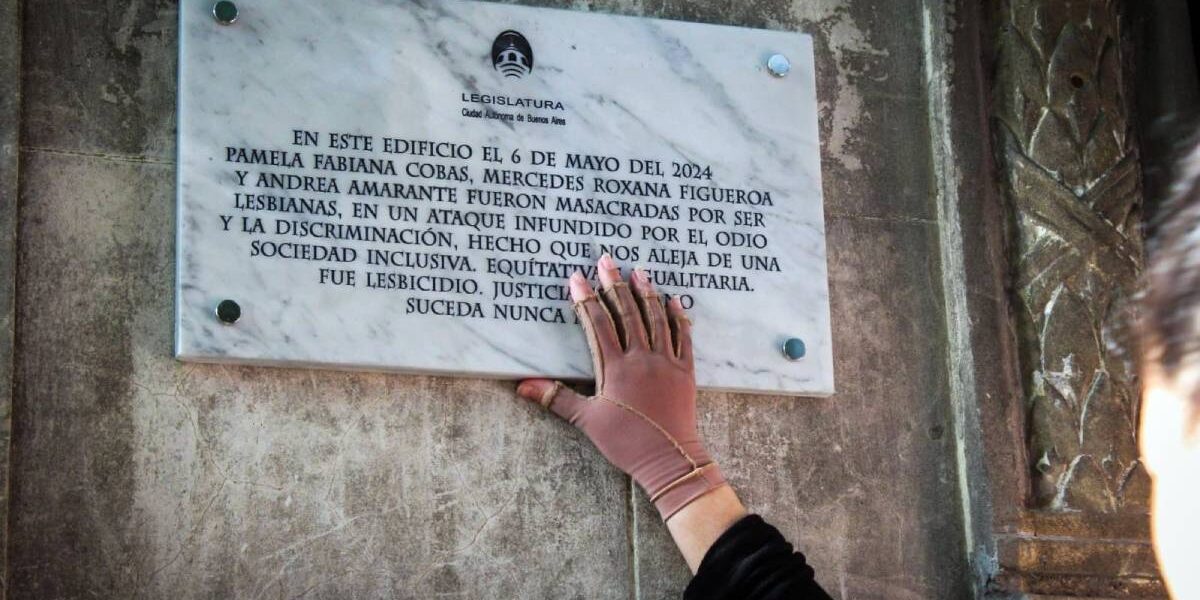
BUENOS AIRES, Argentina. Wednesday, November 6, marked six months since the brutal attack against four lesbian women, in which three of them died. To remember them, LGBT activists held a tribute that began outside the hotel where they were murdered and ended in Plaza Colombia.
“In this building on May 6, 2024, Pamela Fabiana Cobas, Mercedes Roxana Figueroa, and Andrea Amarante were murdered for being lesbians, in an attack fueled by hatred and discrimination, an act that moves us further away from an inclusive, equitable, and egalitarian society. It was lesbicide. Justice means that it never happens again,” reads the plaque placed at the entrance of the Hotel Canarias, located at 1621 Olavarría Street, Barracas.
In addition to the tribute, the call for justice for the triple lesbian murder was renewed, along with the demand for a change in the legal classification of the crime to recognize it as a hate crime. During the activities organized by the Self-Convened Lesbians of Barracas, they demanded justice, a change in the legal classification of the crime, and reparations for Sofía.
It was lesbicide
In the early hours of May 6, Justo Fernando Barrientos, a tenant at the Hotel Canarias, escalated from threats and insults to arson . Using a homemade explosive, he set fire to the room where Pamela Cobbas, her partner Roxana Figueroa, and, temporarily, Sofía Castro Riglos and Andrea Amarante were staying. Pamela, Roxana, and Andrea died, while Sofía survived but spent time hospitalized due to severe burns.
According to neighbors' accounts, which have not yet been considered in the case file, Barrientos insulted and harassed women. "He hated them for being lesbians," they told Presentes . However, Judge Eduardo Rabbone, who is in charge of the case, did not consider either femicide or lesbicide (hate crime). The case is currently classified as homicide with premeditation.
The demand to change the cover was repeated at several demonstrations. It was even included in the document of the Plurinational Meeting of Women and Diversities and also in that of the 33rd LGBT Pride March. At the event held on Saturday, November 2nd, on the Plaza de Mayo stage, the activists of Lesbianes Autoconvocades (Self-Organized Lesbians) were honored.
A network to repair, heal, and demand justice
The hate crime occurred within a context of escalating hate speech. A week earlier, an influencer on a media outlet referred to homosexuality as an illness. The executive branch, through its highest-ranking official, President Javier Milei, has been actively targeting and condemning sexual diversity. This same rhetoric is amplified by media figures (as happened a few days ago with Eduardo Feinmann) and through violent and aggressive trolling on social media.
LGBT activism was vital in publicizing this hate crime, but also in supporting Sofía Riglos Castro, the sole survivor of the brutal murder. In October, Yo no fui and No tan distintxs Casa Andrea , a collective housing project for women, children, and LGBTQ+ people.
“This community experience will allow them to organize their finances, plan a medium-term housing strategy, share caregiving responsibilities, and create networks to embark on a different life project,” the two organizations stated in a press release. Casa Andrea will house eight people and will include a space to address emergency situations.
They explained that the name Casa Andrea arose in homage to Andrea 'la Chucky' Zapata who was part of No Tan Distintxs and lived in Casa Leonor.
Furthermore, they added, “Andrea is Andrea Amarante, a victim of the Barracas lesbicide, whose partner Sofi, a survivor of the massacre and a member of YoNoFui, will live in this house. Andrea is all the Andreas. All the comrades who are homeless, in prisons, in detention centers, or who have gone through these experiences. Andrea is also the other names that make up the struggle, like Pamela and Roxana, also victims of lesbicide,” they expressed.
Photo: Courtesy Shok Argentina .
We are present
We are committed to journalism that delves into the territories and conducts thorough investigations, combined with new technologies and narrative formats. We want the protagonists, their stories, and their struggles to be present.
SUPPORT US

FOLLOW US
Related notes



We are present
This and other stories are not usually on the media agenda. Together we can bring them to light.