

What does journalism seek to achieve by amplifying the voice of anti-rights influencers?
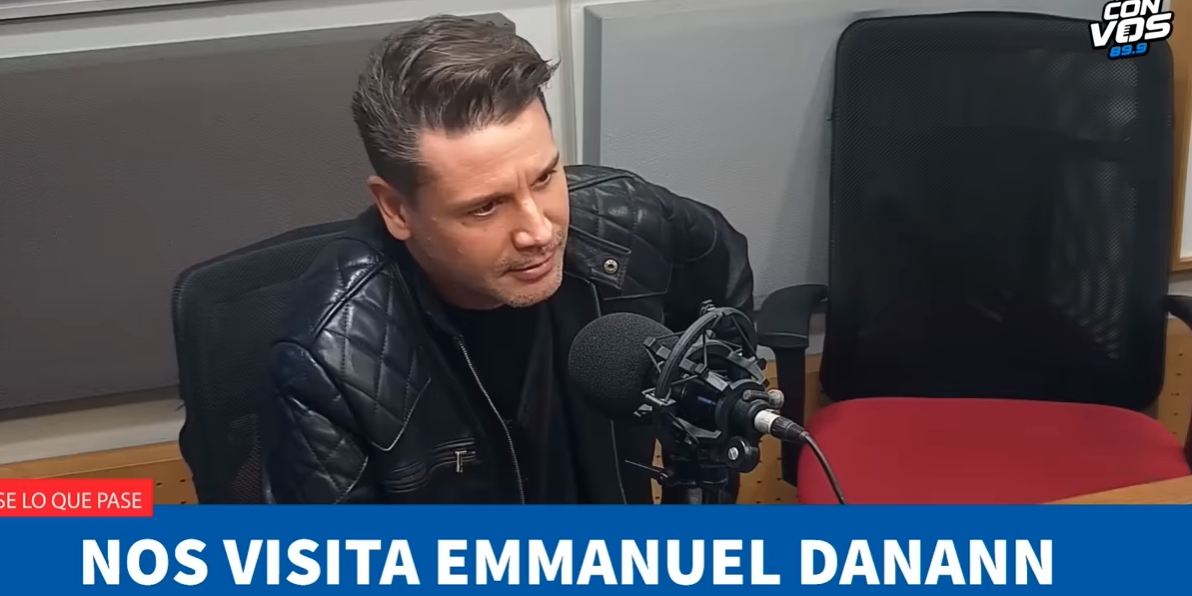
From Presentes we analyze the interview that journalists Reynaldo Sietecase and Ernesto Tenembaum conducted with Emmanuel Danann, we refute misinformation and we ask ourselves about the purpose.


Share

Three men discuss gender and diversity, femicides, and human rights for 45 minutes on one of Argentina's most listened-to morning radio programs. Amidst the dismantling of programs and public policies designed to prevent and contain gender violence, the dismantling of the Ministry of Women and Gender and the National Institute Against Discrimination, Xenophobia and Racism (INADI), and other mass layoffs in the public sector, journalists Ernesto Tenembaum and Reynaldo Sietecase interviewed anti-feminist and libertarian influencer Manuel Jorge Gorostiaga on Wednesday, July 3rd, on Radio con Vos. He calls himself Emmanuel Danann, the name under which he rose to fame on his YouTube channel. There, he has 1.9 million followers and a music video opening where, like a rocker, he sings a song called "Dystopia." "We are a dystopia imagined by a writer / there are no more men or women and life has lost its value," the song says.
At the beginning of the program, Tenembaum tells the audience that they are interviewing Danann to hear from those who think differently. As the conversation winds down, Danann challenges them and asks: "Why did you invite me?"
We ask ourselves the same question. What's really behind this invitation? What's the point of opening up a journalistic space to someone who already has such a large audience? Or is that the reason? Is it just for ratings? Is it journalistically responsible to invite a serial disinformation agent and hate instigator like Danann? Are Radio Con Vos's audiences any better off in terms of their right to pluralistic and responsible communication? Did they never consider having a female communicator as a guest or co-host who could contribute data and a gender perspective?
Danann introduces himself: “I’m a fundamentalist of free speech.” Danann constantly corrects and interrupts his interlocutors; he’s trained in the art of provocation. He can say anything with the same imperturbable tone, his voice raised, somewhere between boasting and revelation. The word “absolutely” speaks volumes.
The disinformation festival
Throughout the interview, Danann breaks records for spreading false information and arguing based on fallacies. He makes it his mission to disseminate lies and offensive statements against feminists and LGBTQ+ people. He does so under the guise of having "gay and trans friends," and "I'm lucky to have such intelligent followers," whom he loves and respects because they don't subscribe to the gender agenda. What Danann consciously generates has a name: disinformation. Specifically, what he constructs is gender disinformation, something that isn't new but is increasingly viral, encouraged by platforms (like this program) that act as echo chambers. Let's look at some examples.
The convictions: At the beginning of the interview, Danann denies having two convictions. He says he cannot give further details on the advice of his lawyer.
In March 2024, it was revealed that Dannan was convicted of discriminating against and harassing a transgender woman in digital environments . It was the first conviction for discrimination in digital settings. In her ruling, the judge argued that he had abused his freedom of expression, as it violated another person's right to identity . Furthermore, it infringed upon personal rights such as honor, dignity, and the right to one's image.
A month later, it was revealed that Danann had requested probation after a lengthy trial following a complaint filed by Marina Abiuso, a journalist whom he had harassed in a violent campaign based on false information. He accused Abiuso, then the gender editor of the news channel TN, of complicity with those who had murdered Lucio Dupuy.
Instead of providing this information, Danann tells reporters: “The only conviction I have is for refusing to recognize a man in a wig as a lesbian woman with a penis.” She then adds: “But even that conviction isn’t final.” She attributes it to “a media campaign and the organizations.” Another lie.
Inclusive language and femicides: Her preferred target is “fourth-wave feminism” because “it is used politically.” She also constantly attacks “green-scarf feminists” (although she later says she agrees with the decriminalization of abortion) and the former Ministry of Women and Diversity, created during Alberto Fernández’s administration.
She says that instead of combating femicides, the Ministry was busy holding inclusive language workshops and "dances," and that this is why the number of femicides increased. Danann believes that the fact that a woman is murdered every 26 hours is the fault of inclusive language and the programs that aimed to prevent gender violence and support victims—programs that were dismantled in recent months.
His argument is built on a fallacious line of reasoning: he causally links things that have no causal relationship, not even a correlation. How could a talk about inclusive language possibly contribute to an increase in gender violence? Or does he mean that these talks or workshops would irritate men so much that they would incite them to abuse or kill women? It doesn't make sense.
What he does, once again, is reverse the burden of proof: the responsibility for gender violence does not lie with a system built on an unequal matrix based on sexist ideas like the ones he spreads, but rather with programs that seek to eradicate violence.
“This gender narrative is just an excuse for us to fund ministries for women, specialized prosecutors' offices (like the one that convicted him), courses, and workshops on masculinities.” This will swing the pendulum back to the right. “Look what's happening in Russia. There are going to be acts of violence,” he warns. Then he says that the Ministry of Women was involved with a “trafficking network” in Chaco. He offers no arguments or evidence for such a serious accusation. He leaves that statement there, to circulate and grow. His interviewers don't refute him or stop him either.
Libertarian ideas and “minority” rights: Danann says he is neither anti-feminist nor against “minority rights,” explaining that he is the great-great-nephew of Benjamin Gorostiaga, one of the drafters of the Constitution, and therefore absorbed libertarian ideas from a young age. He says he understood these ideas when he entered “the marketplace,” “the world of work.” “It doesn’t bother me that Juan Carlos identifies as Diana; what bothers me is that we have laws that force me to believe in things I don’t believe in, like self-identification,” he says.
Besides the insulting tone of his statement, he's spreading false information again. The gender identity law doesn't force anyone to believe in anything; it simply enforces the right to identity. Laws don't seek to interfere with people's beliefs; they are legal instruments to enforce rights and obligations.
Perhaps Danann dislikes the gender identity law, and that's why he chooses to violate it. The problem is that if you violate a law, there is usually (though not always, of course) repercussions. What Danann dislikes is that his decision not to comply with the law (which, as a liberal, is his right) has consequences. What Danann seeks is impunity, not freedom.
Then he demands psychiatric evaluations because, he insists, gender identity is a “neurological” problem. This contradicts the World Health Organization, which in 2018 removed “gender dysphoria” from its list of mental illnesses . But why should Danann have to respect all kinds of protections from international organizations or international human rights conventions?
That may be the problem: Danann doesn't adhere to any collective consensus or "agendas" because he lives in his own world, created from disinformation, conspiracy theories, and hate speech. He chooses to situate himself solely within his world of beliefs, outside of or above any normative or legal framework. We can't fight against that, but we can ask ourselves again: why does journalism (and journalists who call themselves progressive) insist on amplifying this discourse? Especially when these outlets fail to counter it with truthful and verified information that contradicts his lies.
Amplifying hate speech is not without consequences.
Another Wednesday, a week before this interview, Pamela, Roxana, and Andrea, victims of the triple lesbian murder in Barracas, were buried in the Chacarita cemetery. Perhaps the hatred and violence of discriminatory comments are difficult to grasp when listening to a radio broadcast or browsing social media. But their effect is real. Hatred materializes; it kills.
The problem isn't just the fallacious arguments and misinformation spread by Danann. The issue is far more complex and has several layers. One of them concerns the tools available to communicators and their responsibility when reporting. To this day, training in gender and diversity, in a country that still has progressive legislation, remains relegated—in most journalism schools and faculties—to optional seminars or extracurricular courses. As if it were more important to address other topics that are part of the curriculum than to understand the foundations upon which gender inequality is built.
A few days before the triple lesbian murder, Nicolás Márquez, another ultraconservative influencer and Javier Milei's biographer, was presented as a "writer" and spouted another series of false and pathologizing facts about homosexuality, without anyone being able to mention that everything he said was a lie and that the WHO removed homosexuality from a list of diseases more than 30 years ago, in 1990.
What happens when people listen to such a large amount of false information? Are there any considerations about the harm it causes to people of all ages, especially teenagers who might be listening? Are the communicators aware of the extent of the damage? We ask again: why do they invite them?
We are present
We are committed to journalism that delves into the territories and conducts thorough investigations, combined with new technologies and narrative formats. We want the protagonists, their stories, and their struggles to be present.
SUPPORT US

FOLLOW US
Related notes

We are present
This and other stories are not usually on the media agenda. Together we can bring them to light.