

Who are the six women still detained after the repression at Congress?
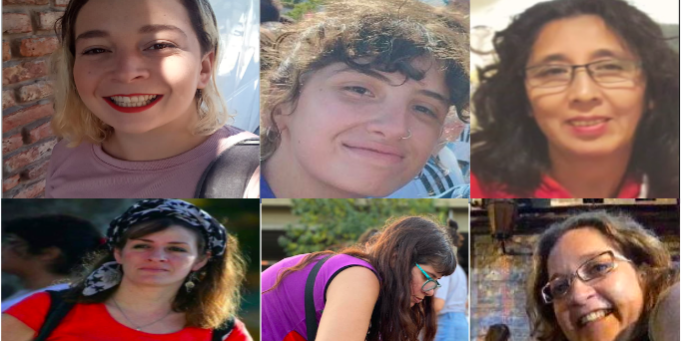
Camila Juárez, Sasha Lyardet, Ramona Tolaba, María de la Paz Cerutti, Daniela Calarco, and Lucía Belén are the six women still detained in the Ezeiza Penitentiary. These are their stories.


Share

BUENOS AIRES, Argentina. The fierce repression on Wednesday, June 12, near the National Congress resulted in 33 arrests. Seventeen of them were released on Friday without any known reason. Of the 16 people arrested, ten men are being held in the Marcos prison and six women in Ezeiza.
Human rights organizations and political figures denounced the unprecedented repression by security forces during the protests against the Basic Law before the UN and the Inter-American Commission on Human Rights. This constitutes an attack on the right to protest.
Last Friday, the demand was made at a press conference held at the headquarters of the Peace and Justice Service of Argentina (Serpaj). There, the speakers unanimously called for the immediate release of those detained and asserted that the accusations were arbitrary and without evidence.
Judge María Servini de Cubría released 17 of the detainees on Friday and is evaluating the situation of the 16 who remain in custody. Meanwhile, the prosecutor in the case, Carlos Stornelli, appealed the release of 14 detainees.
The protesters face accusations of crimes "against Public Powers and the Constitutional Order", "against public safety", "incitement to commit crimes" and "incitement to collective violence against institutions", among others.
Women
Camila, Sasha, Ramona, María de la Paz, Daniela, and Lucía Belén are the six women still detained in the Ezeiza Penitentiary. The Ni Una Menos (Not One Less) movement has been supporting the call for their release since their arrest.
Over the weekend, Victoria Montenegro, a legislator for the City of Buenos Aires representing the Union for the Fatherland party, visited the Ezeiza prison along with the National Committee Against Torture. Currently, the six women are being held in a pre-admission wing. Their families and organizations are demanding their release and that they remain together, given the "threat of being separated" by the prison service.
Presentes spoke with people close to the six women to learn their stories.
Paz Cerutti
María de la Paz Cerutti is 43 years old. She was arrested at the corner of Moreno and Irigoyen streets, 13 blocks from the National Congress. She is an accounting professor and has worked for 15 years at the Ministry of Economy. She had been on leave for mental health reasons for the past few months and had returned to work that day.
Paz passed by the demonstration against the Basic Law. A coworker was there, and she wanted to let him know her leave was over. “She was coming from a personal errand and stopped by to demonstrate, like everyone else, against this law that sells out the country,” Eva Rojas, one of María de la Paz's sisters, told Agencia Presentes . Far from Congress, when the police saw her crossing the street, they asked her for identification, and she shouted her name. They then moved toward her and arrested her.

“For us, it’s horrific. We have five relatives who disappeared during the civic-military dictatorship; I, in particular, was kidnapped in March of ’76. Our lives are marked by the dictatorship, which is why we’re so worried about my sister’s mental health,” says Eva. “A colleague from the Commission for the Prevention of Torture told me he was talking to my sister, who was detained. A little while later, this video surfaced, and that’s when we realized this was going to be a nightmare,” she adds.
María de la Paz is the granddaughter of Sara Derotier de Cobacho, a leading figure in the Mothers of Plaza de Mayo and former Secretary of Human Rights for the province of Buenos Aires during the administration of Daniel Scioli, a member of the current Milei party . She wasn't the only one arrested on that corner. “They were random arrests; they grabbed the most insignificant people. One was selling empanadas, another was hiding, and my sister happened to be passing by,” says Eva, an activist with the Peronist Current for Human Rights. “I'm in an organization, but María de la Paz wasn't; she wasn't an activist,” she clarifies.
María de la Paz, along with other women, was handcuffed and left lying in a hallway for more than 20 hours. Eva says the police commissioner told them they were on a picnic. “We don’t know what condition they’re in. They’re being threatened; it’s very serious.”
Her sister describes María de la Paz as a very intelligent, sensitive, and deeply religious person. She is the youngest of four siblings—three sisters and one brother. Their concern is for Paz's mental and physical health. “We're not a family that's been through anything. We're already emotionally fragile, and I think this is going to be very bad for her,” says Eva. Paz was not among those released on Friday. She is accused of kicking a police officer.
Ramona Tolaba
As in every demonstration, Ramona Tolaba, 54, a domestic worker, came to the protest to join the demands against the Bases Law.
Paola Costas, one of her daughters, recounts that the woman usually goes to the marches alone and doesn't belong to any organization or political party. She arrived in the area a little after 2 p.m., and while walking, she ate a slice of pizza and told her daughter how things were in the street. "I'll text you every hour, let you know how and where I am," she told her daughter. At one point, she stopped communicating, and Paola waited until 7:30 p.m. and started calling her, worried. Later, she learned that her mother had been arrested at 6:20 p.m. at the intersection of Avenida de Mayo and Santiago del Estero.
“She never went near places where things were tense. She told me later that she saw they were dispersing and stopped to talk to a retiree. That's when motorcycles appeared and they fired rubber bullets. She ran down Santiago del Estero Street. There she took cover behind a car, and that's when they arrested her. Lucía Belén was also there; they didn't know each other at that time,” Paola recounts.
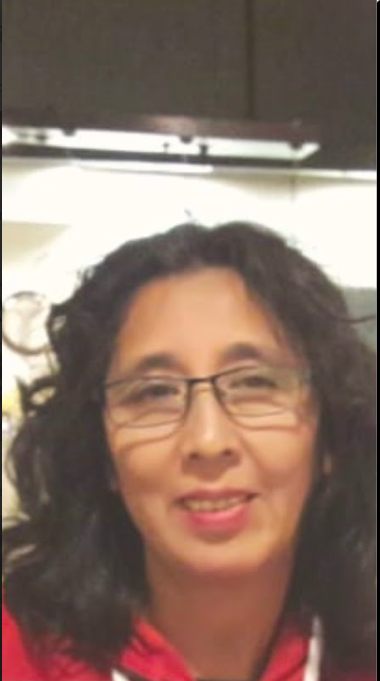
Ramona Tolaba is accused of sedition, resisting arrest, and throwing projectiles. “She would be incapable of that. She was there defending the privatization of companies; she didn't like the Bases Law, but she's not violent,” says Paola, who describes her mother as hyperactive and independent.
It wasn't until 10 p.m. on Wednesday that Paola heard from her mother. Her mother called her at that time and said they were at the 4th police station in Parque Patricios. Paola went there from 3 de Febrero, where she lives, but they had already taken her to the 15th police station in Chacarita. Later, she learned that the detainees weren't taken out of the police van until the next day.
Only on Sunday was she able to see and speak with her; Ramona is now being held in Ezeiza. They weren't allowed to bring the glasses near her because Paola is worried they'll try to make her sign papers that Ramona can't read because of the small print.
“Her bosses love her,” Paola says of her mother. “She’s loving, respectful, very hyperactive, independent, a nature lover, an animal lover. She loves to travel; her dream was to live in Ushuaia, and now I’m afraid she won’t be able to fulfill it,” she says, her voice filled with emotion. She adds, “They’re political prisoners. This government wants to scare people into marching to defend their rights; it’s a form of punishment.”
Ramona's family asks that anyone with photographic or audiovisual records send them to the email address: libertadporramona@hotmail.com
Lucía Belén
Lucía Belén couldn't bear to see the images of the police beating the pensioners who were demonstrating near the National Congress on Wednesday, June 12. She decided to go there alone and arrived around 5 p.m. To feel safer, she shared her location with her best friend, Aylén. She also sent her videos showing the situation. Around 6:30 p.m., she managed to let her know that she had just been arrested.
Like Ramona Tolaba, Lucía Belén, facing rubber bullets and tear gas, ran for cover through Santiago del Estero. She hid behind a car there, as did Ramona. Both were unlawfully detained.

Lucía Belén is 26 years old, a librarian, and studies Literature at the National University of Hurlingham. As soon as she heard about her arrest, Aylén went out to look for her. She managed to see her several hours later in Chacarita. “She told me she was walking along Avenida de Mayo when the motorcycle police started firing rubber bullets into the air. She started running and hid behind a car with Ramona. That's where the City Police arrested her. She told me they punched her in the face, threw her to the ground, and put seven zip ties on her. At no point did they tell her why they were doing that to her. They were kept on the ground for two hours along with four other people.”
Aylén arrived immediately and tried to speak with the police, but the officers began pushing her and her boyfriend. Lucía Belén's phone shared her location for 12 hours, so her friend was able to see the route the police took with the detainees. It was only after these transfers that she was able to see her friend in Chacarita. “Lu told me that they tried to force them to sign a paper stating that they had started the fire. They refused to sign because they hadn't done any of those things. The police told them they were still being detained because they refused to sign that paper.”
Lucía is also accused of kicking a police officer. There are no videos or any other evidence to support this claim, her friend states. “Several media outlets show the moment they arrested her, holding her on the ground between three police officers. Lucía is small in stature; it’s impossible that she hit the officers,” Aylen adds. She and Lucía’s father are leading the calls for her release.
When she talks about Lucía, she describes her as a caring and multifaceted person. “She was studying Literature, but she also studied library science, astrology, and wanted to enroll to study Anthropology at the University of Buenos Aires. She always wants to learn new things. She’s very curious and loves animals. I know she must be missing her pets a lot. She’s a person who defends everyone’s rights, not just her own,” she says.
Patricia Daniela Calarco Arredondo
Last Wednesday, Patricia Daniela Calarco Arredondo was with her partner and fellow activists in the march of the Teresa Rodríguez Movement (MTR) "We Vote to Fight for Social Change" when security forces began to repress them. After passing through a bottleneck on Avenida de Mayo, she managed to turn onto 9 de Julio, while police officers on motorcycles advanced on either side of her, firing rubber bullets and pepper spray.
“We were tripping over each other because we couldn’t see,” María Emilia “Coca” Manazza, Daniela’s partner, told Presentes . “We were about 13 blocks from Congress when a plainclothes police officer grabbed her from behind, with all the brutality and impunity they have. I tried to struggle to get her out, but I couldn’t.”
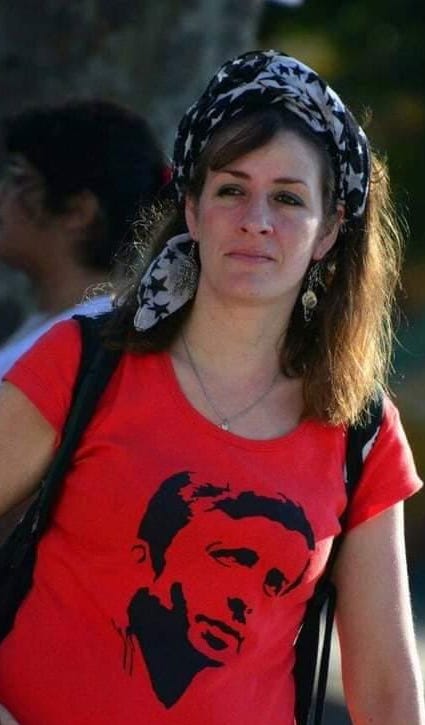
Daniela is 39 years old, from the Hipódromo neighborhood of Mar del Plata, and has lived with Emilia in Lomas de Zamora since 2021. She is an environmental activist, a cause she championed in her hometown against fumigation. She wanted to study Psychology, but the demands of work prevented her from finishing her degree. She held several jobs simultaneously in the food service industry until she began working in 2019 at the former Ministry of Social Development. In March of this year, she and several other employees of that ministry were laid off.
On Wednesday, she was among the 22 people arrested by the City Police who were taken to the Parque Patricios police station, and at midnight on Wednesday she was transferred to the Chacarita police station. Early Saturday morning, she was taken to Ezeiza prison.
Emilia, her life partner, has not yet been able to visit her. However, she was able to speak with her: "She is showing great strength in prison. As part of her training and awareness in the struggle, she knew that these are the consequences we face, especially with governments that have such unchecked repression."
Sasha Lyardet
Sasha Lyardet is a student of Communication Studies at UNSAM and will turn 25 this Wednesday while detained in the Ezeiza Penitentiary. "We want her to be able to celebrate it in freedom," her partner, Nahuel Schiavoni, told Presentes.

When Nahuel was finally able to speak with Sasha, the young woman asked him not to bring her books, but rather her course notes so she could continue studying. "She's very passionate about it," Schiavoni commented. They met in 2018 while working together in the Socialist Workers' Movement (MST) party and have been a couple for several years. The day she received the news of the arrest, she was working a shift at a pharmacy. "I went into shock for a second and had to move quickly; I couldn't afford to be in shock," she recalled.
Sasha was in the San Martín Assembly column near the intersection of Mexico and Lima streets when City Police motorcycles appeared "at full speed" and mounted the sidewalk. In the ensuing chaos, her friend, Camila Oliva, tripped and stopped to help her. "Get on the ground, if you run I'll shoot you and drag you by your hair," the police officers told Sasha, according to her sister Grisel, who shared the account on social media, as well as other friends who witnessed the arrest.
The young woman, a fan of Babasónicos and El Kuelgue, works as a legislative advisor in the José C. Paz City Council. Originally from Pilar, Buenos Aires Province, she currently lives in San Martín. " She does a lot of community work. She organizes soup kitchens at the UNSAM student center and the San Martín Assembly, she leads literacy programs, and she works with low-income neighborhoods ," Nahuel shared.
"She's okay, she's strong. She's trying to transmit strength to the other detainees. I know her, and I can see that she's not doing great either, she's in prison... But she's trying to stay strong," said her partner, after visiting her.
Camila Belén Juárez Oliva
Camila Belén Juárez Oliva is Sasha's friend who tripped over a flowerbed on the sidewalk during the bull runs last Wednesday. She is 33 years old and the mother of two children, ages 8 and 11. She studies Sociology at UNSAM and runs a food business with her partner, Nestor.
Last Sunday, her mother, Silvia Oliva, was able to visit her along with Camila's brother and his partner. She stayed from nine in the morning until eleven at night at the prison gates, while people who had come on their own to bring her a soda or a chocolate bar to "sweeten my soul," she says. There were also dozens of Camila's friends.
"You didn't know I had so many people who loved me, did you?" Camila said to her family when they told her who had come to support her.
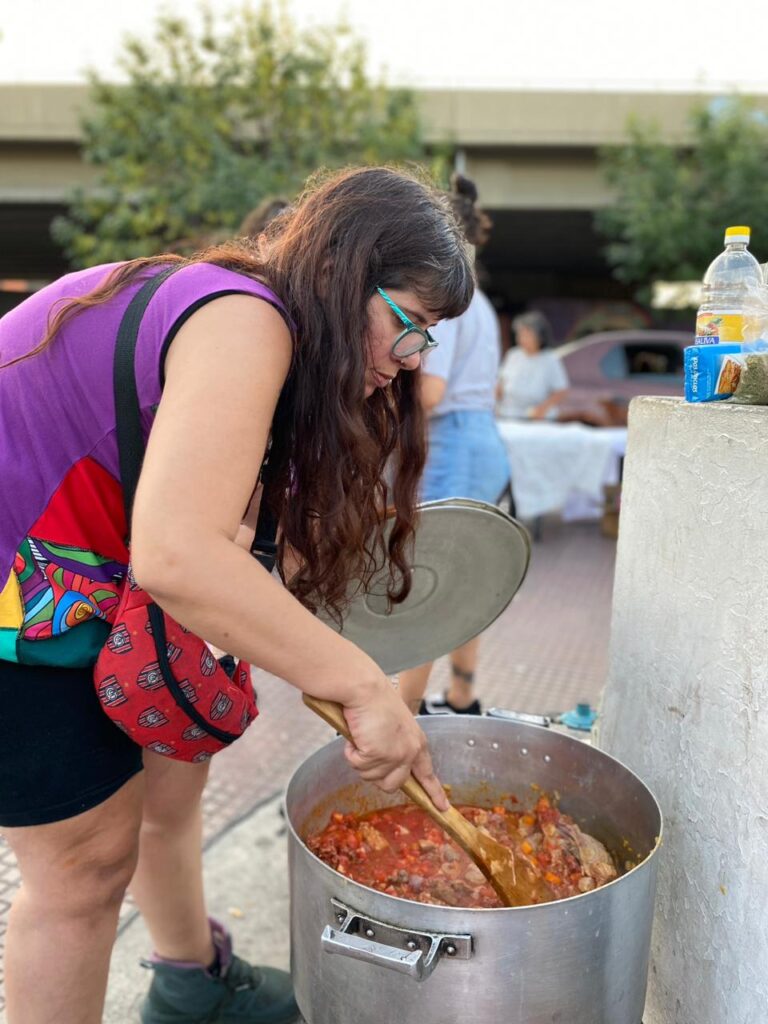
Like the two other people arrested with her (Sasha and Nicolás), Camila organizes community kitchens for the neighborhood. She loves Argentine rock, especially Charly García, La Renga, and Los Piojos, a band she followed closely to see if they would reunite. She's a huge fan of the Chacarita Juniors football club, the same one her father played for, who passed away during the pandemic: a gesture to feel closer to him.
In response to the narrative promoting the idea that those arrested were part of a terrorist organization, their mother, Silvia, commented in an interview with Presentes: “Camila is the terrorist who organizes soup kitchens to provide a meal to those who have nothing to eat. The terrorist for whom her teenage scout group just issued a statement of unconditional support. Camila is a mother, a person obsessed with completing her Sociology degree and using her skills to help those in need.”
A few days ago, her life partner, Nestor, wrote her a letter that went viral. "I would like to bring to you and the others who are with you the remedy I found out here against the hatred they want to instill in us and against the virus of despair, which are the voices... of others. Voices of solidarity that from the very beginning were protesting in the streets, spreading the word about the madness, protecting human life and democracy!, embracing us without knowing us, looking us in the eyes with compassion, giving us their support and their strength."
We are present
We are committed to journalism that delves into the territories and conducts thorough investigations, combined with new technologies and narrative formats. We want the protagonists, their stories, and their struggles to be present.
SUPPORT US

FOLLOW US
Related notes



We are present
This and other stories are not usually on the media agenda. Together we can bring them to light.