

First LGBT mental health survey: more than 50% of young people considered suicide
For the first time in Mexico, specific data on mental health and LGBT+ youth are being collected to identify risk factors and what is needed to guarantee protection and well-being for young people aged 13 to 24.


Share

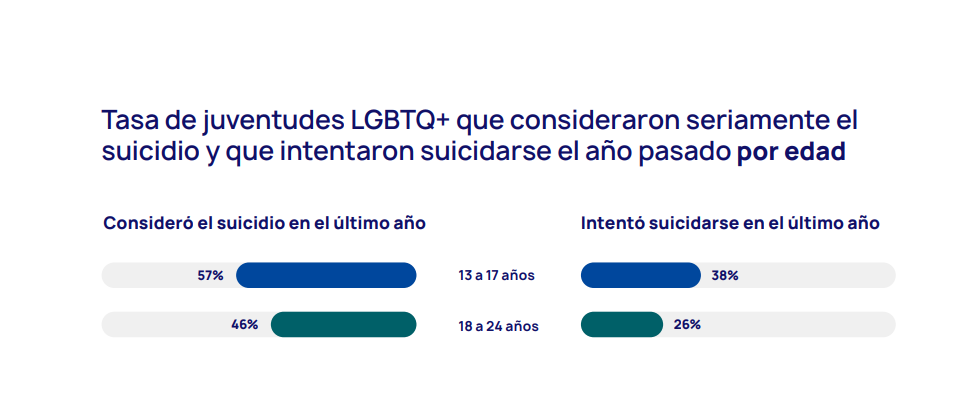
MEXICO CITY, Mexico. In Mexico, more than 50% of LGBT+ youth have considered suicide in the past year. This was the finding of the first mental health survey in the country conducted among people aged 13 to 24, carried out by The Trevor Project Mexico , an organization dedicated to crisis and suicide prevention for young people of diverse sexual orientations and gender identities.
Fifty-seven percent of those who considered suicide were between 13 and 17 years old. Similarly, one in three LGBT people attempted suicide last year. These figures are even higher among trans and non-binary populations, where two out of three considered suicide and almost half attempted it.
Risk factors continue to be primarily the lack of safe spaces in family and school environments. In contrast, those who reported having support and acceptance in these spaces experienced better mental health outcomes.
Talking about mental health
This is the first time in Mexico that specific data on mental health and LGBT+ youth has been collected with the aim of understanding the risk factors and what is lacking to guarantee the protection and well-being of this population.
“Being LGBTQ+ is not directly related to having a crisis or suicide, because being LGBTQ+ is not a problem. What is true is that rates of violence, exclusion, and discrimination are high for this community because society sees us as a problem. So, the solution to improving mental health lies in society, in the context, in not exacerbating the conditions of inequality. It is the stigma, violence, and discrimination that deteriorate mental health, not being an LGBTQ+ person,” emphasizes Edurne Balmori, executive director of The Trevor Project Mexico, in an interview with Presentes .
The Trevor Project is an organization that originated in the United States and expanded its operations to Mexico with a helpline in October 2022. Through WhatsApp and an online chat, they provide free and confidential support and assistance to young LGBT+ people experiencing mental health crises.
If you feel fear, anxiety, or have thought about harming yourself, you can send a WhatsApp message to this number or start an online conversation at this link to be heard and supported.
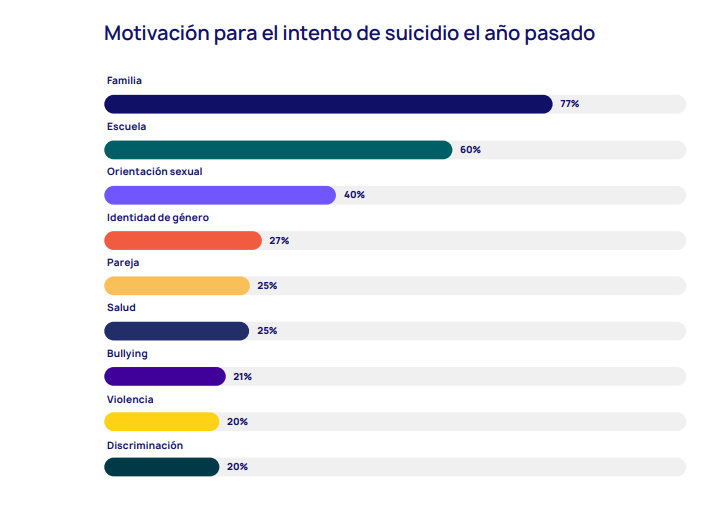
Family exclusion was the reason for attempted suicide in 77% of LGBT+ youth
Of the LGBT+ youth who attempted suicide last year, 77% said their suicide motivation was related to their family situation and 60% to their school environment. Only 22% of LGBT+ youth reported having access to a supportive home, and 34% felt accepted by their family after coming out.
“The results reveal that much more needs to be done; they are more than just statistics. They are an urgent voice from all young people who continue to fight against discrimination, violence, and the lack of validation of their identities in primary environments, places where they should be protected,” Edurne emphasizes.
Another risk factor identified by this survey is the threat of or exposure to so-called “conversion therapies.” In Mexico, these practices are criminalized in 16 states and operate in various ways . In most cases, the primary actors involved in these human rights violations are family members.
Trans and non-binary youth at greater risk
Of the 50% of LGBT youth who have considered suicide, 2 out of 3 are trans and non-binary people; and almost half of these attempted suicide.
In addition, trans men and transmasculine people report the highest rates of suicidal thoughts and attempts, at 75% and 52% respectively, compared to other trans identities.
Currently, some countries around the world are enacting legislation to restrict the progress of human rights for transgender people. In Mexico, some legislators are beginning to export not only the proposed laws but also the misleading narratives that support them.
Edurne believes that these contexts of misinformation and hate speech about trans identities can also be a risk factor for the mental health of LGBT+ people in Mexico.
“We don’t want more than half of LGBT youth contemplating suicide for any reason. We don’t want any of them. But right now it’s more than half. Let’s think about what will happen tomorrow if we don’t do something about it, also in relation to misinformation and hate speech,” Balmori adds.
Support from friends and family protects against depression
The survey reveals that where friends and family are supportive of LGBT+ youth, and where their sexual orientation and gender identity are respected and validated, environments are created where there are fewer risks of experiencing depression, anxiety, and attempting suicide.
More than half of the people surveyed (57%) highlight that their identities and pronouns are most respected in their schools and digital environments.
Furthermore, 40% of young LGBT+ people reported that their community was somewhat or very accepting of LGBTQ+ people. In contrast, only 22% reported having access to a home where their sexual orientation and gender identity were affirmed.
Edurne comments that mental health in Mexico is going through a crisis, not only in terms of budget but also due to a lack of intersectional approach, analysis of contexts and risk factors.
“An increased budget for prevention and rehabilitation services is necessary. But above all, we believe there is a need to focus efforts on building accessible and vital family, school, community, and health service spaces that affirm people’s LGBTIQ+ identity,” concludes Edurne Balmori.
We are present
We are committed to journalism that delves into the territories and conducts thorough investigations, combined with new technologies and narrative formats. We want the protagonists, their stories, and their struggles to be present.
SUPPORT US

FOLLOW US
Related notes

We are present
This and other stories are not usually on the media agenda. Together we can bring them to light.