

3. In first person: Dino, two religions and the same trap
Dino Germani, a trans man, sought support and solace in religion. He encountered attempts to change his identity.

Share

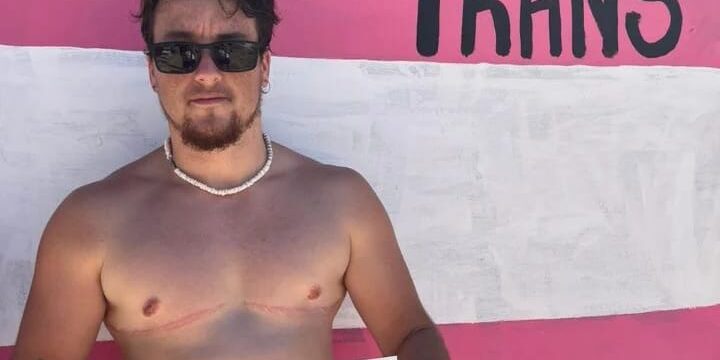
For Dino Germani, a 29-year-old trans man, religion had two faces: salvation and condemnation. He was born in San Justo, a city of just 22,000 inhabitants, 79 kilometers from Santa Fe, the provincial capital. In that small agricultural town, 15 years ago, there was hardly any talk of gender nonconformity. “I couldn’t put a name to what was happening to me; I didn’t know trans people existed,” he recalls. At age 12, he joined the Jehovah’s Witnesses of his own volition. A complicated family situation, he says, led him to seek a supportive environment where he could envision a better life.
“I couldn’t find a way to fit in at home. I wanted to escape. I looked for a religion because I thought it was where I would be most accepted. And I walked right into the lion’s den (laughs). During all those years I could never talk about how I felt because I felt so much guilt. I spent five or six years in an institution that I went to after school every day. Soon after, my mother joined her too. But they never let her participate fully because she wasn’t married,” she tells Presentes.
“I couldn’t find a way to fit in at home. I wanted to escape. I looked for a religion because I thought it was where I would be most accepted. And I walked right into the lion’s den.”
For all those years, he lived his sexual identity “as a sin” because in every class he attended, they emphasized that what he felt was wrong, even if he hadn't spoken about it. The institution's structure is very rigid and hierarchical. The elders have the final say on everything and define the sanctions—generally a ban on speaking to anyone—for those who break the rules. Even during ceremonies, there are designated spaces for each member according to their role in the community. “They mark everything on you. So you're guilty all the time. I shouldn't do this, or I shouldn't think this, or I shouldn't say this. It's horrible,” he says. He recalls that they insisted on finding passages from the Bible to prove that homosexuality was an illness.
At one point, his connection with the organization began to fray. This was partly due to a feeling of always being at fault, but also because Dino began to see that "there were many other people within the congregation who were doing what are called 'worldly things' (participating in activities outside of what the religion dictated)."
“I went to a dance for the first time when I was 19. I didn’t know anything, because they didn’t let us do anything that any other teenager did,” she recalls, adding as an example: “My best friend couldn’t go to the senior prom, for example.”
Another aspect of the organization that she didn't understand was the number of things they gave her. For example, books, which always arrived free of charge. "No one ever told me where the money came from. Those I asked, the ones who worked there the most, told me they 'did it out of love,'" she says.
Her days were spent praying to God to change her way of thinking and feeling. “I didn’t say anything because I felt so guilty. I thought it was a bad thought I had, because everything was based on whether God liked what you thought or did . My father committed suicide, and they taught that those people wouldn’t get anywhere. There were many things that didn’t make sense to me,” she adds.
Dino says he was very afraid to speak his mind. When he told his mother he liked women, she wanted to have him committed to a mental health institution. “I wanted to kill myself several times. I was trying to find myself, to know what I was, because as far as I knew, you were either a lesbian or gay, but I didn't feel like either. One day I grabbed my bike and threw myself under a truck… I don't know how I survived, the doctors couldn't believe it.”
The young trans man finished high school and knew he didn't want to continue with the life he had. He felt lost, he had no one to guide him. "I didn't even know my rights. Doors were closed to me everywhere," he emphasizes. He slept on the streets, spending the night in the plazas.
After that experience with Jehovah's Witnesses, Dino suffered from epileptic seizures for three years. “I didn't know what was happening to me. They told me I was just trying to get attention,” he recalls.
In search of containment
According to the official 2023 report from Jehovah's Witnesses, the organization has 8,816,562 members worldwide, organized into 118,177 congregations in 239 countries and territories. In Argentina, they count over 300,000 attendees at memorial services; over 400,000 in Venezuela; over two million in Mexico; around 600,000 in Ecuador, Cuba, and El Salvador; plus another 500,000 in Peru; to give an idea of their presence in Latin America.
Dino was no longer part of that Jehovah's Witness statistic, but at his mother's request, he tried again to connect with a religious group that would support him. He attended an Evangelical church, also in San Justo, where they practiced various rituals to "cast out the demon" from the people who attended.
“I always told my mom that if there was a God, I didn’t believe he was like they said.”
Shortly after attending those ceremonies, a woman came to his house to perform a kind of exorcism. Dino recounts that she made him kneel on the floor, placed her hands on his head, and began applying pressure and praying. “Supposedly, I had a demon related to sexuality,” he says. As the prayer and pressure intensified, Dino began to cry. “It wasn’t because the Holy Spirit was entering me, as she said; I was crying out of anger. I couldn’t believe this was happening to me,” he says. It was his last connection to religion. Some time later, he moved to the city of Santa Fe and began the transition to his true life. Today he says, “I always told my mother that if God existed, I didn’t believe it was like they said .”
We are present
We are committed to journalism that delves into the territories and conducts thorough investigations, combined with new technologies and narrative formats. We want the protagonists, their stories, and their struggles to be present.
SUPPORT US

FOLLOW US
Related notes
We are present
This and other stories are not usually on the media agenda. Together we can bring them to light.