

2. In the first person: Diego and a religious psychologist "for people like you"
Diego was born into a very Catholic family. He came out at 19, and from then on, he embarked on a painful journey for himself and those around him. Today, he seeks people with whom he can talk and reflect on his experiences.

Share

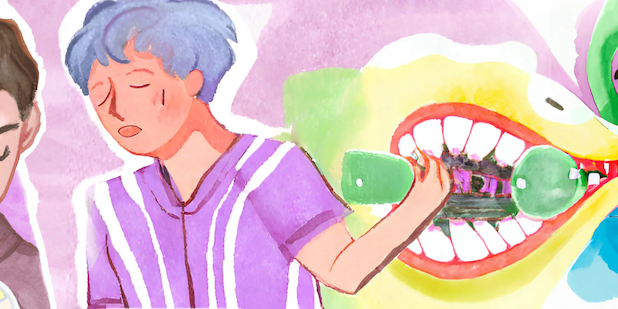
Diego was born and raised in a very Catholic family in Santa Fe, the capital city, one of those who attend Mass every Sunday and participate in spiritual retreats. So, at 19, when he came out of the closet, he was prepared for the shockwaves that would shake his entire home. “It was very difficult for my mom and dad. They didn't react with violence, but with a lot of sadness that made me feel terrible,” he recalls about that time.
The city of Santa Fe was still recovering from the devastation of the 2003 flood when, at Our Lady of the Assumption Church, a young priest was forming groups of teenagers to spend different afternoons, commit to social change, and participate in retreats. His masses were the most well-attended, and Diego's family had a close relationship with him, so his mother decided to seek his advice. It was this priest who recommended that she begin therapy with a religious psychologist from Rosario who traveled to the provincial capital every week to see people like Diego and Gastón Onetto .
“I had imagined that the situation at home was going to be difficult, but I didn’t think it would be this bad. I agreed to go to the psychologist because I was also looking for answers. I lacked the information to be able to explain to them why this was happening to me,” he says, but adds: “It still bothered me a bit. I asked my mom if she wanted me to stop being gay or what it was all about, but she didn’t really know. She had only been told that he accompanied people like me.”
Diego agreed to begin therapy sessions, but made it clear from the start to his family and the therapist: there was no way he would stop being who he was. “I needed to see a psychologist to heal my relationship with my family,” he emphasizes. He also mentions that the therapist had asked his mother to attend sessions as well, but didn't allow them to go together.
At that time, Diego's mother would return from her therapy sessions carrying a heavy burden, he recalls. “My mom suffered terribly. She blamed herself for her motherhood. She felt that everything that was happening to me was because she had to work a lot during her pregnancy and my dad was unemployed, so she believed he wasn't fulfilling his role in the family. A lot of things came to light. It was very hard for her,” he explains.
For more than six months, they continued therapy together. Neither of them felt any better. Every time Diego started to be affected by the comments about his life, the psychologist invited him to activities “for people like him.” On all those occasions, he says, he put a stop to it and made it clear: he wasn't going to stop being gay. “It wasn't until I was able to tell my mom that I didn't want to go anymore that she realized it was hurting him,” he recalls. “She told me she didn't agree with my life at that time, but if I didn't want to go anymore, then I didn't have to.”
Whenever Diego began to be affected by the comments about his life, the psychologist would invite him to activities "for people like him".
There were talks and activism to rebuild the relationship. “Today my mother is one of my closest confidantes. But we had to go through all of that,” he acknowledges. Regarding his experience with the psychologist, he believes the context helped him not to be influenced, but he does remember the impact that professional had on those around him, constantly blaming his mother and father for him being the way he was.
Alongside the sessions, she searched for information online and found content from organizations like the Ministry of Restoration. They validated the psychologist's position from a religious perspective that disguised hatred and discrimination as containment and love.
When it became known that the College of Psychologists of Santa Fe was going to issue a statement against conversion therapy following Gastón Onetto's complaint against the professional who treated him, Diego realized that what he had experienced was similar . He remembered other young people he had met during that time in the church setting who might have fallen prey to this professional or others like him. “I forgot about it for a few months. And I remembered it again when I read Gastón's story and, to some extent, when Desert Stream wanted to hold a seminar on sexual restoration in Paraná in 2012,” he says. And he insists that it is important for those who have experienced or are experiencing these kinds of situations to know that it is wrong.
“I want to find people to talk to about this. Many others must have experienced this. I can’t believe there are only two of us in the city of Santa Fe who have gone through this. I hope this reaches those people and they can rethink what happened to them.”
“I want to find people to talk to about this. Many others must have gone through this. I can't believe there are only two of us in the city of Santa Fe who have experienced this. There are many people who must have undergone these therapies and believed they were healed. I hope this reaches those people and they can rethink what happened to them,” she concludes.
ABOUT DESERT STREAM
Desert Stream is an international organization that presents itself as a religion. “Based on the mercy of Jesus and the dignity of men and women created in the image of God, we equip Christians to come together in pursuit of radical integrity,” it states on its website .
It has an area called Living Waters that specifically deals with accompanying Christians who struggle with, among other things, sexual addiction, promiscuity, masturbation, pornography, gender identity problems, and unwanted same-sex attraction.
We are present
We are committed to journalism that delves into the territories and conducts thorough investigations, combined with new technologies and narrative formats. We want the protagonists, their stories, and their struggles to be present.
SUPPORT US

FOLLOW US
Related notes
We are present
This and other stories are not usually on the media agenda. Together we can bring them to light.