

#8M: Assembly heading towards March 8: this is how feminisms are preparing to take to the streets
Women and LGBTQ+ people came together to organize a massive, unified March 8th demonstration in the streets, focusing on Milei's economic austerity measures. “We were a tide, we will be a tsunami. The enemy is not feminism, it's the fascist right.”


Share

This article is published in partnership with the newspaper Tiempo Argentino .
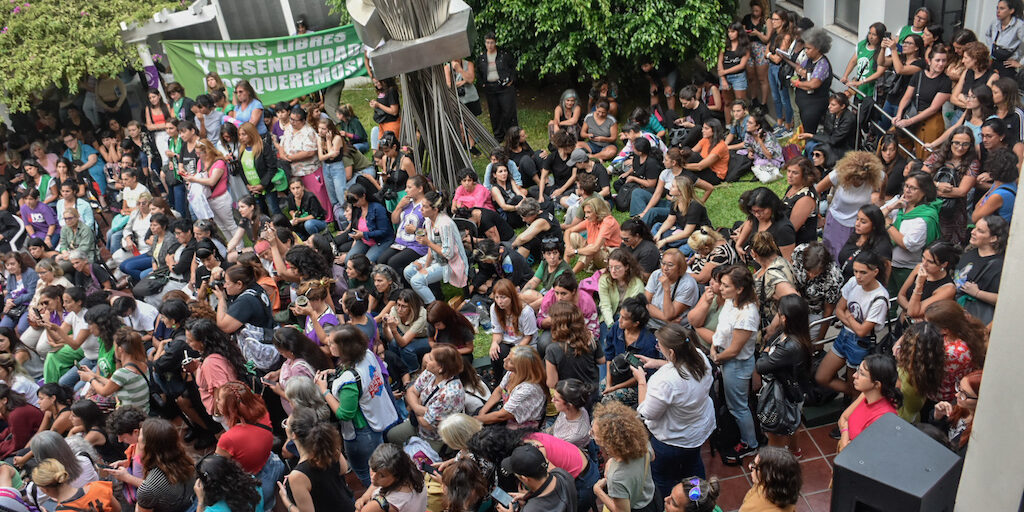
BUENOS AIRES, Argentina. United, organized, and in the streets. That was the conclusion of the first organizational assembly of March 8, which took place at the headquarters of the Association of State Workers (ATE) on Wednesday, February 14.
The debate began an hour late, and until nearly its end, women and diverse workers, activists, and other individuals continued to arrive to participate. It was the first step of the year in a vast network that will continue to grow throughout February and will culminate in the streets on March 8th.
At the opening of the assembly, Lucía Castro testified. She is the partner of teacher Nahuel Morandini, who was unlawfully imprisoned for tweeting jokes about former governor Gerardo Morales in Jujuy. Castro detailed how the Jujuy justice system is seeking to charge him with gender violence for having made comments about the governor's wife and daughter.
With a focus on workers
“We are once again in a situation where we have to show our strength as a feminist movement, which is not coincidentally singled out as one of the enemies of this project they call anarcho-capitalism. But it is a revamped and conservative neoliberalism,” said Luci Cavallero, a leader of Ni Una Menos, the organization that convened the massive assembly.
“This government is turning us against them because we were able to point out very significant structures of inequality. We have done a great deal of work these past years, and that is why we are being portrayed as enemies. I don't believe it's because of our mistakes,” Cavallero concluded.
Clarisa Gambera, Secretary of Gender for ATE, welcomed the hundreds of women who came. “ We are going to build a March 8th that, we believe, must focus on the situation of workers. There is an attack on our hard-won gains. As you know, this government is coming to dismantle the State, to take away our sectors of work. We are going to commit ourselves to building a March 8th of unity and action ,” the leader stated.
“They attack us because of the cross-cutting nature of our agenda. When we talk about violence and economic violence, we start by attacking everything. That's when they begin to portray us as enemies and put us in the ring first.”
Historical Voices
Among the women and diverse people sitting in the ATE courtyard, a voice emerged that drew applause: it was that of Dora Barrancos, a feminist sociologist and active militant for the gender agenda.
“ How afraid these far-right patriarchs are ,” Barrancos said. “I am deeply moved by the historical force we represent, not only in our country but throughout history. We will always say it. There is no possibility of building humanity if we do not recognize ourselves in our absolute freedom of gender and sexual orientation. It is clear that the world has become very complex. I won't dwell on how the far right has chosen us as the focus of their greatest hostility, almost diabolically responsible,” she added.
She also stated that “ now more than ever, we must be united. There is no possibility of us having separate territories. That is what they want. This is the time for a multifaceted union, for many voices. No one can be absent .”
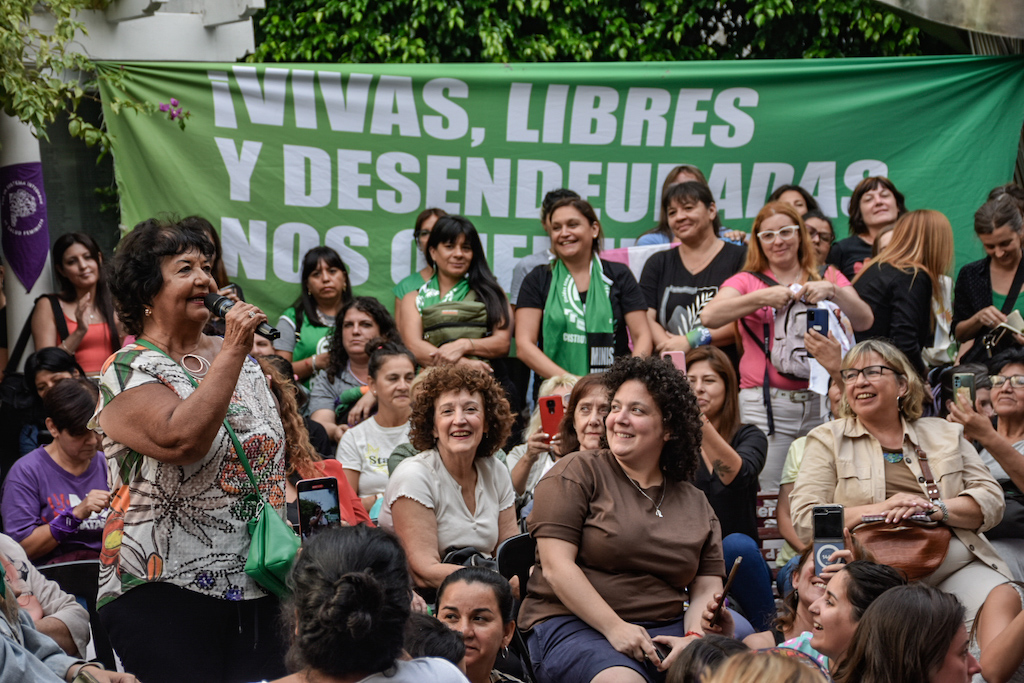
Barrancos recounted that there are men who are calling for feminist action in the streets. She summarized how anti-feminist right-wing movements are expanding worldwide, citing the Spanish party Vox and the situation in Hungary as examples.
“We are going to hold a demonstration on March 8th to show all of humanity that an attack on our rights is an attack on fundamental human rights. Because if they bury our rights, it means the general burial of human dignity in this country. And we will not stop thinking painfully about the poorest, the most excluded, about those women, about those people who are going hungry right now.”
Finally, the feminist leader paid tribute to the Mothers and Grandmothers of Plaza de Mayo and invited everyone to take to the streets in unity.
“How can I speak after Dora, you can’t talk,” said Nina Brugo, an original member of the Campaign for the Right to Legal, Safe and Free Abortion, laughing.
“We’re approaching March 8th, I prefer to say it rather than 8M,” Brugo said. “Feminism is the main enemy. We shake the entrenched structures in their minds. Something’s been echoing in my head as we stand here, that phrase we used when we got the law passed, ‘It’s the law, whether you like it or not.’ I remember that phrase because I want to tell you, let’s not make so many documents, we can manage with slogans,” she said to applause. “Down with the patriarchy, it’s going to fall, up with feminism, it’s going to win,” she concluded.
For freedom of expression and the right to protest
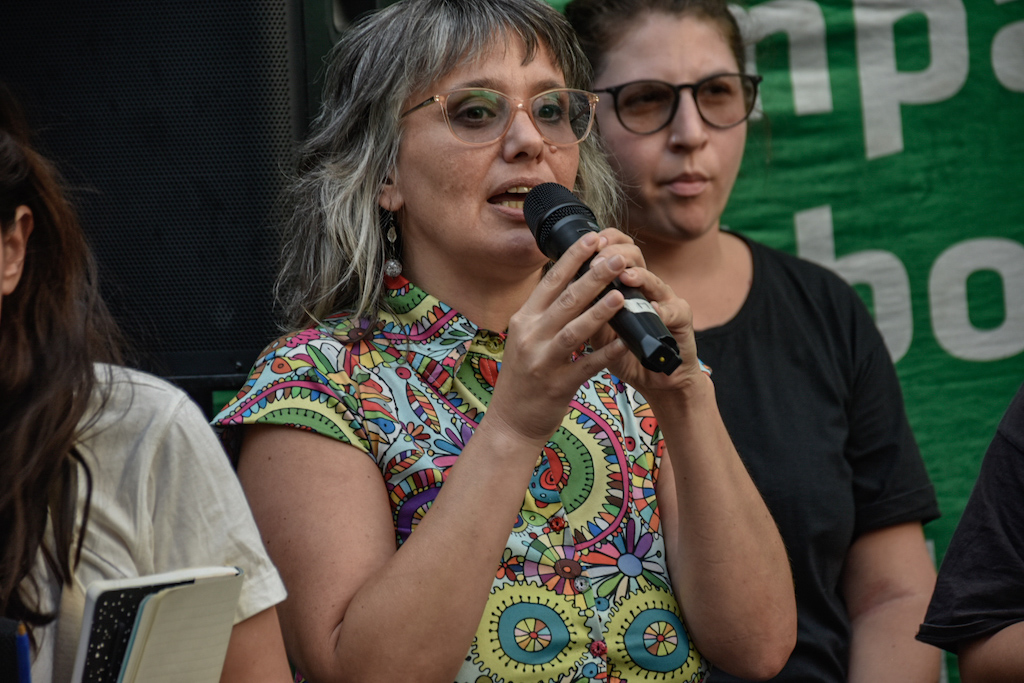
From the Buenos Aires Press Union (Sipreba), Micaela Polak, head of the Gender Department, denounced the harassment of the press by the Milei government. “ It’s not just the organized labor movement, state workers, and grassroots feminism: those of us who work in the press and aren’t puppets, who work seriously and do journalism, are also enemies of this government. We were chosen as the target of repression between January 31 and February 2,” Polak said.
“We need to denounce the fact that those of us who cover the marches and protests need to be able to do our jobs freely so we can tell the stories of what each of us is doing in the streets. So that people know what's happening and so the government doesn't claim there are only 40,000 of us, as they did during the strike, but rather that there are millions of us suffering this every single day,” she added. “On March 8th, let's fill the streets,” she concluded.
Unemployment and informal work
Another voice heard during the assembly was that of Leonor Cruz from the CTA Autónoma. “We are proudly transfeminists. In the streets we demonstrate our strength, but we also know better than ever that we have a decree in effect that is devastating the lives of each and every one of us, of our comrades, in our neighborhoods where death reigns.”
She added, “Today we are below the poverty line. We know who the enemy is. We don't need a strike to be decreed. A strike isn't decreed, it's built, not announced, it's done with our comrades in the neighborhoods, in the soup kitchens, in the unions. But this is a new era, today the streets are not the same, what we need is to build a massive March 8th. One that reclaims feminism and our agendas, and that makes it clear that hunger in Argentina is a political and disciplinary decision against our comrades. We must come together. We were a tide, we will be a tsunami. The enemy is not feminism, it's the fascist right.”
Georgina Orellano, head of the union, also raised the issue of the strike. “I want to ask those calling for a general strike, how are we, the informal workers who represent 50% of the population, going to stop working? Who is going to guarantee that when we strike that day, we won't have a plate of food to take home to our children?” Orellano asked.
“Let’s look at those of us who don’t have formal employment or retirement benefits. Our only right is the right to stand on the street corner, enduring precarious work, the lack of labor rights, the lack of public policies, and institutional violence. If we want this to be a people’s movement, the agenda must focus on what’s at the center, and at the center are hunger, precariousness, informal work, and unrecognized jobs and workers ,” she stated.
Popular economy and feminization of poverty
Dina Sánchez, from the Union of Workers of the Popular Economy (UTEP), stated, “In our sector, we are having a very hard time. The austerity measures are falling on the middle class, but with much greater force on the working class. Seventy percent of those of us who make up the popular economy are women. That's why we say there is a very strong feminization of poverty, and that poverty has a face, and that face is women, our diversity, and our children.”
The leader referred to the protocol of the Minister of Security, Patricia Bullrich, and the right to protest. “There is a system that has deepened, capitalist and patriarchal. That is why I celebrate that today, February 14th, when a system still makes us think we have to go out and celebrate, we have been able to come together, embrace each other, and organize a March 8th that must be resounding in the streets.”
Sánchez recalled the work carried out by community workers during the pandemic. “ This March 8th, we, the workers of the informal economy, are fully convinced that we must be in the streets for our comrades, for those who are no longer with us, but also for those who are yet to come. We must break free from corporate control ,” she emphasized. “There is an agenda that calls us together, and it deals with what is urgent. Food is not something to be trifled with, it is not up for negotiation. It cannot be that today in Argentina, Milei's dogs eat better than the children of our comrades and our neighbors. We will raise our voices because we will not back down one step.”
During the assembly, women and members of the LGBTQ+ community from Orgullo Disca, an organization that began meeting recently, also spoke. They requested accessibility for people with disabilities at the march. “Disability should not prevent us from continuing to fight because we are LGBTQ+ working migrants from the suburbs,” they stated.
Family members and friends of femicide victims also spoke. One of them was Érica Layme, a friend of Claudia Tupa, who was murdered a year ago in Flores. , a muralist facing legal action for calling for the safe return of Tehuel De la Torre in a mural, participated
The assembly will continue next Wednesday to move forward with the organization of March 8th.
We are present
We are committed to journalism that delves into the territories and conducts thorough investigations, combined with new technologies and narrative formats. We want the protagonists, their stories, and their struggles to be present.
SUPPORT US

FOLLOW US
Related notes


We are present
This and other stories are not usually on the media agenda. Together we can bring them to light.