

Misinformation in Mexico: It is false that gender dysphoria is a mental illness
Congresswoman Teresa Castell, from the conservative PAN party, once again pathologized trans people.


Share

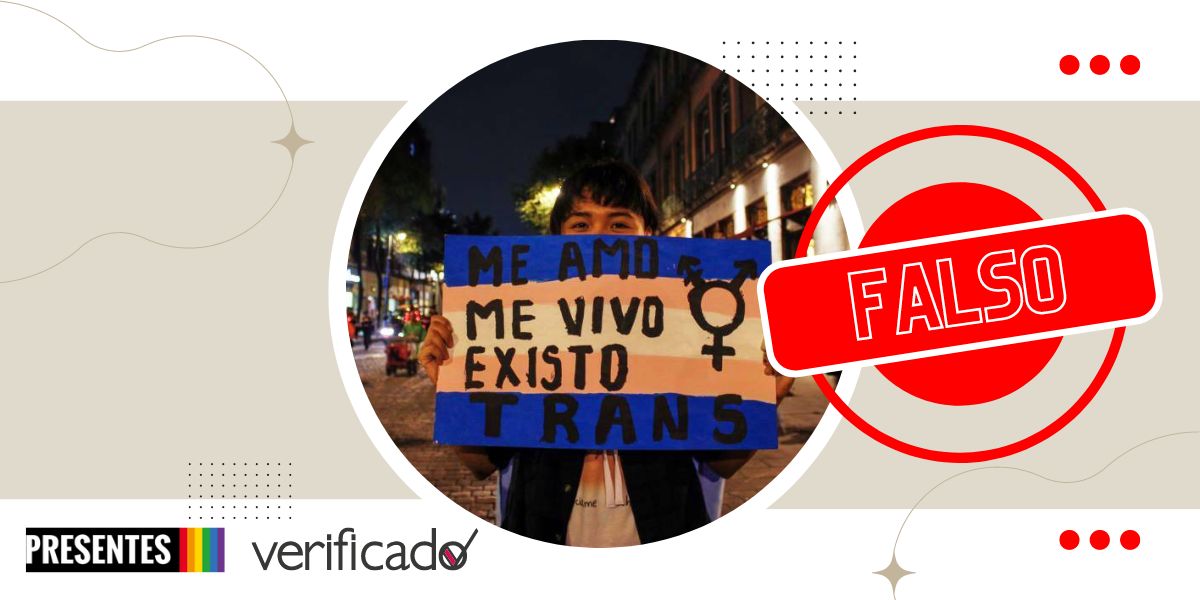
On February 4, federal deputy Teresa Castell, of the conservative National Action Party (PAN), reiterated on her social media platform (formerly Twitter) that gender dysphoria is an illness that must be treated and called it a “sexual fantasy.” In her flawed argument, she used phrases like “mutilating and hormone-injecting bodies” and deceptively included a screenshot to support her false claim.
Gender dysphoria is a term that medicine used for decades to pathologize and explain the existence of transgender people. Activists still debate this term because of its historical burden of pathologization. But it serves to describe a range of distress, contrary to the euphoria, that a person experiences when their gender identity does not match the sex assigned at birth.

“Dysphoria is not an illness, but the expression of a malaise. And this malaise stems, to a great extent, from society’s constant denial of identity (…). Dysphoria (in all its expressions) is strongly linked to a society that constantly monitors, threatens, and punishes bodies and identities that deviate from the norm (and even those that belong to it, as a way of guaranteeing the status quo),” explains César Galicia, a Mexican psychologist and sexologist, in this article .
This does not mean that all trans people experience dissatisfaction with their bodies, nor do they all seek medical, hormonal, or surgical treatments to fully live out their gender identity .
Repeat offender in his discrimination
Since 2023, Representative Castell has used the phrase "gender dysphoria" 28 times, linking it to "mental illness" and "perversion," and calling for transgender people to be "treated." Her arguments about transgender identities not only spread misinformation but also stigmatize these populations.
“The pathologization of LGBT adults, children, and adolescents—that is, labeling them as ill based on their sexual orientation, gender identity, or gender expression—has historically been, and continues to be, one of the main causes of the human rights violations they face. It is also an obstacle to overcoming negative attitudes and stereotypes, as well as the multiple barriers that LGBT people face when trying to exercise their most fundamental rights,” states the Inter-American Commission on Human Rights (IACHR).
Gender dysphoria is not a mental illness
In 2018, the WHO stopped referring to gender dysphoria and removed transsexuality from its list of mental illnesses. The organization considers the trans experience as a “gender incongruence.” In its International Classification of Diseases, ICD-11 , it included this category in the chapter on “conditions related to sexual health,” which came into effect in January 2022.
“Gender incongruence has been removed from the chapter 'Mental and behavioral disorders' to the new chapter 'Conditions related to sexual health'. This reflects the current understanding that trans and gender-diverse identities are not conditions of poor mental health, and that classifying them as such can cause enormous stigma,” reports .
The WHO's argument for maintaining "gender incongruence" in the ICD-11 is that this ensures that trans people have access to health services, since this manual, in addition to classifying diseases, has implications for states in making decisions about the financing of health systems; the development of statistics to monitor health trends; the development of public health policies; and the planning of service delivery.

In that sense, Castell's statement about "mutilating and hormone-treating healthy bodies" is also a stigmatizing and false argument, since trans people do not live in the "wrong body." Not all trans people seek to undergo medical or surgical procedures or hormone therapy to affirm their gender.
In fact, in most countries of the world, access to health services is not guaranteed for trans people, who experience high rates of discrimination.
Not only are they not guaranteed medical and surgical procedures, gender-affirming hormone therapy, or other procedures, but even the most basic health care is still hampered by discrimination due to the lack of implementation of gender and human rights-based protocols and the absence of knowledge about the specific health needs of trans people.
Four out of ten LGBT+ people in Mexico reported not receiving adequate medical care . And 49.4% said they had to hide their sexual orientation and gender identity to avoid discrimination in health services, according to the latest data from the Survey on Discrimination Based on Sexual Orientation and Gender Identity ( ENDOSIG, 2018 ) conducted by the National Council to Prevent and Eliminate Discrimination (Conapred).
Trans identities are still pathologized in the world
Beyond the symbolic achievement, transgender people still experience stigma, discrimination, and violence, both institutionally and socially. The fact that the WHO does not consider being transgender a mental illness does not mean that states around the world do not pathologize transgender people.
Eighteen countries worldwide require gender-affirming surgeries or forced sterilization for transgender people to have their gender identity recognized. In at least 23 countries, some form of expert assessment is required to "diagnose" them in order to access their right to identity, according to the (International Lesbian, Gay, Bisexual, Trans and Intersex Association) database
The Inter-American Commission on Human Rights ( IACHR ) and the Supreme Court of Justice of the Nation in Mexico ( SCJN ) uphold that the recognition of the gender identity of any person (adult and minor) must be guaranteed without them having to prove medical interventions, surgical interventions, hormonal treatments or other procedures.
The IACHR believes it is urgent for states to decriminalize and depathologize trans and gender-diverse identities and calls for them to "provide equal access to health care and gender-affirming treatment to those who request it."
In Mexico, access to gender-affirming healthcare is not guaranteed nationwide. Only three public clinics in the country, all located in the capital, offer gender-affirming hormone therapy. These are the two branches of the Clínica Especializada Condesa and the Unidad de Salud Integral para Personas Trans ( USPIT ).
A struggle of trans activists
The fight for the depathologization of trans identities is an effort of trans activists who since 2008 have been organized in the Trans Depathologization Network from which the Stop Trans Pathologization , which in its first years reached more than 60 cities around the world.
Since 2009, October 22nd has been commemorated as the Day of Action for the Depathologization of Trans People . On this day, trans and non-binary activists and people around the world reclaim their identities, bodies, and subjectivities, and highlight the consequences of pathologizing them.
Despite the fact that one of the main objectives of trans activism was achieved – not considering gender identity as a mental illness – criticism remains regarding the term “gender incongruence”.
In 2019, UN experts warned that while the reclassification in the ICD-11 is an important improvement, “there are a number of issues that remain to be addressed in order to achieve the complete depathologization of trans and gender-diverse people (…). Pathologization has had a profound impact on public policies, legislation, and legal doctrine, and in this way has penetrated all areas of state action in all regions of the world and permeated the collective consciousness. Eradicating the conception of some gender forms as a pathology from everyday life will be a long and difficult process.”
We are present
We are committed to journalism that delves into the territories and conducts thorough investigations, combined with new technologies and narrative formats. We want the protagonists, their stories, and their struggles to be present.
SUPPORT US

FOLLOW US
Related notes


We are present
This and other stories are not usually on the media agenda. Together we can bring them to light.